

Reviews like this take 10+ hours to research and write. If this one was useful, even $1 helps. Support Rhetorical Review.
Salt Lake City, UT—A French Toast, by local playwright Matthew Ivan Bennett and premiering at Meanwhile Park, has the bones of a tidy destination rom-com: divorced mother, disapproving daughter, brooding French innkeeper, a handful of days, and, of course, romance. Lucy arrives at a countryside bed-and-breakfast reeling from her ex-husband’s remarriage abroad, daughter Cassie in tow as chaperone and unwilling audience, and finds the B&B’s proprietor, Gabriel, nursing a fresh betrayal of his own. Their introduction wastes no time cross-wiring these injuries: the pairing of Lucy and Gabriel reads less like a meet-cute and more like two people colliding mid-collapse.
“We don’t say midlife crisis. We say avoir le démon de midi — the midday demon.”
— Gabriel, to Lucy
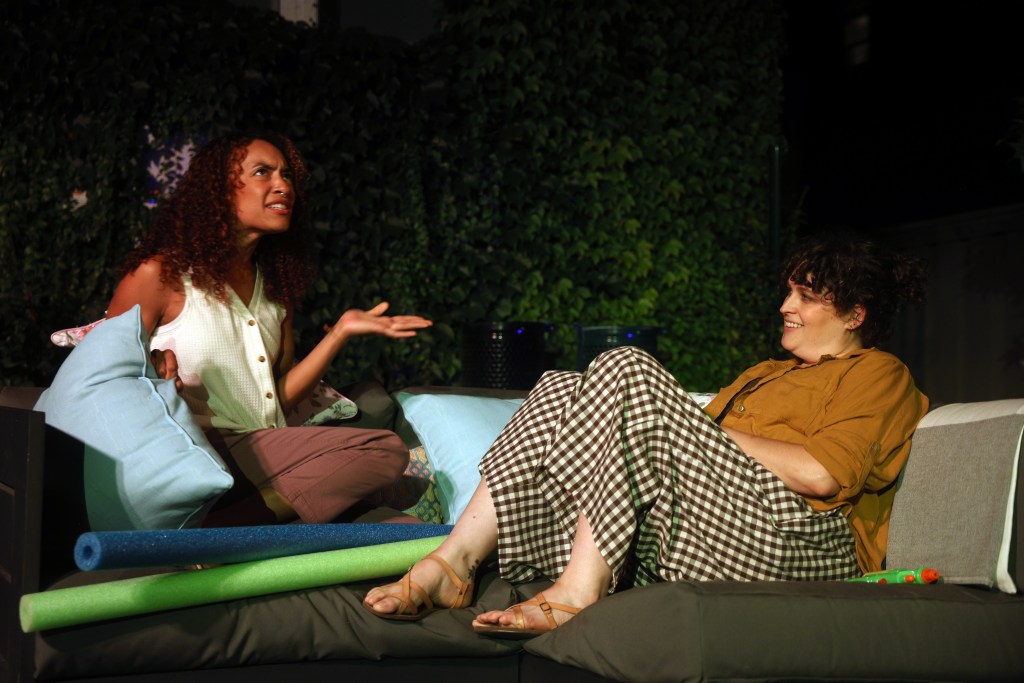
But underneath the pool noodles and mangled slang is a much more specific engine: a woman’s crisis of faith, not just a crisis of the heart. Ironically, the play spends a fair amount of its energy poking fun at the very genre it’s built on, using the familiar shape as something to tease rather than simply inhabit. Yet it also dignifies what it teases, letting one of its most educated characters, Yasmin, a PhD candidate in medieval studies with a secret ambition to write for Hallmark, argue for the form’s value rather than treating it as beneath her. It wants it both ways, and mostly earns that.
Characters
Lucy narrates a self that keeps contradicting the woman we’re watching. She criticizes Gabriel for smoking in scenes after her own drinking has clearly escalated. The pattern isn’t hypocrisy played for a single joke; it’s a character who polices other people’s vices as a way of not looking too closely at her own. Even her small choices carry this doubleness.
Cassie is a lesbian, and her coming out looms over her relationship with Lucy; a tension that surfaces even as she introduces Yasmin to her mother, describing her fondly as having “a brain like every Jane Austen character smushed into one.”

Yasmin is a medieval-lit PhD candidate Cassie falls for over the course of the play, who carries the secret ambition to write for Hallmark, a hidden sincerity tucked inside serious academic rigor. She makes her case to Gabriel with total sincerity, invoking Victoria Nelson’s argument that high and low culture need each other, before admitting what she actually wants is to write the very genre she’s spent her career studying around. Her courtship with Cassie unfolds with real warmth alongside the rest of the play’s noisier business. One of the play’s warmer scenes has Yasmin teaching Cassie French. Cassie’s is rough, but she tries, and it becomes a small exchange that’s its own quiet piece of courtship. It’s a lovely structural contrast: everyone here connects through the gaps and failures of language, mistranslation, self-narration, and verbal sparring, while Cassie and Yasmin’s connection has an ease the rest of the play doesn’t, even when it’s tested later.
Gabriel, for his part, seems to see past everyone else’s performances. His malapropisms do double duty throughout, comic on the surface, unexpectedly charged underneath; the joke is the mistranslation, the chemistry is that nobody fixes it.

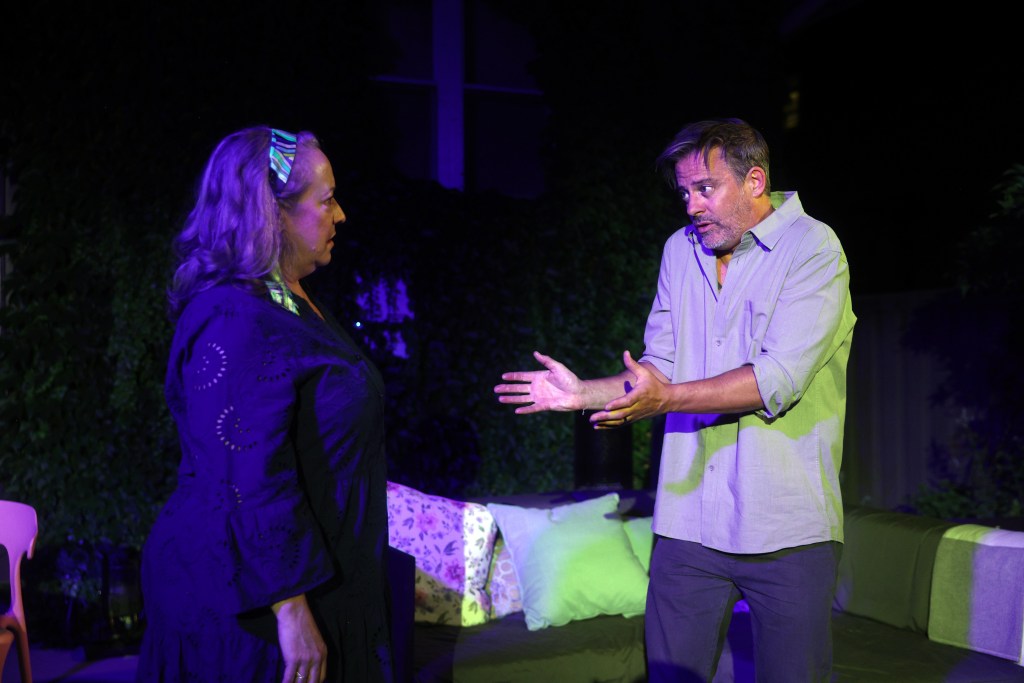
Darby Mest, Ali Lente, April Fossen, and Matthew Sincell. Photo provided by Meanwhile Park.
Actor Highlights
April Fossen as Lucy
April Fossen plays Lucy as someone constantly performing a version of herself the audience never quite sees, and that mismatch is where most of the comedy comes from. Fossen knows exactly how to throw a tantrum, big, funny, and completely believable, without ever tipping Lucy into someone unlikable. Fossen makes sure that Lucy’s contradictions read as real uncertainty rather than a bit. I can’t stress how hard that is to do as an actor.
Matthew Sincell as Gabriel
Matthew Sincell keeps Gabriel’s malapropisms from ever feeling like a bit; he plays them completely straight, so they get laughs without making Gabriel seem foolish. In his biggest scene with Lucy, his French accent flows naturally, never played for a laugh on its own, which is part of why the mistranslations feel like they come from a real person rather than a punchline. That restraint pays off in a line that could easily sting but instead comes across as understanding.
Ali Lente as Cassie
Bennett gives Ali Lente plenty of meat to work with, and she makes the most of it. Lente’s Cassie is someone who cares out loud. You see it when she introduces Yasmin to her mother with real pride, and again when she confronts Lucy directly about how her disapproval lands. That confrontation only works because of what’s underneath it: her strongest scene with Fossen is plain and undefended, and it’s where the relationship’s emotional weight actually sits.
Darby Mest as Yasmin
Darby Mest’s Yasmin has the challenge of being both a rigorous academic and someone who secretly wants to write for Hallmark, and making it believable, also not the easiest thing to do if you actually know academia, when those two sides collide. Mest opens speaking French, fitting for the setting, before switching to her character’s real British accent; it’s the audience’s first clue that Yasmin isn’t who the setting suggests. Her scenes with Sincell’s Gabriel feel specific rather than generic, and her chemistry with Lente gives the production some of its most unguarded, low-key and authentic moments.
Analysis
What elevates this beyond a generic “uptight woman loosens up” arc is specificity. Lucy isn’t religious in some vague, generic way; she’s LDS, raised in a tradition where marriage is treated as a sacrament, which means her divorce doesn’t just end a relationship. It threatens to unmake her sense of who she is. Once that’s understood, the play’s smaller transgressions, a stolen cigarette, a drink that turns into several, stop reading as the point and start reading as symptoms. Lucy isn’t rebelling against her faith for the fun of it; she’s a woman whose foundation already cracked the moment her marriage did, and the small rule-breaks are aftershocks, not the earthquake itself.
Comedy as Tribute, Not Takedown
The play’s whiplash tone, broad physical comedy slamming into sudden confessional grief, often within the same scene, could easily read as tonal whiplash for its own sake. It doesn’t, because the affection underneath is unmistakable. As Bennett stated in an interview with me in May, “in any good drama you’ve got to have counterpoints of humor.” That balance is legible in every scene here: the humor never punches down at Lucy’s background or treats her faith as a punchline; it uses comedy the way people actually use it under pressure, as armor, as relief, as a way to survive a moment that would otherwise be unbearable.
In that same interview, Bennett described working with one guiding rule in mind: don’t get “too clever,” a note he credits to his ongoing collaboration with director Jason Bowcutt. That instinct, Bennett explained, traces back to comedy writer Jean Perret’s own commandments of the form, one of which insists a joke be recognizable.
And then there’s the title itself, which finally pays off at the end and which, delightfully, is Cassie’s own idea within the world of the play: French toast made together, alongside an ending toast (made in France)—a double entendre. It’s a small piece of wordplay, but it’s the right note to end on.
Critique
The play’s stated ambitions run in two directions: Lucy’s personal crisis of faith and the broader dynamic of acceptance versus rejection within religious families. The first lands unmistakably. The second is harder to find in any conventional sense; there’s little sense of a wider LDS community, no ward, no extended family weighing in. But a quiet exchange late in the play complicates that assessment: the language of striving toward perfection while accepting you’ll never reach it alone in this life is doctrinal, not incidental, and Yasmin’s reply quietly echoes that same theological posture back at Lucy. It’s evidence that when the play does reach for theology directly, it treats it with real seriousness rather than as texture or punchline.
I should say plainly that I come to this material from inside it. I was raised in the faith this play is written about, and I have been through a divorce myself, though under different circumstances than Lucy’s. Not every beat in this play landed for me exactly as written. But what I felt underneath all of it, consistently, was genuine love for the people of Utah, shaped by their faith, and for how complicated it is to leave any part of that behind without leaving all of it behind.
Verdict
This is a script operating with more depth than its rom-com chassis suggests, not because it abandons the genre’s pleasures, but because it locates something true underneath them: a specific, doctrinally grounded portrait of what divorce costs a woman for whom marriage was never just a legal contract. It pokes fun at the rom-com and pays it tribute in the same breath, and that contradiction mocks the genre while dignifying it. It is a fitting tribute to the leading lady it portrays.
Show Info
- Title: A French Toast — 2026 Meanwhile Park Playwright Prize Winner
- Playwright: Matthew Ivan Bennett
- Director: Jason Bowcutt
- Venue: Meanwhile Park, Salt Lake City, UT 84105
- Dates: Thu, Jul 9 – Sun, Jul 19, 2026
- Time: 8:30 PM (Show starts around 9 pm)
Cast:
April Fossen as Lucy
Matthew Sincell as Gabriel
Ali Lente as Cassie
Darby Mest as Yasmin
Creative Team:
Jeff Paris — Producer/Set Designer
Desmond Dutcher — Sound Design
Lee Hollar — Lighting Design
Dawn McFarland — Costume Design
To learn more about Meanwhile Park, read my feature on it here
About the Playwright

Photo by Doug Carter
Matthew Ivan Bennett is a Co-Artistic Producer at Sackerson (SLC) and has been a regular contributor at Plan-B Theatre since 2007. He was a recent fellow at the Helene Wurlitzer Foundation in Taos, New Mexico (Fall 2024) and is currently training as a Certified Actor with the National Michael Chekhov Association. He co-wrote JUST ADD WATER with Elaine Jarvik, which premiered at Plan-B with assistance from Wake the Great Salt Lake and the Bloomberg Foundation in the fall of 2025. His adaptation of FRANKENSTEIN won the Best Feature Program award from the Utah Broadcasters’ Association. His one-person play ERIC(A) won Best Drama at the United Solo Festival in New York. His road trip play, A\VERSION OF EVENTS, is published with Stage Rights. His anti-bullying children’s play DIFFERENT=AMAZING is published by Leicester Bay Theatricals. With the O’Neill, he’s been a Finalist (LET DOWN YOUR HAIR, 2016) and Semifinalist (ART & CLASS, 2019). He’s won the Best Local Playwright award from PlayUtah and was honored by Salt Lake City’s City Weekly with an Arty for writing Plan-B’s entire season in 2009. In 2014, he received the Holland New Voices Award from Great Plains Theatre Commons and returned in 2019 to workshop his play ART & CLASS. His short plays have appeared at Pacific Play Company in Seattle, the Source Festival in DC, Monkeyman in Toronto, and Theatre Out in Santa Ana. His comedy A NIGHT WITH THE FAMILY, ran at the Omaha Community Playhouse. His short film B+A appeared at Slamdance, and his feature-length film THE WHOLE LOT was an Official Selection of the Philadelphia Independent Film Festival, the Kansas City Independent Film Festival, and others in 2022 and 2023. In 2015 and 2016, he was a screenwriting finalist at the Austin Film Festival. In Utah, he’s worked as a playwright and/or actor with the Salt Lake Acting Company, Pygmalion, Voodoo, Improv Salt Lake, Sackerson (devised pieces: A BRIEF WALTZ IN A LITTLE ROOM and THE WORST THING I’VE EVER DONE), and Wasatch Theatre Company. His rom-com FROM JUNE TO AUGUST was the Official Selection for Meanwhile Park’s second season in Salt Lake. Matt served 13 years as Assistant Business Manager for Pioneer Theatre Company, as well as reading for their Play-by-Play series, and was previously a part-time Literary Manager for The Constructivists in Milwaukee. His poetry has been published in Sugar House Review, Western Humanities, Utah Life, and Unearthed. Matt earned his Bachelor’s in Theatre from Southern Utah University—where he also acted for the Utah Shakespeare Festival’s educational tours of THE TAMING OF THE SHREW and A MIDSUMMER’S NIGHT DREAM. He’s an alum of Futurescapes and a member of the Dramatists Guild.


Leave a Reply