

SALT LAKE CITY, UT — Jen Silverman’s The Moors, running November 14–23 at Taylorsville’s Mid Valley Performing Arts Center and directed by Ellie Otis with assistant direction by Janell Rogers, brings the playwright’s wild, wicked, and deeply contemporary Gothic to Utah audiences with crackling energy. Set on a barren English landscape, part fog-soaked nightmare and part comedy sketch, Silverman unleashes a story of longing, manipulation, queer desire, and the roles women are told to play. Silverman critiques the patriarchal system by showing how its logic conditions the women who ascend within it, underscoring how power itself, not gender, emerges as the play’s true antagonist.
Funny, bloody, queer, and totally alive—The Moors bites back.
Plot & Tonal Worldbuilding
The story begins with familiar Gothic ingredients—a remote manor, secluded sisters, and an unexpected governess—but Silverman wastes no time unraveling these conventions. From the moment the young woman enters, the Gothic frame begins to warp: the dialogue becomes too sharp, the danger too playful, the tone too knowing. Voodoo’s production leans into that tonal slipperiness: part camp, part menace, part existential absurdity. Nothing behaves as expected—not even the dog.
Inside the manor, sisters Agatha and Huldey preside over a domestic sphere where propriety has curdled into cruelty and longing simmers just beneath the surface. The hopeful governess soon finds herself pulled into their twisted lattice of power games, seduction, and buried desires. Meanwhile, beyond the decaying walls, a philosophical Mastiff and a jittery Moor-Hen grapple with their own existential crises. Their unlikely bond offers a strangely tender counterpoint to the humans’ spiraling ambitions, grounding the play’s absurdism in something startlingly sincere.
Context: Silverman, the Brontës, and the Gothic Rewired
The Moors premiered at Yale Repertory Theatre in 2016, and from the outset it announced itself as both an homage to and a rupture within the Gothic canon. In the Brontë tradition, the Gothic emerges as a form of the sublime—vast landscapes, emotional extremity, and the terrifying simultaneity of beauty and dread. That sublime inheritance shapes Silverman’s world: the moors are endless, devouring, and psychologically charged, a place where longing grows so large it becomes monstrous.
Silverman draws heavily from the Brontës—bleak horizons, lonely manor houses, and women clawing for agency within suffocating domestic worlds—but they push these tropes past their breaking point. Where the Brontës used the sublime to gesture toward transcendence or moral reckoning, Silverman warps it into something feral and darkly comic. Instead of romantic brooding or moral clarity, they give us absurdity, queer desire, and characters whose yearning twists into something grotesque.
For contemporary audiences, this evolution signals that the Gothic is no longer a genre about weather or ghosts; it’s a genre about power, self-invention, and the terrifying ways people contort themselves to be seen. Silverman takes the emotional DNA of the Brontës and mutates it into a modern, feminist critique of the very structures those novels could only gesture toward—but never fully dismantle.

Cast & Crew Highlights
Viviane Turman (Agatha) commands the stage with a chilling blend of poise and predation. Turman’s Agatha wields language as a weapon, slicing through the manor’s stillness with a performance that is as magnetic as it is menacing. Turman captures both the elegance and brutality of Silverman’s design, making Agatha the dark star around which the play’s chaos orbits.
Addilynn Bowler (Huldey) is an absolute standout, delivering the murder ballad with a gleeful ferocity that borders on the feral. Bowler‘s comedic timing, paired with genuine vulnerability, makes Huldey both ridiculous and heartbreaking—a Gothic clown whose hunger for visibility becomes its own tragedy.
Jessica Graham (Emilie) brings tenderness and naïveté to the role, offering a grounded counterbalance to the manor’s spiraling absurdity. Graham‘s gentle musicality—accompanying herself on guitar in key moments—adds an unexpected layer of intimacy to the production, giving Emilie a softness and sincerity that deepen the emotional contrast of the world around her.
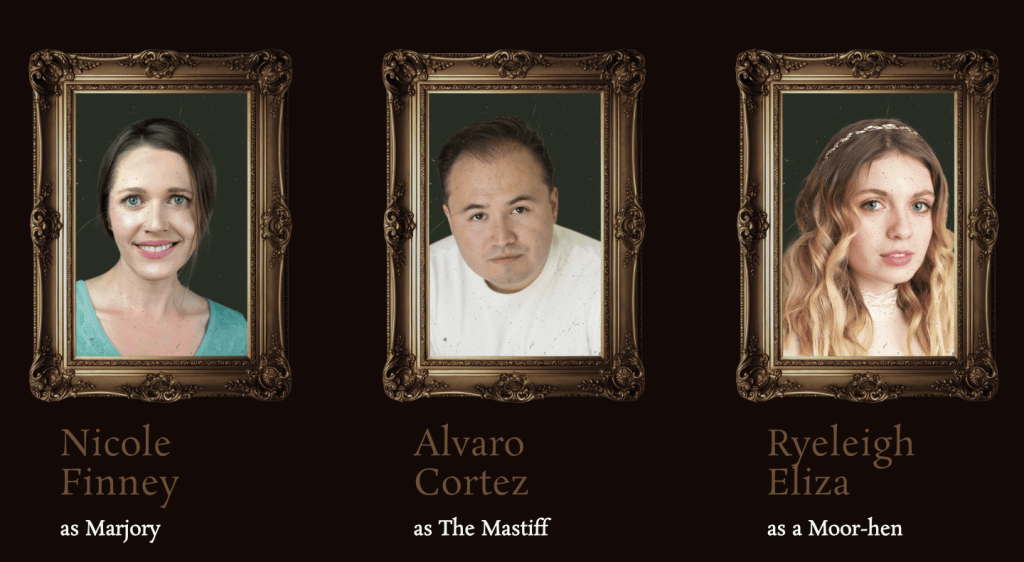
Nicole Finney (Marjory/Mallory) navigates the dual roles with precision, but it’s her razor-sharp humor that steals scenes. Her slippery shifts—pregnant in one moment, deathly ill the next—underline the play’s fascination with identity as performance. Finney is as funny as they are unsettling.
Alvaro Cortez (The Mastiff) delivers one of the most emotionally resonant performances of the evening. His Mastiff balances philosophical yearning with animal instinct, creating a portrait of longing that is unexpectedly profound. His final moment at the hearth—quiet, devastated, ignored—is haunting.
Merry Magee (The Moor-Hen/Swing) brings levity and sharp comedic nuance, embodying both the fragility and quick wit of the bird. Her scenes with the Mastiff deepen the play’s emotional core.
Creative & Production Team
Ellie Otis (Director) brings a sharp instinct for tonal balance, embracing the play’s absurdist humor without losing sight of its darker emotional undercurrents. Her staging allows chaos and vulnerability to coexist, making the world feel dangerous, funny, and vividly alive.
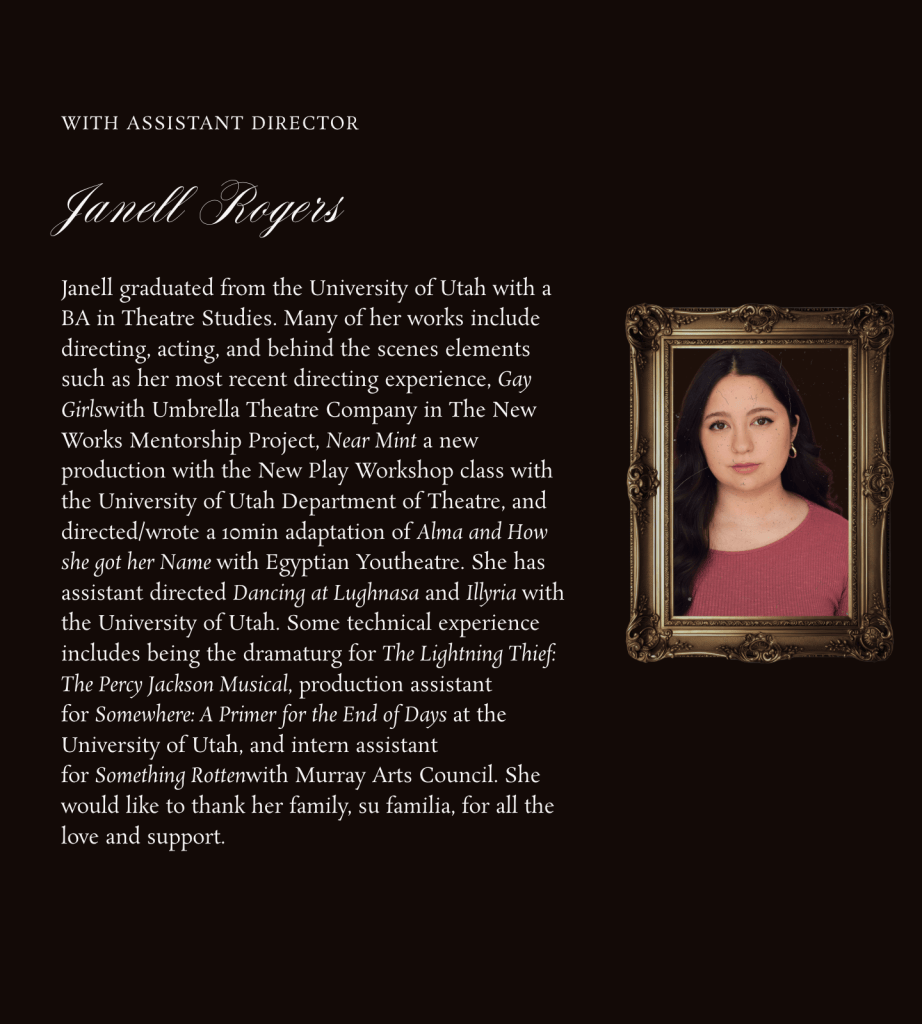
Janell Rogers (Assistant Director) supports with a keen dramaturgical eye, shaping scene rhythms and transitions that hold the production’s tension taut and its humor precise.
Amber Knaras (Lighting Designer) transforms the stage into a shifting psychological landscape—eerie one moment, ecstatic the next. Her work in Huldey’s power ballad is especially electrifying with red lights bleeding the stage.
Grace Heinz (Sound Designer) enriches the production with soundscapes that blur the line between interior and exterior, human and animal. Storms creep in, silence tightens, voices echo with intention. Even the crackling of the manor’s fire becomes part of the emotional landscape, grounding the Gothic world in vivid sensory reality.
Aleisha Meier (Music Director) & Liz Whittaker (Composer) craft musical textures that heighten the play’s tonal instability—romantic one moment, unhinged the next. Huldey’s ballad is a standout achievement of their work.
Taylynn Rushton (Stage Manager) and Jack Cobabe (Assistant) maintain impeccable pace and timing in a tight 90-minute, no-intermission format—a demanding feat executed with finesse.
Though uncredited, the scenic and costume design embrace stark minimalism and a chaotic blend of modern and Victorian elements. Agatha’s black corset feels both contemporary and archaic, Huldey’s look skews theatrical, and Emilie’s softness sits deliberately out of step with the house’s severity.
The effect isn’t cohesive in any traditional sense, but it matches the production’s tone: a world where eras collapse, identities fracture, and each costume reflects the character’s psychological landscape. The aesthetic mismatch becomes part of the absurdist tension—nothing quite belongs. These visual choices deepen the play’s oscillation between realism and surrealism, reinforcing the disorientation at the center of Silverman’s Gothic vision.

Analysis: A Gothic Landscape with Teeth
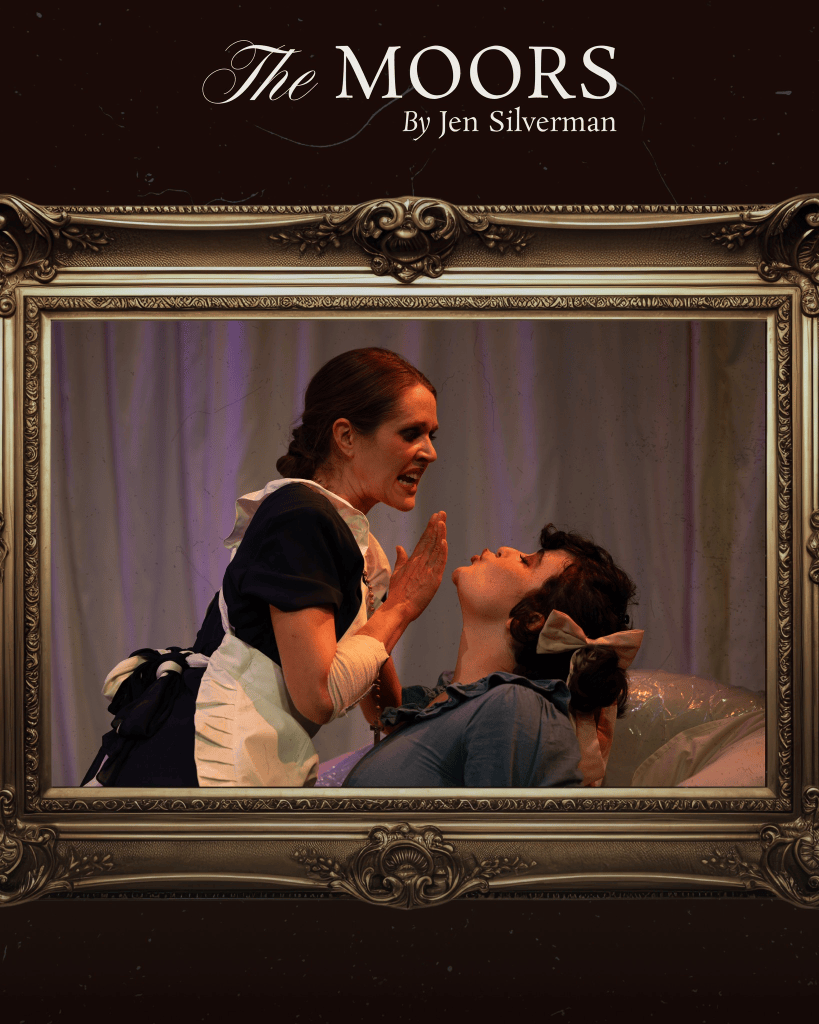
At the center is Agatha, the sharper, colder, more commanding sister, who wields language like a duelist’s blade. Her seduction of the earnest, impressionable Emilie unfolds like a Victorian romance rewritten by a dominatrix with a PhD in philosophy. Their scenes pulse with erotic tension and dread. In this house, desire is a weapon.
Huldey, the other sister, steals nearly every moment with her overwrought self-seriousness and her “memoir,” a journal of petty grievances and delusions of grandeur. Her monologues, especially the infamous murder ballad, inject chaotic joy just when the play threatens to tip fully into the macabre.As the plot unravels, so does the veneer of civility. Murder creeps in at the edges. Power shifts. Loyalties fracture. And the moors—both literal and psychological—press closer until it feels impossible to breathe.
The tension builds relentlessly in this no-intermission format, never giving the audience space to settle. Physical comedy, stark violence, and sharp absurdist dialogue keep us laughing one moment and deeply unsettled the next.
Silverman’s language is tight, strange, and muscular. Voodoo’s cast handles it with confidence, allowing humor to land without diminishing the emotional stakes. The production understands that the Gothic is not about ghosts—it is about the terrifying persistence of desire.
The Dog and the Bird: The Play’s Beating Heart
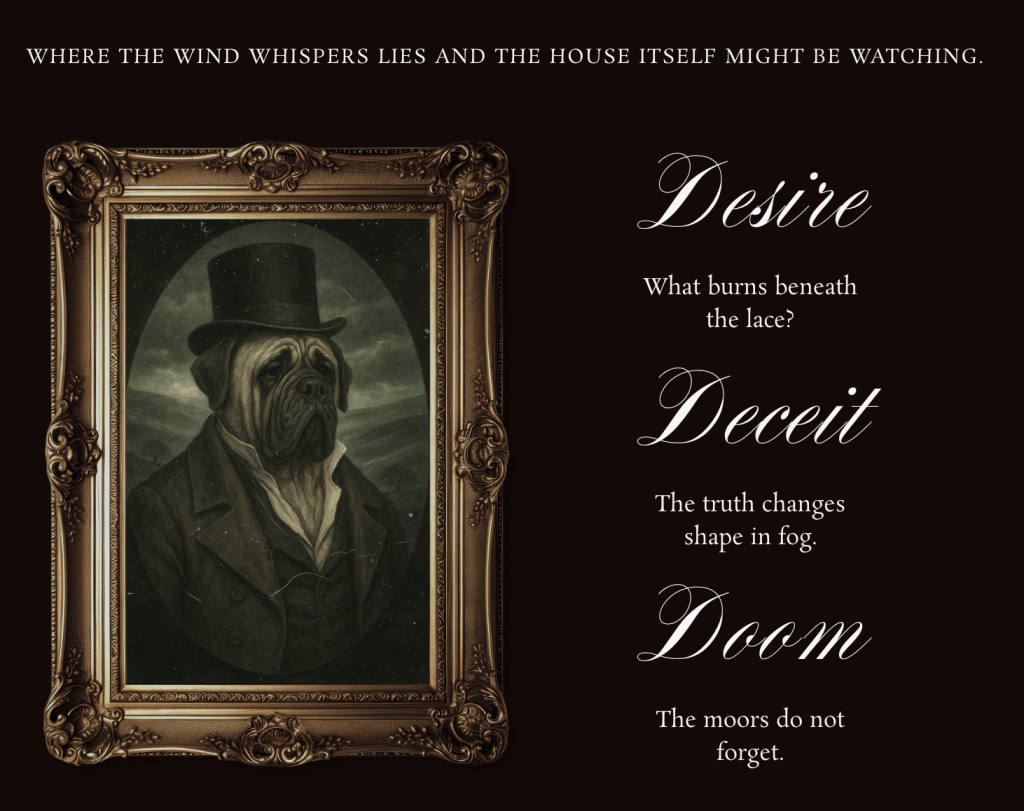
While the human characters spiral through manipulation, delusion, and power games, Silverman anchors the play’s emotional truth in its two animal roles: the Mastiff and the Moor-Hen. What could easily read as comic relief becomes, in this production, the most sincere and existential thread of the evening. The Mastiff’s blunt longing for meaning and the Moor-Hen’s skittish fear mirror the human characters’ own desires—only stripped of pretense, artifice, and self-delusion. Where the humans perform identity, the animals simply exist, and their honesty exposes how absurd the manor’s emotional architecture truly is.
Alvaro Cortez’s Mastiff is remarkable: a portrait of love born from the terror of being alone. His obsessive devotion is rendered with heartbreaking restraint—real tears, breath tightening into a trembling square. In the final moments at the hearth, his body begins to shake, not with melodrama but with the quiet grief of a creature losing the only being who ever saw him. It’s one of the most affecting performances of the production.
Merry Magee’s Moor-Hen offers the ideal counterbalance—quick, nervous, witty, fluttering through scenes with the energy of a creature who survives by staying in motion. Where the Mastiff yearns for connection, the Moor-Hen fears it. Their scenes together form a tiny existential fable nestled inside the larger Gothic machinery: a story about creatures who misunderstand one another, who try their best, who want more from life than the moors will ever give them.
Silverman uses animals not as symbols but as truth-tellers. They misunderstand, but they do not deceive. Their emotional clarity stands in stark contrast to the humans, who hide behind letters, roles, fantasies, and performances. In giving the animals the play’s most emotionally honest register, Silverman expands the Gothic into realms of absurdism, fable, and Beckett-like existential comedy. The Mastiff and the Moor-Hen soften the play’s cynicism and deepen its stakes, reminding us that longing—for love, for meaning, for visibility—is not a human flaw but a universal one.
Huldey, the Animals, and the Play’s Emotional Triad
Towards the end of the play, Huldey steps forward to deliver her “power ballad,” a number that begins as a lilting tune and quickly mutates into a deranged rock anthem, all blood-red lighting and unhinged joy exploding across the stage. Huldey sings of haunting winds and fragile hares hiding from storms—and then gleefully confesses to murder. The moment is hilarious, terrifying, and grotesquely triumphant.
When the ballad ends, Huldey imagines a sea of applause and bathes in it as if it were sunlight. Then—slowly—that applause dissolves into wind and rain. There is no audience. There is only the storm. Huldey doesn’t notice the shift.
This is Huldey in full: a Gothic clown perched between comedy and catastrophe, desperate to be seen. Her ballad is self-mythology, a delusional attempt to rewrite her role from overlooked sister to blood-soaked heroine. The humor lands, but it wounds. Visibility is nourishment Huldey rarely receives.
Silverman’s pairing of Huldey with the animal characters is brilliant. The Mastiff and the Moor-Hen, often dismissed as comedic devices, provide the play’s philosophical truth-telling. Their dialogue is blunt, existential, honest—free from the posturing and self-deception that entangle the humans.
The Mastiff’s longing mirrors Huldey’s own hunger for recognition. The Moor-Hen’s flitting fear mirrors Huldey’s deep insecurity.

A Critique of Patriarchy
Silverman’s work functions as a subversive inversion of patriarchal Gothic tradition—a theatrical middle finger to the system that has historically confined, silenced, and punished women. Rather than centering male authority or male desire, The Moors foregrounds women’s agency in unsettling and often transgressive forms, revealing how Gothic conventions can be turned against the very power structures that once defined them. And yet Silverman builds a deliberate paradox: when a woman gains power in this world, nothing truly changes. Agatha doesn’t dismantle the patriarchy; instead she replicates it. Her dominance exposes a darker truth: the structure is the problem. Place anyone inside it—man or woman—and it twists them into its image.
Silverman sharpens this critique most clearly in Agatha’s treatment of Emilie. In the moment Agatha kisses her, only to immediately convert that intimacy into leverage, the play reveals the full scope of her coercive power. After belittling everyone around her (“My sister…is worthless. My brother was worse. The maid is beyond hope.”), Agatha turns to Emilie with the chilling instruction: “You will obey me, little Emilie.” What follows is a pseudo-romantic recruitment speech, promising that Emilie has been “chosen,” that Emilie alone has a future “unlike any other,” as long as she offers “precision, determination, and unswerving loyalty.” It is seduction disguised as empowerment, domination masked as devotion. Emilie, whose life has been shaped by invisibility, melts at the idea of being “considered,” and Agatha exploits that longing with surgical precision. The dynamic mirrors patriarchal grooming tactics so closely that Silverman doesn’t need a man onstage to indict the system.
In The Moors, women seize power—but the structure they inherit corrupts them in familiar, devastating ways. Voodoo’s staging sharpens this critique through Otis’s direction, which refuses to romanticize Agatha’s authority; every gesture is rendered with the precision, unsettling control of someone who has inherited power but not liberation.
And to be clear, critiquing patriarchy is not critiquing men. Patriarchy is a system, not a gender. Men can be—and often are—feminists, just as women can be some of its most devoted enforcers. Silverman’s play makes this distinction unmistakably clear: power structures shape behavior far more profoundly than gender does. Agatha replicates patriarchal violence not because of gender, but because Agatha is operating within a system that has taught her its language.

Emilie and the Logic of Staying
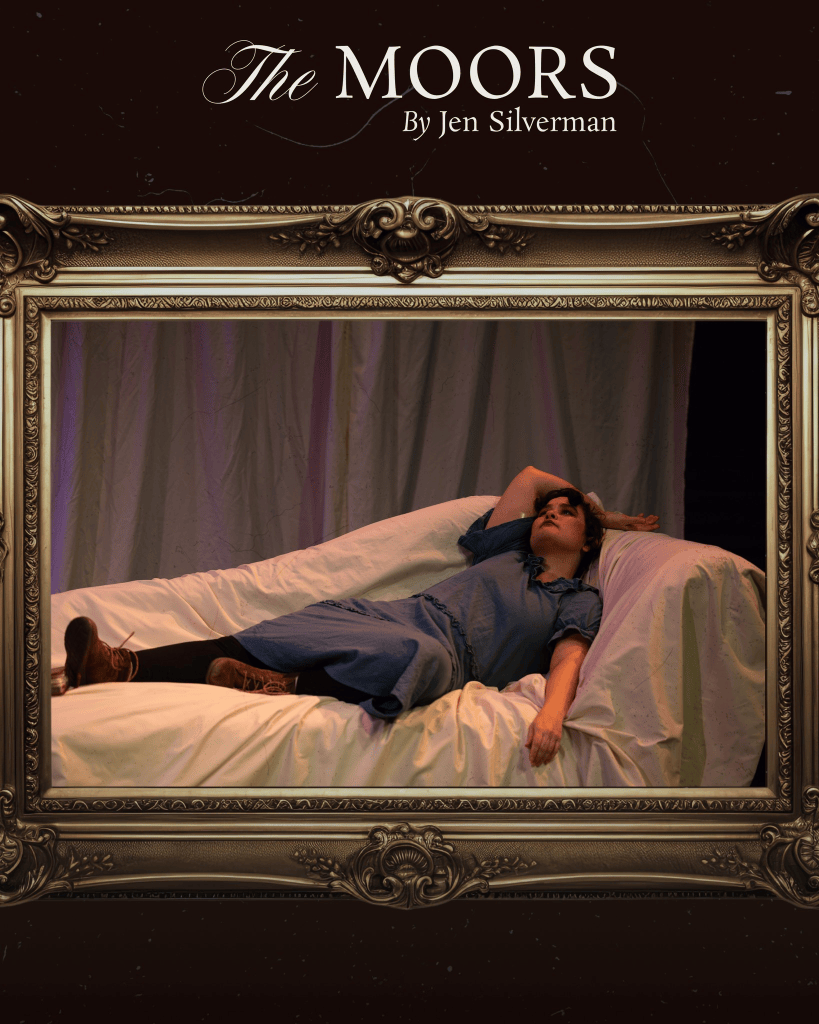
Emilie is where Silverman’s critique appears to fracture. Why on earth does she stay when she arrived under such different pretenses? But that contradiction is precisely where Silverman’s commentary sharpens. On a literal level, nothing about this household should entice her to remain. Yet in a broader symbolic sense, Emilie becomes a critique of modern relationship dynamics and the ways patriarchal culture has normalized the belittling, dismissing, or emotional starvation of women. So starved for genuine attention, Emilie stays in a situation that is clearly harmful because, for once, someone is actually looking at her.
Jessica Graham’s performance keys into this beautifully. Her Emilie isn’t foolish—she’s conditioned. Her gentleness and sincerity make visible the social forces that teach women to find sustenance even in the most toxic forms of visibility. This isn’t weakness so much as cultural training: the belief that being chosen, however precariously, is better than being unseen.
We are living in a moment when many women are choosing to stay single in protest of impossible expectations, while others are discovering they feel safer, more understood, or more autonomous with women partners. In that light, Emilie’s choice reflects a wider cultural reality—the way patriarchy has so thoroughly distorted intimacy that even dangerous affection can masquerade as refuge. Perhaps that is the contradiction Silverman intends: Emilie stays not because it makes sense, but because she has been taught that any form of being seen, even harmful, is preferable to invisibility.
The Ending
Silverman states her thesis outright in the final line: “Everything shall always be different now. And yet nothing changes.” The play leaves us suspended in that contradiction—caught between transformation and stasis, desire and futility. The blackout arrives with a cold abruptness that denies the audience the chance to metabolize what they’ve just witnessed. The moment wants to rupture us, but the lights cut before the devastation can fully land.
The result is a finale that demands contemplation but offers no breath in which to begin it—an ending that feels intentionally destabilizing, though perhaps at the cost of emotional clarity.
A Bold, Hilarious, and Haunting Night at the Theatre
By the time the final tableau arrives—part empowerment fantasy, part horror story—the audience is left facing the question that haunts every character in The Moors: What are you willing to become in order to be seen?
Voodoo Theatre Company delivers a sharp, stylish, and unsettling production that embraces the full strangeness of Silverman’s world. It’s funny, bloody, queer, and totally alive—a perfect dark comedy for audiences hungry for theatre that bites back. For anyone hungry for theatre that is strange, sharp, queer, and unafraid to draw blood—literally and metaphorically—The Moors is essential viewing.
Recommended for mature audiences (18+), with simulated violence and intense themes. Run time: 90 minutes, no intermission. Performances run through November 23 at Mid Valley Performing Arts Center.
About the Show
Voodoo Theatre Company presents
The Moors by Jen Silverman
Dates: November 14–23, 2025
Venue: Mid Valley Performing Arts Center (the black box space within the venue)
Address: 2525 Taylorsville Blvd, Taylorsville, UT 84129
Run Time: 90 minutes, no intermission
Rating / Advisory: Mature themes, queer content, simulated violence. Recommended for ages 18+. No infants or babes-in-arms. All patrons require a ticket.
Ticket Prices
- General Admission: $25
- Students (w/ID): $12.50
Save $10 with code ARTIST10
Accessibility:
Wheelchair seating, companion seating, and assisted-listening devices are available through the Salt Lake County Arts box office upon request.
Box Office & Tickets:
Purchase at artsaltlakecounty.org or at the Mid Valley Performing Arts Center box office.
General Info 385-468-1010
ArtTix Phone 801-355-2787
ArtTix Email arttix@slco.org
Buy tickets for events at Mid-Valley Performing Arts Center:
- Online at saltlakecountyarts.org
- On our ArtTix app
- By Phone at (801)-355-2787
- In person at our Arttix Ticketing Hubs open Mon-Fri 10 am – 6 pm, Sat 10 am – 2 pm with extended hours on show days
– Mid-Valley Performing Arts Center – 2525 Taylorsville Blvd, Taylorsville
get in touch
General Information
Phone: (385)-468-1010
Lost & Found: (385)-468-2577
Event Booking: (385)-468-1030
saltlakecountyarts.org
Interview with Ellie Otis about The Moors
Cast
- Agatha — Viviane Turman
- Huldey — Addilynn Bowler
- Emilie — Jessica Graham
- Marjory / Mallory — Nicole Finney
- The Mastiff — Alvaro Cortez
- The Moor-Hen / Swing — Merry Magee
Creative & Production Team
- Director: Ellie Otis
- Assistant Director: Janell Rogers
- Artistic Director: Patrick Kibbie
- Music Director: Aleisha Meier
- Composer: Liz Whittaker
- Lighting Designer: Amber Knaras
- Sound Designer: Grace Heinz
- Stage Manager: Taylynn Rushton
- Assistant Stage Manager: Jack Cobabe

About the Playwright
Jen Silverman (they/them) is an award-winning playwright, novelist, poet, and screenwriter whose work spans theatre, fiction, television, and film. Their plays—including The Roommate, Witch, Spain, Collective Rage: A Play in 5 Betties, Phoebe in Winter, and The Moors—have been produced on Broadway and at major venues such as Steppenwolf, The Goodman, The Geffen, and Second Stage, as well as internationally throughout Europe, Australia, and South America.
Silverman holds a BA in Comparative Literature from Brown University, an MFA in Playwriting from the University of Iowa, and completed an Artist Diploma at the Juilliard School.
They are also the author of the novel We Play Ourselves (Lambda Literary Award finalist), the story collection The Island Dwellers (PEN/Robert W. Bingham Prize finalist), and the poetry chapbook Bath, with a forthcoming novel from Random House. Their television work includes Tales of the City (Netflix), Tokyo Vice (HBO Max), and the short film Troy, an OSCAR®-qualifying selection featured by The New Yorker.
A three-time MacDowell Fellow and alum of New Dramatists, Silverman has received fellowships from the National Endowment for the Arts, the Guggenheim Foundation, and the New York Foundation for the Arts. Across mediums, their work interrogates identity, reinvention, and the restless humor that sits at the edge of transformation.


Leave a Reply