

Reviews like this take 10+ hours to research and write. If this one was useful, even $1 helps. Support Rhetorical Review.
Taylorsville, UT — I’ll be honest up front: Voodoo Theatre Company’s Heroes of the Fourth Turning is not an easy night at the theatre. There were stretches when I wanted to leave my seat. That isn’t a knock on the actors; it’s a sign of how convincingly they do their job. Will Arbery’s Pulitzer finalist runs about two hours without an intermission in Studio 5400, and director Jack Cobabe doesn’t let the audience off the hook. The play begins with a striking image and ends with a genuinely surprising moment, but the journey between them is demanding by design.
Cobabe anticipates exactly this. His director’s note opens with a plea: “Please, please, please, stay for the entire show,” because “some of these conversations will be difficult to sit through. That’s okay, they should be difficult.” He asks the audience to “listen fully, honestly, and open-heartedly.”
I stayed, and I’m glad I did. But I left with questions about whether the conversations onstage accomplish what Cobabe hopes they will.
A Script With Staying Power
Heroes of the Fourth Turning began as a shorter piece Arbery wrote for Ensemble Studio Theatre just before the 2016 election, imagining conservatives reacting to an expected Hillary Clinton victory. After Donald Trump won, Arbery rewrote and expanded it. The full play premiered Off-Broadway at Playwrights Horizons in September 2019, directed by Danya Taymor, with Jeb Kreager, Julia McDermott, Michele Pawk, Zoë Winters, and John Zdrojeski.
The production was extended twice, and the play became a 2020 Pulitzer Prize finalist. The jury praised it as “a scrupulously hewn drama” in which four alumni of a conservative Catholic college clash over theology, politics, and personal responsibility. (The prize went to Michael R. Jackson’s A Strange Loop.) Arbery also won the Obie Award for Playwriting, the Lucille Lortel Award for Outstanding Play, and the New York Drama Critics’ Circle Award for Best Play. The original cast reunited for a Zoom revival during the pandemic, and the Canadian premiere followed at Toronto’s Crow’s Theatre in 2023.
The play is close to home for Arbery. The fictional Transfiguration College is modeled on Wyoming Catholic College in Lander, a small great-books school with mandatory outdoor education that Arbery’s father, Glenn Arbery, led as president.
The play received attention from critics across the political spectrum. Jesse Green of The New York Times made it a Critic’s Pick and called it a “red-state unicorn,” while Rod Dreher of The American Conservative and the Catholic Herald also reviewed it warmly. That cross-ideological reception is part of what makes the play unusual: it asks audiences to spend time with people whose beliefs may be deeply unfamiliar or even repellent to them.
The Setup
It’s August 2017 in Lander, Wyoming, one week after Charlottesville and two days before the solar eclipse. Four alumni of Transfiguration College gather in Justin’s backyard after the inauguration of their mentor, Dr. Gina Presson, as the school’s new president.
Justin (Alvaro Cortez) is the older ex-Marine who stayed in town. Teresa (Emily Tatum) is a conservative writer living in Brooklyn. Kevin (Nat Vaughn) is drunk, lonely, and searching for something to believe in. Emily (Charlotte Gordon), Gina’s daughter, has returned home while living with a debilitating chronic illness.
The opening is the strongest stretch of the night. Before anyone speaks, Justin shoots a deer, drags it onto his porch, and tries to gut it while his hands shake. The scene is quiet and eerie, communicating that something is wrong before the arguing begins. The blood remains on the porch for the rest of the evening, a physical reminder of the violence beneath the characters’ conversation.
What the Title Means
The title comes from The Fourth Turning, a 1997 book by William Strauss and Neil Howe. Teresa explains its theory of history moving through roughly 80-year cycles of four “turnings”: a High, an Awakening, an Unraveling, and finally a Crisis, such as a war or revolution that remakes the nation. Each generation fits an archetype, and the Heroes are those who come of age during the Crisis and fight to rebuild, like the generation that fought World War II. Historians largely treat the theory as pop history; Green called it pseudoscientific.
The characters fit themselves into these archetypes. Gina is a Boomer “Prophet,” the wise elder. Justin, born in 1979, is a Gen X “Nomad” on the cusp. Teresa, Kevin, and Emily are Millennial “Heroes.” Teresa is convinced that her generation is destined to fight. Steve Bannon helped popularize the theory on the political right, and Teresa is a proud admirer. She believes a war is coming and that she and her friends are meant to lead it.
The irony is that nobody on that patio is heroic in the way Teresa imagines. They’re drunk, wounded, lonely, and turning on each other. When something like heroism finally appears, it’s quiet and gentle, bearing little resemblance to the warrior Teresa wants to become.

Three Rounds, No Winners
The middle of the play unfolds like a series of bouts, with Teresa at the center of most of them. She’s formidably well-read, quoting Brueggemann, Arendt, Thucydides, and Strauss and Howe, and she’s working on a book of essays. She comes prepared to argue, but the people around her don’t always come prepared to fight.
Round one: Teresa versus Kevin.
Kevin is the one person who genuinely wants a big conversation, and he keeps asking for one. Teresa lectures him instead, calls him a soy boy, and insists that a war is coming. She’s not trying to understand him; she’s trying to recruit him, using shame to push him toward her worldview.
Round two: Teresa versus Emily.
This was the hardest stretch for me to sit through. Emily is pro-life, too. She worked for a pro-life women’s organization in Chicago. But when she tries to describe the women she served and defend a friend who works at Planned Parenthood, Teresa repeatedly cuts her off. The argument escalates to comparisons with the Holocaust.
Emily admits she’s not good at debating, and Teresa overrides even that. Emily is in physical pain throughout the exchange, yet nobody intervenes. Watching her struggle to get a word in is exhausting, not because the ideas are difficult, but because the encounter is so unequal.
Round three: Gina versus Teresa.
When Gina (Barb Gandy) arrives, the relief is palpable. For me, it was almost therapeutic: finally, someone Teresa can’t steamroll.
Gina wins decisively. But she wins by wounding, not persuading, and I’ll leave it to you to see how.
Then the arguments stop being metaphorical. Earlier, Teresa told Kevin that a real man should be prepared to snap a neck if someone attacks a woman. Before the night is over, words give way to violence, and Cobabe stages it without softening a thing.
Across all three rounds, the pattern is unmistakable: whoever wins does so by hurting the other person, not by persuading them. That makes the middle of the play exhausting to watch, and it’s a testament to how convincingly this cast plays it.
The Performances
This is a strong local ensemble, several of them early in their careers, anchored by a veteran as Gina. That mirrors the play itself: young people orbiting their elder.
Emily Tatum as Teresa
Tatum takes on the most demanding role in the play and commits completely to Teresa. She starts out playful and warm, catching up with old friends, then builds to relentless. If Teresa becomes hard to bear, that is Arbery’s design, and Tatum doesn’t flinch from it.

Barb Gandy as Gina
Gandy gives Gina the authority the role needs. Her entrance shifts the whole room, and the characters snap to their best behavior like kids when a parent gets home.

Alvaro Cortez as Justin
Cortez commands the stage every time he walks on it. From the wordless opening with the deer, he holds the audience’s attention without needing to raise his voice, which makes Justin’s quiet steadiness, and the cracks underneath it, land all the harder.

Nat Vaughn as Kevin
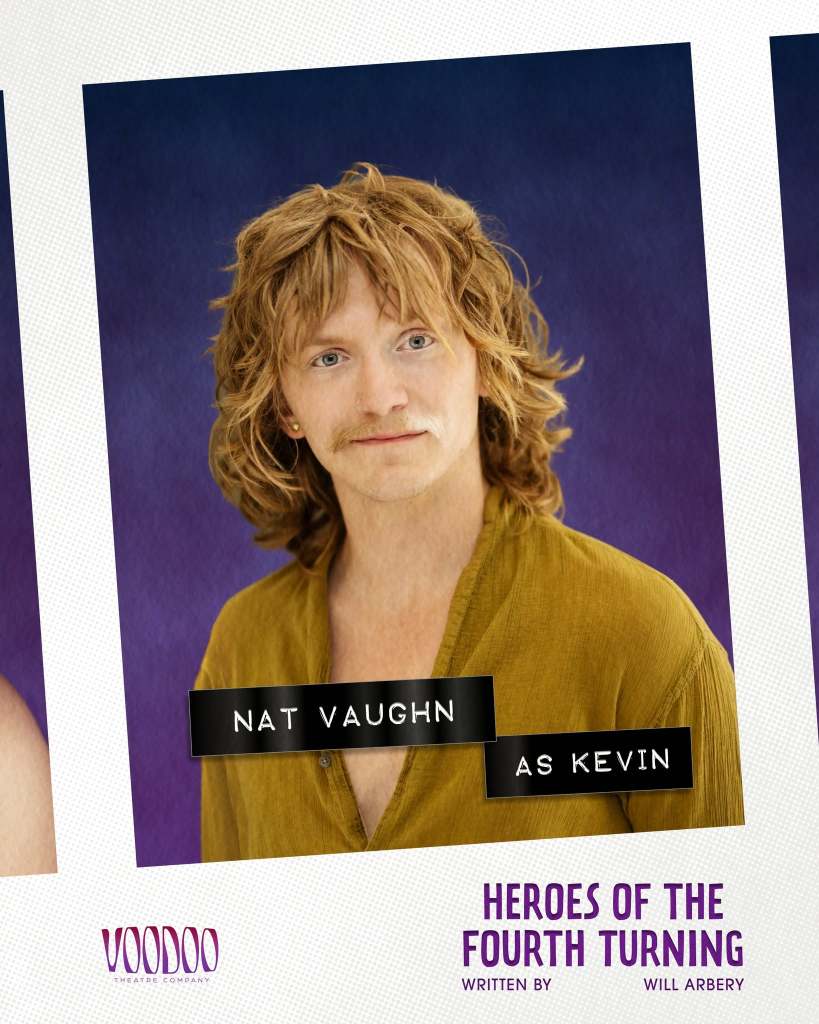
Vaughn plays Kevin untamed: drunk, loud, impulsive, and all over the place. That wildness lands strangely whenever Kevin talks about becoming a priest. The gap between the man we’re watching and the vocation he keeps reaching for is jarring, and maybe that’s the point. Kevin is searching for a structure big enough to hold him, and nothing he’s been given fits.
Charlotte Gordon as Emily
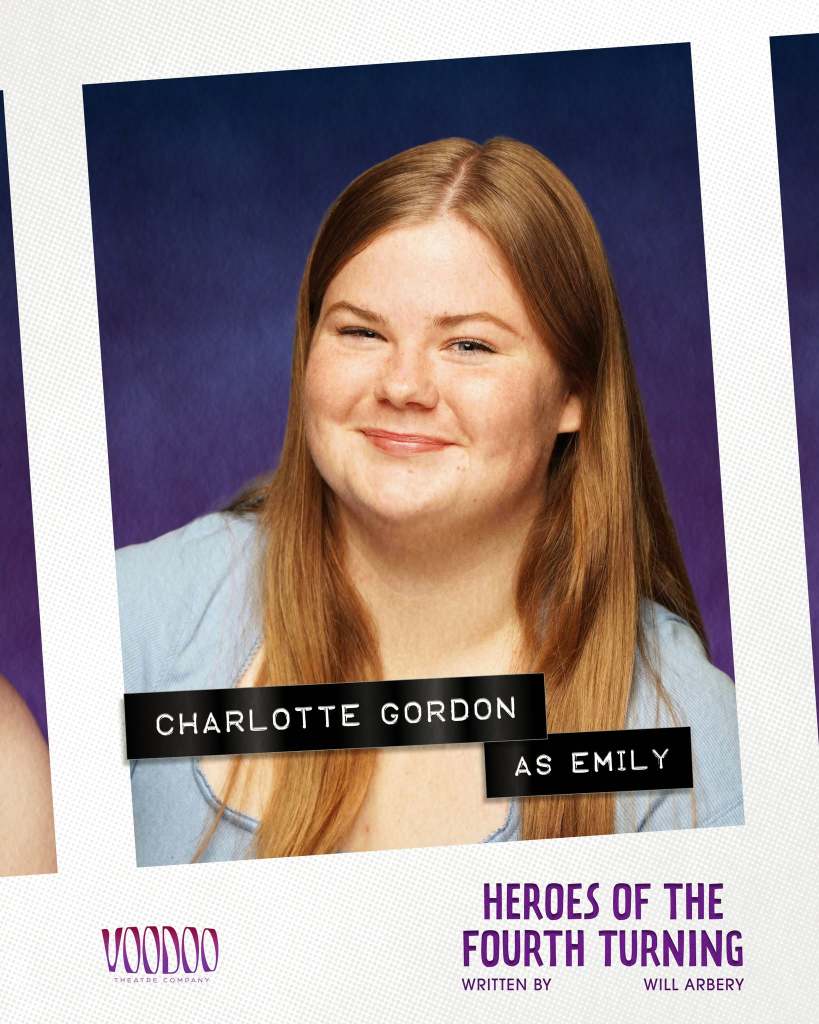
Gordon wowed me as Emily. Her vocal inflections and small physical mannerisms make Emily’s pain and her habit of apologizing feel lived-in rather than performed. She lets us see how much effort it takes Emily just to stay in the conversation, which makes her final moments all the more startling.
Design and Staging
Grace Heinz’s sound design earns its keep. The generator screech is loud and shocking every time, never becoming something the audience gets used to. It cuts through the arguments as though the house itself is objecting, setting up the ending’s sense that something here can’t be explained away.
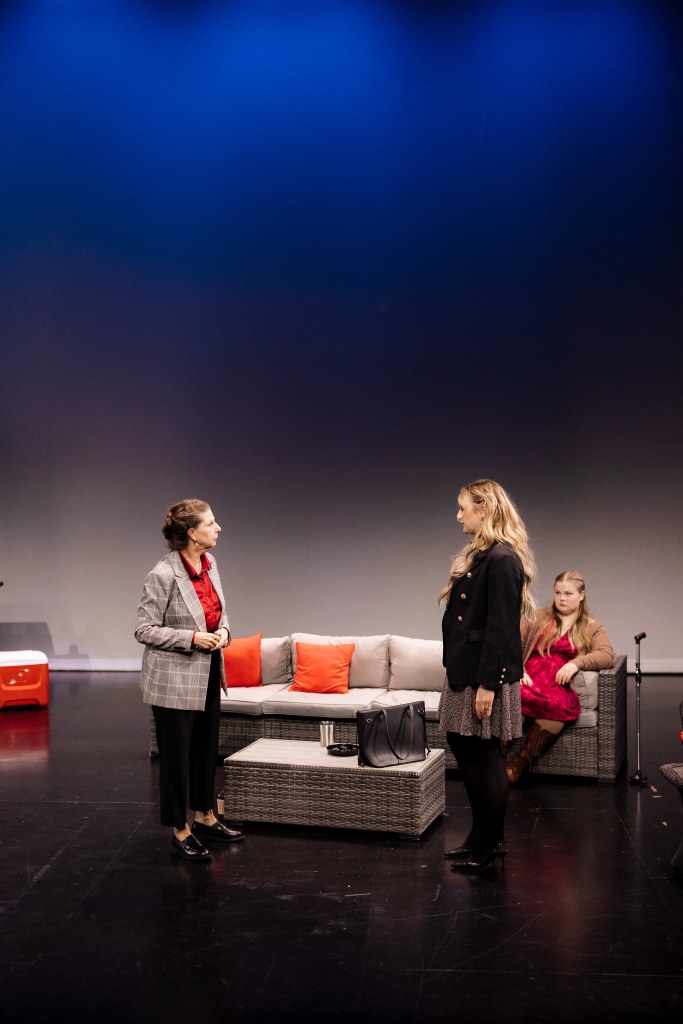
The set is simple, little more than camping chairs, a fire pit, and a barbecue grill on Justin’s patio. In Studio 5400’s intimate black-box space, that simplicity keeps the focus squarely on the actors and their words. Austin Ray designed the lighting, and Alicia Kondrick designed the costumes.
The staging is less interested in protecting the audience. The vomit lands inches from the front row. I was sitting there, and I had to look away. The play’s physical violence is similarly unflinching; Cobabe stages its one major moment of violence more forcefully than the script calls for. We aren’t watching from a safe distance. We’re on the porch with these people.
I’ll admit I would have liked an intermission, and I’m not alone. Reviewing a 2022 San Francisco production, a critic for 48 Hills argued that one was needed. But I can see why Cobabe chose to run the play straight through. A break would release some of the pressure, and the production depends on that pressure building. His director’s note asks us to stay for the whole show, and the staging makes us feel the cost of doing so.

A Different Read Than the Critics’
In his 2019 review, Green praised the play for giving every argument its say and quietly critiquing those arguments by placing them alongside one another. He also cautioned that audiences who don’t believe in the dramatic potential of debate might not enjoy it much. Even Green conceded that the play may take a few turns too many.
I’d push back on the word “debate.” A debate requires two willing opponents, ideally on roughly equal footing. What I watched in the middle of this play wasn’t that. It was Teresa stomping on Emily, a woman in pain who never agreed to fight and came home to celebrate her mother. If you want to debate, join a debate team. A backyard party is not a tournament, and friends are not opponents.
Rhetoric gives us more precise language for this distinction. Plato distinguished eristic, arguing to win, from dialectic, two people reasoning together toward the truth. Teresa practices eristic. Every exchange is a contest, and the point is victory, not understanding. What Green calls the drama of debate is, for much of this production, the drama of eristic.
Krista Ratcliffe’s concept of rhetorical listening offers another way to understand what’s missing: listening to understand someone rather than simply waiting for your turn to respond. Emily keeps trying to do that, and Teresa refuses her every time.
Arbery has said he struggled with how to invite audiences to engage with his characters’ ideas without requiring them to empathize with the characters or giving hateful speech a platform. I understand that dilemma. But during the long middle stretch, I didn’t feel as though I was engaging with Teresa’s ideas. I felt as though I was absorbing her attacks alongside Emily.
Cobabe frames the play differently in his director’s note. He calls it “an honest conversation between people discussing their beliefs, and allowing them to change,” and closes with a charge to the audience: “If you’re met with someone or something you do not understand or agree with, engage with it; do not retreat. Only through honest discussion and listening can we find common ground.”
I share that hope. But the characters on this patio rarely achieve what Cobabe describes. When minds change, the changes come through shame rather than persuasion, and genuine listening arrives very late. Perhaps that’s the point: the play shows us the cost of honest discussion’s absence so that we might choose differently when we leave the theatre.
Still, there’s a distinction worth making. Engaging with people we disagree with doesn’t mean submitting to their attacks. Emily stays in the conversation all night and pays for it in her body. Honest discussion requires a willingness to listen on both sides; when that willingness is absent, stepping back isn’t retreat but self-protection. The challenge is knowing when to stay for the conversation and when to walk away from the fight.

The Ending
The ending is what won me back. After two hours of people talking past each other, Arbery gives us a final scene that feels different from everything that came before it. The shift is startling, and I found myself reconsidering what I’d watched. I won’t spoil what happens. It’s the kind of moment that’s best experienced without knowing too much in advance, and Arbery leaves enough unexplained that I’d rather you sit with it yourself.
The scene also left me with an uncomfortable question. Its emotional power depends in part on suffering that the play asks us to understand indirectly, through someone else’s account. I’m not sure the play fully reckons with what that means.
Catholic writer Eve Tushnet offers a complication. Earlier, Teresa mocks liberals as “empathy addicts” who believe feeling someone else’s pain gives them the right to speak for that person. Tushnet reads the ending as Arbery’s own self-criticism.
That interpretation opens an uncomfortable but important question. If Teresa is right that empathy can become a way of speaking for people we haven’t truly heard, does the play’s most moving moment risk doing exactly that? Or is Arbery deliberately exposing the limits of his own approach?
Critics have described the ending as a near-exorcism (Colin Thomas), a haunting by grace (The Outline), and a first step toward healing (People’s World). Arbery himself has pushed back on at least one of those readings. I’m not sure the scene resolves its contradictions, but perhaps it doesn’t need to. Its power lies partly in the fact that we’re left to wrestle with them.
Final Word
This review was harder to write than most. I still don’t know exactly where I stand with this play, and I think that’s an honest place to land. The opening works. The ending surprised me. The cast commits fully, and the production makes bold choices with its intimate space. The middle is long and demanding, by design. Heroes of the Fourth Turning isn’t my favorite Voodoo production, but that reflects the script, and where I was that night, more than the company’s work. Voodoo deserves real credit for taking on a play this challenging and staging it with such commitment.
The play also has a clear audience. Those interested in the fractures within the religious right, or who enjoy dense, combative dialogue, will find plenty here. But for viewers who have been on the receiving end of these arguments in real life, the experience may be considerably harder. If you’re liberal, non-Christian, or simply not in the mood for two hours of heated ideological conflict, go in prepared. The play is worth engaging with, but that doesn’t mean it’s for everyone at every moment.
What stayed with me is simple: Heroes of the Fourth Turning shows what happens when friendship becomes a competition. We need to stop treating the world and the people in it as opponents to beat, and start treating them like they matter.
And I keep coming back to that final scene. Whether Arbery is showing genuine self-awareness or having it both ways, I’m still deciding. Maybe that’s fitting: a play full of people who refuse to sit with uncertainty leaves its audience sitting in it.

Production Highlights
Heroes of the Fourth Turning, presented by Voodoo Theatre Company
- Written by: Will Arbery
- Directed by: Jack Cobabe
- Featuring: Alvaro Cortez as Justin; Charlotte Gordon as Emily; Nat Vaughn as Kevin; Emily Tatum as Teresa; Barb Gandy as Gina
- Assistant Director: Emily Kitterer
- Producer: Patrick Kibbie
- Resident Stage Manager: Taylynn Rushton
- Assistant Stage Manager: Christine Imrick
- Sound Design: Grace Heinz
- Lighting Design: Austin Ray
- Costume Design: Alicia Kondrick
- Dramaturg: Annika Zoetmulder
- Assistant Dramaturg: Aleisha Meier
- Run Crew: Ev Tanner
- Dates: October 15–18 and 22–25, 2026
- Venue: Studio 5400, Mid-Valley Performing Arts Center, 2525 Taylorsville Blvd, Taylorsville, Utah
- Run Time: About 2 hours, no intermission
- Rating: Recommended for mature audiences
- Tickets: ArtTix, 801-355-2787
- Production photos: @madrobphotography
Sources
- Jesse Green, “Review: In ‘Heroes of the Fourth Turning,’ a Red-State Unicorn,” The New York Times, October 7, 2019
- The Pulitzer Prizes – Finalist: Heroes of the Fourth Turning
- Voodoo Theatre Company – Heroes of the Fourth Turning
- Colin Thomas – Heroes of the Fourth Turning: Intelligent, Complicated Theatre
- The Outline – ‘Heroes of the Fourth Turning’ is a haunted play about religious conservatives
- People’s World – Probing the souls of young Catholic conservatives
- Eve Tushnet, Patheos – Lambs and Dragons
- 48 Hills – Review: In ‘Heroes of the Fourth Turning,’ a long night’s journey into Trumpism
- Wikipedia – Heroes of the Fourth Turning


Leave a Reply