

SALT LAKE CITY, UT — Hell’s Kitchen, on its national tour and currently playing a limited engagement at the Eccles Theater through Sunday, July 12, 2026, arrives with a pedigree few jukebox musicals can claim: Alicia Keys isn’t just lending her catalog; she’s telling her own coming-of-age story through it, with Kristoffer Diaz shaping the book and Michael Greif directing. The result is a semi-autobiographical portrait of 17-year-old Ali, growing up in Manhattan Plaza in the 1990s, caught between her fiercely protective mother, Jersey, a boyfriend named Knuck, and a piano teacher, Miss Liza Jane, who cracks open a door to who Ali might become.
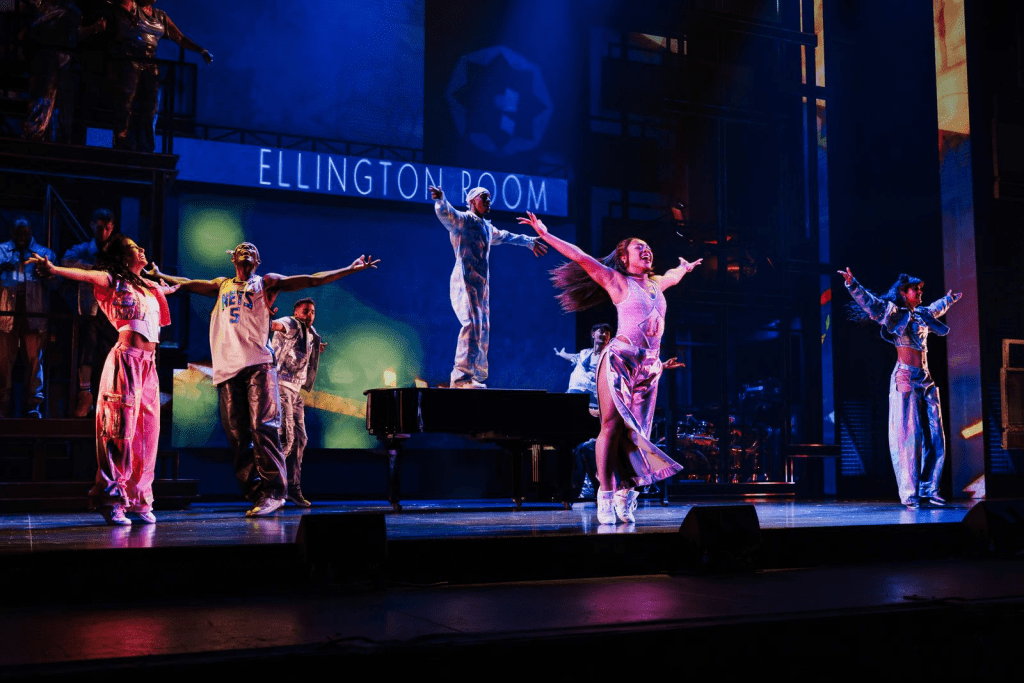
And that’s the case for the whole show, really: it’s at its best whenever it lets the music carry the meaning, and its rare missteps happen exactly when it asks the dialogue to do that work instead. I loved it for the former, and forgave it the latter, though not for the same reasons. The New Yorker’s Helen Shaw held back. Where she felt shut out, like the show was speaking to itself rather than to the audience, my reservations are more structural, though that framing undersells what the show is actually doing at its best. This isn’t only a story about a book that occasionally can’t keep up with its songs. It’s about a girl learning that inheritance itself is mixed, real harm alongside real gifts, and that the work of growing up is choosing what to build with. When the show trusts that idea fully, in the Ellington Room, in “Perfect Way to Die,” and in the finale, it’s deeply moving. My reservation isn’t that the story feels too private, the way hers was; it’s that the show doesn’t always extend that same trust to every character it should.
A Bit of Context
The show had a long gestation: Keys started developing it back in 2011, with Diaz attached from the start, and Greif joining as director in 2018. It premiered Off-Broadway at The Public Theater in late 2023 before transferring to Broadway’s Shubert Theatre in April 2024. The Broadway run closed on February 22, 2026, after 23 previews and 767 regular performances, a remarkably long life for a new musical. The North American tour I saw began at Playhouse Square in Cleveland in October 2025, with Serena Williams joining the producing team. A South Korean production is set to open at the GS Art Center this month, July 2026, in Seoul.
Critically, it’s been one of the better-received entries in the jukebox musical genre, and at the 77th Tony Awards it picked up 13 nominations, winning Best Actress in a Musical for Maleah Joi Moon, who played Ali, and Best Featured Actress in a Musical for Kecia Lewis, who played Miss Liza Jane. Not everyone was fully won over, though. Helen Shaw described it at times as feeling like “a private communication, one not meant to be shared more widely,” which is a useful counterpoint to keep in mind alongside my own reservations about the book.
The Performances Are the Show
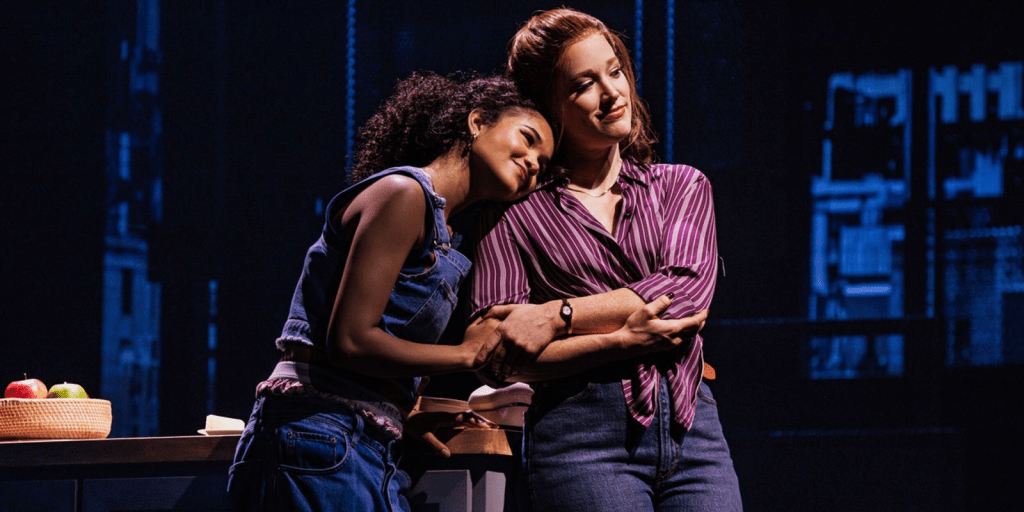
If you asked me what Hell’s Kitchen is “about,” my honest answer would be: watching Maya Drake and Kennedy Caughell fight, forgive, and fight again. The mother-daughter axis between Ali and Jersey is where the show’s most immediate electricity lives. Every other relationship in the musical, Knuck, Davis, even Miss Liza Jane, orbits around it, and the two actors playing it make you believe the stakes are life-sized even when the plot mechanics around them are thinner than they deserve.
Drake is doing double duty as both narrator and lead, breaking the fourth wall to talk the audience through her own story while also living inside it, and it’s mostly charming, especially with the New Jersey accent she brings to the role. It gives Ali a warmth and a directness right from the opening moments, before the plot has even asked you to care about her yet. Worth noting: this is Drake’s professional stage debut, a recent high school graduate carrying a lead role of this size, which makes the range on display here even more impressive.
It’s a reminder that this show, for all its scale, is at its best in the two-hander moments, a mother and daughter in the same room, saying the thing they’ve been avoiding saying.

The Songs That Landed
Technically, this is a jukebox musical: it’s built around Alicia Keys’ existing catalog. But it doesn’t really feel like one, and that’s a big part of why it works. Most jukebox musicals feel like a greatest-hits set with a plot stapled on; this one has actual narrative flow, songs that seem to grow out of the scene rather than interrupt it.
Part of that comes down to how the score was actually built. Of the nearly two dozen songs in the show, only one, “Seventeen,” was written entirely new for the musical. Two more, “The River” and “Kaleidoscope,” were songs Keys had written previously but never released, so they land with the freshness of new material even though they predate the show. Everything else is catalog: “Fallin’,” “Girl on Fire,” “Empire State of Mind,” and the rest, songs audiences already know, folded into the story so carefully that the seams barely show.
For me, the most emotional songs came in “If I Ain’t Got You” and “Fallin’,” both tied to Davis, Ali’s absent, unreliable father. There’s something quietly devastating about hearing Keys’ most aching songs handed to the relationship defined by absence rather than presence. Davis barely has an arc, structurally, but those two songs alone give him more emotional weight than his stage time technically earns.
A shoutout is owed here, too, to Desmond Sean Ellington as Davis, who hits some gorgeous high notes across both numbers. His voice does a lot of the same work the songs themselves are doing, making a thinly written character feel worth caring about anyway.
There’s a lovely, sly bit of writing tucked into how the show gets to “If I Ain’t Got You” in the first place: Davis tells Ali he wrote the song for her when she was a little girl, then sits down and plays it with her, turning the number into a father-daughter duet rather than a solo. It’s one of the show’s best-earned moments, even with his thin arc elsewhere; that scene alone makes you believe in the bond, however neglected, between them.
Worth noting, for anyone else who wonders the same thing watching it: that’s a piece of fiction specific to the show, not something drawn from Keys’ actual life. “If I Ain’t Got You” was released on her 2003 album The Diary of Alicia Keys, written well before Hell’s Kitchen existed. The show is repurposing one of her real songs and inventing a new, in-universe origin story for it. It’s a clever bit of jukebox-musical sleight of hand, folding an existing hit into Davis and Ali’s relationship as if it had always belonged there. It’s also a good entry point into a bigger question worth sitting with: how much of this show is actually true? More on that below.
“Fallin’” gets its own smart rework, separate from that. It’s reimagined here as a duet, built up with harmonies and a scat-inflected feel, and pushed to a noticeably faster tempo than the original recording. It changes the whole emotional register; instead of the slow-burn ache people know from the record, it becomes something more urgent and alive on stage, which suits Jersey and Davis’s dynamic better than a straight replay of the familiar version would have.
Jersey gets her own reckoning with Davis later on in “Pawn It All,” and it’s one of the clear highlights of the whole show. Where “Fallin’” is about the pull she still feels toward him, this one is the opposite: Jersey drawing a hard line, refusing to let him repeat the same damage on Ali that he did on her. It’s big notes and big feels, delivered with everything Caughell’s got, the most purely satisfying solo in the show, years of accumulated frustration finally given somewhere to go.
How Much of This Is True?
Keys did grow up in Manhattan Plaza in the ’90s, and Jersey is closely modeled on her real mother, Terria Joseph, who came to New York from Ohio at nineteen and largely raised Keys on her own. But Keys and book writer Kristoffer Diaz have been explicit that this isn’t a biomusical in the Beautiful or MJ sense: Keys actually started playing piano about a decade earlier than Ali does on stage, and her real father wasn’t a traveling jazz musician the way Davis is. NBC Insider summed it up well, calling it a story that’s “fictionalized, but it expertly captures the essence of Keys’ journey.” That’s about right. It’s emotionally autobiographical, not factually autobiographical.
A Few Other Numbers Worth Singling Out
A few other numbers earned their own kind of standing ovation in my head:
“The River” is Ali’s (Maya Drake), and it’s the first time you really understand who she is before anything else happens to her, restless, hungry to get out from under her mother’s grip, singing like she means to prove it. It sets the emotional terms of the whole show before the plot even really starts.
“Seventeen” is Jersey’s (Kennedy Caughell) answer to it, and it’s a genuine mouthful of a number, dense, fast, defensive, a mother talking herself into her own protectiveness in real time. It’s a hard song to pull off because it has to be exhausting and justified at once, and it works.
And then there’s Tiny (Sydney Townsend) and Jessica’s (Sangeetha “Sang” Santhebennur) number, “You Don’t Know My Name”, which is just plain fun. The two of them egging Ali on toward Knuck have sharp comedic timing, the kind that lands a laugh line and a killer vocal in the same breath. It’s a nice reminder that this show can be funny, not just heavy, and that the friendship material deserves more of that lightness elsewhere.
“Girl on Fire” gets a similar lift from that friendship; it’s Jessica who carries the number, egging Ali on and riding the high of her relationship and her new love of music right alongside her, while Tiny’s warnings sit underneath it as the number’s one note of caution. There’s a great beat where Tiny basically breaks the spell mid-song, a flat, incredulous “wait, hold on, this isn’t how it goes” kind of moment, cutting through Ali and Jessica’s momentum just enough to remind you someone in the room still has her head on straight. It’s a sharp little corrective, too: a pointed reminder that a guy showing up isn’t actually the thing that solves Ali’s problems, however much the high of new romance makes it feel that way in the moment. It’s a good example of how the show uses the friend characters as a kind of Greek chorus for Ali’s emotional state, cheering and warning at once.
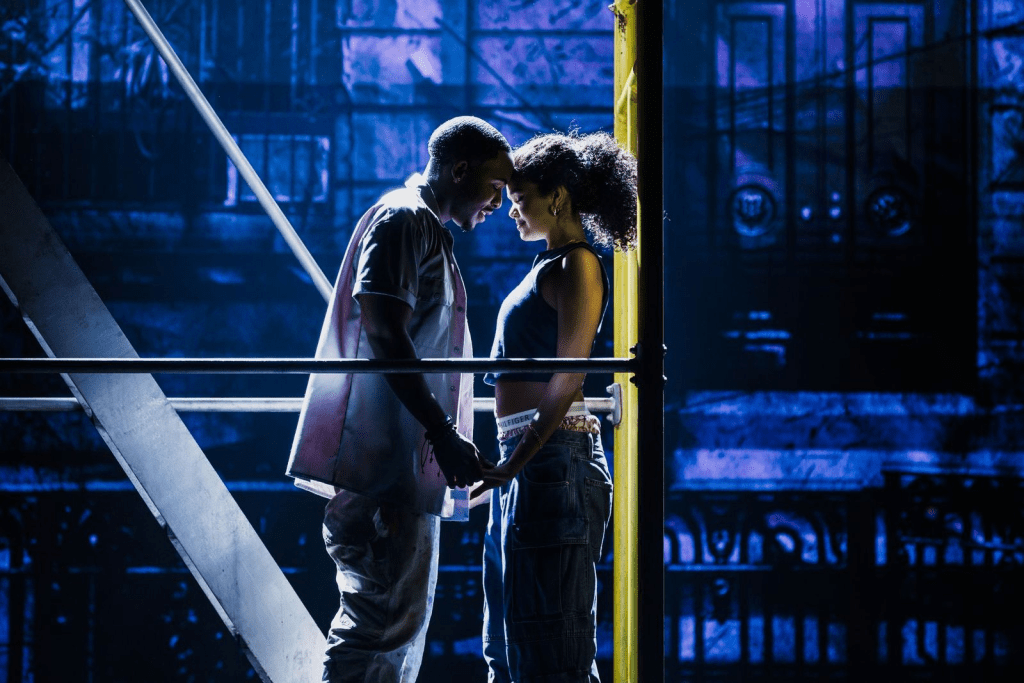
I’d be remiss not to single out JonAvery Worrell as Knuck here, too. He’s got a gorgeous tenor, with runs that make you sit up and look again. It’s the kind of voice that almost makes the character’s thin arc beside the point; you forgive the book for not giving him more to do because the sound of him doing it is so satisfying on its own. And whatever the book leaves underwritten between Ali and Knuck, Drake and Worrell make up for with pure chemistry; their scenes together crackle in a way that sells the relationship even when the plot around it is doing the bare minimum.
A Kairotic Moment
The moment that won me over is right before “Kaleidoscope” begins, the set turning to bring the grand piano into view. It doesn’t play like a scene change. It plays like fate arriving on cue.
There’s a precise word for that kind of moment: kairotic. Kairos is the ancient Greek term for the right, ripe moment, as distinct from chronos, the ordinary tick of clock-time. The show earns the word honestly, stacking up the exact contingencies that put Ali in that room: the fight with Jersey, Knuck’s rejection, the rain that traps her inside rather than letting her storm off. Live through it, and it’s pure luck, a door that happened to be open at the right second. Look back on it as a story, and it reads as fate, inevitable in hindsight even though it wasn’t inevitable at all. The show wants you holding both readings at once.
That’s not a lens I’m just inventing, either. Miss Liza Jane says as much herself, later telling Ali that her presence in that room wasn’t a coincidence, that the ancestors called her there. She’s naming, in her own words, exactly what the staging already showed: chance, revisited, becomes inheritance. The dancers’ kaleidoscope-colored costumes and the projections blooming into matching patterns behind them make the same argument visually, before Ali has even sat down at the keys. Of everything in the show, this is the moment that got me.
Where the Book Comes Up Short
That shortfall is clearest in Jersey’s political material, her support for Giuliani-era policing, and the real consequences that has for Knuck and the drummers in the building. It’s a rich, specific, uncomfortable choice for a protagonist’s mother to make, and the show clearly knows it’s thematically loaded (it’s tied directly to the racial reckoning Miss Liza Jane later voices in “Perfect Way to Die”). But it gets raised, then largely absorbed back into the mother-daughter melodrama rather than sat with. It’s the one place where I wanted the book to slow down and let the discomfort be the point, instead of resolving it through the next emotional beat.
Tellingly, the show does this work more effectively elsewhere, through Miss Liza Jane. Her reflections on the racism she’s lived through land with a weight and specificity that Jersey’s arc doesn’t quite reach, because the show lets her simply speak it rather than routing it through plot mechanics. It’s a reminder that Hell’s Kitchen is capable of sitting with this material; it just doesn’t trust every character to carry it the same way. Roz White, who plays the role on this tour, brings exactly the stillness and quiet command that material demands, an authority that never needs raising her voice to prove itself, and when “Perfect Way to Die” finally asks more of her, she has the reserves to deliver it in full. It’s no surprise Kecia Lewis won the Tony for Best Featured Actress in a Musical originating the role on Broadway; that same throughline, warmth in the lessons, steel with Jersey, “Perfect Way to Die,” is exactly what makes it work here too.
If I had to point to a single quiet moment that captures why the role holds up, it’s tucked away from the big Act One blowups: Miss Liza Jane telling Ali she’s “the latest branch on a long-standing tree,” rooted in a lineage that runs through Florence Price, Margaret Bonds, and Hazel Scott. Price, Bonds, and Scott were real Black women pianists and composers whose careers were shaped and often limited by the same racial barriers Miss Liza Jane alludes to elsewhere in the show. Naming them specifically, rather than gesturing vaguely at “the greats,” grounds Ali’s individual coming-of-age story inside a much longer, real historical continuum of Black women musicians fighting for space and recognition.
It also reframes what Miss Liza Jane is actually teaching Ali. It isn’t just piano technique, it’s inheritance, the ancestors-calling-her-there idea from the Kaleidoscope moment made explicit. She frames herself as a caretaker of that lineage rather than its origin point, and Ali as its next steward rather than a student who’ll eventually “graduate” and move on. That framing is what makes Miss Liza Jane’s arc land as generational continuity rather than simple loss: the piano lesson was never really about the piano. It’s the show’s clearest statement of an idea it’s better at showing than saying elsewhere, that what you inherit isn’t clean. Ali gets Jersey’s fear alongside Jersey’s fierceness, Davis’s absence alongside Davis’s music, and loss alongside the gift of music. None of it cancels out. The work the show actually cares about isn’t escaping what she’s been handed, it’s learning to build with all of it.
A Word on the Place Itself
It’s worth pausing on the neighborhood the show is named for, because it isn’t incidental; it’s practically a character. Hell’s Kitchen sits on Manhattan’s West Side, roughly from 34th to 59th Street between Eighth Avenue and the Hudson River, a stone’s throw from the Theater District it now shares a border with. The name itself has murky, contested origins. Most stories trace it to the area’s rough, working-class, often violent reputation in the 19th and early 20th centuries, when it was home to waves of Irish, and later other immigrant communities, and no small number of street gangs.
By the time the musical is set, in the 1990s, the neighborhood was in the middle of a long transition, still gritty, still affordable by Manhattan standards, but increasingly gentrifying, sitting uneasily between its old identity and what it would become. That tension is baked into the show’s DNA: Ali’s home, Manhattan Plaza, is a real subsidized housing complex built specifically to house working performers, musicians, and artists, which is why the building itself is so thick with musicians, dancers, and drummers passing through its courtyard. It’s not just set dressing; it’s the reason a girl growing up there would be surrounded by exactly the kind of music that ends up saving her.
The choice to set the show here, rather than somewhere more overtly glamorous, matters too. Hell’s Kitchen in the ’90s was a place defined by exactly the frictions the show dramatizes, over-policing, gentrification pressure, working-class families holding onto ground in a rapidly changing city. Jersey’s protectiveness and her uneasy alliance with the era’s “broken windows” policing read very differently once you know the neighborhood it’s set in was itself a frequent target of that same policing philosophy.
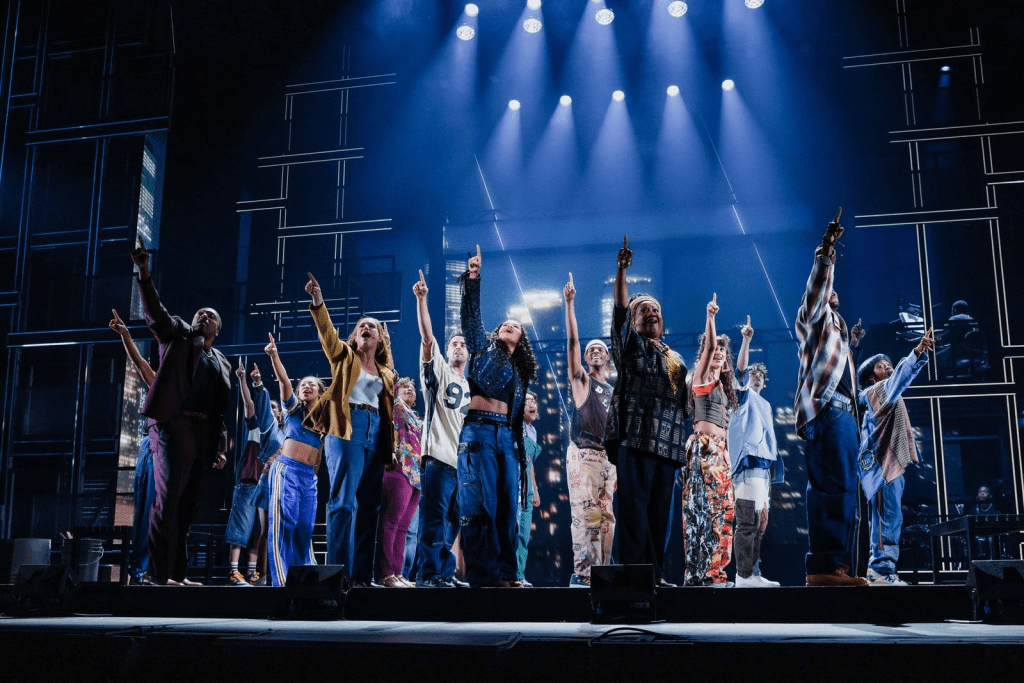
And of course, the closer is worth its own mention: “Empire State of Mind” sends the show out exactly where it should: Ali, having lost Knuck to Atlanta and Miss Liza Jane to illness, still standing in Hell’s Kitchen, still choosing it. After two acts spent watching her chase a way out, it lands as a genuine, earned turn rather than a forced feel-good ending. She’s not settling for the neighborhood; she’s claiming it. It’s the right note to end on for a show that’s spent its whole runtime insisting this specific block, this specific building, and this specific room made her who she is.

The Design Team
Whatever reservations I have about the book, the design team solved a problem I didn’t know I wanted solved: how do you stage live music without it feeling like theatrical pantomime? The answer here is a raised, almost architectural box upstage where a pianist is visibly, actually playing, in real time, in harmony with the performer at the grand piano downstage. It’s not underscoring dressed up to look diegetic; it’s two real musicians in conversation with each other, in full view of the audience.
For a show about a girl discovering that music is something you do, not just something you hear, that transparency is exactly right. You watch the craft happen instead of having it implied. It’s a small structural choice that ends up saying something the book sometimes struggles to say as directly: music isn’t decoration here; it’s labor, and it’s collaborative.
That same care shows up in how the production builds its 1990s New York around Ali. Robert Brill‘s sets favor abstract, sliding urban backdrops over literal street sets, and Peter Nigrini‘s projections layer cityscapes over them so the space feels like it’s constantly in motion, closer to how a neighborhood actually feels than a fixed picture of one would. Camille A. Brown‘s choreography leans hard into period-accurate street dance and hip-hop, giving the ensemble numbers a block-party energy that keeps the world around Ali alive even when she and Jersey are the ones carrying a scene. Dede Ayite‘s costumes do similar work in miniature, oversized silhouettes and bright, baggy styles that root the cast in the era without ever feeling like costume-shop nostalgia.
The Verdict
Hell’s Kitchen is a jukebox musical that mostly escapes the genre’s usual trap; it isn’t songs in search of a story, most of the time. It’s a story that occasionally isn’t as layered as the songs are. Drake, Caughell, and White carry the emotional spine of the show with genuine force, “If I Ain’t Got You” and “Fallin’” hit harder than the plot around them technically justifies, and the live, visible musicianship built into the set design is one of the smartest staging choices I’ve seen in this genre in a while. The Jersey/policing thread is the one place I wanted more nerve from the book, but even with that left underexplored, this is a show that knows exactly what it’s good at, and leans into it without apology.
A closing thought, one that took some sitting with after the lights came up: I don’t think the show is ultimately about escaping hardship, or even about healing from it in any final sense. Ali doesn’t get her father back in her life permanently. She doesn’t get the guy she wants. She suffers a loss. By the end, sorrow is just part of her life, the way it’s part of everyone’s. What the show actually argues, underneath the mother-daughter fights and the will-they-won’t-they, is narrower and truer than a redemption arc: hardship doesn’t go away, but you’re not meant to carry it alone, or carry it in silence. Community and music are how Ali metabolizes what she can’t undo, and she can draw inspiration from those who came before her. That’s a smaller claim than “everything works out,” and a much more honest one.
The Company (North American Tour)
Principal Cast
- Ali: Maya Drake
- Jersey: Kennedy Caughell
- Davis: Desmond Sean Ellington
- Miss Liza Jane: Roz White
- Knuck: JonAvery Worrell
- Crystal: Rashada Dawan
- Q: Sherée Marcelle Dunwell
- ‘Riq: Marques Furr
- Millie: Beda Spindola
- Jessica: Sangeetha “Sang” Santhebennur
- Ray: Usman Ali Mughal
Creative Team
- Music & Lyrics: Alicia Keys
- Book: Kristoffer Diaz
- Direction: Michael Greif
- Choreography: Camille A. Brown
- Music Supervision: Adam Blackstone
- Scenic Design: Robert Brill
- Costume Design: Dede Ayite
- Lighting Design: Natasha Katz
- Sound Design: Gareth Owen
- Projection Design: Peter Nigrini
- Hair & Wig Design: Mia Neal
- Orchestrations: Tom Kitt & Adam Blackstone
- Conductor: Emily Orr
- Stage Management: Veronica Aglow, Jasmin Holton, Hollace Jeffords, Amber Dickerson
Show Info
Venue: Delta Hall at the George S. and Dolores Doré Eccles Theater, 131 S. Main Street, Salt Lake City, UT 84111
When: July 7–12, 2026
Tickets: For tickets, call ArtTix at 801-355-ARTS (2787) or visit www.artsaltlake.org.
Run time: Approximately 2 hours, 35 minutes, including one intermission
Advisory: Recommended for ages 8 and up; contains some strong language and mature themes
Accessibility: ASL-interpreted, audio-described, and open-captioned performances are offered on select dates, check with the box office for specifics


Leave a Reply