
Salt Lake City, UT — As UtahPresents celebrates its tenth-anniversary season, it fittingly welcomed a titan of American dance: Ballet Hispánico—the New York–based company now in its fifty-fifth year, celebrated for blending contemporary choreography with the textures of Latin and Caribbean forms.
As arts writer Les Roka observed in his preview for The Utah Review (2025), Ballet Hispánico was founded in 1970 by Tina Ramirez, emerging during the height of the civil rights era as a revolutionary space for Latin artists. Reflecting on that moment, Ramirez recalled:
“At that time, people didn’t know what Hispanic meant—not even the Hispanics. I was criticized for calling the company Ballet Hispánico. People felt I should name it after a country or a city or a town. But I said no, because we’re twenty-one nations that all speak Spanish—and we should all be included… my purpose was to create better understanding between Hispanics and non-Hispanics, and what better way than through dance and through art?”
That inclusive philosophy continues to guide Artistic Director Eduardo Vilaro, whose programming frames identity not as static heritage but as an evolving dialogue (Roka, 2025).
Salt Lake City marks Ballet Hispánico’s fifth stop on a six-city October tour—an itinerary that mirrors the company’s broader mission to move across borders, communities, and languages. In Utah, that mission felt especially resonant: a reminder that Latin identity is not a singular story, but a constellation of histories, rhythms, and reinventions (Roka, 2025).
As a scholar and reviewer, part of my mission is to highlight artists and performances that push the boundaries of “traditional” art—works that reimagine form, unsettle expectation, and reveal how performance as an archive can become an act of resistance and revelation. Ballet Hispánico embodies this commitment. What unfolded onstage at Kingsbury Hall was not only technically exquisite but thematically expansive: a living archive of Latin identity that moves through colonial memory, gendered myth, and collective joy.
Buscando a Juan
Choreography: Eduardo Vilaro
Music: Osvaldo Golijov — La Pasión según San Marcos (including “Lua descolorida,” “Procession,” and “Crucifixion”), recorded by Orquesta La Pasión, members of the Simón Bolívar Youth Orchestra of Venezuela, and María Guinand
Costume Design: Eduardo Vilaro with Dianela Gil
Lighting and Set Design: Christopher Ash
Featured Roles: Juan de Pareja (Amir J. Baldwin), Diego Velázquez (Antonio Cangiano), The Calling of Juan (Francesca Levita & Amir J. Baldwin)

The evening opened with Artistic Director Eduardo Vilaro’s Buscando a Juan, a meditation on the life of Afro-Hispanic painter Juan de Pareja, who was enslaved by Diego Velázquez for more than two decades before becoming an artist in his own right. Vilaro described Buscando a Juan as “a meditation on this man who is full of intersections,” emphasizing that the piece is “not a narrative” but rather a reflection of the “immigrant experience of those who were removed, who were extracted…without clear lineage or legacy” (Boguszewski, 2024). Vilaro situates the work not merely as an homage to an unsung figure but as a meditation on authorship, erasure, and the ongoing reverberations of colonial history.
Until recently, Pareja was known largely through an oft-repeated myth. As arts writer Shanti Escalante-De Mattei summarized, “Velázquez, a favorite of King Philip IV, resided in court along with his dutiful slave de Pareja. Unknown to him, Pareja was making paintings in secret. One day, the art-loving king stumbled upon Pareja’s surreptitious labor and demanded that he be freed, declaring that ‘The man who had such talent cannot be a slave.’” The reality, however, is more complex. The key to understanding Pareja’s circumstances came when art historian Jennifer Montagu discovered the artist’s manumission document, reframing him not as the grateful protégé of a benevolent genius but as a self-determined craftsman navigating power and precarity (Roka, 2025).
Vilaro was particularly moved when Pareja’s work was featured in the Metropolitan Museum of Art’s 2023 exhibition Juan de Pareja: Afro-Hispanic Painter. In seventeenth-century Seville, enslaved artisans were common, but Pareja’s proximity to Velázquez—so esteemed by the crown that he was permitted to accompany his master on European travels—made his position singular (Roka, 2025). After Velázquez’s death, Pareja remained in the studio “if only to make ends meet.” As Escalante-De Mattei notes, over his career as a free man, he produced large, luminous religious scenes—The Virgin Mary Surrounded by Cherubs at the Moment of Immaculate Conception, The Baptism of Christ, and The Flight of the Holy Family to Egypt. In one particularly stunning work, The Calling of Saint Matthew (1661), Pareja inserted a self-portrait at the left edge of the canvas—“the figure holding a slip of paper with his name on it” (Roka, 2025).
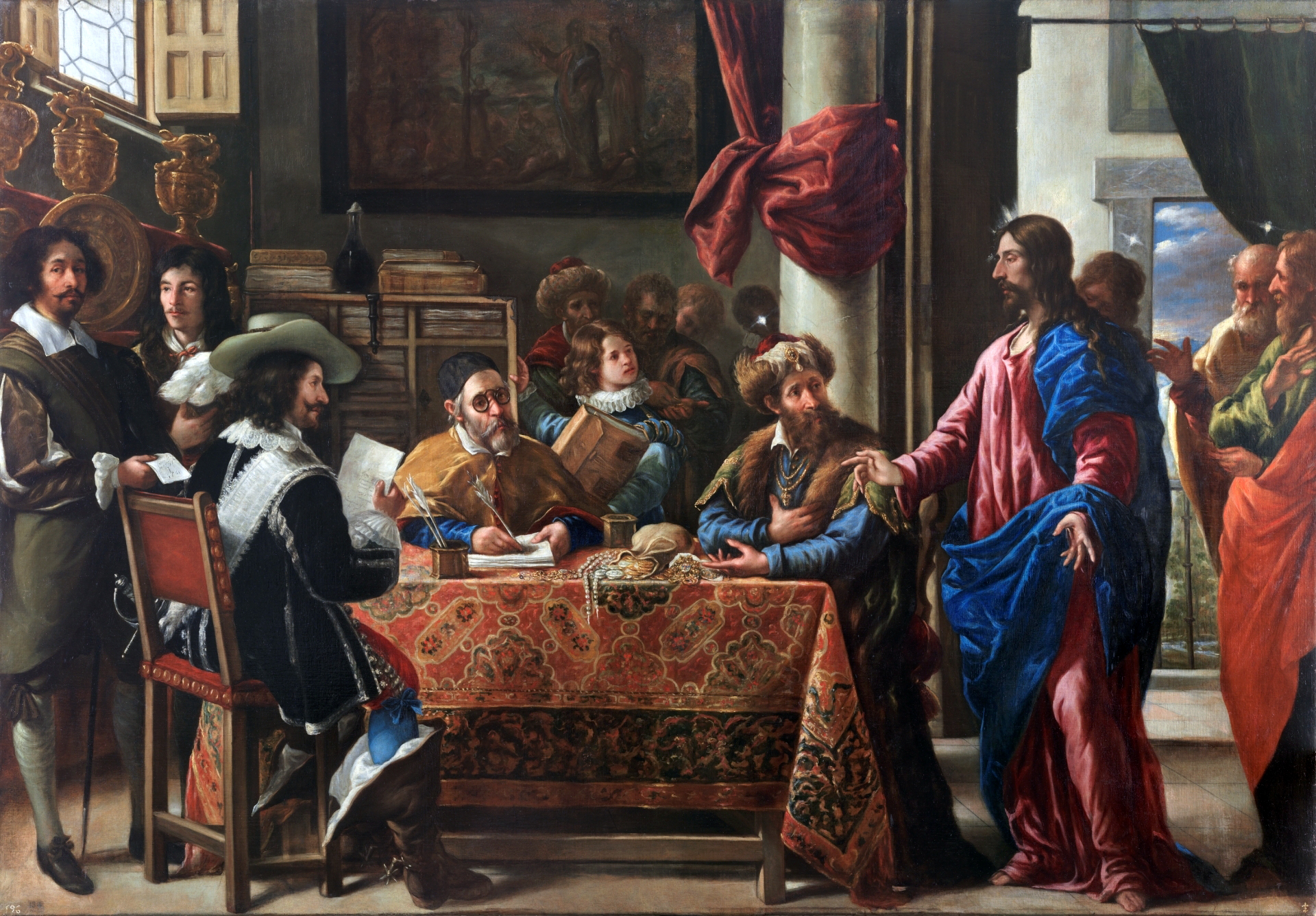
Painting: Juan de Pareja, The Calling of Saint Matthew, 1661, oil on canvas, 225 x 325 cm (Museo del Prado, Madrid, Credit: Steven Zucker)
Vilaro translates this act of self-representation into embodied motion. At Kingsbury Hall, Buscando a Juan opened with the sound of ocean waves and Golijov’s layered percussion, evoking both passage and exile. Amir J. Baldwin as Pareja and Antonio Cangiano as Velázquez moved in counterpoint beneath a gauzy light, their skin tones and gestures in deliberate contrast. According to Vilaro, he “wanted to begin with the tension between the seen and unseen body—the artist as both presence and absence in history” (Roka, 2025). This opening duet embodies that vision: a dialogue between bondage and freedom, shadow and recognition (Benjamin, 2024). While Baldwin is credited as Pareja and Cangiano as Velázquez, the duet resists literal reenactment; instead, it serves as a metaphor for the artist’s divided selfhood—creator and property, visibility and servitude, resistance and reverence.
Their movements trace the tension of a body becoming visible through creation even as it remains bound by history. Dressed in soft earth tones and flowing linen, the dancers evoked the muted palette of a Baroque painting—ochres, creams, and deep browns recalling the canvases of Velázquez himself. The restrained costuming emphasized texture over spectacle, allowing gesture and light to become the primary instruments of storytelling.

The ensemble followed, rippling outward from Baldwin’s body like a chain reaction of acknowledgment. Their movements, alternately fluid and fragmented, mirrored Golijov’s percussive score—a soundscape fusing sacred choral lament with Afro-Caribbean rhythm. At times, silence punctuated the motion, the dancers’ audible breathing filling the hall—a stark contrast to the moments saturated in sound.
At its premiere, The New York Times dance critic Gia Kourlas described Buscando a Juan as “a search for artistic identity and the struggle and faith it takes to find it,” noting how the duet between Leonardo Brito as Pareja and Antonio Cangiano as Velázquez “trades strength and resistance in sculptural balances and lifts” (Kourlas, 2024). In Salt Lake City, Amir J. Baldwin and Antonio Cangiano carried that same dynamic forward — a physical dialogue where the question of control dissolved into shared vulnerability.
Describing the premiere, The Dance Enthusiast said the choreography “simmers beneath the surface, thrashing fists and covered eyes hinting at explosive potential” (Benjamin, 2024). That same restrained intensity defined this performance: a portrait in motion where the painter’s brushstroke becomes heartbeat, each phrase of movement a reclamation of authorship through rhythm.
The effect was both elegiac and urgent—a living restoration of a man once confined to the margins of another’s canvas. In Buscando a Juan, Vilaro resurrects him not as subject or servant but as creator, his story continuing to pulse through every movement of the diaspora.

House of Mad’moiselle
Choreography: Annabelle Lopez Ochoa
Music: Leonard Bernstein (“Maria”), Chavela Vargas (“La Llorona”), Oro Sólido (“La Tanguita Roja”), Charles Gounod (“Ave Maria”), and Bart Rijnick (original sound design)
Soundscape: Bart Rijnick
Costume Conception: Annabelle Lopez Ochoa
Costume Development and Construction: Diana Ruettiger
Drag Dramaturgy and Wardrobe: Nicholas Villeneuve
Lighting Design: Christopher Ash
Featured Role: María (Mia Bermudez)
Buscando a Juan reflected the colonial gaze outward; House of Mad’moiselle turned that gaze inward—to interrogate cultural and psychological inheritance, specifically the intertwined gender scripts of marianismo and machismo that continue to shape emotional expression in Latinx communities.
Anchored in the exploration of stereotypes and representations of icons, House of Mad’moiselle builds upon the duality of sacred and profane dimensions of the ubiquitous María in many of her manifestations (Roka, 2025). It is also a deeply personal work for Ochoa, who is part Colombian and spent her formative years in Belgium, only later learning Spanish in her life (Roka, 2025).
In an interview with The Dance Enthusiast, Vilaro explained that Ochoa’s restaging of House of Mad’moiselle expands its original celebration of womanhood to interrogate “larger questions of what is gender” and “how do we accept gender,” framing femininity and machismo within contemporary discourse on identity and power (Boguszewski, 2024).
Ochoa’s surreal, camp-infused work—filled with pink wigs, bare-chested male dancers, women in nude-toned bras, and waves of operatic distortion—unfolded like a fever dream of the Virgin Mary herself. The soundscape, stitched from Bernstein’s “Maria,” Vargas’s haunting “La Llorona,” Oro Sólido’s merengue hit “La Tanguita Roja,” Gounod’s “Ave Maria,” and Rijnick’s electronic collage, moved between sacred and profane registers: lush classical grandeur giving way to static-filled screams, cha-cha rhythms colliding with devotional hymns.
The ensemble cycled through images of devotion, hysteria, seduction, and defiance: dancers slapped their thighs, shouted “¡María!”, and collapsed under invisible expectations. The choreography illuminated what scholars have long observed—that marianismo, the cultural ideal of the self-sacrificing, pure, family-centered woman, can engender emotional repression and internalized suffering, while machismo valorizes dominance, anger, and stoicism as masculine ideals (Nuñez et al., 2016; Roka, 2025), findings grounded in empirical research linking traditional gender scripts to emotional distress.
Through the physical vocabulary of dance, Ochoa translated these sociocultural constructs into affective motion: a body trembling between holiness and humiliation, a chorus torn between reverence and revolt. The work’s chaos felt psychological—echoing research connecting rigid gender roles to depression, anxiety, and hostility among Hispanic men and women (Chida & Steptoe, 2009; Gallo & Matthews, 2003). In this sense, House of Mad’moiselle was more than theatrical—it was diagnostic, turning centuries of gendered emotional conditioning into kinetic critique.
At its center, Mia Bermudez’s María embodied both saint and survivor. Her final slow walk through haze to Ave Maria, glittering with feathers, radiant and strangely still, captured the paradox of liberation through performance. Conceptually, the image might verge on absurdity; in the moment, it feels utterly sincere.
As Dance Enthusiast wrote of the 2024 New York restaging, “Lopez Ochoa’s House of Mad’moiselle establishes its aesthetic within seconds—bright red wigs, black pants, and drag sensibility. The dance never stops moving, shifting between satire and worship.” Similarly, Voce di Meche called the work “wacky, weird, and wonderful,” praising its “stimulating, colorful, and ultimately satisfying” theatricality. In Salt Lake City, those same qualities resonated more as inquiry than spectacle: the movement felt not wacky but wounding, a dialogue between icon and emotion, between divine image and human cost.
Club Havana
Choreography: Pedro Ruiz
Music: Israel “Cachao” López (“A Gozar con Mi Combo”), Rubén González (“Mandinga”), A.K. Salim (“Afro-Soul”), Pérez Prado (“Mambo No. 5”), and Francisco Repilado — Compay Segundo (“Chan Chan”)
Costume Design: Emilio Sosa
Lighting Design: Donald Holder
Featured Dancers:
Opening: Mia Bermudez and Omar Rivéra
Caballo: Olivia Winston and Dylan Dias McIntyre, Maya Canestaro and Matthew Mancuso, Andrea Mish and Amir J. Baldwin
Cha Cha Cha: Amanda Ostuni, Antonio Cangiano, and Omar Rivéra
The night closed with Pedro Ruiz’s Club Havana, a luminous celebration of Cuban music, movement, and memory. Ruiz’s musical selections—drawn from the giants of pre-revolutionary Cuba, from Pérez Prado’s brassy mambo to Rubén González’s lyrical piano, infused the piece with irresistible nostalgia (Roka, 2025). Smoke drifted across the stage as dancers flicked their cigarettes and stepped into the rhythmic pulse of rumba, cha-cha, and conga, their bodies tracing the syncopations of son cubano and jazz.
The Opening, led by Mia Bermudez and Omar Rivéra, established a tone of smoky intimacy and precise sensuality—hips swaying in conversation with Israel “Cachao” López’s bass lines. The scene felt like an invitation: a doorway into Havana before the revolution, where social dance doubled as ritual and rebellion.
In Caballo, Olivia Winston and Dylan Dias McIntyre, Maya Canestaro and Matthew Mancuso, and Andrea Mish and Amir J. Baldwin charged the stage with syncopated flirtation. Their duets alternated between competitive play and effortless partnership, echoing the dialogue of González’s musical phrasing. Each pairing carried its own tone—one bold and teasing, another graceful and restrained—all steeped in the humid thrill of dance-floor challenge.
Finally, Cha Cha Cha, featuring Amanda Ostuni, Antonio Cangiano, and Omar Rivéra, shimmered with exuberance. Under amber and crimson light, the trio spun through Pérez Prado’s brassy crescendos, transforming rhythmic pulse into spectacle. Ruiz’s choreography balanced sensuality with precision: Ostuni in red and the men in gold and black, followed with a blend of deference and bravado. Each musical phrase sparked a new rhythm—flirtation, competition, seduction—until a disco ball descended, bathing the ensemble in kaleidoscopic color.
Club Havana has long been acclaimed for its choreographic opulence and remains one of Ballet Hispánico’s signature showstoppers (Roka, 2025). In the twenty-five years since its creation, the work has been featured prominently: in 2016, Lincoln Center at the Movies: Great American Dance presented it in select theaters, and in 2017, PBS broadcast the film nationally to celebrate Hispanic Heritage Month (Roka, 2025).
Ruiz—a Cuban immigrant who danced as a principal with Ballet Hispánico for twenty-one years—crafted the piece as both a love letter to home and a portrait of cultural duality (Roka, 2025). The choreography revels in romantic clichés and period-specific tropes of machismo and desire, yet when viewed alongside Buscando a Juan and House of Mad’moiselle, those gestures gain a new dimension. As Vilaro himself has observed, it is essential “not to negate that part of the history,” but to contextualize it—understanding that such representations mark a chapter in a larger continuum of heritage, transformation, and reclamation (Roka, 2025).
BroadwayWorld called Club Havana “an atmospheric dance celebration filled with cigar puffing, flicks of disco ball light, and rhythm,” while CriticalDance praised it as “a rousing tribute to pre-Castro Havana…filled with zest, sensuality, and Latin pride.” In Salt Lake City, that same exuberance transformed Kingsbury Hall into a nightclub: joy elevated to art.
Final Reflections
Ballet Hispánico’s 55th-anniversary program illuminated how dance can translate cultural history, emotions, and lived experience into embodied form, while telling a story. Through Golijov’s sacred lament, Ochoa’s sound-collaged fever dream, and Ruiz’s intoxicating Cuban rhythms, the company showed that music and movement are inseparable languages of identity and endurance.
As my colleague Mitzi Ceballos, a PhD candidate at the University of Utah studying decolonial theory, insightfully noted after the performance, Ballet Hispánico “disrupts monolithic representations of Hispanidad.” That disruption was palpable from the moment Artistic Director Eduardo Vilaro addressed the audience—reminding us, with humor and warmth, that if we came expecting folklórico, we might be surprised. In a state where university-sponsored cultural events often center Aztec dance and mariachi (beloved traditions in their own right), Ballet Hispánico offered a different vision: one where Hispánico and Hispanidad are not bound by the past, but actively reshaped through contemporary expression, complexity, and contradiction.
UtahPresents could not have chosen a more fitting partner for its milestone year. Both institutions remind us that art’s highest calling is not replication but transformation—an ever-evolving conversation between tradition and innovation, between the heart, and the body that carries it.
References
Boguszewski, T. (2024, April 20). The Dance Enthusiast asks: Ballet Hispánico’s Eduardo Vilaro on “Buscando a Juan” and changing narratives. The Dance Enthusiast. https://www.dance-enthusiast.com/features/the-dance-enthusiast-asks/view/Ballet-Hispanico-Eduardo-Vilaro-Buscando-a-Juan
Chida, Y., & Steptoe, A. (2009). The association of anger and hostility with future coronary heart disease: A meta-analytic review of prospective evidence. Journal of the American College of Cardiology, 53(11), 936–946. https://doi.org/10.1016/j.jacc.2008.11.044
Gallo, L. C., & Matthews, K. A. (2003). Understanding the association between socioeconomic status and physical health: Do negative emotions play a role? Psychological Bulletin, 129(1), 10–51. https://doi.org/10.1037/0033-2909.129.1.10
Nuñez, A., González, P., Talavera, G. A., Sanchez-Johnsen, L., Roesch, S. C., Davis, S. M., Arguelles, W., Womack, V. Y., Ostrovsky, N. W., Ojeda, L., Penedo, F. J., & Gallo, L. C. (2016). Machismo, marianismo, and negative cognitive-emotional factors: Findings from the Hispanic Community Health Study/Study of Latinos Sociocultural Ancillary Study. Journal of Latina/o Psychology, 4(4), 202–217. https://doi.org/10.1037/lat0000050
Roka, L. (2025, October 13). Ballet Hispánico, American dance institutional titan, set to take Salt Lake City stage, as part of UtahPresents’ Touring Dance Trio offerings. The Utah Review. https://www.theutahreview.com
Show Information
Ballet Hispánico at Kingsbury Hall
Presented by UtahPresents as part of the Touring Dance Trio series
Venue: Kingsbury Hall, Salt Lake City, Utah
Date: October 15, 2025
Presented by: UtahPresents (Tenth Anniversary Season)
Company: Ballet Hispánico (New York, NY)
Artistic Director & CEO: Eduardo Vilaro
📧 info@ballethispanico.org
🌐 ballethispanico.org
📸 Instagram | Facebook | YouTube | TikTok
Upcoming performance: Ballet Hispánico Performance (Whitewater, WI)
October 18, 2025: The Young 930 West Main Street, Whitewater, WI 53190
Buscando a Juan
World Premiere: 2024, New York City Center
Choreography & Costume Design: Eduardo Vilaro | Associate Costume Design: Dianela Gil | Set & Lighting Design: Christopher Ash
Music: Osvaldo Golijov — La Pasión según San Marcos (including “Lua descolorida,” “Procession,” and “Crucifixion”), recorded by Orquesta La Pasión, members of the Simón Bolívar Youth Orchestra of Venezuela, and María Guinand
Featured Roles: Juan de Pareja (Amir J. Baldwin), Diego Velázquez (Antonio Cangiano), The Calling of Juan (Francesca Levita & Amir J. Baldwin)
House of Mad’moiselle
Premiere (Revision): 2024, New York City Center | Original Premiere: 2010, The Joyce Theatre
Choreography & Costume Conception: Annabelle Lopez Ochoa | Soundscape: Bart Rijnick | Lighting Design: Christopher Ash | Drag Dramaturgy & Wardrobe: Nicholas Villeneuve | Costume Development: Diana Ruettiger
Music: Leonard Bernstein (“Maria”), Chavela Vargas (“La Llorona”), Oro Sólido (“La Tanguita Roja”), Charles Gounod (“Ave Maria”), and Bart Rijnick (original electronic sound design)
Featured Role: María (Mia Bermudez)
Club Havana
World Premiere: 2000, The Joyce Theater
Choreography: Pedro Ruiz | Costume Design: Emilio Sosa | Lighting Design: Donald Holder | Costume Construction: Ghabriello Negron
Music: Israel “Cachao” López (“A Gozar con Mi Combo”), Rubén González (“Mandinga”), A.K. Salim (“Afro-Soul”), Pérez Prado (“Mambo No. 5”), and Francisco Repilado — Compay Segundo (“Chan Chan”)
Original Production Support: Jody & John Arnhold, Dhuanne & Douglas Tansill, Caroline Newhouse, American Express Company, AT&T, and New York State Council on the Arts
Many thanks to Les Roka at The Utah Review for his exceptional preview and contextual insights, which informed portions of this review.

Leave a Reply