

Salt Lake City, UT — On November 5, 2025, the UtahPresents concert did not start with music. It began with testimony. A representative from Utah for Ukraine stepped to the microphone and asked the audience a simple question:
“How many of you are from Ukraine tonight?”
Nearly half the room raised their hands—dozens of them, like small flags lifted in the dark. In that moment, the hall shifted from performance venue to homecoming.
He continued:
“Ukrainians are amazing people. They are defiant people. They are standing up against genocide. And one of the ways they do that is with culture—with preserving their language, their art, their song.”
He spoke of his first journey to Ukraine in 2022, of founding Utah for Ukraine, and of partnering with Car for Ukraine to send pickup trucks directly to frontline brigades. Then he invited the audience into an act of linguistic solidarity:
“Two words,” he said. “До перемоги. Say it with me—it means ‘to victory.’”
And the crowd answered: softly at first, then louder—до перемоги (do peremohy).
Context and Continuum
What followed was not a concert in any conventional sense, but a gathering—an act of memory, art, and endurance.
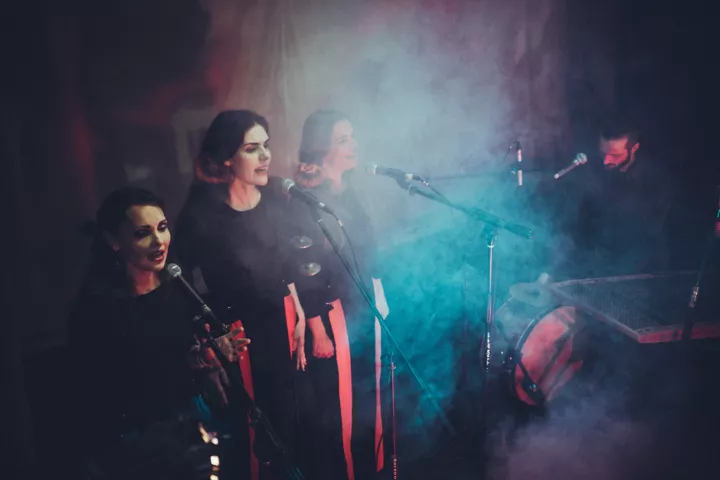
Kurbasy—founded by singer-actors Mariia Oneshchak and Nataliia Rybka-Parkhomenko—took the stage in long embroidered white dresses, joined by:
- Vsevolod Sadovyi – Ukrainian folk instruments
- Severyn Danyleiko – cello
- Artem Kamenkov – double bass
- Markiian Turkanyk – violin
Kurbasy emerged from the experimental Les Kurbas Theatre in Lviv, named for director Les Kurbas, executed in 1937 for refusing to abandon Ukrainian identity under Soviet rule.

In 2018, Vogue Ukraine profiled the group and called them:
“not just singers, but actresses who create music.”
Their Utah performance was part of the U.S. State Department’s Center Stage cultural diplomacy program. Before stepping into Kingsbury Hall, they taught in the University of Utah Honors College, spoke at the Hinckley Institute of Politics, performed for high school students, and described plans to visit the Great Salt Lake—connecting memory, ecology, and homeland across continents.
“We believe in the power of the arts to connect us across real and perceived differences,”
said Chloe Jones, Executive Director of UtahPresents.
By the time the lights dimmed, those connections had already begun weaving.
Ritual Beginnings
The stage was nearly bare: just instruments, chairs, no spectacle—only bodies, breath, and intention. The seventy-five-minute cycle unfolded as a single uninterrupted breath—vesnianky (spring-invocation songs), lullabies, love laments, soldier farewells, and polyphonic forest chants from Polissia, Bukovina, Podillia, Lemko, and beyond.
Their opening was ancient and spare—voices in unison, calling to awaken the sun after winter. This was a performance not just for applause but for solidarity and ritual.

Music as Resistance
Kurbasy’s brilliance lies not only in melody, but in fracture—how they break it apart.
They begin in unison, then split into harmonies that dissonate and shimmer, finding beauty inside tension. Beneath them, the shruti box (Indian harmonium) drones like the earth’s own pulse. A wooden flute cuts through the air. The double bass rumbles like distant thunder.
In one striking moment, Danyleiko’s cello and Kamenkov’s bass moved against each other in conflicting rhythms—two tectonic plates colliding beneath song.
Oneshchak and Rybka-Parkhomenko leaned toward each other, breathing at the same tempo, and their voices locked perfectly. A third tone—an overtone or “ghost note”—floated above them. Not sung, not seen—just heard.
Instrumentally, the ensemble was just as fearless. The percussionist played a wooden flute with one hand while drumming with the other. The singers clapped in complex rhythms and played several percussive instruments while singing: a circular rain disk, bells, and more—without breaking pitch or breath. Every sound was placed with intent. Nothing ornamental. Everything essential.
Visual Language: Memory Under Pressure
Projected behind the performers, fragments of a forest world slowly appeared. At first, the images were gentle: blooming flowers, women’s faces in sunlight. Then, almost imperceptibly, they began to change. Petals blurred at the edges. Faces softened and slipped from focus. Figures dissolved into shadow. What began as tender and pastoral shifted into something ghost-like—memory under erasure, playing out in real time. The images no longer looked natural.
As one of the musicians later wrote to me, “There’s always a temptation in art to be too literal, and walking that line is delicate.” Kurbasy never crossed that line. They allowed the projections to stay suspended between symbol and sorrow—unexplained, unresolved, and painfully alive.

Witness in Song
At an artist talk at Penn State, Oneshchak said:
“We are being murdered. This folk music witnesses our history—our ancient history, our dreams.”
She did not say it at Kingsbury Hall. She didn’t have to. It lived in every note.
Their rendition of “Chervona Kalyna”—a recruit song—was powerful! They did not dramatize grief. They sat upright and sang.
Grief, here, did not collapse. It endured.
Language, Memory, Repertoire
Scholar Diana Taylor writes of repertoire—memory carried not in books but in bodies.
Kurbasy is repertoire. These songs are not archived on paper. They live in breath, gesture, and inheritance. Passed grandmother to granddaughter, village to village. To sing them is to resist forgetting.
Towards the end of the evening, the phrase from the opening returned—this time softer:
“До перемоги — to victory.”
Voices joined quickly together in unity.
After the Echo
At the end of the concert, Kurbasy carried in a large Ukrainian flag and sang one last song as they held up the flag. Another flag sat in the lobby for people to sign. Utah for Ukraine and Car for Ukraine gathered donations for pickup trucks headed to the front. Art and aid were not separate things; they belonged to the same gesture.
Songs of the Ukrainian Forest is not just a concert. It is ritual, record, and resistance.
To sit with their music again:
- RaiTse (Paradise, 2014) — available via SoundCloud
- Charm-Creation (Чарування), 2018
- https://music.apple.com/us/album/the-miracle-of-creation/1447342581
- Cars for Ukraine: https://car4ukraine.com/nl/campaigns/50forua-utah-battalion/


Leave a Reply