Across three productions, from a sweltering Fringe venue to the stage of Kingsbury Hall, Footpath Theatre Co. has rebuilt its love letter to southern Utah almost from scratch every time. Its creators say that’s the only way they know how to work.
Most theatre companies that land a hit hold on to what worked. Footpath Theatre Company takes it apart. “Each version of the show, there’s no attachment to it being the last version,” says Connor Johnson, the playwright and co-creator of Western Minerals and Their Origins. The play has now been staged three times in three years: at the Great Salt Lake Fringe in 2024, at Salt Lake Acting Company in 2025, and most recently at Kingsbury Hall. Each time, the company rebuilt it almost from scratch. “Now that we’ve done it three times, I don’t think there’s any other way we could do it,” Johnson says. “We’re a little too restless to not reinvent ourselves.”
Johnson believes that constant rebuilding is what makes remounting a show worthwhile. Returning to the same script year after year usually yields less each time. “But because we keep reinventing it,” he says, “that excites our imaginations and lets us sink our teeth in, rather than doing the same thing we did the year before.” The approach has risks, and Johnson admits that tearing down a show audiences have already embraced can be nerve-wracking. “Once you get a positive response to something,” he says, “it feels a little risky.” Three years after the show’s first Fringe run, I sat down with Johnson and Harrison Lind, Footpath’s music and sound designer and a co-founder, to look back on all three versions.
“We’re a little too restless to not reinvent ourselves.”
— Connor Johnson
I first saw Western Minerals on a hot final weekend at Fringe. I hadn’t planned to review anything that year, but people in Salt Lake’s theatre community were talking about the show, so I reached out and got a seat. That version included a blindfolded sequence, a psychedelic hunt for a legendary gem called Leopard Beryl, and a descent into the canyon staged with a cloth-draped plank that Johnson and Lind lifted higher as co-founder Jessica Graham climbed across it. Anyone who saw only the later versions would have no idea what I’m describing.
That has become a running joke with the company. A few audience members saw the first and third versions but missed the second, and they’ve come out asking, more or less, what happened? Johnson and Lind say those viewers who’ve seen multiple versions are the ones they most enjoy talking to. “Hearing what they missed, what they loved, what they noticed, is sometimes the most helpful thing from our perspective,” Lind says. “Even though it’s so simple.”
Jessica Graham, Connor Johnson, and Harrison Lind in rehearsal for the first version of Western Minerals and Their Origins, before its 2024 Great Salt Lake Fringe premiere. (Photo courtesy of Footpath Theatre Company)
A company forged on the road
Footpath’s story starts in Brooklyn, where Johnson and Lind were living. Their first project, The Wreck of the Queen Thomasina, was a rhyming-verse play about pirates, performed for a house of about ten people. When they took it to the Edinburgh Fringe in 2023, Graham, then living in Ireland, joined them. In Scotland, she became, as Johnson puts it, the surrogate director, stage manager, tour manager, technician, and cheerleader: “everything we couldn’t do.” Graham, now a performer and the lead on much of Footpath’s scenic design, was absent from our conversation.
Lind considers the Edinburgh trip Footpath’s real beginning; Johnson calls it “a crucible.” It’s where three friends learned they could survive a month of performing together. “We ended up still liking each other enough to keep working together,” Lind says. “It was like, oh, maybe we could do this.”
Connor Johnson and Harrison Lind in The Wreck of the Queen Thomasina, Footpath’s first production, ahead of its 2022 Brooklyn premiere. (Photo courtesy of the University of Utah Department of Theatre)
“We ended up still liking each other enough to keep working together. It was like, oh, maybe we could do this.”
— Connor Johnson
All three grew up in Utah and studied theatre at the University of Utah, where Lind graduated in 2020 and Johnson and Graham in 2021. After their time away, each eventually came home. Lind, who also works as an electronic musician and sound designer, moved back to Salt Lake. Graham returned after working in San Francisco, Colorado, and Ireland as a production manager, outdoor adventure guide, and educator. Johnson spent summers in Salt Lake while earning an MFA in playwriting at the University of Arkansas, which he completed this spring, a few months before the Kingsbury run.
In the summer of 2024, they decided to make a show for the Fringe. They knew three things: it would be about Utah, specifically southern Utah, and about canyoneering. Everything else came during a rushed development period of about three weeks before opening in late July. “It was really rough and tumble,” Lind says.
Rock layers, garage layers
What has survived every version is the geology. The first production presented it through William K. Wagley, a Victorian-era Oxford professor played by Johnson in a British accent and loosely inspired by Charles Lyell, the Scottish geologist whose travels in North America in the 1840s brought the continent’s geology to British readers. In later versions, Graham took over the explanation, still using the scale model of canyon country she built for the first production. I was impressed by that model from the beginning.
The science behind it is real. Johnson’s father is a geologist, and so is Lind’s sister. “We all at the very least have a passing interest in these kinds of things,” Lind says.
Johnson remembers the first version’s makeshift rehearsals. “We had a whiteboard, and we were rehearsing in our houses because we didn’t have any space,” he says. “My dad would come by when we weren’t rehearsing, look at the whiteboard, and cross things out and correct things. So it was all based in very good science.”
To Lind, the geology is essential to the play’s purpose. “We want the show to be a complete love letter to southern Utah,” he says. “You can write about how much you enjoy recreating there, but you can’t write a love letter to a place like that and not talk about some of the hard science.”
The play’s most important structural idea came from having room to experiment. Salt Lake Acting Company’s Making Space for Artists program, which lets small companies produce their own work at SLAC, gave Footpath its chapel theatre for a full month. The staff let them rehearse late into the night. “We could do whatever we wanted, really,” Johnson says. “They were so generous.”
“You can’t write a love letter to a place like that and not talk about some of the hard science.”
— Harrison Lind
That freedom changed what the show could be. Fringe productions move in and out of shared venues, so they have to work anywhere. At SLAC, Footpath could shape the room itself. The first change was flipping the orientation, placing the audience on the stage and the actors in the tiered, kiva-like seating. Then came the central idea: a garage. A family garage holds layers of accumulated history, and those layers could mirror the strata of a canyon wall. The play’s story, about Ari and her brother Rion, carries its own layers of family history too.
“We could have a marriage of content and form,” Johnson says, “in a way that was really satisfying to us.” It also gave them a practical advantage, since the space allowed them to build full arches from stacked boxes. Both creators agree that the third version could not exist without that month. “If we hadn’t had the ability to rehearse and perform in one space last year,” Lind says, “I don’t think this year’s version of the show would have happened.”
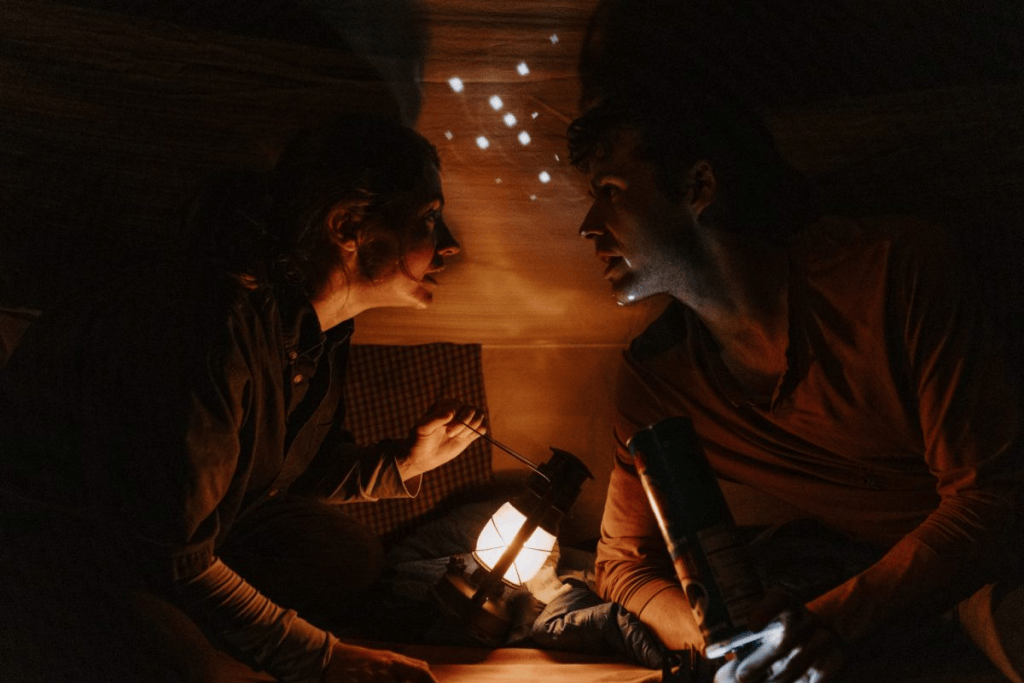
Connor Johnson as Rion and Jessica Graham as Ari in Western Minerals and Their Origins. (Photo: Anna Chapman)
Scaling up at Kingsbury Hall
The third production brought new challenges. When UtahPresents agreed to produce the show at Kingsbury Hall, in association with Flying Bobcat Theatrical Laboratory, Footpath arranged a workshop week in the theatre. They knew they wouldn’t be able to develop the whole show there. “Even though they cut off the audience, I looked at how huge and how tall that stage is,” Johnson says, “and I just thought, oh my God, I don’t know how we’re going to fill this.”
The SLAC chapel had been roughly the size of a garage. Kingsbury was not. “There’s probably no garage on Earth that’s this tall,” Lind says. That height became an advantage. The company had considered including a real rappel from the ceiling, and UtahPresents agreed to make it happen. “Truly the best team I’ve ever encountered in my life,” Lind says. “Everything we suggested to them, they were like, yes, we can make that happen. They never said no.”
“There’s probably no garage on Earth that’s this tall.”
— Harrison Lind
The set grew, and the show did too, running about thirty minutes longer. “We had to clear a higher bar now,” Johnson says. “And it was hard.”
Part of the difficulty was losing control. At SLAC, Footpath had left its setup in place for a month, and the show was lit by a friend, Harvey, an actor with an interest in lighting who did remarkable work with a small budget. At Kingsbury, the technical demands were far greater. While touring the space, the company met James, a longtime UtahPresents lighting technician, who asked whether they needed a lighting designer. “We were like, yes,” Johnson says.
“The bigger a show gets, the more people you need,” Johnson continues. “It’s kind of obvious, but it was a learning experience for us to relinquish some control. When you’re doing it with friends, you have a say in everything. The bigger it gets, the less power you have over the whole.”
Lind sees that loss of control as a result of success. “People are invested in us and our process now,” he says. “That means more people are going to come in. And it’s hard to relinquish some of that. There’s someone on staff who’s done this for years, and it’s like, all right, we can let this go.”
The trust went both ways. “We were also inviting these people to trust us,” Lind says. “We have our own funny way of working, a process we’re pretty confident in.” That process is unusually flat. Johnson writes most of the script, about ninety percent, but the roles in the room are fluid; director Alexandra Harbold, who staged both the SLAC and Kingsbury productions, is credited alongside the three founders as a co-creator. “There’s an exchange of ideas,” Lind says. “If we feel strongly about something someone else is heading, we’re free to voice it. That’s pretty unique, because most of the time there’s a clear hierarchy.”
Johnson says the reward is seeing collaborators realize they have real influence. “The goal is that the best idea is the one we go with, no matter who it comes from,” he says. “It’s fun to see people lean in and recognize, oh, I have an impact on this show. The way they take ownership is really exciting.”
Connor Johnson and Jessica Graham starring as Rion and Ari in “Western Minerals and Their Origins.” (Photo: Anna Chapman)
From heartbreak to momentum
The biggest change between the second and third productions was the ending. According to Johnson, the first version lacked emotional stakes the team was satisfied with. The second fixed that, maybe too well. It ended in grief, focused more on the siblings than on the land. The Kingsbury version turned outward, and I felt it carried a clearer political message about the land itself.
During rehearsals, news came of another move to shrink Grand Staircase-Escalante National Monument. Johnson says Lind came into rehearsal that day distraught. For Lind, the loss was personal. The show’s emotional and geographic center, for him, is Coyote Gulch, a canyon in the Escalante country he once visited every year. “The thought that this place could be taken away from everyone, at the whim of someone,” he says, “that these precious Native lands and recreational lands could be destroyed, was a little overwhelming.” “I didn’t want the show to become about this,” he adds. “But I think we would have been remiss not to let it be part of what we’re thinking about.”
The Greek rhetoricians called this kairos: the right moment. Footpath’s creators have mixed feelings about how timely their play became. “These places are literally constantly under threat,” Johnson says. “But for it to be right when that announcement came was a weird feeling. This is terrible, and also it makes the play feel more important to me. And I don’t know if I want to feel that way. It’s a strange tension.”
Shadow play in Western Minerals and Their Origins. (Photo courtesy of Footpath Theatre Co.)
Lind describes the change as urgency. “At the Fringe it was, we just love this place, and maybe in the back of our heads there was a bit of a conservation message,” he says. “As things get more dire, the narrative and the relationships are still important, but they’re in service of this larger message about a place we love.”
Johnson is careful to say the new ending isn’t a turn to activism. Plays organized around a message, he argues, often keep audiences at a distance. “It’s difficult to connect on a human level with a message,” he says. “It’s much easier to connect with other humans, and then the message is incidental to that experience.” So they kept the siblings at the heart of the story and changed where the ending leads. “We wanted to end it with momentum, this sense of going out,” Johnson says. The response they heard most often was the one they hoped for: I want to go to the canyons. Johnson and Lind see that shift as a reflection of their growth as creators.
“If that’s what we were able to elicit, the show is a success for us,” Johnson says. “We can’t make people love these places, but we can make people remember how much they love them. Ideally, people start to understand why it’s important that these places are preserved and not exploited for their resources. There’s a deeper resource that’s harder to put into a container, and it’s much more precious and much easier to lose than what we’d gain.”
The company’s unofficial mission, Johnson says, is to bring the outdoors onstage. He admits that’s a little ironic for an art form that happens almost entirely indoors, and that part of the appeal is the challenge. “It’s really interesting as a task, as a problem,” he says. “How do you make a canyon appear on stage?” But the goal goes further: telling stories that make people care, remind them that they care, “or make people feel seen for caring.”
“We can’t make people love these places, but we can make people remember how much they love them.”
— Connor Johnson
Lind has noticed that the moments audiences remember most are the big theatrical images of nature, not a single line or scene. “People will remark on a song or a character interaction,” he says, “but by and large it’s these grand, sweeping things that stick out to them, like the big canyon wall.”
The pull of risk
The play’s emotional power still comes from its people. When I brought a friend to the Kingsbury production, he walked out reminiscing about climbing mountains with his sister. Memory creates the pathos, even when the audience’s memories are different from the characters’. Footpath has heard similar stories. Some audience members told the company they needed to call a brother or sister. One man, an outdoor guide, has returned for multiple versions. He has lost friends in the backcountry, including one in a flash flood.
“Living here in Utah, and in the West in general, where being outside is such a big part of our lives, we’re all within one or two degrees of separation from someone who’s had these experiences,” Lind says. “And yet it’s important to us to keep going back to these places and engaging with them, even if there’s an inherent risk.”
That tension runs throughout the play. It shapes the siblings’ relationship and the shadow their father casts over it. The questions are simple: Why do people keep going back? And how much risk is too much?
Johnson, who calls himself “a bit of a chicken,” is especially interested in Rion. “Understanding the psychology, the sort of brain that does that, is really fascinating to me,” he says. He points to the current cultural attention on climbers like Alex Honnold and to a recent documentary about Dean Potter. “It’s just a great character. It’s endlessly fascinating. I want to write more.”
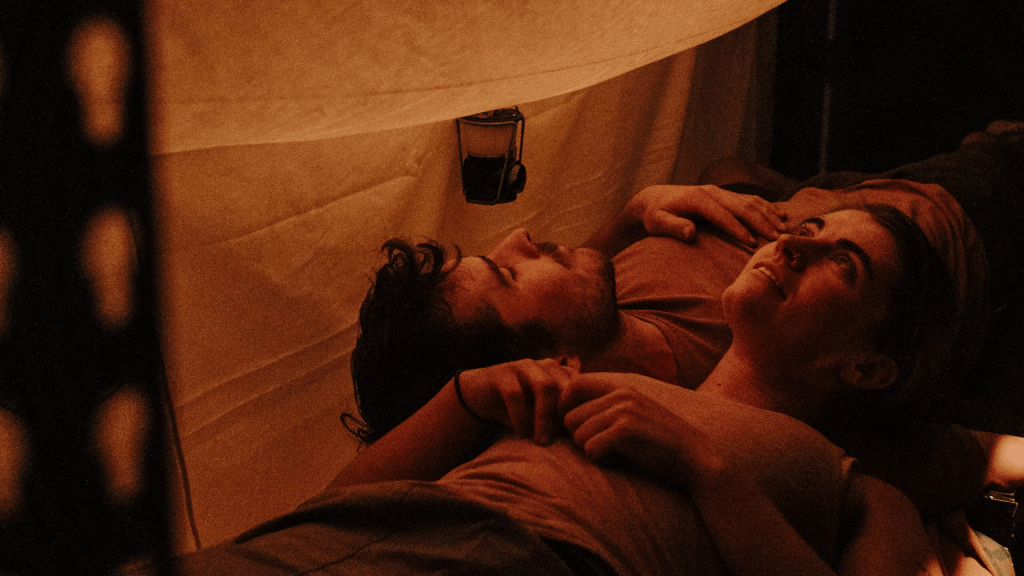
Connor Johnson as Rion, and Jessica Graham as Ari. (Photo courtesy of Footpath Theatre Co.)
The sound of an echo
The music changed as much as the script. The Fringe production had a live electronic score and one guitar. The Kingsbury version had a full set of songs, with a regional sound that fit the landscape. Lind gives much of the credit to guitarist Max Bastiani, who came back this year with four new songs. “He has this immense gift for songwriting,” Lind says. “When we approached him about being in the show again, he said, ‘Oh yeah, also I’ve written four new songs.’ And we said, ‘Well, you have to put these in the show.’” Bastiani also has a deep, rich voice that the company clearly loves.
Lind created the ambient score and synthesizer work underneath. He describes the two layers as serving different purposes. “The abstract ambient sound was a cushion that lifted the show up,” he says. “The written songs are what ground it. They give it its heart, and maybe some of its laughter.”
He also believes songs make audiences trust a show. “It’s very rare in your day that you listen to people sing a five-minute song,” he says. “But you hear people talking all the time. Even if the songs are non-narrative and don’t propel the story forward, they tell you something about the character and the relationships. It adds this richness.” It’s something Footpath wants to keep in future shows.
The score’s signature is an echoing whistle that connects the play’s timelines. It came from a correction. For the early versions, Lind tried to build a full desert soundscape, then realized on a later trip that the desert is mostly quiet. “There’s not a lot of insect sound, not a lot of animal sound, not even a lot of wind, like in a forest,” he says. “But when you’re in a canyon, you get these very small reflections of your own voice.”
“If there’s one other sound I could have added,” he says, “it’d be the very occasional plane way overhead.”
“When you’re in a canyon, you get these very small reflections of your own voice.”
— Harrison Lind
What’s next
The Kingsbury run will probably be the last in Salt Lake. “There are only so many times we can ask our friends and family to see the same play,” Johnson says, laughing. Their next local project, he says, will be something new.
For Western Minerals, the company hopes to tour, though Johnson admits they’re still figuring out how. He’s drawn to bringing the show to audiences with no direct connection to canyon country, while recognizing a case for performing it closer to home. A fourth version, if it happens, will likely be very different again. For Footpath, that’s the point.
About Footpath Theatre Company
Footpath Theatre Company was founded by Jessica Graham, Connor Johnson, and Harrison Lind. Its first production, The Wreck of the Queen Thomasina, premiered in Brooklyn in 2022 and played the Edinburgh Fringe in 2023. Learn more at footpaththeatreco.org.
Front Row Reviewers, “Footpath Theatre Company’s Western Minerals & Their Origins Unearths Memory, Myth, and the Music of Stone” by Jason and Alisha Hagey (July 6, 2025). https://frontrowreviewers.com/?p=26468
Front Row Reviewers, “Echoes in the Sandstone: Excavating Grief in Western Minerals & Their Origins” by Alisha Hagey (August 29, 2026). https://frontrowreviewers.com/?p=28096
The Rhetorical Review is built on the belief that local theatre, art, and storytelling deserve thoughtful, accessible, and independent coverage.
Every review, interview, and feature takes time, energy, and money to produce. Attending performances often means travel costs, parking fees, research time, and hours spent writing and editing with care.
Many local artists and productions do not receive the coverage or visibility they deserve, and The Rhetorical Review exists to help amplify those voices and preserve Utah’s artistic and cultural conversations.
Your support helps make this work possible. Even a $1 donation on Venmo helps sustain independent arts criticism and keeps this writing available to the community.
Keola received her undergraduate degrees from Brigham Young University of Hawai’i in English and music and then went on to study English literature at Weber State University for her master’s degree. She is currently pursuing her doctorate in Writing and Rhetoric Studies at the University of Utah.
Rhetorical Review is built on the belief that local theatre, art, and storytelling deserve thoughtful, accessible, and independent coverage.
Every review, interview, and feature takes time, energy, and money to produce. Attending performances often means travel costs, parking fees, research time, and hours spent writing and editing with care.
Many local artists and productions do not receive the coverage or visibility they deserve, and we exist to help amplify those voices and preserve artistic and cultural conversations.
Your support helps make this work possible. Even a $1 donation on Venmo helps sustain independent arts criticism and keeps this writing available to the community.






Leave a Reply