
Ogden, UT — Running through October 25, 2025, Ogden’s Ziegfeld Theater transforms into a temple of glitter, rebellion, and community. Beneath twin projection screens, a voice purrs through the speakers: “It’s just a jump to the left…” Half a century after The Rocky Horror Show first scandalized London, its corseted gospel of pleasure and defiance still pulses with electric, defiant life.
Conceived in 1973 by British actor, writer, and musician Richard O’Brien, who fused 1950s sci-fi nostalgia with the gender-bending energy of glam rock, the show began as an experiment in joyful transgression. O’Brien’s creation invited audiences to sing, shout, and cross boundaries long before “interactive theatre” became a buzzword.
Ziegfeld’s 2025 production revives that same radical invitation, not just to watch but to become. Part musical, part ritual, Rocky Horror continues to blur the line between audience and spectacle, turning participation into liberation. In Utah, that act of collective daring feels both risky and redemptive, a reminder that performance can still create sanctuary where conformity is the norm.

From London’s Fringe to Global Phenomenon
First staged in 1973 at London’s Royal Court Theatre (Upstairs), O’Brien’s The Rocky Horror Show fused sci-fi B-movie camp, glam rock, and gender subversion into a post-Stonewall theatrical fever dream. As Jackie Roach observes, its “storm-tossed exterior world and the warmth and safety of queer spaces inside the castle mirrored the lived tension of 1970s queer life, caught between repression and liberation” (Roach 4). That contrast between rain and revelation continues to animate modern stagings like Ziegfeld’s.
Developed while O’Brien was an out-of-work actor seeking creative refuge during London’s long winter, Rocky Horror emerged from the Royal Court’s experimental Upstairs stage, the same crucible that launched John Osborne’s Look Back in Anger two decades earlier. Directed by Jim Sharman and designed by Brian Thomson, with costumes by Sue Blane, the original production blended glam-rock theatricality, science-fiction parody, and erotic satire into a one-act underground sensation.
Within months, the show transferred to larger venues—first the Chelsea Classic Cinema, then the 500-seat King’s Road Theatre—running for more than 2,960 performances and earning the 1973 Evening Standard Award for Best Musical. When it reached Broadway in 1975, it closed after only forty-five performances, yet its DNA endured through the cult-film adaptation The Rocky Horror Picture Show (1975), now the longest-running release in cinema history.
O’Brien described his creative impulse as a desire to blend “B-movie absurdity with the unguarded sincerity of glam rock.” That alchemy, as the BBC noted on the show’s 50th anniversary in 2023, has made The Rocky Horror Show “one of the most performed and translated musicals in the world, staged in over twenty languages and seen by more than thirty million people globally.” From a 63-seat fringe theatre to a global queer phenomenon, each revival becomes a resurrection.

Film Legacy: From Screen to Stage
When The Rocky Horror Picture Show premiered in 1975, starring Tim Curry, it transformed camp into cult, bringing O’Brien’s transgressive stage vision to global audiences through the midnight movie circuit. What began as a fringe musical about “a sweet transvestite from Transsexual, Transylvania” evolved into a participatory ritual that invited fans to blur the line between screen and self. As Roach explains, the film’s “storm-tossed world of repression and release offered a blueprint for queer performance and community” (Roach 5).
Lines like “Give yourself over to absolute pleasure” and “Don’t dream it, be it” became queer manifestos disguised as B-movie fun—an invitation to embody defiance through joy. The Ziegfeld production channels that same energy, transforming cinematic chaos into live communion and proving that, even fifty years later, Rocky Horror still teaches its audience how to perform freedom.
(Sources: “The Rocky Horror Show,” Wikipedia, last updated 2025; BBC News, 50th Anniversary Coverage, 2023.)

Cult and Community: A History of Belonging
When The Rocky Horror Picture Show first became a cult phenomenon in the late 1970s, it offered refuge for a generation dislocated from both mainstream and counterculture. By 1980, The English Journal was already analyzing the phenomenon in U.S. classrooms. Teachers writing to the journal observed that the film attracted “disaffiliated, nonjoiners… those who at school are either invisible or labeled weirdos.” Its message, they noted, was deceptively simple but profoundly radical: “It’s OK to be different, it’s OK to feel good” (Tyson et al., Our Readers Write). What began as a midnight movie for misfits had already entered the American pedagogical imagination as a study in self-acceptance and creative resistance.
At Ziegfeld, that inclusive spirit still thrives. Each performance becomes a communal event, costumed audiences shouting callbacks, newcomers initiated with confetti and applause, and ASL-interpreted showings that expand access and affirm belonging. In a state where conformity often masquerades as civility, Ziegfeld’s Rocky Horror reminds audiences that joy itself can be an act of rebellion, and that participation can be pedagogy.
Nel Ward, another English Journal contributor, described the midnight audience as “a contemporary Greek chorus,” replacing passive viewing with embodied critique (Our Readers Write). That insight anticipates today’s performance ethos: in Ziegfeld’s hands, the “Time Warp” isn’t merely a dance number but a rehearsal of collective freedom, a theatre of participation rather than observation.

Myth, Ambivalence, and Liberation
Scholar John F. Knowlton once called The Rocky Horror Picture Show “religious-mythic,” a ritual of contradictions—creation and destruction, purity and desire, life and death (Our Readers Write). Those tensions pulse through Frank-N-Furter, whose audacious presence recalls what Jackie Roach identifies as the erased legacy of trans and drag activists after Stonewall (Roach 6).
Frank’s creation of Rocky and his destruction of Eddie replay a primal cycle: birth and banishment, the sacred and the profane. His seductions of both Brad and Janet—mirrored in gesture and tone—dissolve the rigid moral binaries that haunted the 1970s, transforming shame into spectacle, and spectacle into a form of truth. When Frank-N-Furter sings “I’m Going Home,” the moment lands not as defeat but as queer ascension—a reclamation of his earlier call to “give yourself over to absolute pleasure.”
Even moments that flirt with discomfort—like a fleeting fascist pose or the “They never proved nothink!” gag during Eddie’s Teddy—remind us how Rocky Horror once weaponized parody. In that scene, Dr. Scott is accused of being a secret Nazi, and the ensemble snaps into a synchronized “Ein, zwei, drei!” The gag originated in O’Brien’s send-up of postwar B-movie tropes, where mad scientists and Cold War villains often bore the residue of Nazi caricature. By turning menace into absurdity, O’Brien didn’t endorse fascism—he inverted it. The striped lab coat (modeled, as Seth Rogovoy notes, on Nazi prison uniforms) and the small pink triangle stitched to Frank’s chest both extend the satire, transforming symbols of persecution into emblems of camp defiance. The triangle, once used to mark queer prisoners in concentration camps, becomes an act of reclamation—a sign that tyranny itself can be mocked and undone through performance. Decades later, ACT UP would reclaim the pink triangle as the emblem of ‘Silence = Death’—a reminder that reclamation is never static.
The brief salute in Ziegfeld’s production—absent from O’Brien’s original staging—reflects a later tradition of interpretive exaggeration that heightens Rocky’s fascist parody through visual excess.

But in 2025, that irony no longer lands as safely. When the ensemble raised their left arms in salute, the person next to me audibly gasped—a visceral reminder that in an age of resurgent authoritarianism, parody can slip into unease. In 1975, gestures toward fascism mocked power’s absurdity. Today, with real salutes and incendiary rhetoric resurfacing at political rallies, the line between satire and reality feels perilously thin. The Ziegfeld salute doesn’t read as endorsement—but its impact has shifted. What once lampooned the impossibility of tyranny within queer space now brushes against the possibility of tyranny beyond it. As audience member Mitzi Ceballos aptly observed, “If a neo-Nazi can assume you are one of them, you aren’t denouncing them hard enough.”
Still, Rocky Horror has always thrived in contradiction, between liberation and danger, pleasure and panic. On the Ziegfeld stage, that ambivalence becomes its own kind of revelation. Frank becomes both martyr and maker, consumed by the very light he commands. It is the paradox at the heart of Rocky Horror: excess can reveal sincerity. In that unstable space—between myth and mockery, fear and freedom—liberation reveals itself, but only in flashes, never fully secure. And unless productions like Ziegfeld’s center the BIPOC queer actors who feel those flashes most viscerally, the moment risks becoming performance without politics.
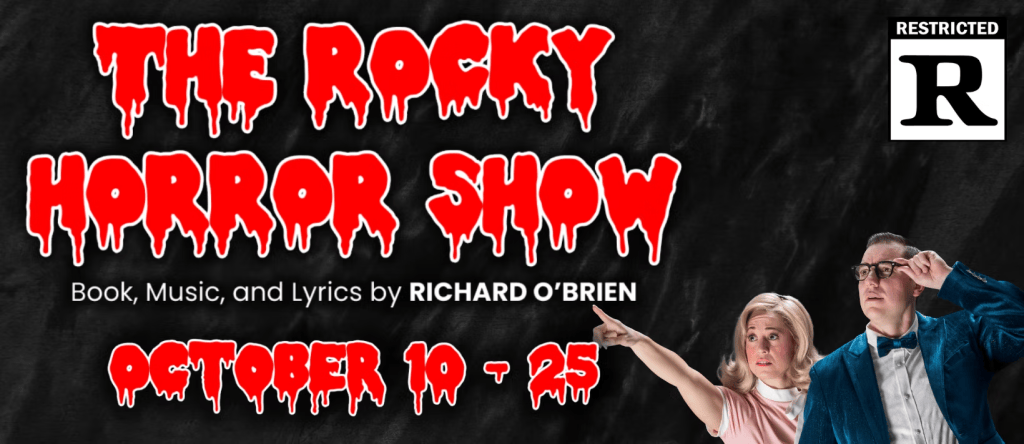
Ziegfeld’s staging of The Rocky Horror Show is not nostalgia—it’s the continuation of a queer ritual.
Utah’s Rocky Rebellion
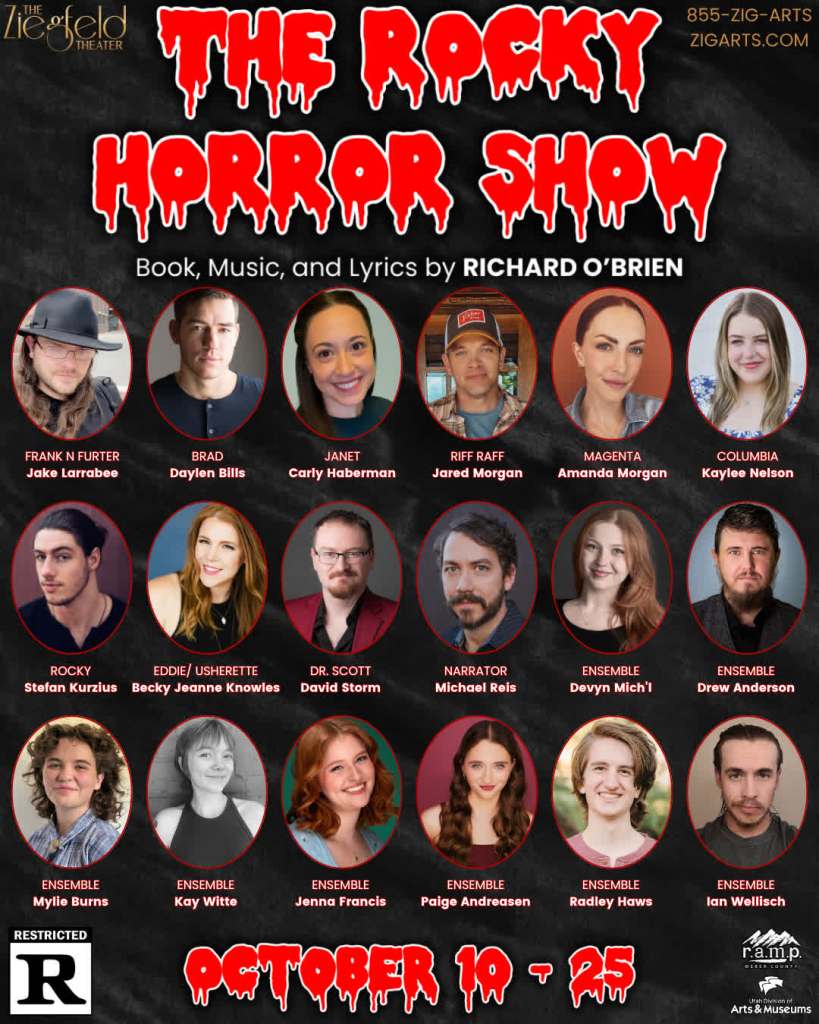
In a state where theatrical boldness is often tempered by caution, Ziegfeld’s Rocky Horror Show feels at once risky and relieving—an exhale of glitter after too much restraint. Jake Larrabee’s Frank-N-Furter blazes through sequins and smoke, equal parts seducer and showman, commanding the stage with gleeful precision.
Daylen Bills and Carly Haberman trace Brad and Janet’s comic-tragic awakening with quiet finesse, finding tenderness amid absurdity. Their voices fit the score perfectly, and for a community production, their control and emotional clarity are genuinely impressive—Ziegfeld is stepping it up with this show. When they reprise the spirit of “Dammit, Janet, I love you,” that straight-faced sincerity becomes its own punchline, an earnestness undone under Frank’s neon spell, played here for both comedy and catharsis.
Around them, Jared and Amanda Morgan (Riff Raff and Magenta) and Kaylee Nelson (Columbia) anchor the ensemble in gothic chaos, while Stefan Kurzius—a gleaming, unselfconscious Rocky, described in the program as “just a finance guy”—brings both physicality and charm to the role. Becky Jeanne Knowles opens the show with an explosive solo as the Usherette and later returns as Eddie for a mid-show number that showcases her powerhouse vocals to thrilling effect. Michael Reis, as the Narrator, is delightful—measured yet mischievous, grounding the spectacle with just the right dose of self-aware wit. By mid-show, audience and actors merge into a single, riotous organism—Ogden’s own shadow cast reborn, resurrecting a ritual that’s half satire, half communion.
Creative Team and Crew
Jennifer Westfall (Director & Costume Designer)
A veteran of over 200 productions across the western U.S., Westfall began her theatre journey more than thirty-five years ago. Her favorite past roles include Annie Sullivan in The Miracle Worker, Annabelle Glick in Lucky Stiff, the Baker’s Wife in Into the Woods, and Amanda in The Glass Menagerie. Over the last decade, she has expanded her creative range into costume design and direction for productions such as To Kill a Mockingbird (CenterPoint), The Music Man (OMT), The Odd Couple (The Terrace), and Young Frankenstein (Ziegfeld Theater). Westfall also writes and directs her own adaptation of Dracula, staged annually at Ogden’s historic Egyptian Theater every Halloween. As she reminds us, “It’s not easy having a good time.”
Sunny Simkins (Choreographer)
Simkins’ choreography pays gleeful homage to Rocky Horror’s gothic origins while giving it a distinctly Ziegfeld pulse. Each movement winks at O’Brien’s 1970s glam-rock roots, the sharp hips, the strut, the mock-ritual precision of the “Time Warp.” Her ensemble work fuses burlesque and parody with theatrical craft, transforming the stage into a gothic cabaret where desire becomes choreography.
Having choreographed productions across the Wasatch Front—Joseph and the Amazing Technicolor Dreamcoat, The Drowsy Chaperone, Jekyll & Hyde, and more—Simkins brings both discipline and decadence to Ogden’s creatures of the night. In her hands, Rocky Horror’s dance language feels newly alive: equal parts ritual, rebellion, and rock concert.
Matt Hewitt (Music Director)
Hewitt’s musical direction shapes the pulse of Ziegfeld’s Rocky Horror. His work brings clarity and drive to the glam-rock score, from the swaggering riffs of “Sweet Transvestite” to the ecstatic chaos of “Time Warp.”
Troy Martell (Projection Design)
Martell’s projection work turns the Ziegfeld stage into a living film reel. Vintage sci-fi clips shimmer across layered scrims and walls, bathing the cast in flickering nostalgia. The projections spill over the performers, blurring the line between stage and cinema, transforming nostalgia into critique, and projection into performance.
Josh Curtis (Stage Manager, Props & Sound Design)
Curtis sustains the show’s kinetic rhythm, turning mayhem into movement and sound. Chainsaws roar into a cloud of glitter, each cue landing like a wink—part chaos, part choreography.
Kyle Esposito (Lighting Design)
Esposito’s lighting sculpts the show’s mood between laboratory glare and cabaret glow, using color, fog, and shadow to amplify both tension and decadence. Sparks literally fly, and a laser show dazzles with rainbow precision—turning light itself into a kind of electric choreography.
Erica Choffel (Set Design, Dressing & Painting)
Choffel transforms the stage into a delirious fusion of Gothic decadence and sci-fi spectacle. Her centerpiece, the act two bed that conceals and reveals, anchoring the show’s most infamous scenes. And her sly humor shines through the painted female legs framing the staircase—a wickedly funny image of rebirth that turns the stage itself into part of the joke.
Byron Batista (Costume, Wig & Makeup Design)
A recent transplant from Los Angeles, Batista’s craftsmanship shines in the details: Rocky’s bright pink ruffled robe, a costume of pure exhibitionism, catches the light like a living provocation. The laboratory’s transparent aprons, flecked with paint and shimmer, turn the act of creation into performance—half science, half seduction.
Together, Westfall and Batista create a visual language that honors the show’s bawdy camp while celebrating its queer opulence. Every lace trim and glittered heel feels deliberate, grounding excess in purpose.
Behind Ziegfeld’s riotous spectacle is a creative team whose craftsmanship turns chaos into communion. Their work grounds the show’s decadence in intention—translating O’Brien’s subversive vision into something both playful and precise. From choreography to lighting, costume, and sound, each artistic choice contributes to a Utah production that honors Rocky Horror’s irreverent heart while expanding its accessibility and reach.
The Rocky Horror Show can only truly be lived in the flesh, with callbacks hurled like confetti, glitter suspended in the air, and the crowd shouting itself into being. Born of both film and theatre, it becomes not just a story to watch but a world to enter: a gleeful act of joyful disobedience.
Final Curtain
In 1980, critic Nicholas A. Salerno described The Rocky Horror Picture Show as “ultimately conservative,” arguing that its ending proved “unconventional behavior does not lead to happiness” (Our Readers Write). But time has rewritten that moral. What once looked like punishment for transgression now reads as endurance, the refusal to die quietly.
For modern queer audiences, Frank-N-Furter’s “failure” is his triumph, a defiant rejection of conformity that still reverberates fifty years later. As Jackie Roach observes, keeping Rocky Horror alive today is “a quiet act of defiance and continuity,” especially as anti-drag legislation threatens queer and trans visibility in performance spaces (Roach 7). When Frank croons “I’m going home,” it lands not as surrender but as fulfillment—a reclamation of his earlier command, “Give yourself over to absolute pleasure.” The Ziegfeld’s staging, then, is more than camp nostalgia, it’s resistance in sequins.
When the cast and crowd rise for the finale, the moment feels less like nostalgia than inheritance. Half a century after its debut, The Rocky Horror Show endures not only as kitsch but as a living archive, a ritual of difference that invites audiences to sing, to shiver, and to celebrate transformation.
Half a century later, audiences still echo Frank’s mantra: “Don’t dream it—be it.” It’s more than a lyric; it’s an ethic of survival.
At the Ziegfeld, that ritual becomes local liturgy. Each fishnet-clad step renews a lineage of queer resilience stretching from London’s Royal Court to Utah’s own stage. Here, theatre is no longer escape, it’s survival.
Works Cited
BBC News. “The Rocky Horror Show at 50: How a Camp Cult Hit Changed Theatre Forever.”
BBC, 2023.
Roach, Jackie. The Rocky Horror Picture Show’s Impact on Queer Communities in the 1970s. PDF uploaded 2025.
Tyson, Christy; Knowlton, John F.; Ward, Nel; Ward, Dan; and Salerno, Nicholas A. “Our Readers Write: What Is the Significance of The Rocky Horror Picture Show? Why Do Kids Keep Going to It?” The English Journal, vol. 69, no. 7, Oct. 1980, pp. 60–62.
National Council of Teachers of English. JSTOR.
“The Rocky Horror Show.” Wikipedia, Wikimedia Foundation, last modified 2025,
https://en.wikipedia.org/wiki/The_Rocky_Horror_Show.
Show Information: The Rocky Horror Show
Book, Music, and Lyrics by Richard O’Brien
Directed and Costumed by Jennifer Westfall
Choreography by Sunny Simkins
Music Direction by Matt Hewitt
Projection Design by Troy Martell
Lighting Design by Kyle Esposito
Set Design, Dressing & Painting by Erica Choffel
Costume, Wig & Makeup Design by Byron Batista
Production Management by Sydney McAlister
Presented by: The Ziegfeld Theater, Ogden, Utah
Run Dates: October 10 – 25, 2025
Venue: The Ziegfeld Theater, 3934 S. Washington Blvd, Ogden, UT
Tickets: zigarts.com/shows/rockyhorror
Cast Highlights:
- Jake Larrabee as Dr. Frank-N-Furter
- Daylen Bills as Brad
- Carly Haberman as Janet
- Jared Morgan as Riff Raff
- Amanda Morgan as Magenta
- Kaylee Nelson as Columbia
- Stefan Kurzius as Rocky
- Becky Jeanne Knowles as Eddie / Usherette
- Michael Reis as Narrator
- David Storm as Dr. Scott
Special Performances:
- Student Night: Saturday, October 11, 2025
- ASL-Interpreted Performance: Saturday, October 18, 2025
Showtimes:
- Evenings: 7:30 p.m. (seating begins at 7:00 p.m.)
- Matinees: 2:00 p.m. (seating begins at 1:30 p.m.)
Box Office:
🎟️ Tickets: Adults $26.95 | Seniors (65+) $24.95 | Children (15 and under) $24.95 | Students $10.00 — available at zigarts.com/shows/rockyhorror.
- Phone: 855-944-2787
- Hours:
- Monday, Tuesday & Thursday: 1:00–6:00 p.m.
- Friday & Saturday: 1:00–7:00 p.m.
Ticketing Policies:
- Tickets available online until one hour before showtime; remaining tickets sold at the door.
- Exchanges allowed up until ticketed performance time.
- All sales are final. No refunds.
Theater Policies:
- No outside food or drink permitted.
- No children under 3 or babes in arms.
- Rated R for adult themes, strong language, sexual content, flashing lights, and fog effects.
Presented by arrangement with Concord Theatricals. Audience participation kits encouraged—but please, no rice.
About the Playwright
Richard O’Brien, born in Cheltenham, England in 1942, is a writer, actor, and composer best known for creating The Rocky Horror Show (1973) and co-writing its film adaptation The Rocky Horror Picture Show (1975). A self-described “child of B-movies and rock ’n’ roll,” O’Brien fused his love of 1950s sci-fi, comic books, and glam rock into a musical that celebrated transgression, camp, and queer desire long before such themes were mainstream.
O’Brien’s collaboration with director Jim Sharman, designer Brian Thomson, and costume designer Sue Blane at London’s Royal Court Theatre (Upstairs) transformed a small experimental musical into a global phenomenon. Beyond Rocky Horror, O’Brien’s credits include Shock Treatment (1981), Disgracefully Yours (1985), and numerous stage and screen performances.
Openly gender-fluid, O’Brien has long described his identity as existing “somewhere in the middle,” a sentiment that echoes throughout his work’s play with performance, costume, and transformation. His enduring creation—part satire, part liberation ritual—continues to invite audiences to “give themselves over to absolute pleasure.”


Leave a Reply