

Salt Lake City, UT — On a storm-lashed night in 1954, six strangers assemble at Boddy Manor under threat of blackmail and exposure before the House Un-American Activities Committee. Each is handed a pseudonym and a weapon. The rules are simple. The stakes are not.
When Mr. Boddy collapses in the dark, suspicion detonates. Doors slam. Lights snap to black. A scream ricochets through the mansion, and then, almost immediately, another body falls.
At the Eccles Theater, where the national tour runs through February 15, 2026, Clue embraces what has kept the franchise alive for decades. The 2017 stage adaptation by Sandy Rustin is based not directly on the 1949 board game, but on the cult 1985 Paramount Pictures film written by Jonathan Lynn; a distinction that matters. What began as a parlor game became a cinematic farce, and only later a theatrical machine. Under the direction of Casey Hushion, the production makes clear that farce only works when it is engineered. The silliness isn’t random. It’s calibrated. The mystery establishes stakes, but the pleasure lies in watching how precisely the comedy locks into place.
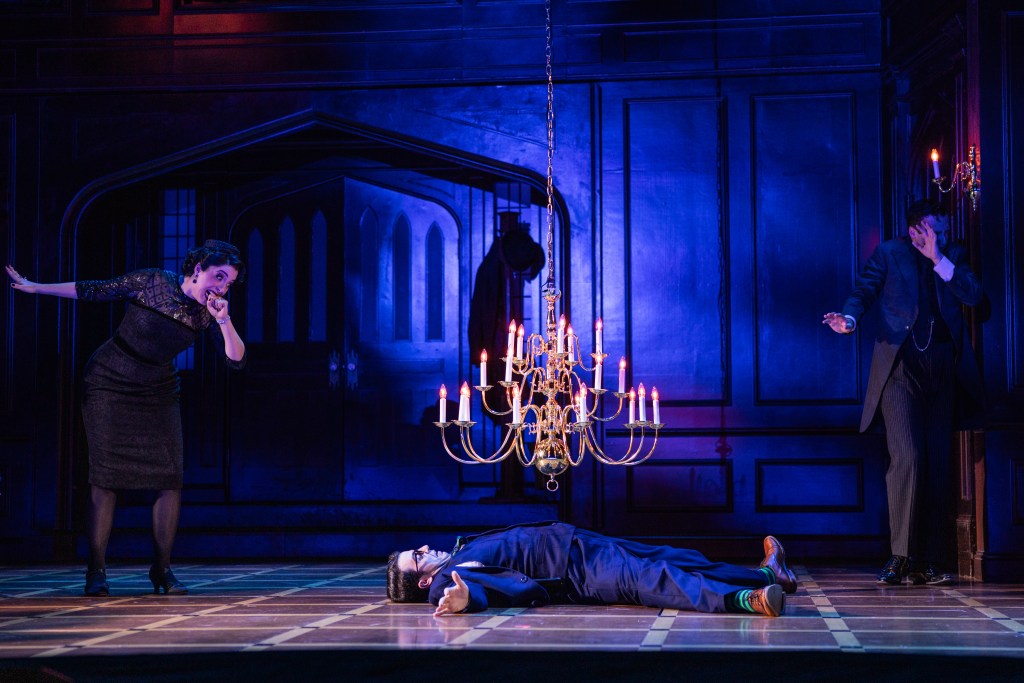
Film vs. Stage: Speed Reimagined
Any stage adaptation of Clue lives in the shadow of the 1985 Paramount film. The movie thrived on editing, split-second reaction shots, manic velocity, and Tim Curry’s elastic unpredictability. It felt loose, campy, barely contained.
The stage version cannot rely on montage. It relies on bodies in space.
What the film achieved through cuts and camera shifts, this tour achieves through spatial choreography. The humor is cleaner, more engineered. Some of the movie’s anarchic looseness gives way to mechanical precision, a necessary recalibration for live performance. The result feels less chaotic but more structurally impressive.
There is one moment when the production leans too literally into its premise. Midway through the chaos, characters pull out Clue-style paper checklists, the familiar grid of suspects, rooms, and weapons. The audience laughs in recognition, but the gesture feels slightly overdetermined. By that point, the structure is already evident. Farce works best when the rules hum beneath the surface rather than announcing themselves.
Still, it is a brief detour in an otherwise disciplined machine.

Touring Scale vs. Local Intimacy
For Utah audiences accustomed to local farce, where intimacy and improvisational warmth often drive the humor. this touring production operates differently. At the Eccles, comedy must project. Timing must hold across a cavernous auditorium. The laughter lands in waves rather than pockets.
Local productions often breathe with the room. This one runs like clockwork.
That distinction is not a flaw; it is the aesthetic. Clue arrives fully calibrated, city after city. The spectacle is part of the contract. Where smaller venues privilege proximity, touring farce privileges synchronization.

A Set That Performs
Lee Savage’s scenic design is astonishing. Sections of Boddy Manor rotate and swing outward, expanding from the entry hall into adjoining rooms with fluid precision. Doors multiply. Staircases conceal and reveal. Entire rooms glide into view. The mansion is not background — it is a performer.
At one point, the ensemble tiptoes in synchronized formation as walls revolve around them, a sequence so tightly timed it feels animated. Later, Mr. Green (TJ Lamando) nearly meets his end beneath a descending chandelier in exaggerated slow motion. These are not throwaway gags; they are feats of choreographic engineering.
Lighting designer Ryan O’Gara punctuates the action with razor-sharp blackouts and tonal shifts, turning each murder into a comic beat. Jeff Human’s sound design heightens the storm outside and the chaos within — thunderclaps, gunshots, and slammed doors landing with emphasis rather than menace. Jen Caprio’s costumes sharpen silhouette and status: Miss Scarlet’s controlled glamour, Mrs. Peacock’s operatic propriety, Mrs. White’s restrained severity. Michael Holland’s original music stitches transitions together, ensuring momentum never slackens.
Farce is fragile. One mistimed entrance can collapse the illusion. Here, the illusion holds — sustained by meticulous stage management from Jenna Wadleigh and Harrison Solenday.

Performances
At the center of the chaos is Adam Brett’s Wadsworth, and he is genuinely funny. Brett’s timing is razor-sharp, his physicality loose without being sloppy, and his escalating urgency keeps the audience locked in. Even at top speed, his joke lands. He doesn’t just move the plot forward—he makes the chaos delightful.
Zoie Tannous as Yvette matches that tempo with flirtatious precision, balancing heightened sensuality with exact timing. Sarah Mackenzie Baron’s Mrs. White (dressed in black) provides the counterweight; her dry, delayed delivery offering necessary oxygen between crescendos.
Camille Capers’ Miss Scarlet leans into controlled seduction. Madeline Raube’s Mrs. Peacock vibrates at operatic pitch, clutching pearls and indignation in equal measure. Nate Curlott’s Colonel Mustard wanders in perpetual confusion, while Kyle Yampiro’s Professor Plum toggles between intellectual pretense and panic with clean comic turns. Kebron Woodfin’s Cop attempts—briefly—to impose order before being swallowed by the machinery. AT Sanders’ Singing Telegram Girl delivers one of the evening’s most efficient and committed appearances.
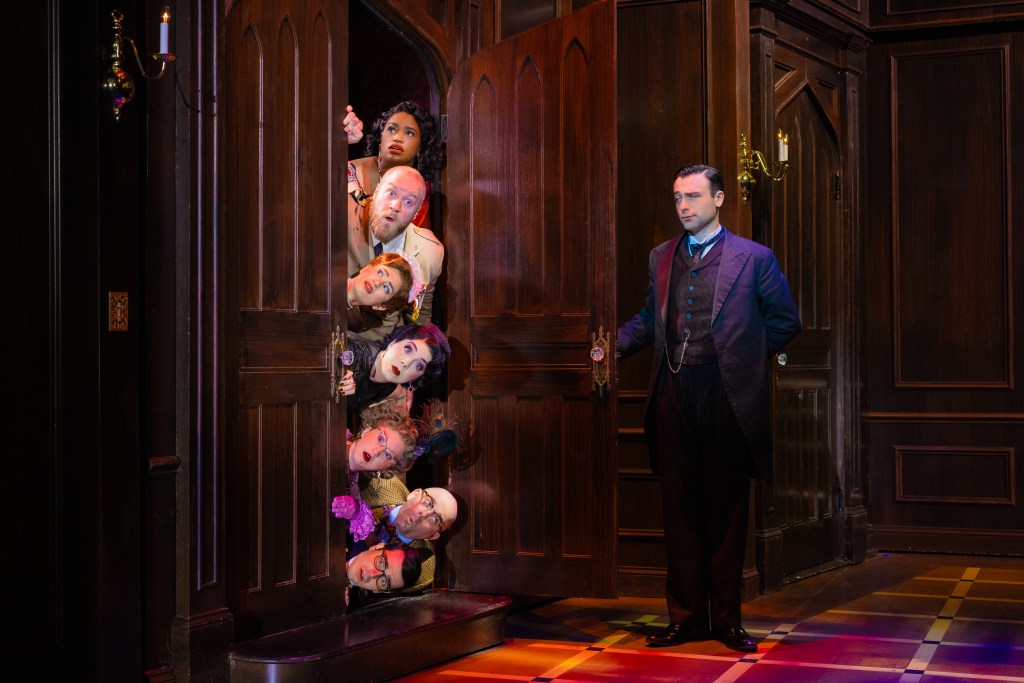
Is It Worth It?
A few patrons slipped out early, perhaps fatigued by the relentless tempo. Farce is not democratic; its velocity can overwhelm.
But the show is brisk—80 minutes, no intermission—and that economy works in its favor. It never stretches beyond its premise. When the set opens and the ensemble moves as one organism, the effect is exhilarating.
Is it worth it?
Yes, especially if you admire comedy that commits fully to structure as spectacle.
The bodies pile up. But the real achievement is how flawlessly they fall.
Show Info
Clue runs February 10–15, 2026 in Delta Hall at the Eccles Theater in Salt Lake City. The production runs approximately 1 hour and 20 minutes with no intermission and is recommended for ages 12 and up. Advisory: the show includes smoke, haze, and gunshot sound effects.
Tickets are available at Broadway-at-the-Eccles.com or by calling 801-355-ARTS (2787). Student Rush tickets are available for every performance with a valid student ID. Ticket limits apply.
Accessible performances include ASL interpretation (Feb. 12 at 7 PM), Audio Description (Feb. 13 at 7:30 PM), and Captioning (Feb. 14 at 1 PM).
About the Playwright
Sandy Rustin is one of the most produced playwrights in America, according to American Theatre magazine. She made her Broadway debut with her comedy The Cottage. Her newest play, The Suffragette’s Murder, is a winner of the Edgerton Foundation New Play Award and Denver Center Theatre Company’s Women’s Voices Fund.
Her musical adaptation of the film Mystic Pizza was most recently seen at Paper Mill Playhouse (cast album available), and her new original musical Always Something There premiered in Chicago last summer. Her adaptation of Dear World for New York City Center was a New York Times Critic’s Pick, and her play with music, Houston, is currently in development with Grammy winner Edie Brickell.
Rustin has also written for Disney, ST Entertainment, Primary Wave Music, and Mattel. Other works include Loch Ness, Rated P…For Parenthood, Elijah, Struck, and more. A graduate of Northwestern University, she serves on the board of Project Write Now and the advisory board of The Bridge.


Leave a Reply