
Reviews like this take 10+ hours to research and write. If this one was useful, even $1 helps. Support Rhetorical Review.
Salt Lake City, UT—Samuel D. Hunter’s A Case for the Existence of God is a deeply intimate and emotionally resonant exploration of human connection, financial struggle, and existential yearning that ultimately asks, “How do we find space to hope, and still be grounded, realistic and honest about what’s going on in the world?” The show originally premiered at the Signature Theatre in New York City in 2022 and exemplifies Hunter’s signature approach—deeply empathetic storytelling grounded in the realities of working-class America, particularly his home state of Idaho.
With its Utah premiere at Pioneer Theatre Company (PTC), this production offers local audiences a chance to experience Hunter’s distinctive blend of naturalism and emotional depth at the newly established Meldrum Theatre. The play’s intimate storytelling and nuanced portrayal of economic precarity and fatherhood provide a unique opportunity for Utah theatergoers to engage with a work that elevates a simple encounter into a profound meditation on contemporary life.
Plot
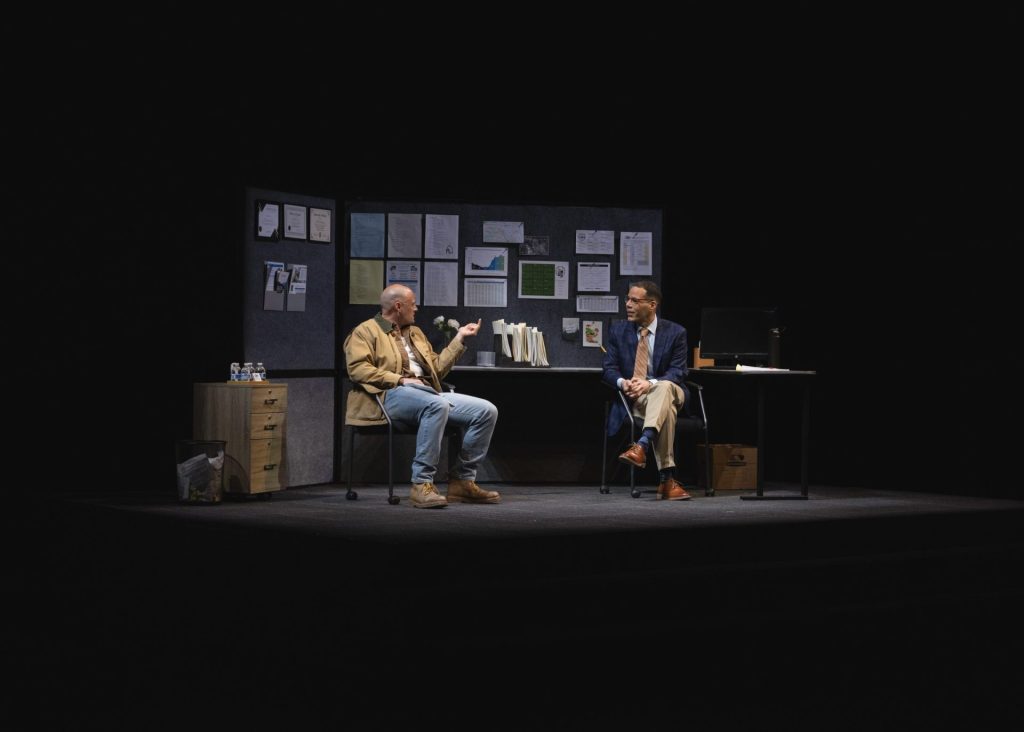
Set in the confined walls of a mortgage broker’s office, the play follows Keith (Jon Hudson Odom), a Black, middle-class loan officer, and Ryan (Lee Osorio), a working-class single father employed at a yogurt plant. What begins as a routine financial consultation quickly evolves into a deeply personal exchange, as their discussion shifts from homeownership and financial insecurity to fatherhood, loss, and the universal search for stability in an unpredictable world.
The play asks, “How do we find space to hope, and still be grounded, realistic and honest about what’s going on in the world?”
The cramped office space mirrors their emotional entrapment, reinforcing themes of isolation and resilience. Despite their differing social positions, both men grapple with systemic barriers—Ryan’s hopes rest on a piece of land that once belonged to his family, threatened by economic forces beyond his control, while Keith, despite his financial security, navigates the challenges of being a queer Black man in a world that often denies him full belonging.
Hunter’s ability to craft small, contained stories with immense emotional weight is evident here. With just two characters, the play explores expansive, universal themes, turning a transactional meeting into a profound meditation on contemporary existence.
Playwright and Context
This work marks a shift in Hunter’s artistic trajectory. Having written larger-scale productions in previous years, A Case for the Existence of God reflects his desire to “hit the reset button” and return to essential storytelling—a play that, in his words, “could be produced with full integrity in someone’s kitchen.” This minimalism strengthens the play’s emotional intensity, allowing the dialogue and performance to take center stage without distraction.
Hunter’s ability to craft small, contained stories with immense emotional weight is evident here.
Hunter, a MacArthur “Genius” Grant recipient, has built a career on portraying the struggles and quiet dignity of everyday people. His most famous works, including The Whale (2012), A Bright New Boise (2010), and Lewiston/Clarkston (2018), often grapple with faith, economic hardship, and the search for meaning in overlooked corners of America. His Idahoan roots are central to his storytelling, creating a fictional yet deeply authentic map of rural life that resonates beyond its geographic specificity. A Case for the Existence of God is no different—it may be set in Twin Falls, Idaho, but its themes of longing, disappointment, and unexpected human connection speak to something universally felt.
My favorite quote of the show came in probably the first five minutes. Keith is in the middle of explaining the fundamentals of his business when he gets a phone call that triggers a panic attack, and when he finally catches his breath he says:
Keith: Look, you’re not the first person to realize that the financial system is convoluted. Most of us realize that in college. But you either play by the rules and pretend it all means something, or you don’t get anything. That’s most of what being an adult is. And you just hope that everyone else agrees to keep playing by the rules long enough so you have time to grow old and die.
(Pause)
RYAN: I think I’d like to work with you.
With direction by Timothy Douglas, the Pioneer Theatre Company’s production of A Case for the Existence of God brings this profound, minimalist drama to Utah audiences, inviting them into Hunter’s quiet yet emotionally expansive world. The play reminds us that, despite life’s uncertainties and struggles, moments of understanding and connection can still emerge in the most unexpected places.
Director Timothy Douglas brings a delicate yet powerful touch to the production.

Performances and Direction
Jon Hudson Odom and Lee Osorio, both making their PTC debuts, deliver nuanced and deeply moving performances. Odom’s portrayal of Keith is layered with quiet restraint and emotional complexity, allowing the audience to witness a man who has learned to navigate the world with composure yet harbors deep insecurities. Osorio, known for his work in True Detective and Your Honor, brings a raw, heart-wrenching sincerity to Ryan, embodying the desperation and tenderness of a father fighting for stability. Their chemistry is electric, transforming the mundane setting into a space of profound revelation.
Jon Hudson Odom and Lee Osorio’s chemistry is electric, transforming the mundane setting into a space of profound revelation.
Director Timothy Douglas, a veteran of PTC (Native Gardens, Clybourne Park, Fences), brings a delicate yet powerful touch to the production. His direction emphasizes the play’s quiet intensity, allowing moments of silence to carry as much weight as the dialogue. By keeping the action confined to a single space, Douglas magnifies the play’s themes of entrapment—both societal and personal—while also showcasing the unexpected ways human connection can transcend such constraints.

Design and Staging
Lex Liang’s scenic and costume design reinforces the stark realism of the play, with Keith’s sterile office space acting as both a literal and metaphorical backdrop for the characters’ struggles. The use of minimal props and strategic lighting by Yael Lubetzky creates an atmosphere that shifts subtly with the play’s emotional beats. Matt Mitchell’s sound design enhances the production’s immersive quality, with ambient noise and carefully placed moments of silence amplifying the tension and intimacy of the characters’ exchanges.
The title, A Case for the Existence of God, is deliberately provocative, suggesting a theological or philosophical debate that the play never directly engages with. Instead, Hunter’s work offers something more subtle: an argument for the existence of humanity, connection, and love in a world filled with uncertainty and suffering.
‘You either play by the rules and pretend it all means something, or you don’t get anything. That’s most of what being an adult is.’
~Keith~
Is this a Play about God and Theology?
Though the play never explicitly discusses God, its title invites the audience to consider where meaning and divinity might reside—not in religious doctrine, but in human relationships and acts of care. The characters, Keith and Ryan, grapple with financial hardship, fatherhood, and personal insecurities, yet they persist, offering one another kindness and understanding in a seemingly indifferent world. In this way, the play suggests that the proof of something greater—whether we call it “God” or simply the endurance of hope and love—lies in the stubborn resilience of human beings to keep moving forward, to care, and to try.
In an interview with the playwright, Hunter said,
The play’s title can be read as ironic, hopeful, or even a quiet challenge: What if the evidence for God isn’t found in religious institutions or grand theological arguments, but rather in the small, intimate moments of human connection? Perhaps friendship, love, and persistence in the face of despair are divine in their own way. By the end of the play, the audience is left with something deeply spiritual—not in the form of faith in a deity, but in the enduring belief that people can save each other, even in their darkest moments.

Friendship as Salvation
One of the most striking aspects of the play is its portrayal of male friendship as a source of salvation. Theatre and media often frame male relationships around competition or conflict, yet Hunter presents a more nuanced vision: two men finding solace and strength in one another. In an interview with Hunter in 2024, he said,
Something that really bothers me about depictions of male relationships in our media is that we have an expectation that they are either going to punch each other or have sex. And I think that’s a real disservice to young men, teaching them that any kind of platonic male love is impossible. It’s a real reflection of the kind of toxic masculinity that is still so, so predominant in our culture.
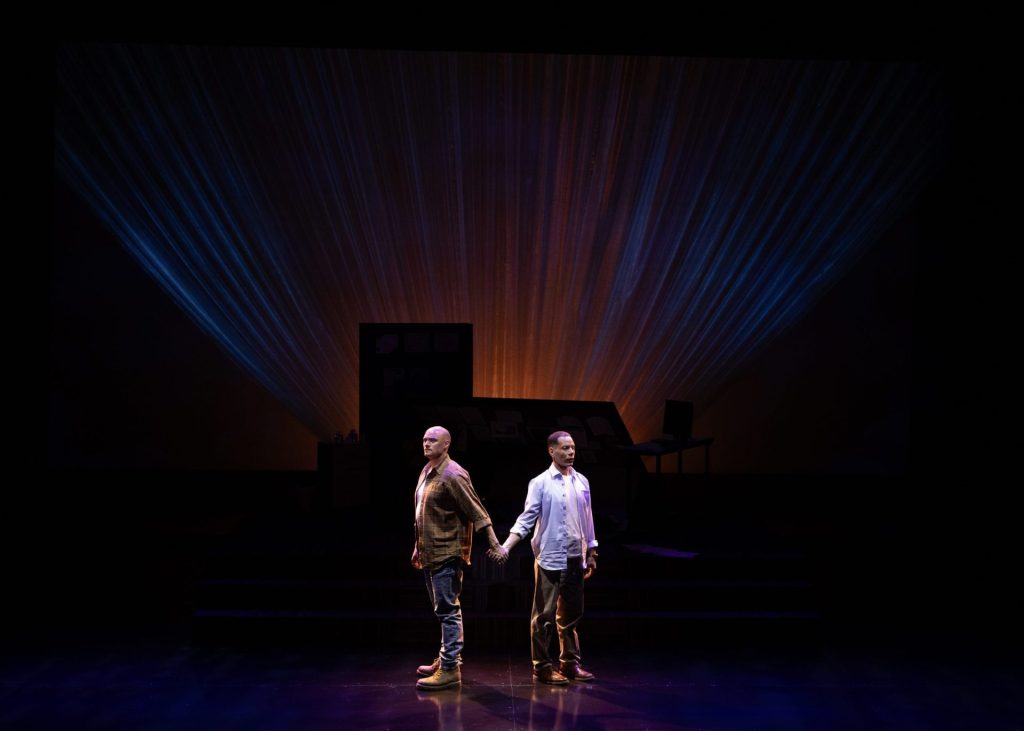
Ryan and Keith, despite their different racial, economic, and sexual identities, form a bond that is rare in its tenderness and honesty. As Dr. Emily Garside notes in ThoughtfulTheatreReviews, this friendship is central to the play’s emotional weight—it does not reduce men to stoicism but instead allows them vulnerability and intimacy, challenging traditional narratives of masculinity.
Critique: A Masterpiece of Quiet Power
What sets A Case for the Existence of God apart is its commitment to authenticity. The play refuses to offer easy resolutions, instead allowing the audience to sit in the discomfort of uncertainty—mirroring the very experience of its characters. Hunter’s writing is at its best when it captures the fragility of human connection, and this production does full justice to that vision.
If there is any critique to be made, it lies in the play’s conclusion. The shift from stark realism to a more abstract resolution may not resonate with all viewers. Some may find it a necessary emotional release, while others might feel it slightly undercuts the grounded nature of the preceding narrative. However, this is a minor quibble in an otherwise masterfully executed production.
The play’s intimate storytelling and nuanced portrayal of economic precarity and fatherhood provide a unique opportunity for Utah theatergoers.
Final Thoughts
Pioneer Theatre Company’s production of A Case for the Existence of God is a triumph. With two powerhouse performances, meticulous direction, and a script that lingers long after the final scene, this is a play that demands to be seen. It is not just a meditation on faith, but a testament to the enduring power of human resilience and empathy. For Utah audiences, the Utah premiere is an opportunity to witness one of America’s most profound contemporary playwrights at his best, in a production that I believe stands on par with the original premiere.
Tickets for A Case for the Existence of God are available through PioneerTheatre.org or by calling the box office at 801-581-6961. The production runs March 28 – April 12, 2025, with a special “pay what you can” performance on March 31.
Venue: Pioneer Theatre Company – Utah Premiere
Meldrum Theatre at the Einar Nielsen Field House
Directions: Here
Dates: March 28 – April 12, 2025March 28 – April 12, 2025
Contact: 801-581-6961
Tickets: Here $44 – $57 in advance; $5 more when purchased on day of show. Students K – 12 or ages 5-18 are half-price Monday – Thursday
Curtain Call for All (“pay what you can”) performance: Monday, March 31 at 7:00 PM
Accessibility: ASL-Interpreted performance, Monday, April 7 at 7:00 PM
Content Advisory
Study Guide: Here

Please Note:
The age-based guidance below is intended as a recommendation only. Pioneer Theatre Company encourages you to use your judgment based on your own research of the show, your own sensibilities, and a child’s age and maturity level.
Also, in accordance with theatrical licensing agreements, Pioneer Theatre Company presents each production as originally written and intended by its author(s). If you are concerned with any content beyond what is provided below, a copy of each production script is available for in-person perusal during PTC’s regular Box Office hours.
Contains strong adult language and some alcohol use. Recommended for ages 13 and up.


Leave a Reply