

A grandmother, a tornado, and a Borges story, dreamed up on a floating clod of dirt.
A note before you start: this review discusses the structure and late turns of Sugar Mud in some detail. Great Salt Lake Fringe has wrapped for the year, but if you’re planning to catch Beasley’s show somewhere else you may want to hold off until after.
SALT LAKE CITY, UT. Sugar Mud, the solo clown show from Los Angeles-based performer M. Beasley (who works under the name Meat Bar), closed out its run at the Alliance Theatre Blackbox this past weekend as part of the Great Salt Lake Fringe Festival, following its 2025 premiere at Hollywood Fringe. It is, by its own billing, a surreal clownshow, and it earns the word “surreal” honestly: logic here works the way it works in a dream, or in a tornado’s eye, where a grandmother, a Bible story, a divorce hearing, and a pile of rocks can all occupy the same square foot of stage without anyone stopping to explain how they got there. Beasley’s own promotional copy calls it “absurdly stupid,” and I won’t argue the point on their behalf. Underneath that self-description, though, is one of the more genuinely rigorous pieces of devised solo performance I’ve seen come through a Fringe stage in a while, a piece that uses the form of a grandmother’s ramble to smuggle in an argument about who gets to tell a family’s story, and what happens to the people written out of the telling.
I should say up front that Sugar Mud wasn’t originally on my docket this year. I’d already lined up at least twelve shows to cover at Great Salt Lake Fringe before I’d even heard the title. But the buzz around it kept surfacing anyway, enough times that I added it in late, and I’m glad I did. It’s funny and not funny at the same time, which I’ve come to think is what humor often actually is. Comedy is one of the roadways many artists prefer to make a real statement onstage because it doesn’t announce itself as a demand, so it slips past your guard. Sugar Mud pulls that off well, and more consistently than most solo Fringe work manages across a full runtime.

Broadly, the show moves like this: an entrance under a quilt that sets the tone before a word is spoken; an opening set of “rules” that conscripts the audience before they know who they are in the story; a run of granny material, tornado, Dust Bowl, the gay-little-girl-shit bit, that builds out the family mythology through direct address; a swerve into Genesis, with Leah narrating her own betrothal and betrayal as if it were gossip; a back half that drops the jokes almost entirely for a letter and a looping divorce-court recording; and a return, at the very end, to the semicircle of rocks the show opened with, now answered rather than just posed. It’s worth holding that shape in mind, because the show’s real argument lives less in any single bit than in how deliberately it returns to where it started.
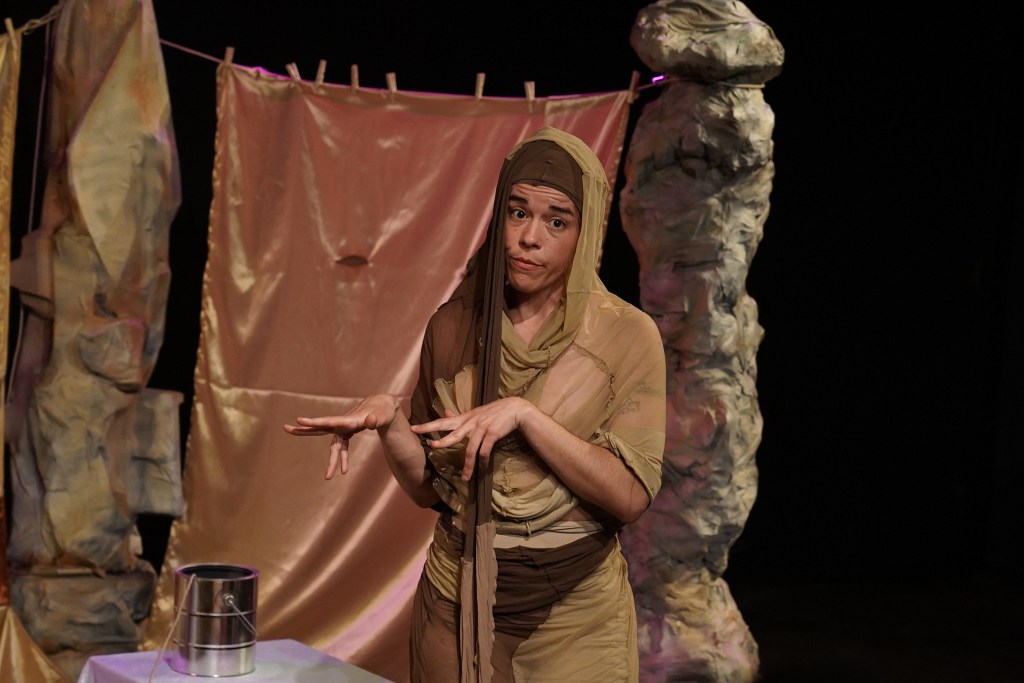
The entrance alone tells you what register you’re in. Beasley comes on with an old, patchwork quilt draped over their head (the kind of thing that looks less like a family heirloom and more like something scored off a shelf at DI, secondhand history standing in for the real thing), pulling a flute apart into its two halves and talking into the bottom piece like a makeshift microphone. The sound coming out from underneath it is wet, guttural, faintly gross, less a human voice than something you’d expect out of a Star Wars creature feature. The set is just as odd before a word is spoken: ordinary blankets hanging loosely across the back of the stage, while others, a few with recognizable Mormon temple symbols, are hung instead, arranged with an unmistakable echo of the veiled entrance into a an LDS temple’s celestial room. Rocks are set up around it all with real deliberateness, in a semicircle, lighting pitched somewhere between campfire and interrogation. Beasley’s own look underneath the quilt doesn’t resolve the strangeness so much as extend it: a pair of tights pulled over the head, flattening and distorting the face before anything else registers, under costuming that reads as scavenged rather than styled. Nothing about it asks to be taken as a coherent “outfit” so much as a pile of signifiers (grandmother, farmhand, something older and stranger than either, something not quite human) worn all at once. As one audience member put it in the show’s own promotional materials, it’s “an inventive, beautiful mix of sacred and profane,” and that mix is built directly into the set dressing, not just the tone.

The tights are worth lingering on a beat longer than a first glance suggests, and not just as a stock clown-mask device. Nylons were, for generations, a mandatory piece of women’s dress: something worn under a skirt as a matter of modesty rather than choice, in Mormon culture especially, where hemlines and coverage carried real moral weight. Stretched over the face instead of the legs, that same garment stops signaling propriety and starts erasing the particulars it was supposedly protecting: brow, jaw, the shape of a mouth, all flattened into something generic and faintly unsettling. It’s a sharp piece of costume logic, taking an object whose entire cultural job was making women look a certain “appropriate” way and using it instead to make a woman (or someone who reads as one) look like nothing recognizable at all. And the face isn’t the only place the tights turn up. They’re hung right alongside the temple-symbol quilts and blankets that frame the celestial-room-style entrance, folded into the same visual family as sacred fabric rather than kept separate from it, and Beasley keeps inventing other wrong uses for them across the runtime: never once worn the “correct” way, on legs, under a skirt, doing the modest job they were manufactured for. That refusal is the real trick. It’s not just defacement; it’s reclamation, taking an object designed to keep women looking a specific, sanctioned way and insisting, over and over, that it can be literally anything else instead. In a piece this interested in how identity gets assigned rather than declared (Granny’s gayness read backward out of a tornado, Leah’s reputation decided in advance by “the town book,” a grandfather who took one look at a girl in a yard and renamed her Billy), that’s the clearest visual argument the show makes without a single line of dialogue: nobody here gets to just look like who they are, least of all according to the rules that garment was built to enforce, so the production simply refuses to let it do its assigned job even once.
Dreaming It Up
Beasley’s own program notes list an unlikely set of source materials: their grandmother, born in 1908, who was picked up by a tornado in 1920; Jorge Luis Borges, born in 1899, and his 1940 short story “The Circular Ruins”; an eternal marriage curdling into an eternal divorce; a redacted Mormon temple name; and, simply, rocks. It’s worth taking that list at face value, because Sugar Mud does.
“The Circular Ruins” is about a man who arrives at a ruined temple and spends years dreaming another man into existence, cell by cell, only to discover, in the story’s famous last line, that he himself is being dreamed by someone else. It’s a story about creation understood as an act of telling, nested infinitely, where nobody involved actually knows if they’re the dreamer or the dreamed. Beasley met Borges’ writing during a Latin American studies capstone at Brigham Young University, which, per Deseret News and BYU Studies, Borges visited twice late in life and was set to return to for a teaching seminar before he died in 1986, reportedly drawn in part by curiosity about why Mark Twain disliked Mormons. That detail is funny on its own, but it also hands you the show’s whole method: Sugar Mud is a Borges story wearing a housedress. The granny character isn’t just telling stories to pass the time. She is, like Borges’ dreamer, actively dreaming her grandchildren into being, assigning them nicknames, roles, birth-order grievances, a place in a family mythology, and the piece never lets you forget that being dreamed into a story is not the same as being asked what story you wanted.
The Dust Bowl material does similar double duty. Granny’s 1920 tornado predates the Dust Bowl proper by close to a decade, but the show doesn’t bother much with strict chronology, treating the Dust Bowl instead as an origin myth for a certain kind of American self-mythology: hardship transmuted, generation over generation, into a personality trait. “Not like me. I come from dust bowl people,” Beasley tells us early on, speaking as themselves rather than in character. “We’re dirty people… but we can live through anything.” Live long enough, to 100, and the President sends you a letter, Beasley tells us next, dragging the whole idea out with a long, drawn-out “chug, chug, chug, chug,” time itself rendered as a train you’re riding through rather than something simply passing over you. It’s the kind of story a family tells about itself to make deprivation sound like character.
The show’s single sharpest line follows close behind, and it’s built like a joke with the setup stretched out for maximum effect. “I know my granny was gay,” Beasley tells us, and then spends a beat ruling out every reason you’d expect: it’s not because anything was ever legally changed; it’s not because, when Granny was a little girl, her own grandfather saw her out in the yard and declared “no, girl, that’s a boy,” and started calling her Billy from then on; it’s not even because of a particular song Granny loved. It’s because Granny got sucked up into a tornado. “That is gay little girl shit,” Beasley explains, deadpan. “Straight little girls don’t do that.” It got some of the loudest laughs I’ve heard at a Fringe show all year, the kind that takes a second to fully land before it detonates, and it’s also a completely serious claim about how queerness travels through a family that never lets anyone say the word out loud directly: every plausible, nameable reason gets waved off in favor of the one piece of “evidence” that was never actually about identity at all. Nobody in this story ever comes out. Somebody just gets picked up by a storm, and a grandchild decides, decades later, that’s proof enough.

The Rules, and the Family You’re Drafted Into
The show opens by conscripting its audience. You’re handed rules: keep the gate shut, be nice to your sister, don’t let the family wrench “roam,” before you’ve been given a single piece of context about who you are in this world. That’s the point. Before Beasley tells you anything about themselves, they tell you what you owe them, and the piece is quietly upfront about how families actually work: obligation arrives before biography. “You want to be my little postulants, jumping up into my tornado,” they tell us, somewhere in the first few minutes, which is as close as the show comes to stating its own premise out loud. A few beats later they’re pulling out cough drops: “oh, you’re dozing on my cough drops, take one, that’s enough,” the kind of stray, over-familiar logic that lands as pure texture the first time and starts to look like control the third or fourth time it recurs. The impulse peaks in the “equidistant materials” bit, a mock-serious attempt to arrange rocks “equidistant from a center source” while “equally in relationship to the historicity” of one another, an impossible task dressed as a solvable one and handed to the audience like an inheritance, because that’s what family does with impossible tasks: distributes them.
The best example of that slow accumulation is a small device Beasley returns to constantly and never explains: a stuffed dog, collared and leashed, that Beasley keeps asking the audience to name. Every time they come back to it, the dog has a different name. Babette one round, Ozzy the next, at one point simply “Dog,” as though the show had run out of patience with its own bit and decided the joke was funnier flat. Nobody remarks on the inconsistency; Beasley asks with the same total sincerity each time, as though this were the first time the question had ever come up. It’s an almost throwaway bit, and maybe the single smartest piece of writing in the show: a running joke that doubles as the show’s own thesis on memory and family narrative, condensed. The story changes every time it’s told, and everyone involved has agreed, tacitly, not to notice.
Beasley’s affection is just as physical as their control is verbal. At one point they produce a jar of something that looks like chocolate, sugar, they call it, and work their way down the front row planting big kisses on cheeks, cooing over each “grandkid” by name, then offer each person they’ve just kissed a chance to wipe their cheek clean. It’s warm, and a little too much, in the specific way an overbearing relative is warm and a little too much: you don’t get to opt out of the affection any more than you got to opt out of the rules at the top of the show. That equation, love and obligation arriving in the same gesture, sugar and control poured from the same jar, keeps resurfacing across the night. It’s the same logic behind a smaller aside earlier on.
Beasly’s Granny got a job at a candy shop during the Depression, everyone wanted it, and she couldn’t keep it, because she kept eating the candy. Even the failures get told as evidence of appetite rather than as anything to apologize for. The family material and Biblical material keep turning out to be the same story in different decades. Granny hands down the family vinegar pie recipe, except “hand down” isn’t quite right, since there’s nothing to hold onto. She writes it out in the dirt with her own toe, a recipe delivered in a medium built to be erased by the next gust of wind or the next audience member’s footstep. It’s a sharp joke about oral history generally: the show’s own press materials list “oral histories” among its explicit subjects, and here the mechanism is laid bare: a recipe for something sweet, made of nothing but sugar and vinegar in escalating cups, transmitted in a form that guarantees it will need to be told again, by someone, to someone, before it’s lost for good. The rocks in this show last. The recipe, on purpose, does not.

Leah at the Well
The show’s clearest set piece is a retelling of Genesis 29: Leah, whom the town book credits with “lovely eyes,” a backhanded update on the Bible’s own divided verdict of “weak” or “tender,” older sister to Rachel, narrating her own story to strangers “from afar” while roping one of them into an impromptu sheep-showing competition. Beasley voices her in a bright, sing-song register that lands closer to a schoolgirl gossiping at recess than to a biblical matriarch, which does a lot on its own without a word of explanation: betrothal, birthright theft, and forced marriage all narrated in the cadence of a kid who can’t wait to tell you what happened at lunch. Leah never calls her scripture by its name; she calls it “the town book,” a plain enough stand-in for the Book of Mormon: a record kept by elders, about a people, that decides in advance what gets written down about a girl and what doesn’t. It’s the same anxiety Leah voices about her own reputation (“thank God no one’s going to read it,” she says, almost to reassure herself) pushed back a few thousand years and given a scriptural cover story. Leah turns her own betrayal (her father Laban will trick a bridegroom into marrying the wrong sister, in the dark, with no take-backs) into stand-up material. “Jacob’s so dumb. I wish you could meet him,” she says, with real affection buried somewhere under the insult, before launching into bits about his incompetence at lambing and a runbit about his mother Rebecca’s scheme to steal a birthright with a sheep hide.* She never once says the word trafficked. She doesn’t have to. The audience is trusted to clock that she’s doing comedy because the alternative, sitting with what actually happened to her, is unbearable, and that the sheep-show bit, ridiculous as it is, is also the one moment in the story where Leah gets to be an expert at something on her own terms, rather than a bargaining chip in someone else’s plan.
Before the sheep show itself even starts, Leah recruits a different audience member for the setup: someone from the crowd has to make the sheep sounds, so the “flock” can be located and driven back through the open gate. It’s a small piece of stagecraft, but it means the audience doesn’t just watch the sheep-showing bit: they have to help conjure the animals into existence first, bleating on command before anyone gets dressed up or judged. Authorship, again, handed off and demanded in the same breath.
“I caught my own placenta,” Leah announces at one point, with the flat pride of someone reciting a real credential, and the line only works because it sounds like one; Beasley’s bio backs it up, noting a rural Sacramento Valley education that specialized in animal husbandry and domestic sheep. It isn’t a bit built from research. It’s a bit built from labor Beasley actually knows in their hands, which is exactly why it lands with the confidence it does.
There’s also a running physical bit worth a mention: an inflatable cow gets batted around the audience for the entire runtime, pure crowd-work chaos with no fixed script. During the Leah sequence it finally does what an unpredictable prop is always threatening to do, coming down on the jar Granny had used earlier for kisses and knocking it over mid-scene. Beasley doesn’t break. Without missing a beat, Leah folds it into the bit already in progress: “one of the sheep had an accident,” about as concise a summary of the show’s whole register as exists in ninety minutes of material.
Rock Bottoms
Then, before the show turns to its actual ending, it sets its own comic engine down entirely for one last vulnerable turn. Beasley breaks character to introduce it plainly: a letter they actually wrote, once, to someone far away, read straight to the audience with none of the deadpan or bits the rest of the night has run on. Distance has been sitting under the whole show without being named as such (the strangers Leah keeps addressing as having “come from afar,” a granny handing down stories to grandkids who’ll eventually scatter), and it finally gets said plainly, once the jokes are gone. “I can’t write letters anymore,” Beasley tells the audience, before reading this one anyway. “So I’m hoping that if I do, maybe I’ll be able to again.”
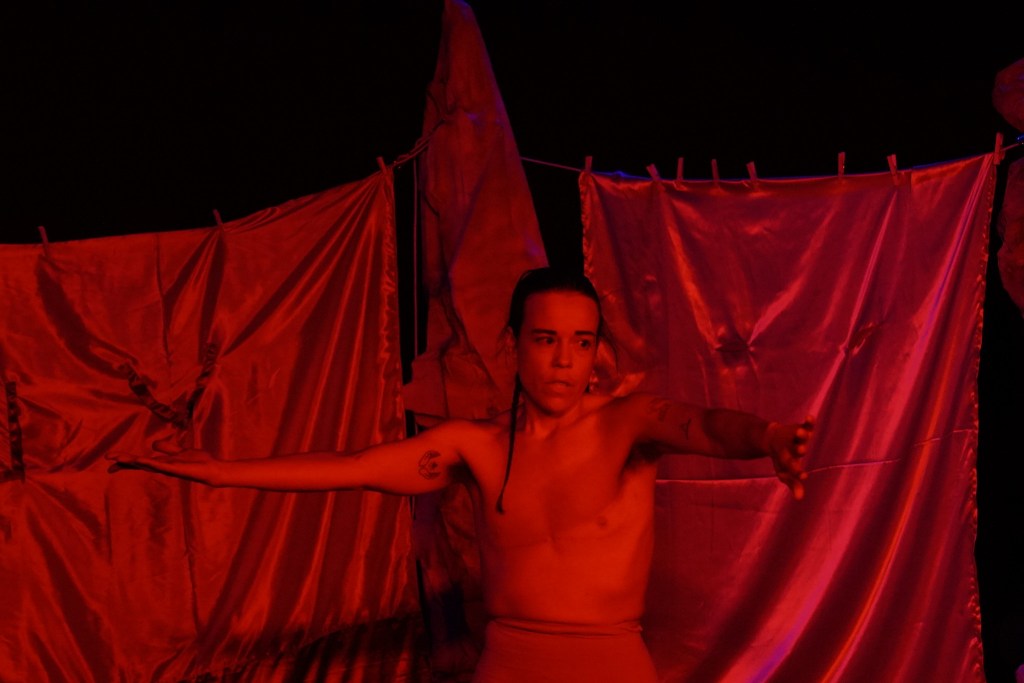
By the back half, Sugar Mud has shifted registers entirely, the costume-comedy framework briefly abandoned for something rawer, a shift that pays off fully in a letter-and-courtroom-audio sequence. Beasley delivers it from a warrior yoga pose, body still, no props or costume business, a sharp contrast after ninety minutes of physical comedy. The letter moves through drowning and resurfacing, ending with the body washing ashore, “glistening, as if you had never been touched by anyone before.” Later: “I’m going to keep loving you, because, okay, it’s just not fucking personal,” said with no punchline and no comic release. Underneath it, a looping “Divorce 661” courtroom recording keeps cutting in, case numbers and bureaucratic phrasing sawing through the most unguarded writing in the show. It doesn’t play as comic relief. It plays like intrusive thought, the paperwork of an ending refusing to stay out of a moment trying to be about something bigger than paperwork. The letter isn’t a finished piece of grief so much as a test of whether grief is still speakable at all, and by this point in the show, it’s earned the vulnerability. Sugar Mud drops its characters here entirely, settling into stillness to read something true out loud before closing the way it opened: with rocks.
The set does some of its most exact thinking around this same material. The clothesline pillars framing the stage, fabricated by Aubrielle Hvolboll and the team at Freak Nature Puppets, are modeled directly on the “Lot’s Wife” salt formation, the pillar a woman becomes for the crime of looking back at what she was told to leave behind. It’s a fitting echo, staged next to a divorce sequence about a person who can’t stop looking back at a marriage, but it’s the temple-veil staging discussed above that gets the bulk of the show’s craft and attention: the hung quilts, the tights, the redacted temple name in the artist’s own program notes. Lot’s Wife gets a nod in the architecture. The temple veil gets the whole night’s attention.
That attention pays off in one of the show’s last physical images before it turns fully toward its ending. By this point the tights are visibly stretched out of shape from an hour-plus of being repurposed (a garment worn past the point of doing the job it was built for, in the most literal sense possible), and Beasley hands the two loose, sagging ends out into the crowd, still worn on their own head, choreographing a short, tethered dance anchored to those two audience members. The same fabric that once had to cover a body is now used to hold a performer in orbit rather than restrict them. Staged as pure image, with no dialogue needed, it makes the show’s whole case at once: the thing that used to control you is still in the room, still touching you, but now you’re the one holding the ends of it while somebody dances.
Beasley carries all of it alone, out of costume changes, prop logic, and vocal register, and the hour-plus runtime never sags, its own quiet technical achievement for solo clown work.
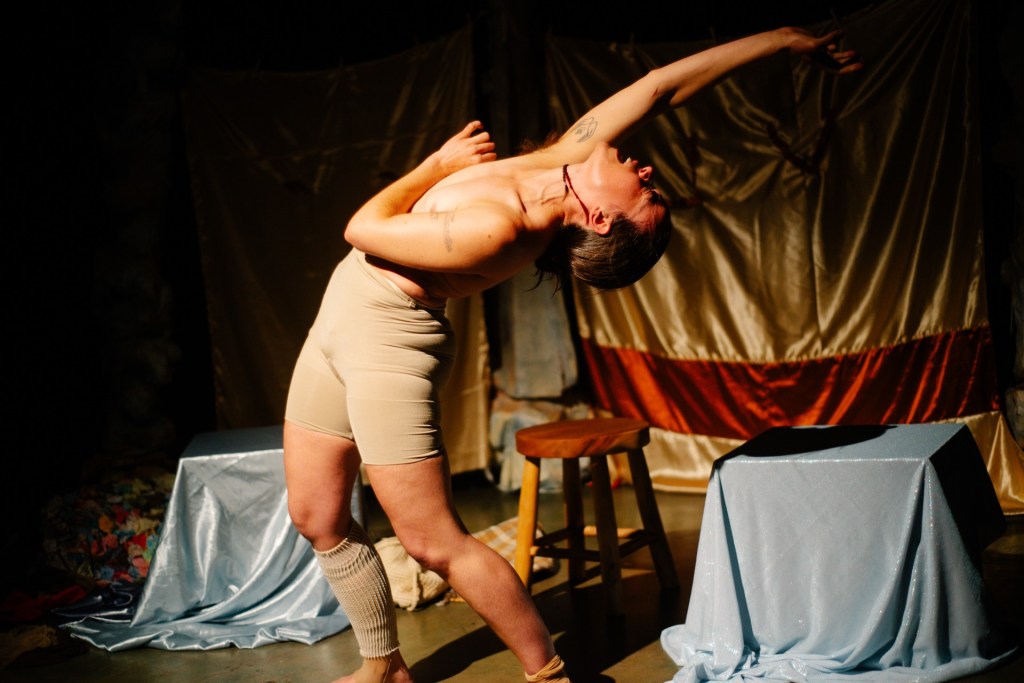
The actual final beat returns to the semicircle of stones from the top of the show. Granny, or Beasley, unmasked now, it’s hard to say which by this point, moves from rock to rock with each audience member in turn, asking the same question that’s threaded through the whole night: what do you see in this one? But now they answer alongside them, telling the real story of where each rock came from, or what they learned carrying it. It’s a small formal move with a large effect. 60 minutes of teaching you to read meaning into everything (a dog’s name, a stretch of nylon, a jar of chocolate), and the show finally turns that same instinct on itself, out loud, in front of you, using nothing but rocks and true stories about rocks. There’s no bigger reveal waiting underneath it. That’s the point. The rocks were never symbols standing in for something else. They’re just rocks that happen to have a person’s whole life pressed into them, and by the end, you’re holding one too.
Closing Thoughts
Borges’ dreamer spends the whole story terrified of being discovered as an illusion, only to learn in the last line that illusion was never the exception; everyone in that world was someone else’s dream. Sugar Mud spends sixty minutes building toward that same vertigo through costume, comedy, and inherited family myth, sets nearly all of it down for one bare, unmasked letter to someone who isn’t in the room, and then, instead of ending on that confession the way a lesser show might, walks itself calmly back to where it started: a semicircle of rocks, and the question of what you see in one. That return is the real trick of the show, and the reason it’s stuck with me since I saw it. The letter earns its vulnerability by first being relentlessly, specifically, purposefully silly for as long as it needs to be. The rocks earn their weight by refusing to cash the letter’s grief in for a bigger, more legible ending. You came in for a joke about rules and a talking wrench. You leave holding a stone someone told you the true story of. It’s an odd show, genuinely, unapologetically odd, and it’s also one of the most vulnerable things I’ve seen on a Fringe stage this year.
*In Genesis 27, Rebekah actually disguises Jacob’s hands and neck with goat skins, not sheep hide, to fool the blind Isaac. Beasley referred to “sheep hide,” which tracks with how hard the show leans on sheep elsewhere; whether it’s a deliberate swap or a slip, it’s the show’s detail, not this review’s.
Show Info
Company: Meat Bar (M. Beasley)
Written & Performed by: M. Beasley
Costumes, textiles & original design: M. Beasley
Clothesline pillars (“Lot’s Wife”): Aubrielle Hvolboll and Freak Nature Puppets
Production photography: Maddie Keyes-Levine
Festival: Great Salt Lake Fringe Festival
Venue: The Alliance Theatre, Blackbox, 602 E 500 S Suite E101, Salt Lake City, UT 84102
Great Salt Lake Fringe performances (concluded): Sat, Jul 25 at 7:30 PM; Sat, Aug 1 at 9:00 PM; Sun, Aug 2 at 6:00 PM
Runtime: approx. 60 to 70 minutes, no intermission
Setting: a floating clod of dirt, in the eye of a tornado
Award: Outstanding Solo Performance, Great Salt Lake Fringe Festival
About the Artist
M. Beasley, performing as Meat Bar, is a queer comedian and interdisciplinary artist born and based in California, working across performance, writing, costume design, and visual art. Sugar Mud premiered at Hollywood Fringe in 2025. Beasley has performed at LA Astro Fest and Elysian Spaghettifest as part of the astrology clown ensemble Planets, Planets, Planets, and in 2024 was a VIP-in-Residence at Elysian Theater as part of the performance art ensemble Autobodies. Additional credits include Moab Stoopfest, UCB’s Del Close Marathon, SF Sketchfest, and the San Diego Improv Festival. They trained in clown under Amrita Dhaliwal and Zach Steel at the Idiot Workshop in Los Angeles and with Endgames Improv Theater in San Francisco.
Press Contact
M. Beasley / Meat Bar
magg.beasley@gmail.com
IG: @meat_bar
Audience Reviews
“Rarely do you arrive in a theater and get transported both gently and instantaneously. Part magical realism, part grandma hang time–Meat made us all familiars in this strangely beautiful space.”
“Meat was not just a granny, a Mormon gossip, I was a grand kid, I was a Mormon gossip. I was so brought into this transcendent world and did not want to leave. The stage pictures, set, and costuming were in a riveting conversation with each other. Laughing every second, this lil’rally throbbed with brilliance.”
“Sugar Mud was an inventive, beautiful mix of sacred and profane. Surprises throughout and the ending had me sitting with my mouth wide open. I felt like I was in the damn Courage the Cowardly Dog house.”
“There are shows where you are aware the whole time you’re watching a show and there are shows where you are utterly moved away from traditional time and space. I got lost within this show’s magic–its elegant movement, its crunchy weird comedy, its ethereal exploration of familial ick and heart–this is a special show.”
Borges & “The Circular Ruins”
- Borges’ birth date (Aug 24, 1899): Academy of American Poets, “About Jorge Luis Borges” — poets.org/poet/jorge-luis-borges
- “The Circular Ruins” first published 1940, plot summary: Wikipedia, “The Circular Ruins” — https://en.wikipedia.org/wiki/The_Circular_Ruins
- Latin American writer lost his sight, but never his insight (1999) — https://www.deseret.com/1999/8/15/19460709/100-years-of-jorge-luis-borges-br-latin-american-writer-lost-his-sight-but-never-his-insight/
- Borges’ Twain remark (“It’s not at all like Mark Twain portrayed… not at all like Twain said”): BYU Studies, “An Interview with Jorge Luis Borges” — byustudies.byu.edu/article/an-interview-with-jorge-luis-borges-conversation-and-commentary-on-art-strength-and-religion


Leave a Reply