

Siempre recuerdo el peligro, como si fuese ayer.
I always remember the danger, as if it were yesterday.
—Adelina García Mendoza, in ¿Hasta cuándo tu silencio? Testimonios de dolor y coraje
Content note: This review discusses state violence, torture, and enforced disappearance, including a brief description of bodies found after killings.
Memoria Colectiva is an official selection of Grief Fest 2026 and streams online November 25 to 29 and December 24 to January 3 with an $11 Virtual All-Access Pass.
On the night of December 1, 1983, soldiers broke into Adelina García’s home in Huamanga, Ayacucho, and took her husband, Zósimo Tenorio Prado, a locksmith who had studied agronomy at the university there.1 She never saw him again, and decades later she still does not know what happened to him.2 When she went to the police and the army, she was met with silence. No official record shows he was ever taken. What remains is what García remembers, and what the women who stood beside her remember.
I’ve stepped back from reviewing for the most part to finish my dissertation, but when the film’s publicist reached out about Memoria Colectiva, this felt like a piece of art I was uniquely prepared to write about because it is archival at heart, and that is what I do. Watching it, I kept thinking of testimonio, a form of witness rooted in Latin American struggles against state violence, and work that is near and dear to me. In a forthcoming article with artist Alexandria Rachel Yaa Dikwa-Nkrumah, I draw on Dolores Delgado Bernal, Rebeca Burciaga, and Judith Flores Carmona’s work on Chicana/Latina testimonios, and on Sarah Cathryn Majed Dweik and Bernardita M. Yunis Varas’s account of Palestinian feminist witness, both of which treat witness as something communities make together under state violence. Testimonio usually reaches us as spoken or written witness, like the accounts gathered by the women of ANFASEP, the association of families of the disappeared that García later led, in their own book. Memoria Colectiva brings it into animation. García’s memory, drawn and set beside her own recorded voice, becomes a record the women made themselves when the state refused to keep one, and a call for the rest of us to listen.
Memoria Colectiva, a 15-minute animated documentary directed by Cristina Colmenares, with co-director Manuel-Antonio Monteagudo, opens in darkness. Knocking grows louder and turns metallic, and a tin door gives way. Soldiers in ski masks drag Zósimo out with a jacket over his head while their 11-month-old daughter screams. Their life together flashes past: meeting when García was 14, their wedding, Zósimo lifting their newborn into the air. Then it shatters like glass. At dawn, García ties her baby into her lliclla and goes out to look for him.

That lliclla, the woven shawl Andean women use to carry their babies and belongings, is the film’s central image. Later, as red and green bullets rain down, the mothers shelter under theirs, photographs of their disappeared pinned to their clothes, until together they become the ANFASEP building, which holds. Red stands for the insurgents and green for the state.
The film’s script calls these bullet-rain sequences “intervened archival material.” In the short, the archive is García herself. Clips of her speaking and remembering run through the drawings, so the record is made from her memory rather than from any state file.
Context
Between 1980 and 2000, Peru lived through an armed conflict between the state and the Shining Path (Sendero Luminoso), a Maoist insurgency. Peru’s Truth and Reconciliation Commission estimated that 69,280 people died, though only about 32,000 are known by name; the rest is a statistical projection.3 Counts of who was responsible vary. By one, Shining Path caused just over half the deaths and disappearances and the state and its allies more than a third;4 by another, the shares were closer to 46 and 30 percent.5 The film’s narration puts the armed forces’ share at almost half. When the report came out in 2003, commission president Salomón Lerner said three of every four victims were rural people whose first language was Quechua, an Indigenous language of the Andes.6
Thousands of people were disappeared: Peru’s national registry lists more than 22,000.7 Ayacucho lost more than any other region.8 Many were taken to Los Cabitos, the army base outside Huamanga, where detainees were tortured and killed.9
ANFASEP, the National Association of Relatives of the Kidnapped, Detained and Disappeared of Peru, was founded in Ayacucho in September 1983 by Angélica Mendoza de Ascarza, whose 19-year-old son soldiers had taken, and five other women.10 Known as Mamá Angélica, she led Peru’s first victims’ organization until 2006 and died in 2017, still searching for her son.11 García joined the association after soldiers took her husband that December and later became its president. ANFASEP now runs a memory museum in Huamanga called “So It Won’t Happen Again.”12
Justice has been slow. Peru passed a law to search for the disappeared in 2016 and created a genetic data bank in 2018.13 But in 2024 it put a statute of limitations on crimes against humanity committed before 2002,14 and in August 2025 President Dina Boluarte signed an amnesty for soldiers, police, and self-defense committees accused of crimes during the conflict.15 She called it a tribute to those who fought terrorism;16 victims’ families warned it would close the door on truth and justice.17 The women of ANFASEP are still asking where their husbands and children were taken.
Colmenares, a sociologist from Lima now living in Frankfurt, met García in 2017 while interviewing survivors in Ayacucho.18 She has said animation lets the film portray emotion more sensitively, and she did not want García shown only in suffering: the film is about transforming pain to keep going.19 About sixty people worked on it over roughly eight years. Its first audience was the women of ANFASEP, about a hundred of them, who watched on Colmenares’s laptop, recognized their building and their own story, and talked about it afterward in Quechua.20
Animation as Testimonio
The film does not hide the violence, but it shows it with restraint. Drawn rather than filmed or photographed, it lands less intensely than footage would, though how hard it hits will depend on each viewer and their comfort with scenes of violence. García searches for her husband every day, following rumors of bodies. On the hillside of Infiernillo, she and other women find corpses whose faces are burned beyond recognition. As a truck of soldiers approaches, the women huddle together under their llicllas while bullets spark off the stones.
The violence follows her home. Her daughter, Liliana, four years old, curls into a ball at the sound of fireworks because they sound like gunfire, and tells her mother she is afraid of the military. García tells her that her father has only been detained, that he could come home any time. Remembering it on camera in a 2022 interview, García cries.
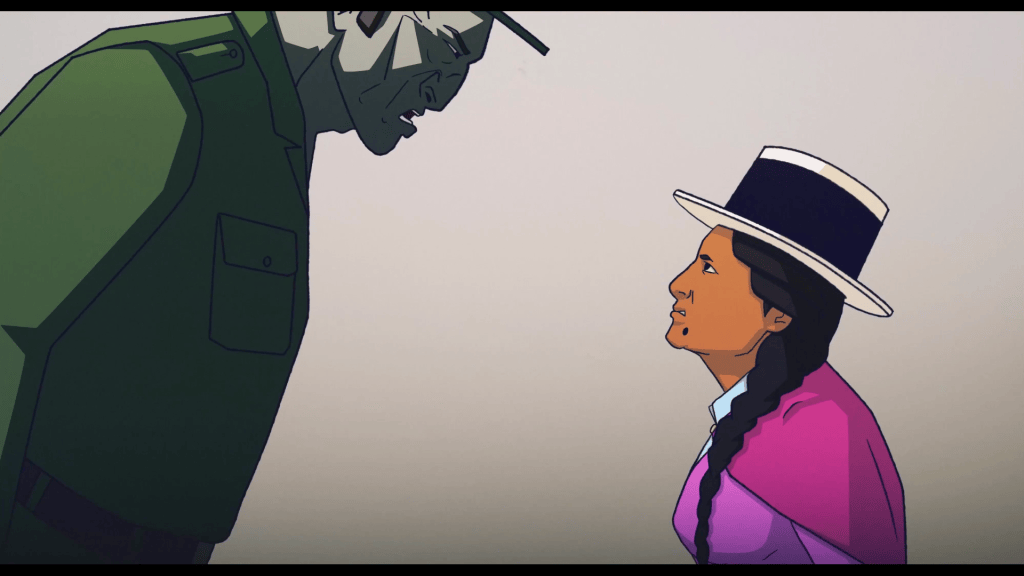
In this film, the police are drawn as giants. Women line up outside the station with photographs of their disappeared, and the two officers at the door tower over them, waving some through and turning others away. Many of the women, García included, spoke mostly Quechua, and the police neither hear nor understand them. Behind García in line stands Mamá Angélica, her name written on her skirt, urging her to speak up. Inside, an officer crumples Zósimo’s photograph, calls García a liar, and a second officer leans in with a sneer: “She’s a terrorist, no doubt about it! I’d take her to a cell myself.” García clutches her papers to her chest, trembling. The English subtitles say “terrorist,” but the word he actually uses is terruca, a slur used in Peru to brand someone a Shining Path sympathizer. Outside, the women’s grief hardens into determination, and they band together in ANFASEP. The animation does its best work when two of those giants confront García, tear her bag from her, and scatter her documents on the floor. They tower over her, demanding to know whom she calls and why she lies, while her body shakes. Then she answers back: what do they talk about on the phone with their own families? As she speaks, the officers shrink until they are her size, and they leave. I can’t imagine live footage showing this moment, when her fear turns into courage. “My body was shaking,” she says in the interview, “but then I became strong.”
Delgado Bernal, Burciaga, and Flores Carmona describe testimonio as a form of witness that breaks silence and builds solidarity, placing one person’s story within a shared struggle; Dweik and Yunis Varas show how Palestinian women’s counterstories carry similar forms of witness and survivance.21 The women of ANFASEP have long practiced it.22 In García’s account in their book, ¿Hasta cuándo tu silencio?, she writes that the soldiers took “un proyecto de vida,” a whole life her family had planned.23 Memoria Colectiva works the same way. García’s story is hers, but she shares it with the other women of ANFASEP.
Inside the ANFASEP building, the eldest mother, in her eighties and tired, tells García her face may be wrinkled, but her heart is still strong. García says it was her elders’ words that gave her strength.

The film’s most tender scene comes near the end, at La Hoyada, the memorial on the ground where the army disposed of bodies. The mothers lay flowers for their disappeared and plant a cross together. García says it took fourteen years to win the shrine; before it, they had nowhere to bring flowers. Together they sit, share food and soda, and laugh. For a moment, Zósimo appears before García, still young and smiling, and then he is gone.

Voice and Language
The film credits Renata Flores as narrator. Flores is a rapper from Ayacucho known for making music almost entirely in Quechua. Born in 2001, she first went viral in 2015 with Quechua covers of Michael Jackson and The Animals posted to YouTube.24 Her grandmothers taught her the language,25 and she has said her family told her stories of their resilience during the armed conflict.26 Her 2021 album Isqun centers Andean women in Peru’s history. Casting her matters. A young woman from Ayacucho who learned Quechua from her grandmothers is telling the story of the women who searched there, which fits Colmenares’s aim of reaching younger generations. The film itself is entirely in Spanish, with English subtitles, so the narration is in Spanish too. That means García’s testimony reaches us in Spanish, even though she says she spoke mostly Quechua then and struggled to follow meetings held in Spanish. The filmmakers have addressed this: a Quechua-dubbed version of the film exists, and Colmenares hopes to bring it to schools and community groups outside Lima.27 Flores’s narration runs alongside García’s own voice from her interviews, and together they are fantastic.
Craft
Qamaqi Studio’s 2D illustration makes much of the film’s argument through images, such as colored bullets falling like rain, police who tower and then shrink, and shawls that become shelter and then a building. The film moves between these drawings and García’s live-action interviews, recorded in 2022 with García in the traditional clothes of Ayacucho, often morphing from one into the other, so her present-day face and her remembered past share the screen. The original score is by Juan Carlos Hincapié and Simón Jaramillo, with sound post-production by Vinilo Studio in Cali, Colombia. The film ends with an original song, “La América que se olvida” (“The America That Is Forgotten”), written by Renata Flores and her mother and manager, Patricia Rivera, and performed by Flores; it is a beautiful close. In under fifteen minutes, the film covers four decades, so some moments pass quickly. One choice struck me as interesting: the soldiers are drawn with gray skin and strange, unhuman features. They wear ski masks, and the hands that drag Zósimo away multiply like a monster’s. The officials who turn her away are drawn the same way. At the police station, the officer behind the desk has the same gray skin and a uniform in the same green as the state’s bullets, while García sits across from him in her bright striped lliclla, her baby on her back. Other people are drawn as ordinary, even the man who turns García away from his courtyard. This may seem at odds with the film’s closing plea to recognize one another. But to someone whose family and country were being terrorized, the soldiers would not have seemed human. In her written testimony, García describes an anger toward the soldiers responsible that never left her.28 The film draws them as García lived them, and it lets them shrink back to human size only when she finds her voice.
As the film nears its end, the narration widens from García’s own story to the audience. The closing words, written by Cristina Colmenares and spoken by the narrator, Renata Flores, look beyond Ayacucho. In Peru, she says, the state relates to its people through violence. That violence falls unevenly, and many of us assume it will never reach our own lives. Inequality has become so normal that it keeps us from recognizing each other and clouds our empathy.
Si queremos ser escuchados no podemos hacer oídos sordos a las voces de los otros. Si queremos que nuestras vidas tengan valor, no podemos negar el valor de las vidas ajenas.
If we want to be heard, we cannot turn a deaf ear to the voices of others. If we want our lives to have value, we cannot deny the value of the lives of others.
As she speaks, the film closes a circle it opened. Early on, García runs from falling bullets into the courtyard of a man sweeping stray bullets off his patio, and he pushes her back out with his broom, barely looking at her.29 He is every bystander who decided the state’s violence was someone else’s problem. Now the bullets return, and he is the one running, turned away from every doorway. Just as the window above him shatters, García and the mothers of ANFASEP cover him with their llicllas, and García offers him her hand, which he takes. For me, it is the strongest image in the film, because the women no one protected are now protecting him.
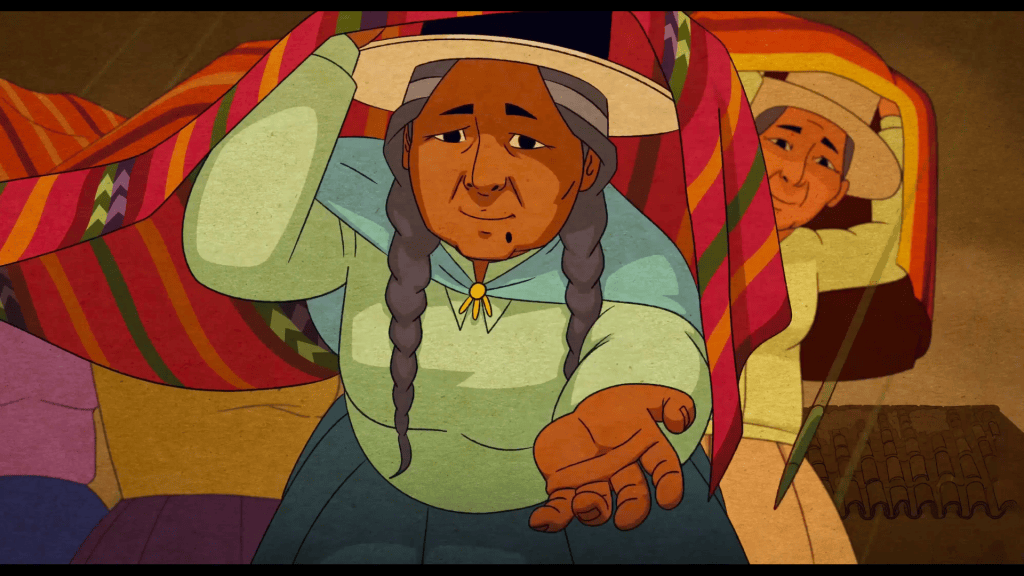
That moment is what testimonio asks of us: to be accountable for what we’ve heard. For decades, García spoke to a state that refused to listen. In the film’s final moments, Colmenares puts the same choice before us: stay silent, as the state did, or listen. Every time someone watches, the witnessing begins again.
This is a message we all need to hear right now. Colmenares is speaking about Peru, but wherever you live, I hope you see your own world in it. We need to humanize each other.
Memoria Colectiva is an Oscar contender, eligible for the 99th Academy Awards in the Animated Short Film category, with shortlists to be announced December 15. It has won awards across the festival circuit, including best animated short at the 2026 LA Femme International Film Festival Europe, best documentary at the 2026 Festival de Cine del Cusco, best animated film at FEMI 2026 in Guadeloupe, and best animation and human rights at Begiradak 2025 in Spain, and it screened in competition at Short Shorts Film Festival & Asia 2026 in Tokyo. It was directed by Cristina Colmenares and co-directed and produced by Manuel-Antonio Monteagudo, with a script by Carolina Wiegering. The digital 2D illustration is by Qamaqi Studio in Tacna, Peru, led by Andrés Cotrina with Elena Tueros. It is a Peru–France–Colombia co-production. It runs about 15 minutes, in Spanish with English subtitles, and is recommended for viewers 14 and older. For future screenings, visit the film’s page at Films on the Road or follow the filmmakers on Instagram at @memoriacolectivadoc. English quotations from the film are taken from its subtitles. Rhetorical Review received a screener, script, and images from the film’s publicist, Entertainment Public Relations.

Notes
- Alba Ñaupas, “Las huellas del ‘terruqueo,’” La Antígona (for Perulogía), https://laantigona.com/las-huellas-del-terruqueo/.
- Team WOLA, “How the Film ‘NN’ Explores Issues of the Missing in Peru,” WOLA, September 22, 2015, https://www.wola.org/analysis/how-the-film-nn-explores-issues-of-the-missing-in-peru/.
- “Horrifying Death Toll in Peru,” CBS News, August 2003, https://www.cbsnews.com/news/horrifying-death-toll-in-peru.
- Amnesty International, “Perú: La Comisión de la Verdad y Reconciliación – un primer paso hacia un país sin injusticias,” media briefing, AMR 46/010/2004, August 26, 2004, https://www.amnesty.org/es/wp-content/uploads/sites/4/2021/09/amr460102004es.pdf.
- Patrick Ball, Jana Asher, David Sulmont, and Daniel Manrique, How Many Peruvians Have Died? An Estimate of the Total Number of Victims Killed or Disappeared in the Armed Internal Conflict between 1980 and 2000 (Washington, DC: American Association for the Advancement of Science, August 28, 2003), https://dmanriqu.pages.iu.edu/prints/2003_How_many_peruvians_have_died_AAAS.pdf.
- “Horrifying Death Toll.”
- Gobierno del Perú, “Dirección General de Búsqueda de Personas Desaparecidas,” gob.pe, accessed November 26, 2026, https://www.gob.pe/11872.
- “Ayacucho es la región con mayor número de desaparecidos entre 1980 y 2000 en el Perú,” La República, September 19, 2021, https://larepublica.pe/sociedad/2021/09/19/ayacucho-es-la-region-con-mayor-numero-de-desaparecidos-entre-1980-y-2000-en-el-peru-atmp.
- Latin America Bureau, “Organisations | ANFASEP,” https://lab.org.uk/wrv-organisations-anfasep/.
- International Committee of the Red Cross, “Perú: Mamá Angélica, símbolo de lucha y fortaleza,” 2016, https://www.icrc.org/es/document/peru-dia-mujer-mama-angelica-simbolo-lucha-fortaleza.
- “National Association of Relatives of the Kidnapped, Detained and Disappeared of Peru,” Wikipedia, accessed November 26, 2026, https://en.wikipedia.org/wiki/National_Association_of_Relatives_of_the_Kidnapped,_Detained_and_Disappeared_of_Peru; “Angélica Mendoza de Ascarza,” Wikipedia, accessed November 27, 2026, https://en.wikipedia.org/wiki/Angélica_Mendoza_de_Ascarza.
- Iris Jave, Tesania Velázquez, and Grace Mendoza, “Participatory and Healing Methodologies with ANFASEP Women: A Collaborative Learning Project,” New Area Studies 4, no. 1 (2024), https://reference-global.com/download/article/10.37975/NAS.57.pdf.
- International Committee of the Red Cross, “Search for Disappeared Persons in Peru: Achievements and Challenges,” https://icrc.org/en/document/search-disappeared-persons-peru-achievements-and-challenges.
- World Organisation Against Torture (OMCT), statement on Peru’s Amnesty Law, July 16, 2025, via ecoi.net, https://www.ecoi.net/en/document/2136028.html.
- Human Rights Watch, “Peru: Amnesty Bill Signed into Law,” August 13, 2025, https://hrw.org/news/2025/08/13/peru-amnesty-bill-signed-into-law.
- “Peru’s President Signs Military Crimes Amnesty Bill into Law,” Buenos Aires Times, August 2025, https://batimes.com.ar/news/amp/latin-america/perus-president-signs-military-crimes-amnesty-bill-into-law.phtml.
- “New Amnesty Law for Human Rights Abuses in Peru Prompts Fury, Action,” Al Jazeera, July 11, 2025, https://www.aljazeera.com/news/2025/7/11/new-amnesty-law-for-human-rights-abuses-in-peru-prompts-fury-action.
- “Cristina Colmenares y los ocho años detrás de ‘Memoria Colectiva,’” Infobae, October 19, 2026, https://www.infobae.com/peru/2026/10/19/cristina-colmenares-y-los-ocho-anos-detras-de-memoria-colectiva/.
- “Memoria Colectiva: cortometraje que cuenta la historia de lucha de Adelina García, expresidenta del Anfasep,” Jornada, June 26, 2025, https://jornada.com.pe/memoria-colectiva-cortometraje-que-cuenta-la-historia-de-lucha-de-adelina-garcia-expresidenta-del-anfasep/.
- “Cristina Colmenares y los ocho años.”
- Dolores Delgado Bernal, Rebeca Burciaga, and Judith Flores Carmona, “Chicana/Latina Testimonios: Mapping the Methodological, Pedagogical, and Political,” Equity & Excellence in Education 45, no. 3 (2012): 363, https://doi.org/10.1080/10665684.2012.698149; see also Mujeres Activas en Letras y Cambio Social (MALCS), “Special Issue: Chicana/Latina Testimonios: Mapping the Methodological, Pedagogical, and Political,” August 9, 2012, https://malcs.org/blog/2012/08/09/special-issue-chicanalatina-testimonios-mapping-the-methodological-pedagogical-and-political/. The authors build on earlier feminist testimonios, especially Latina Feminist Group, Telling to Live: Latina Feminist Testimonios (Durham, NC: Duke University Press, 2001). Sarah Cathryn Majed Dweik and Bernardita M. Yunis Varas, “To Gather Amongst the Olive Trees: Counterstorytelling through Palestinian Feminist Survivance Rhetorics,” Peitho 27, no. 3 (2025): 81–98, https://wacclearinghouse.org/docs/peitho/v27n3/dweik-varas.pdf.
- Asociación Nacional de Familiares de Secuestrados, Detenidos y Desaparecidos del Perú (ANFASEP), ¿Hasta cuándo tu silencio? Testimonios de dolor y coraje, 2nd ed. (Ayacucho: ANFASEP, 2015; first published 2007). García’s testimony appears as “Siempre recuerdo el peligro, como si fuese ayer,” https://www.verdadyreconciliacionperu.com/admin/files/libros/175_digitalizacion.pdf.
- ANFASEP, ¿Hasta cuándo tu silencio?, 209.
- “Renata Flores: How Is She Revolutionizing Peruvian and Quechua Music?,” Peru.info, https://peru.info/en-us/talent/blogperu/6/25/renata-flores-how-is-she-revolutionizing-peruvian-and-quechua-music.
- “Peru’s Quechua Rappers Have the World Taking Notice,” National Geographic, https://nationalgeographic.com/culture/article/rap-music-indigenous-quechua-language.
- Sisa Quispe, “In Peru, the Quechua Language Takes to Hip-Hop, Trap, and ‘Q-Pop,’” Condé Nast Traveler, August 17, 2024, https://www.cntraveler.com/story/in-peru-the-quechua-language-takes-to-hip-hop-trap-and-q-pop.
- “Cristina Colmenares y los ocho años.”
- ANFASEP, ¿Hasta cuándo tu silencio?, 209.
- The script names him Infausto, Spanish for “ill-fated”; the name appears only in the stage directions and is never spoken in the film. Carolina Wiegering, Memoria Colectiva, screenplay, provided to the author by the film’s publicist.


Leave a Reply