

A note before you start: this review contains spoilers for Waiting for Godot. If you haven’t seen the show and want to go in fresh, hold off on reading until after.
OGDEN, UT—I want to start by saying that sisters Alicia Washington and Camille Washington own the only Black-owned theatre in Utah, and they are some of the most thoughtful, intellectually engaged people I’ve encountered in the state’s theatre scene. These days, they only put on one or two shows a year, so each one is meaningful, and they are both deeply involved in the ones they commit to. This one was no different, and I’m always honored to review for them.
It also makes me think: why this show, why now? A company that picks its productions this carefully doesn’t land on Waiting for Godot by accident. This is a play built entirely around the word “wait,” used over and over as a way of deferring something that’s owed, and that word carries real weight in this country’s history. Martin Luther King Jr. wrote about it directly in “Letter from Birmingham Jail,” noting how often “wait” has, in practice, meant “never” for people asking for what they were already owed. Staged by the only Black-owned theatre in Utah, a play about two men endlessly told “not today, but surely tomorrow” lands differently with that history in the room.
Here’s the image I keep coming back to: Godot is sand falling through your fingers while the night comes on faster than you expected, something you can feel slipping away in real time, a deadline you can never quite prepare for no matter how long you’ve spent waiting for it. Waiting doesn’t pause time. It just hides how fast it’s actually running out. That idea runs under everything else in this review: deferral, power, habit, and the two men who keep showing up for each other anyway.
We wait. We are bored. No, don’t protest, we are bored to death, there’s no denying it. Good. A diversion comes along and what do we do? We let it go to waste. …In an instant, all will vanish and we’ll be alone once more, in the midst of nothingness.
-VLADIMIR
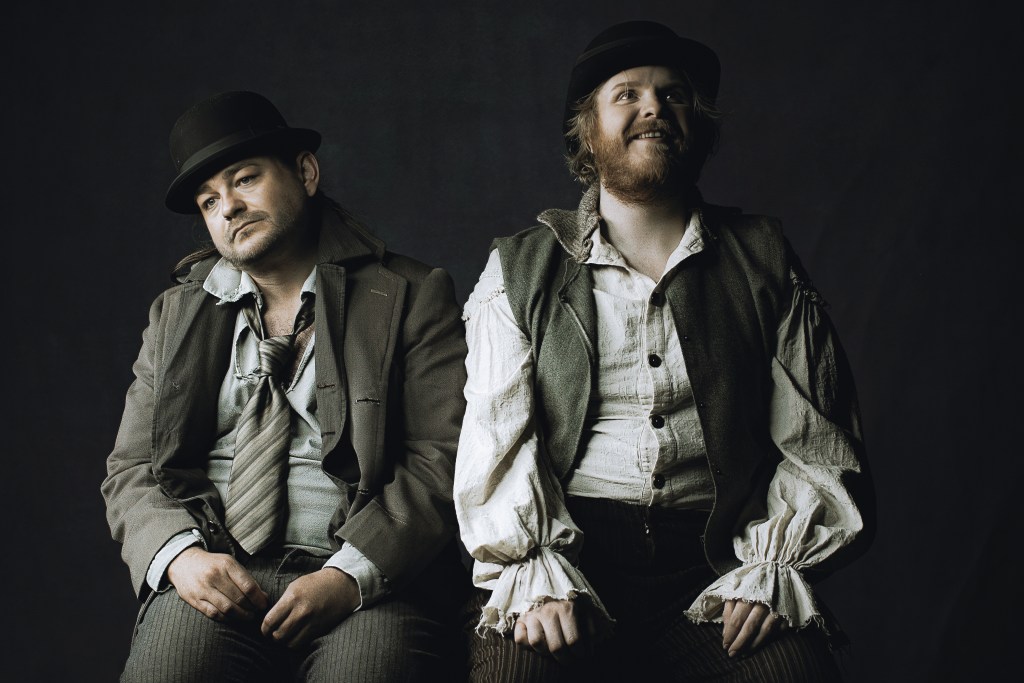
This was my first time experiencing Waiting for Godot, and let me just say—wow! It is such a pleasure to hear such an intellectually stimulating play performed by actors who put such intention behind every line and with the guidance of a director who has thought through every detail with painstaking care. Beckett’s language is famously slippery on the page: circular, evasive, built out of half-finished thoughts and repeated questions that never resolve. Read cold, it can feel like an academic puzzle. Performed with real attention to pacing and rhythm, as it was here, it becomes something closer to what I suspect Beckett actually intended, a study of what people do with language when they have nothing else to hold onto. I felt lucky to encounter the play this way rather than on the page first.
Some Context
Waiting for Godot premiered in Paris in January 1953, and Beckett’s own English translation reached London two years later. Both openings were famously rocky, with early audiences baffled or outright hostile before critics turned the tide. Despite that shaky start, the play went on to become Beckett’s best-known work and, decades later, was voted the most significant English-language play of the twentieth century in a poll conducted by London’s Royal National Theatre. It has since been staged constantly and unpredictably across the world, from an all-Black Broadway cast in 1957 to a starry 2025 Broadway revival with Keanu Reeves and Alex Winter. There’s something fitting in that pattern: every few years a splashy production pulls the play’s name back into public conversation, drops it again once the run closes, and waits for the next revival to bring it around once more. A play about circularity keeps circulating in exactly that shape. This Good Company Theatre production, directed by Mark Fossen in Ogden, Utah, is a small but no less important link in that long chain, a community staging of a play whose meaning has never settled, performed by people clearly taking the material seriously without losing its comedy.

Language as the Real Subject
It’s easy to describe Godot as “a play where nothing happens,” but that undersells what actually fills the two hours: talk. Vladimir and Estragon fill silence compulsively, circling the same handful of questions (are we in the right place, was it yesterday, what did we ask Godot for) because stopping talking means confronting the silence underneath. The actors here understood that the pauses matter as much as the lines; nothing was rushed, and the comic rhythms (a very vaudeville, call-and-response cadence in places) were given room to land before the play undercut them with something bleaker. That balance is hard to get right, and it’s a large part of why the play felt legible to me as a first-time viewer rather than opaque. It showed in the room, too: this was a preview performance, and several people around me were laughing out loud at points, real laughs, not polite ones, which says something about how well the comic timing landed. Godot has a reputation as dense and forbidding, but a room full of people genuinely cracking up during it is proof that the humor Beckett actually wrote is still very much alive and reachable, if the actors trust it.
Production Highlights
Beyond the performances, the design team did real, considered work to build this world, and it’s worth calling out on its own terms as craft, separate from what it symbolizes.
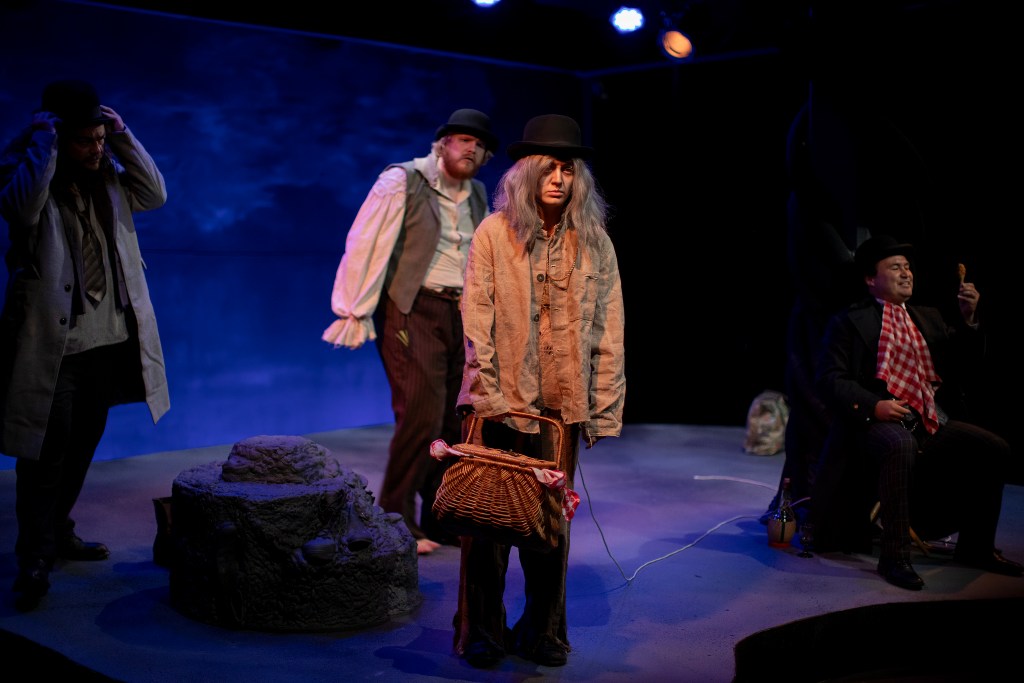
The set. Scenic designer Raquel M. Jackson built the tree at center stage from black pipe, an industrial rather than natural material, materially ambiguous in a way that felt deliberate rather than accidental. It sat on a visible concrete base, which turned out to be disguising an actual structural pillar in the venue, perhaps equal parts practical solution and directorial statement, but one that ended up suiting the play’s bleakness regardless of intent. Ringed around its base were grey stones with boots embedded in them, a choice that gave the stage a sense of accumulated history before a single line was spoken.
Lighting and atmosphere. Lighting designer Timothy Swenson had the back of the stage painted to suggest a sky, with a large moon projected onto it each night, a direct nod to Beckett’s own stage directions, which call for the moon to rise near the end of each act. The contrast between a flat, painted backdrop and the more textured, three-dimensional set in front of it gave the whole stage a layered, thoughtful quality, atmosphere handled with real attention rather than as an afterthought.
Overall polish. Citlali Urquiza’s costume design leans into the shabby-genteel look that’s become traditional for Vladimir and Estragon, worn and mismatched without tipping into full clown costume, which suits a pair of characters who are meant to have clearly known better days. Every costume in the show is well realized, but Pozzo and Lucky’s are the standouts: Pozzo’s outfit does real work selling the character’s overblown self-regard before he says a word, while Lucky’s, worn down and burdened-looking, communicates the years of servitude the text only implies. Stage manager Madison Hill’s work is easy to overlook precisely because it’s done well: a play built almost entirely on two actors’ timing, with pauses that matter as much as lines, depends on a stage manager who can hold that rhythm consistently night after night, and nothing here ever felt rushed or dragged. Credit as well to producers Alicia Washington and Camille Washington, co-founders of Good Company Theatre, who have spent close to fourteen years building the kind of company that can take on a play this demanding and trust its own community to meet it seriously.

Themes
Beckett subtitled the play “a tragicomedy in two acts,” and that label isn’t a throwaway. The comic scaffolding (the boot business, mistaken identity, running bits about hats) is often the delivery mechanism for the bleakest material in the play rather than relief from it; Vladimir and Estragon’s back-and-forth about hanging themselves plays as a vaudeville routine right up until you register what they’re actually discussing. This production honored that balance rather than flattening it toward pure comedy or pure despair.
That same refusal to settle runs through the play’s religious content. It’s tempting to read Godot as being about God, given the near-homophone of the name, the two thieves, the boy’s shepherd imagery, characters organizing their whole existence around an authority who never explains his silence. It’s just as tempting to read it as being about the absence of God, given how openly Beckett denied strict allegory and regretted the name specifically because of what it implied. The most honest answer is probably that the play isn’t making a claim about God’s existence either way; it’s a portrait of what waiting does to people regardless of whether anything is actually coming, dressed in religious vocabulary because that’s the vocabulary Beckett grew up with and knew intimately, not because the play is trying to settle the question for you.
I found myself drawn less to the God question directly and more to the purgatory reading that’s shaped a lot of early criticism of this play: a world where two men are stuck, indefinitely, neither punished outright nor released, waiting on a judgment that never actually arrives. That framing doesn’t require Godot to be God at all, it just requires the condition of being suspended between one state and another, which this production’s set (the bare road, the dead-looking tree, the fossilized boots at its base) captured better than the dialogue alone could.
I want to be upfront that everything below is exactly that: one reading among many, not a claim that this is what the play “really” means. Given how openly Beckett himself refused to pin the play down, even to his own directors, it would be disingenuous for me to turn around and insist on a single fixed interpretation here. These are the readings that struck me watching this particular production, from scripture to power to the objects the characters can’t stop fussing over, often in ways that argue with themselves rather than offering comfort.

The two thieves. Vladimir’s digression on the two thieves crucified alongside Christ is the play’s thesis statement in miniature: only one Gospel records that one thief was saved, and that coin-flip uncertainty over which account to trust sits behind the play’s larger refusal to confirm anything, not the day, not the place, not even what was asked of Godot.
Power, and how unstable it really is. Estragon mistakes Pozzo for Godot the instant he arrives, and it’s worth taking that confusion seriously for a moment: Pozzo plays the authority figure well in Act I, a landowner in fine clothes who controls another person’s fate and even claims to be “made in God’s image.” But the more he talks, the less commanding he seems, losing track of his watch, his memory, his own thoughts mid-sentence. Lucky, it turns out, taught him everything refined about himself, so Pozzo’s whole persona looks borrowed rather than owned; by Act II, blind and led around by the very man he once dragged by a rope, whatever power he had is revealed as circumstantial rather than earned. That instability runs through every power relationship in the play: Godot holds Vladimir and Estragon through pure absence, and even the boy’s family gets folded in, Godot beats one brother and spares the other for reasons nobody explains. It shows up in the language too: Pozzo never addresses Lucky by his actual name, only “pig” and “hog,” and tellingly, Vladimir uses the same words on Estragon later, in moments that are supposedly caring rather than cruel. Power here is never earned or stable; it just lands on someone, for a while, until it doesn’t.
The tree. With almost nothing else specified in Beckett’s stage directions, the tree carries enormous symbolic weight: tree of knowledge, site of crucifixion, barren fig tree. Here it was built from black pipe over a structural pillar, on a visible concrete base, ringed with boot-embedded stones, as if generations of prior waiters had calcified into the landscape. Practical necessity or not, the effect answered the play’s “same tree?” question before the dialogue ever asked it.
Boots. No object recurs in this play quite like boots do, and this production leaned into that. The play opens with Estragon fighting his own boot and closes with him leaving both behind for “another” with smaller feet; in between, boots get pulled off, peered into, argued over, mistaken for the wrong color, and generally treated as the one physical fact nobody can escape, no matter how philosophical the conversation gets. It’s a small pattern that runs well beyond this one play, too: Beckett’s characters are chronically afflicted at the feet, struggling to walk, to stand, to simply get a boot on or off, as if the body itself keeps refusing to cooperate with whatever the mind is trying to accomplish. It’s a fitting emblem for the whole play: something worn, painful, endlessly fussed over, and never actually solved. Grounding the set’s boot-embedded stones in that same imagery, rather than treating it as a one-off design flourish, gave the physical world of the production a coherence that matched the text’s own obsession with the object.
Literary kin. The bare road and leafless tree put Godot in company with T.S. Eliot’s The Waste Land, both trust a stripped, desolate landscape to stage spiritual emptiness rather than argue for it. There’s a kinship too with Yeats’s “The Second Coming,” another modernist vision of a promised, dreaded arrival, except Yeats delivers a climax, however monstrous, while Beckett withholds it entirely, perhaps the crueler choice.

Performance Highlights
This is a truly standout five-person principal cast, and the care taken with the language throughout is a testament to all of them equally. This is an ensemble where every performance is doing real, specific work.
Michael Scott Johnson as Vladimir (Didi) carries a huge share of the play’s language and philosophizing, and his performance finds something less anxious and more contented in the role than you might expect. This Vladimir seems almost grateful for the waiting itself, settled into the routine of it rather than straining against it. It would be easy to play him as a man desperately trying to hold a coherent world together out of fragments he can’t remember correctly, but Johnson instead suggests someone who’s made peace with not knowing, finding the digressions (the two thieves, the questions about the day and the place) genuinely engaging rather than distressing. What this Vladimir seems to need isn’t Godot specifically so much as a task, any task, to keep him occupied; the waiting supplies its own structure and its own busywork, and Johnson plays that need for occupation as the real engine underneath the character, with Godot’s arrival almost beside the point.
Arie Allred as Estragon (Gogo) is the yin to Vladimir’s yang, though in the most unconventional way. Yin and yang philosophy implies balance and harmony, and these two don’t have harmony: they bicker, contradict each other, and drive one another to distraction constantly. But they do create balance, just not the peaceful kind: two opposing temperaments that only function because they’re locked together, each completing something the other lacks even as they irritate each other doing it. Allred is the more physical, grounded counterweight to Johnson’s Vladimir, finding real pain and real petulance in the boot business without ever tipping into pure clowning; there’s a childlike quality to Estragon’s neediness and forgetfulness that makes his dependence on Vladimir feel emotionally true rather than just a comic device. Their chemistry sells the play’s central, quietly devastating point: these two men annoy each other constantly and could never actually leave each other. By the end, they seem to know it, the bickering never quite hiding that each of them has realized, on some level, that they need the other one to keep going.
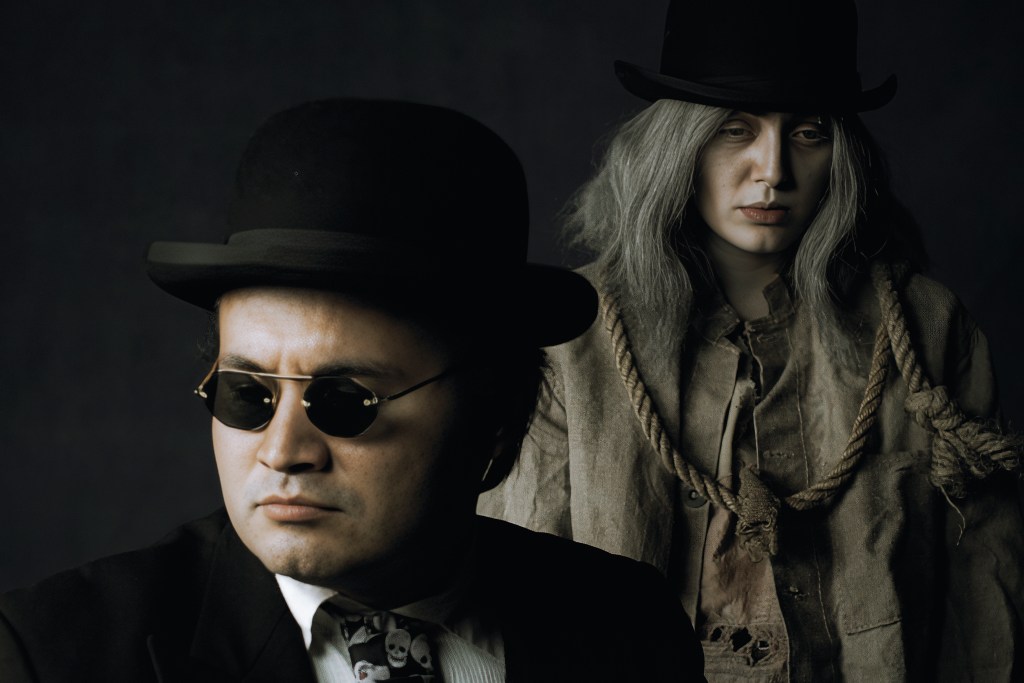
Alvaro Cortez as Pozzo builds the role on a smart, difficult choice: this Pozzo is convincingly menacing in his first entrance, and entirely blind to his own menace, harder to play than a Pozzo who knows he’s cruel and enjoys it. The self-satisfaction (the little speeches about the evening light, the theatrical unpacking of the picnic basket) sits right next to real cruelty toward Lucky, and Cortez never signals that he sees the contradiction. That obliviousness is what makes the performance unsettling rather than cartoonish, and it sets up one of the production’s most satisfying pieces of dramatic irony: this Pozzo is morally blind in Act I and literally blind by Act II. Beckett wrote that reversal into the text, but it only lands as tragedy because Cortez makes the earlier blindness so convincing. What struck me most, though, was how Johnson and Allred played the moment of meeting this changed Pozzo, not as another absurd beat to shrug off, but as something that visibly landed on them, a real “oh, wow” that seemed to shift something in both characters. For a minute, you actually believe things might change. Then Pozzo and Lucky exeunt, and Vladimir and Estragon are right back to waiting, as if nothing happened at all.
Elio Patterson as Lucky turns in an inspired performance built on an unusually hard contrast: Lucky has almost no words for nearly the entire play (silent, burdened, entirely reactive, present on stage but barely registering as a person with an interior life), and then, on command, that silence erupts into something almost deranged in its volume of language, thought, and feeling all at once. Holding that kind of blankness convincingly for so long, so that the eruption reads as something bursting out of real pressure rather than simply “the actor’s big moment finally arriving,” is its own kind of discipline. There’s a real vein of angst running through the performance, not just noise and speed, but something that reads as real anguish underneath the collapse, and a clear sense of a specific mind disintegrating in real time rather than an actor generically performing chaos. Patterson, a senior-standing BFA acting student at Westminster University making his Good Company Theatre debut with this production, brings real technical control to a role that could easily become unintelligible noise in less careful hands.
Oscar Bateman-Rapier as the messenger boy, in his first show with the company, handles a small but structurally important role with real composure. The staging choice to show the boy visibly marked in both his appearances, quietly contradicting his own claim to Vladimir that only his brother is beaten, depends on an actor who can hold a still, guarded stillness while delivering lines that suggest otherwise, and that restraint comes through clearly. It’s a role with very little dialogue and a lot riding on presence alone, and Bateman-Rapier makes the boy feel wary and a little haunted rather than simply neutral, which is exactly what the part needs.
“Tomorrow, when I wake, or think I do, what shall I say of today? That with Estragon my friend, at this place, until the fall of night, I waited for Godot? That Pozzo passed, with his carrier, and that he spoke to us? Probably. But in all that what truth will there be? (Estragon, having struggled with his boots in vain, is dozing off again. Vladimir looks at him.) He’ll know nothing. He’ll tell me about the blows he received and I’ll give him a carrot. (Pause.) Astride of a grave and a difficult birth. (Pause.) I can’t go on! (Pause.) What have I said?”
—Vladimir
Closing Thoughts
For a first encounter with Godot, I couldn’t have asked for a more careful or thoughtful introduction to it.
One moment from late in Act II has stayed with me, and this production handled it with real restraint: one man sleeps while the other keeps watch. Alone beside a dozing Estragon, Vladimir wonders what he’ll actually remember of today by tomorrow, and guesses it will amount to nothing more than “the blows he took,” smoothed over with a carrot, same as always. He catches himself mid-thought, breaks for a moment, then loses the thread entirely. It may be Beckett’s clearest statement on habit: it doesn’t just pass the time, it quietly trains people to stop noticing pain, even when it’s happening right next to them.
Underneath all that bleakness, though, something else is doing real work: the bickering, the reconciling, the small shared rituals of boots and hats and carrots. Whatever else fails Vladimir and Estragon, they never actually leave each other. “Not saints,” as Vladimir puts it, but faithful to their appointment all the same, night after night. That companionship doesn’t erase the despair this review keeps circling, but it sits right alongside it, and this cast gave it real warmth. If the play studies what people do while waiting for a meaning that may never arrive, it’s just as much a study of what they do for one another in the meantime.
Still, it would be dishonest to stop there; companionship wasn’t the only thing I carried out of the theater. What follows is my own reading, not a claim about the company’s intent, but I doubt a group this deliberate stages this play without wanting its audience to leave with more than plot. Beckett’s imagery keeps arguing with itself, capable of entirely opposite readings depending on who’s looking. That instability feels familiar right now: in the U.S., both white nationalist rhetoric and, at times, Christian institutions have become tangled in politics in ways that resist easy naming, scripture’s language doing double duty as comfort, exclusion, and justification, sometimes in the same breath. Beckett draws on that same well of imagery, denying any single fixed meaning, and never resolves the ambiguity, any more than our culture does.
This production makes that tension physical in one deliberate addition: marking the boy, a detail nowhere in Beckett’s text. It’s the same flat denial he voices in the script, insisting nothing is happening while the evidence stands in plain view. And the complicity doesn’t stop with him. Vladimir and Estragon see those marks, hear the denial, and let it go rather than push further, the same way they glance at Lucky’s raw rope-burns in Act I and settle for theorizing about the knot, the same way they let Pozzo talk them into believing his cruelty is somehow fine. It’s always easier to believe the person causing harm than to sit with what the evidence is actually saying.
And that’s worth turning inward, too: how often do the rest of us choose that same complicity? Not out of malice, but because making a scene is exhausting, because looking away is simpler, because we’re tired, uncertain, afraid, or quietly waiting to be saved ourselves. More than anything else in the play, that’s the note I walked out on.
Production Credits
Produced by Alicia and Camille Washington
Scenic Construction Crew: Allen Smith, Taylor Knuth
Scenic Charge Artist: Camille Washington
Properties Designer: Alicia Washington
Electrics Crew: Austin Stephenson, Taylor Knuth, Sean Bishop
Show Info
- Company: Good Company Theatre
- Director: Mark Fossen
- Dates: July 30–August 16, 2026
- Performances: Thu 7/30 at 7:30pm; Fri 7/31 at 7:30pm; Sat 8/1 at 7:30pm; Sun 8/2 at 4pm; Fri 8/7 at 7:30pm; Sat 8/8 at 4pm; Sun 8/9 at 4pm; Fri 8/14 at 7:30pm; Sat 8/15 at 7:30pm; Sun 8/16 at 4pm
- Runtime: approximately 2 hours, with a 10-minute intermission
- Tickets: Section 1 (yellow) $18, Section 2 (blue) $22, Section 3 (green) $26, Section 4 (purple) $30; $15 student tickets available at the door day-of, subject to availability
- Location: 2404 Wall Avenue, Ogden, Utah 84401
- Setting: a country road, evening
- Cast: Michael Scott Johnson as Vladimir/Didi (University of Utah Actor Training Program graduate; credits include Pioneer Theatre Company, Salt Lake Acting Company, Plan-B Theatre), Arie Allred as Estragon/Gogo (last seen at Good Company Theatre in The 25th Annual Putnam County Spelling Bee and Queer the Stage), Alvaro Cortez as Pozzo (Westminster BFA graduate; recently seen in The Moors and The Seagull), Elio Patterson as Lucky (Ogden native; senior BFA Acting student at Westminster University), Oscar Bateman-Rapier as the Boy (most recently seen as Nathan in The Full Monty at the Grand Theatre)
- Synopsis: Two wandering tramps, Vladimir and Estragon, wait by a lonely tree for the enigmatic Godot, in a world where time, place, and memory blur together, and meaning is wherever you happen to find it. They hope Godot will change their lives for the better; instead, two very different travelers show up, one man literally on the end of the other’s rope.
About the Playwright
Samuel Beckett was born near Dublin in 1906 and studied at Trinity College before eventually settling permanently in Paris, where he fell in with the city’s avant-garde literary scene and became close friends with James Joyce. He wrote in both English and French, often translating his own work between the two, and spent World War II involved with the French Resistance after fleeing occupied Paris, an experience biographers frequently connect to the bleakness and moral uncertainty running through his later plays. Waiting for Godot, written in French in the late 1940s and first staged in Paris in 1953, became by far his most famous work and the one most responsible for his 1969 Nobel Prize in Literature, awarded for writing that found a strange kind of elevation in human destitution. Beckett was famously private and resistant to explaining his own work, a trait that shows up throughout this review: he denied fixed meanings to his directors, regretted naming a central character after a word that sounded like “God,” and, after winning the Nobel Prize, agreed to a televised interview only on the condition that he not be asked a single question. That resistance to attention extended to the prize itself: he was in hiding in a small fishing village in Tunisia when the announcement came, promptly booked another hotel under a false name to dodge the press, and never attended the ceremony at all. His own wife reportedly described his reaction to winning as a “catastrophe.” He continued writing spare, increasingly minimal plays and prose until his death in Paris in 1989, having spent a career treating silence, uncertainty, and repetition as subjects worth taking as seriously as anything else literature has to offer.


Leave a Reply