

Reviews like this take 10+ hours to research and write. If this one was useful, even $1 helps. Support Rhetorical Review.
Pleasant Grove, UT—Running May 4 through July 3, 2026, at the Lindsay Legacy Theater, Once on This Island, with book and lyrics by Lynn Ahrens, music by Stephen Flaherty, and direction by Lisa Hall, arrives as both a beloved contemporary classic and a deeply resonant work of theatrical storytelling. Since its Broadway debut in 1990, the musical has earned multiple Tony Award nominations, won the Laurence Olivier Award for Best New Musical (1995), and secured the Tony Award for Best Revival of a Musical (2018) for its celebrated revival. Yet its enduring power is not simply a matter of accolades. What makes Once on This Island persist—across decades, productions, and audiences—is its commitment to storytelling as an act of survival, memory, and community carried through music and dance.
The musical evokes the same storytelling logic found in Anaïs Mitchell’s Hadestown (2019) and even Shakespeare’s Romeo and Juliet, not because it mirrors their plots, but because it shares their relationship to narrative itself. These are stories less concerned with shocking the audience and more invested in guiding them toward emotional and communal understanding. While Hadestown openly frames itself as a story that will end in sorrow, and Shakespeare’s tragedy famously signals its fate from the outset, Once on This Island takes a more gradual approach. It begins as a communal act of storytelling—one meant to comfort, teach, and remember—and only over time reveals the weight such stories carry. What ultimately aligns all three is their shared insistence that even painful stories must continue to be told.
Drawing on Caribbean folklore and Rosa Guy’s novel My Love, My Love, the musical stages a world shaped by colonial histories, rigid social hierarchies, and deeply embedded racial divides. In doing so, it participates in a long lineage of tragic love stories while foregrounding storytelling itself as an act of preservation. In this world, storytelling becomes a way of carrying pain, grief, hope, and love across generations—transforming memory into something communal rather than solitary.

Storytelling, History, and the Divide Between Worlds
The show opens with a dramatic burst of thunder and lightning, immediately immersing the audience in the stormy atmosphere of the island. Crashes of thunder echo through the theater as a frightened child emerges onto the stage, and soon the full ensemble gathers around her, beginning the story of Ti Moune as both memory and ritual. With nearly the entire cast present from the outset, the production establishes storytelling not as an individual act, but as a communal one.
From the very beginning, the production immerses audiences in the division between two worlds—separated by class, history, and race. Drawing from African and Caribbean storytelling traditions, the narrative unfolds on an island shaped by the legacy of colonialism and social hierarchy. The use of actual sand and water, extending close to the audience, creates an almost immersive “splash zone” effect that reinforces the physicality of the world being depicted. This is not merely atmosphere; it is storytelling through environment.
One of the production’s most compelling elements is its willingness to foreground the historical foundations of the island’s class structure. Through the retelling of the Beauxhomme family history and the legacy of French colonial influence dating back to Napoleon, the musical situates its romance within a much larger social and historical framework. The divide between the grands hommes and the peasants is not simply economic—it is racialized, inherited, and deeply embedded within the island’s colonial hierarchy. By foregrounding that reality, the production gives additional emotional weight to Ti Moune’s attempts to cross those boundaries.
At several moments, the musical directly confronts this reality. One line in particular—“They despise us for our blackness”—lands with striking force, making explicit the racial foundations of the social hierarchy shaping Ti Moune’s world. The production does not shy away from the uncomfortable reality that race and class remain inseparable on the Island, and that truth gives additional emotional weight to Ti Moune’s attempts to cross those boundaries.
Even smaller moments reinforce this tension. Early in the story, Ti Moune’s adoptive parents hesitate before taking her in, weighed down by age, poverty, and the practical realities of survival. Yet despite every reason to turn away, they choose compassion. Their reluctance and eventual acceptance quietly foreshadow the larger tensions of the musical itself: a world where social structures dictate belonging, but where acts of care still attempt to defy those divisions.
Performance Highlights
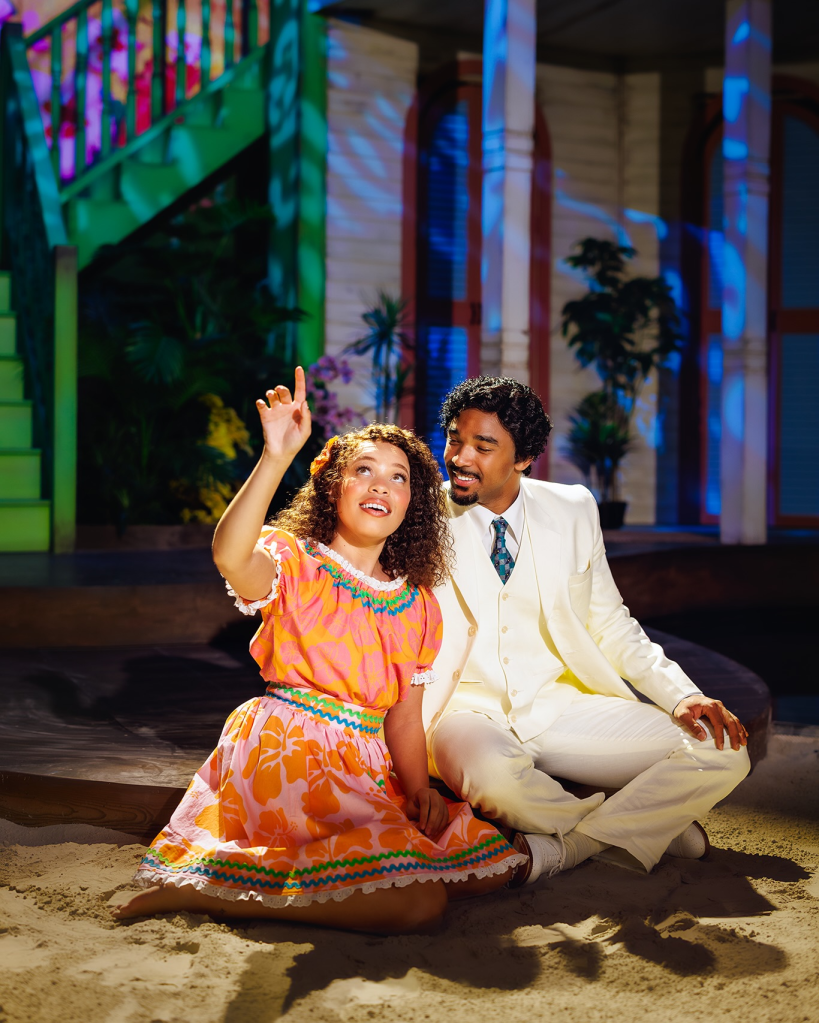
At the center of the production, Ti Moune—alternating between Blythe Snowden (Monday, Wednesday, Friday) and Sibley Snowden (Tuesday, Thursday, Saturday)—anchors the narrative with a performance that balances openness and determination. Having attended a Monday/Wednesday/Friday performance, I experienced Blythe Snowden‘s interpretation, which brings a sweetness and emotional sincerity to the role. Rather than resisting Ti Moune’s innocence, Snowden leans into the character’s naivety in a way that feels earnest rather than simplistic, allowing her hopefulness and belief in possibility to remain emotionally compelling throughout the production. As the story moves through increasingly mythic terrain, Ti Moune’s journey still feels intimate and deeply human.
Opposite her, Daniel—portrayed by JRay Kuhn (Monday, Wednesday, Friday) and Corey Stefon Johnson (Tuesday, Thursday, Saturday)—captures the pull between genuine affection and the expectations placed upon him by the world around him. There is warmth in the performance, but also an underlying uncertainty that keeps the character from slipping into straightforward romance. That tension becomes essential to the production, especially as the realities of class and social obligation begin to close in around him. In the MWF performance, Kuhn also brings a rich vocal presence to the role, particularly in the show’s more intimate musical moments.
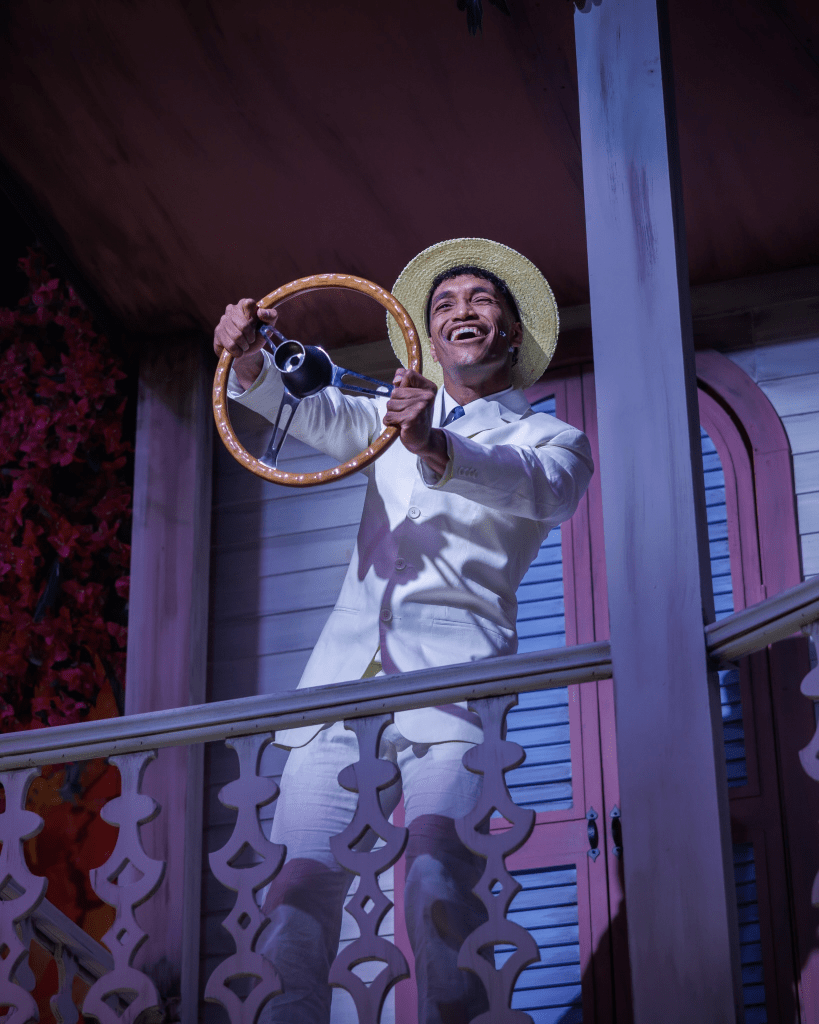
Daniel’s solo “Some Girls” becomes one of the clearest articulations of the musical’s central conflict between personal desire and social expectation. In the song, Daniel contrasts Ti Moune’s authenticity with the carefully cultivated expectations placed upon upper-class women, admiring the way she “sees the world through a child’s wide eyes.” Yet the song simultaneously exposes the limitations of his worldview. The line “some girls you marry, some you love” reveals that, despite his affection, Daniel remains deeply shaped by the class structures surrounding him. The moment becomes bittersweet precisely because the audience can feel both his sincerity and his inability to imagine a world beyond those boundaries.
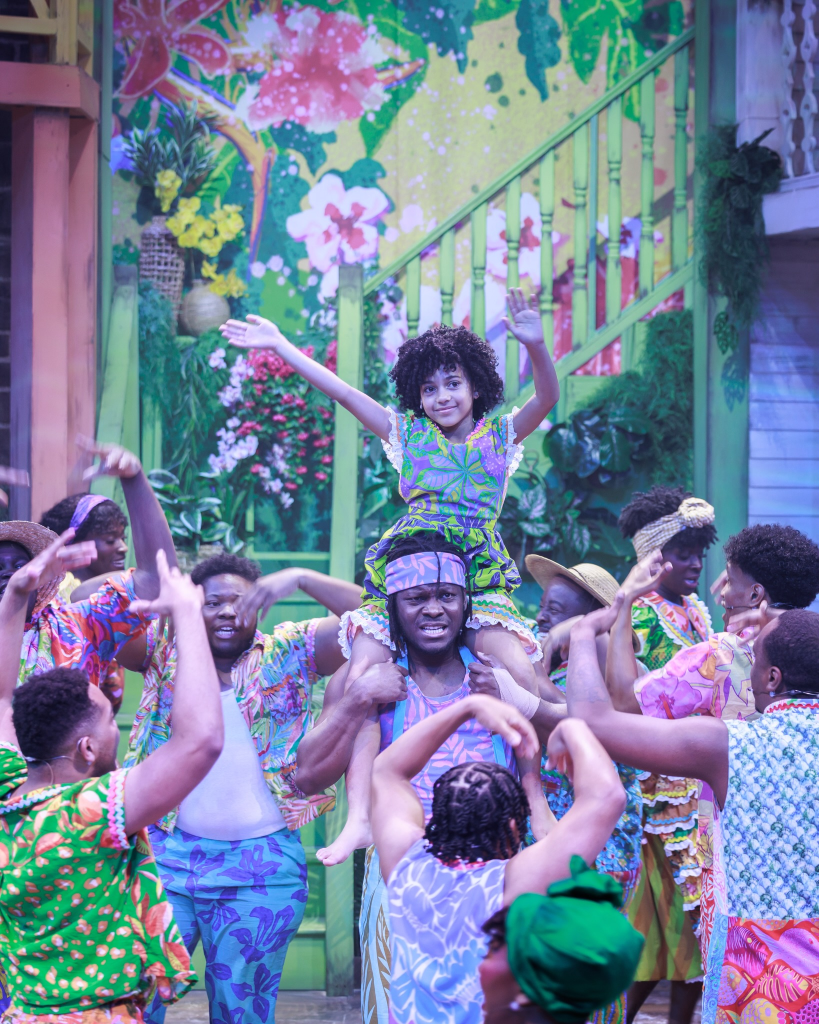
The ensemble functions as the true engine of the production, with standout performances by Paola Molina Guzmán as Andrea and Chad Brown as Armand helping deepen the musical’s emotional and social tensions. Serving simultaneously as villagers, storytellers, and extensions of the gods, the cast moves fluidly between roles, creating a sense of constant transformation. Their presence reinforces the idea that this story does not belong to any single character—it is collectively held and continuously reshaped. Group numbers feel less like traditional set pieces and more like acts of communal witnessing, with voices layering together to build both rhythm and meaning.
The four gods emerge as the undeniable standouts of the evening. With commanding stage presence and exceptional vocal performances, they elevate every scene in which they appear. Their chemistry and confidence anchor the production, lending the musical a mythic scale without losing its emotional intimacy.
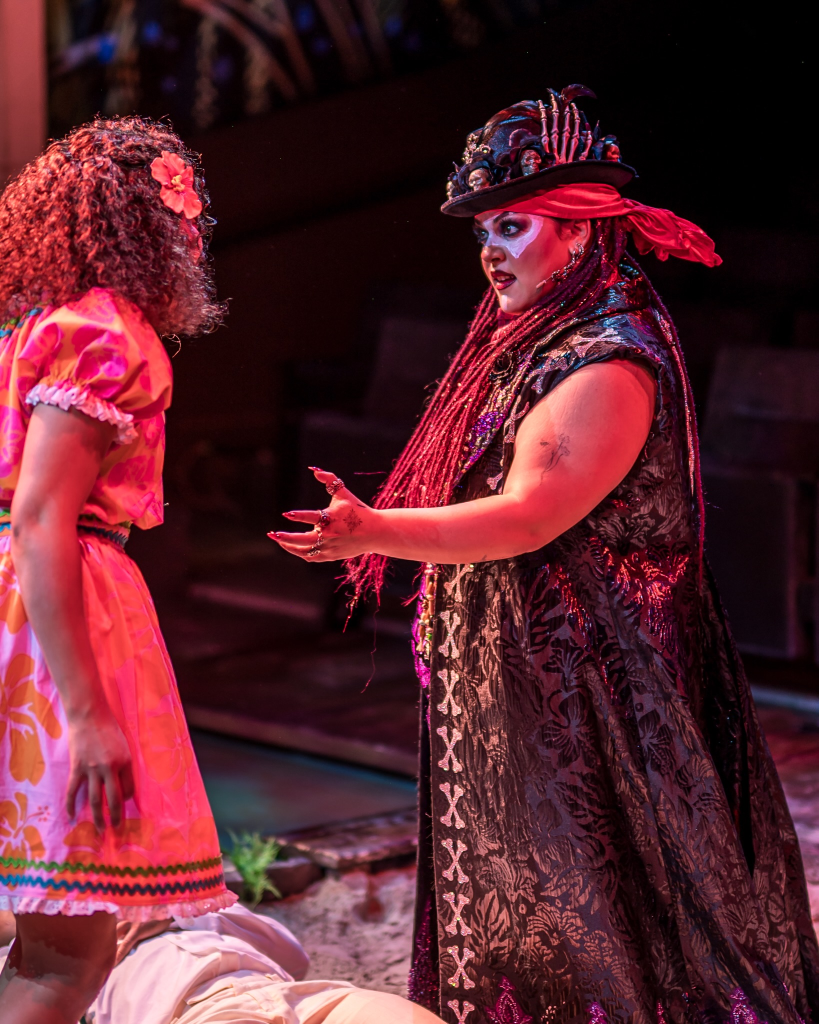
Among them, Beatriz Melo (Papa Ge, single cast) commands the stage with sharp, controlled energy. Typically played by a male performer, Melo brings a distinct interpretation to the role, and the result is mesmerizing—measured, deliberate, and deeply unsettling. Her performances during “Promises” and “Forever Yours (Reprise)” lean fully into the character’s seductive manipulation and theatrical menace.
In contrast, Anya Sulimoni (Monday, Wednesday, Friday) and Malia Morris (Tuesday, Thursday, Saturday) as Erzulie provide a lyrical emotional counterpoint. In the performance I attended, Sulimoni grounds the production’s exploration of love in warmth and vulnerability, particularly during “The Human Heart,” where the musical’s emotional center becomes most visible.
As Asaka, Brittany Andam (Monday, Tuesday, Friday) and Aria Love Jackson (Wednesday, Thursday, Saturday) emerge as stabilizing forces. In the MWF performance, Andam nearly stops the show with “Mama Will Provide,” the high-energy Act One closer filled with rapid-fire vocal runs, infectious momentum, and commanding stage presence that electrifies the audience heading into intermission.
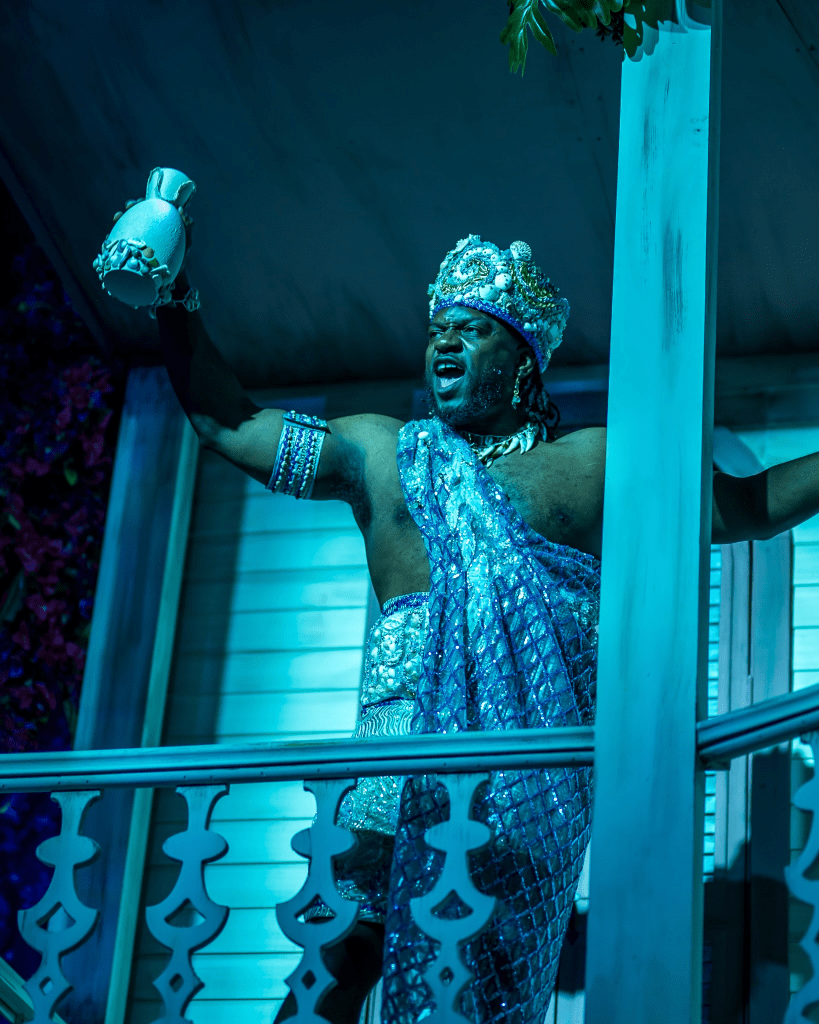
Meanwhile, Yahosh Bonner (Monday, Wednesday, Friday) and Kiirt Banks (Tuesday, Thursday, Saturday) as Agwe contribute a fluidity and physicality that beautifully complement the production’s elemental storytelling. During “Rain,” the vocals, choreography, ensemble movement, and environmental staging combine to create one of the production’s most visually dynamic sequences. Banks performed the evening I attended, and his rich, resonant vocal performance became one of the musical highlights of the night.
The gods—Asaka, Agwe, Erzulie, and Papa Ge—function less as divine overseers and more as rhetorical forces shaping the narrative’s stakes. They debate, intervene, and manipulate events, framing Ti Moune’s journey as an experiment: can love overcome death?
This framing is crucial. The gods do not simply observe; they construct the conditions of the story. Their wager transforms Ti Moune into a kind of rhetorical figure—an embodiment of love’s potential and its limits. Papa Ge’s challenge to “prove that death is stronger than love” reveals the story’s central tension: not whether love exists, but whether it can disrupt entrenched systems of power.
The production’s emotional grounding also owes much to the performers portraying Ti Moune’s adoptive family and the framing storytellers. Koryn Sobel (Mama / Female Swing, Monday, Wednesday, Friday) brings warmth, emotional steadiness, and impressive vocal power to the role, while Rosemay Webster assumes the role on alternating evenings. Likewise, Oba Bonner portrays Tonton (Monday, Wednesday, Friday) and Nicholas Warren portrays Tonton on Tuesday, Thursday, and Saturday performances, contributing to the production’s emphasis on communal care and generational storytelling. Nahla Fernelius (Monday, Wednesday, Friday) and Heidi Malia Warren (Tuesday, Thursday, Saturday) also stand out as the Little Girl, serving as central storytellers whose strong vocal performances help frame the musical’s emotional core. Their presence becomes a beautiful reminder that stories survive because they are passed from one generation to the next.
Production Highlights
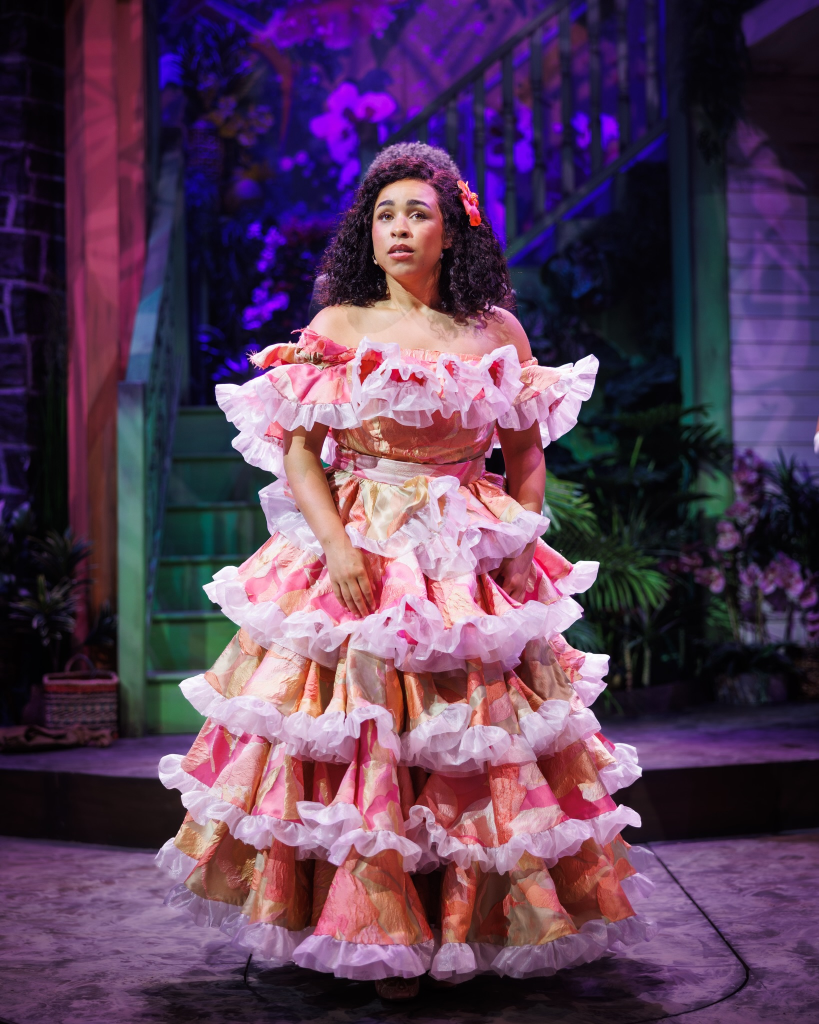
The production’s visual design is among the evening’s greatest strengths, with both the costuming and scenic design emerging as clear standouts. Candice Nielsen’s costume design embraces the musical’s blend of folklore, ritual, and elemental storytelling, creating a world that feels textured, dynamic, and visually cohesive. Seeing the ensemble adorned in bright, Caribbean-inspired costumes rich with vibrant patterns and color creates a visually stunning stage picture throughout the evening. The costumes feel alive in motion, allowing choreography and ensemble storytelling to remain central while contributing to the production’s celebratory, folkloric atmosphere.
Equally impressive is Carter Thompson’s scenic design, which transforms the stage into a space that feels simultaneously intimate and mythic. Rather than relying on excessive realism, the production uses tactile environmental elements—most notably actual sand and water—to create a world that feels physically lived in. Cast members splash through water, wash clothing by hand, and move barefoot through the sand, grounding the musical’s folkloric storytelling in tangible physical detail. The effect is especially striking during dance sequences, where movement through the sand adds texture, weight, and authenticity rather than simply functioning as spectacle.
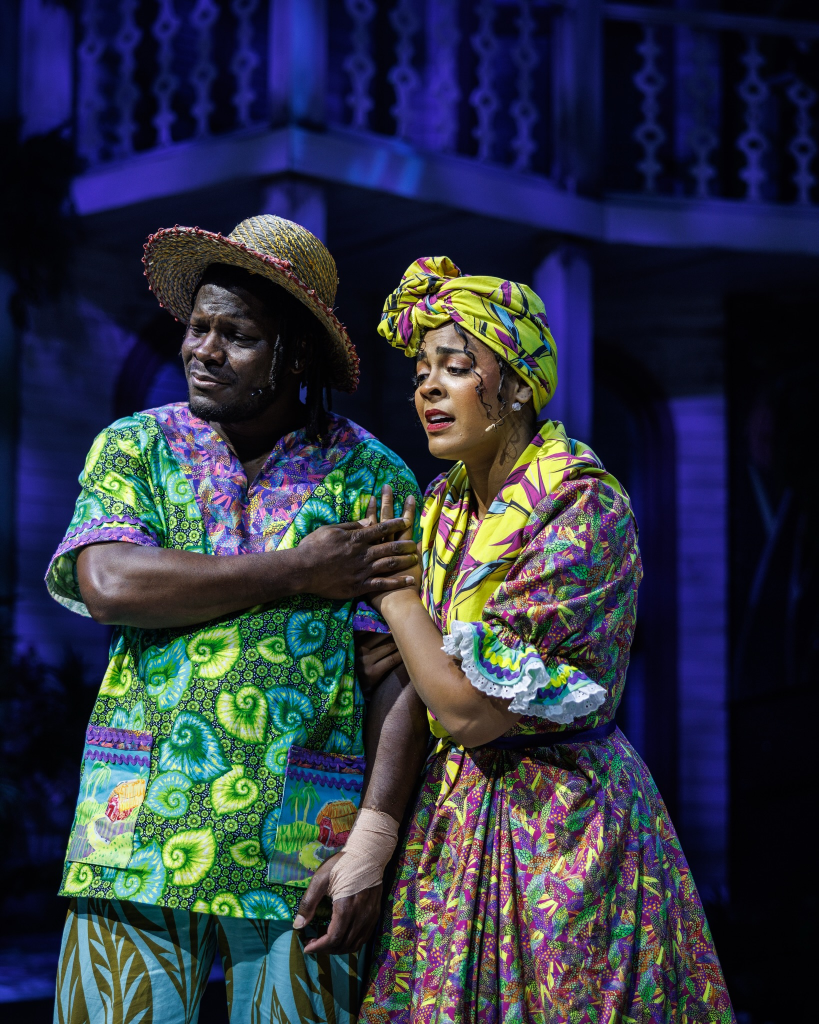
The immersive quality of the production is heightened further through the interplay between scenic, lighting, and sound design. Michael Gray’s lighting design and Tim Riggs’ sound design work in tandem to create an environment alive with storms, rainfall, thunder, lightning, and layered rainforest sounds. At several moments, the theater itself seems to transform into the island environment, allowing transitions between ritual, memory, celebration, and danger to feel fluid and emotionally immediate.
The production’s movement vocabulary, shaped by choreographer Izzy Arrieta, plays a central role in sustaining the show’s communal energy. Ensemble movement rarely feels ornamental; instead, choreography becomes part of the storytelling language itself, particularly during “Rain” and “Mama Will Provide,” where rhythm, gesture, and collective movement transform the stage into a living ritual space.
The production also demonstrates strong attention to vocal and linguistic detail. Under the guidance of dialect coach Myah Bridgewater, the cast navigates the musical’s Caribbean-inspired speech patterns with clarity and care, contributing to the production’s immersive atmosphere without allowing the accents to feel exaggerated or distracting.
Conclusion
For contemporary audiences, the musical resonates as a reminder that systems of inequality are not abstract—they are lived, felt, and reproduced through everyday practices. But it also offers a model for how those systems might be challenged: not through singular acts of heroism, but through the persistence of story, memory, and community.
The final number, “Why We Tell the Story,” ultimately reveals the musical’s deepest investment: not tragedy for tragedy’s sake, but storytelling as a communal act of survival. Pain, grief, hope, and love all become reasons the story must continue to be told. Collectively, the cast and creative team succeed in creating a production where no single element overwhelms the others. Instead, meaning emerges through accumulation—gesture by gesture, voice by voice, story by story. In that sense, this staging of Once on This Island understands the musical’s central truth: stories survive because communities choose to come together and carry them forward anyway.

About the Show
The Ruth and Nathan Hale Theater presents Once on This Island in the Lindsay Legacy Theater from May 4 through July 3, 2026. Directed by Lisa Hall, the production features alternating casts throughout the week and runs approximately two hours, including intermission
Ticket prices vary by seating location and performance date, with standard tickets generally ranging from approximately $58–$96 through ticket vendors, though pricing may fluctuate based on demand and seating selection. Performances are scheduled Monday through Saturday, with evening performances at 7:30 p.m. and select Saturday matinees.
The production also includes immersive front-row seating, with audience members seated close to the stage’s sand, water, and environmental effects. According to the theater’s ticketing information, guests in the front row may experience splashing water and other interactive elements as part of the storytelling environment.
Tickets, accessibility information, parking details, and digital playbill materials are available through The Ruth and Nathan Hale Theater website: https://www.theruth.org/events/detail/once-on-this-island
creative team
Directed by Lisa Hall
Music Direction by Alec Powell
Choreography by Izzy Arrieta
Scenic Design by Carter Thompson
Costume Design by Candice Nielsen
Lighting Design by Michael Gray
Sound Design by Tim Riggs
Inclusion Consulting and Director’s Assistance by Shelby Noelle Gist
Props Design by Megan Heaps
Wigs, Hair, and Makeup Design by Bekah Wilbur
Stage Management by Anna Birch
About the Creators
Lynn Ahrens and Stephen Flaherty are one of the most celebrated writing teams in contemporary musical theatre. Their collaborations include Ragtime, Anastasia, and Seussical, works often characterized by emotionally driven storytelling, sweeping musical scores, and an interest in history, identity, and community. Based on Rosa Guy’s novel My Love, My Love, Once on This Island premiered in 1990 and remains one of their most enduring works, praised for its fusion of Caribbean-inspired storytelling traditions with contemporary musical theatre form.


Leave a Reply