

SALT LAKE CITY, UT— Pioneer Theatre Company closes its 2025–2026 season with Come From Away, a heartfelt musical that looks beyond tragedy to the human response that follows. Director Karen Azenberg frames the production through her own experience of September 11, 2001, recalling a morning in Manhattan that began like any other, only to rupture into uncertainty. For those who lived through it, the date carries a weight that requires no explanation. For those born after, it exists differently—less as memory and more as something learned, pieced together through stories, images, and accounts passed down.
I was a child in Hawai‘i when I woke up to the first tower having already been struck. I remember being kept home from school, watching the television without fully understanding what I was seeing, but sensing through my mother’s worry that something irreversible had happened. Years later, I returned to that moment from a different angle, sitting in the audience with my eleven-year-old son—born more than a decade after it happened—who had read Jim DeFede’s The Day the World Came to Town in preparation for the show. A self-described bookworm, he gravitates toward historical narratives because they allow him to place himself inside experiences he has never lived, to feel as though he is there. Watching Come From Away with him, I realized the musical was attempting something similar—and largely succeeding.
However, it is also worth acknowledging the limits of the piece. Come From Away does not attempt to capture the full scope or lasting effects of 9/11—and it is not meant to. Instead, it focuses on a specific window of response, choosing to center moments of care, connection, and generosity rather than the broader complexities of loss and aftermath.
Rather than recreating the events, the production turns toward what followed. It asks not how we remember the tragedy itself, but how we understand the moments of response that emerged around it—moments shaped not by proximity to the attacks, but by the choices of ordinary people suddenly placed in extraordinary circumstances.
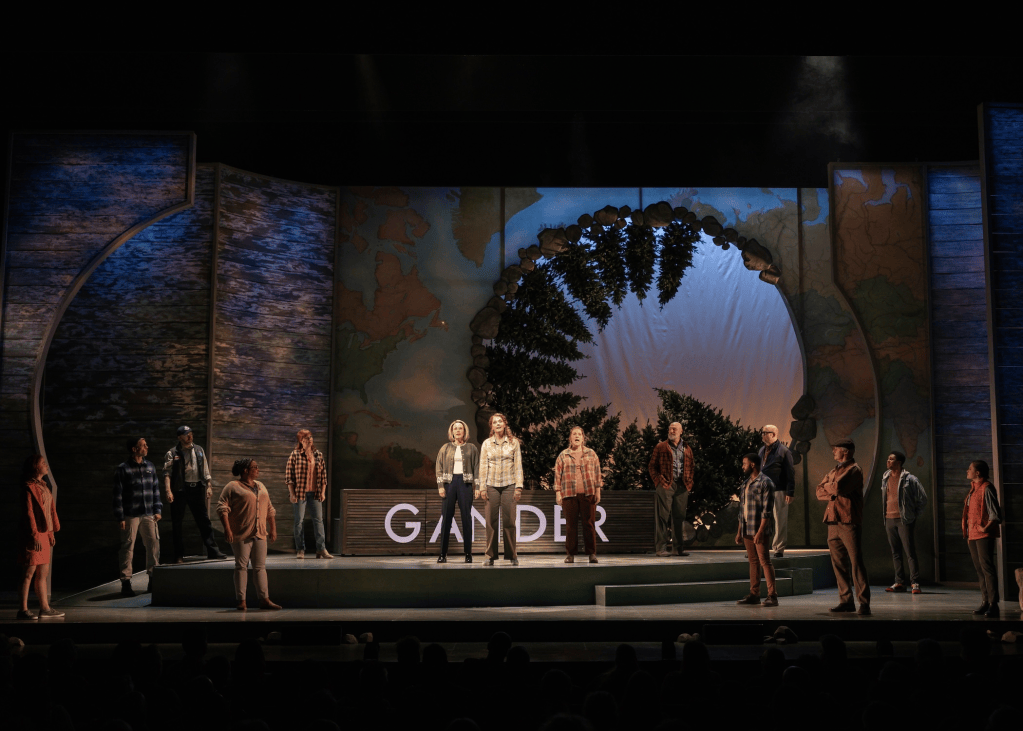
Production Overview
With book, music, and lyrics by Irene Sankoff and David Hein, Come from Away tells the story of 38 planes carrying nearly 7,000 passengers that were diverted to the small town of Gander, Newfoundland, in the immediate aftermath of the September 11 attacks. What followed, known as Operation Yellow Ribbon, transformed a remote town of fewer than 10,000 residents into a temporary home for thousands of stranded travelers from around the world.
Directed and choreographed by Karen Azenberg, with musical direction by Phil Reno, this Utah premiere at Pioneer Theatre Company embraces the musical’s ensemble-driven structure. A cast of fourteen actors portrays dozens of characters, shifting rapidly between roles and perspectives to construct a narrative that is less about individual protagonists and more about collective experience. Come From Away is not a conventional retelling of events; instead, the production moves through overlapping stories of passengers and townspeople, capturing moments of confusion, fear, humor, and unexpected connection. In doing so, it reframes a global crisis through a localized lens, centering not the event itself, but the acts of care that emerged in its wake.
While Come From Away is grounded in real events, it is not a documentary reconstruction so much as a carefully shaped theatrical synthesis of lived experience. Developed from extensive interviews conducted by Sankoff and Hein, the musical draws on firsthand accounts of the stranded passengers and the Gander residents who received them, preserving many of the events that define the story—from the prolonged confinement on grounded planes to the spontaneous generosity of the town. At the same time, the production relies on composite characters, condensed timelines, and heightened moments of interaction to translate those experiences into a cohesive narrative. Individuals like Beverley—based on real-life pilot Beverley Bass—and the real-life couple Nick Marson and Diane Gray emerge from documented histories, while others, such as Hannah, draw from multiple sources, including the story of Diane Snyder, whose son, firefighter Kevin Tuerff, was initially missing. These figures are streamlined and interwoven to emphasize collective rather than singular experience. In this way, the musical prioritizes emotional and ethical truth over strict factual replication, allowing it to function not only as a retelling of what happened, but as a reflection on how those events were felt, remembered, and shared.
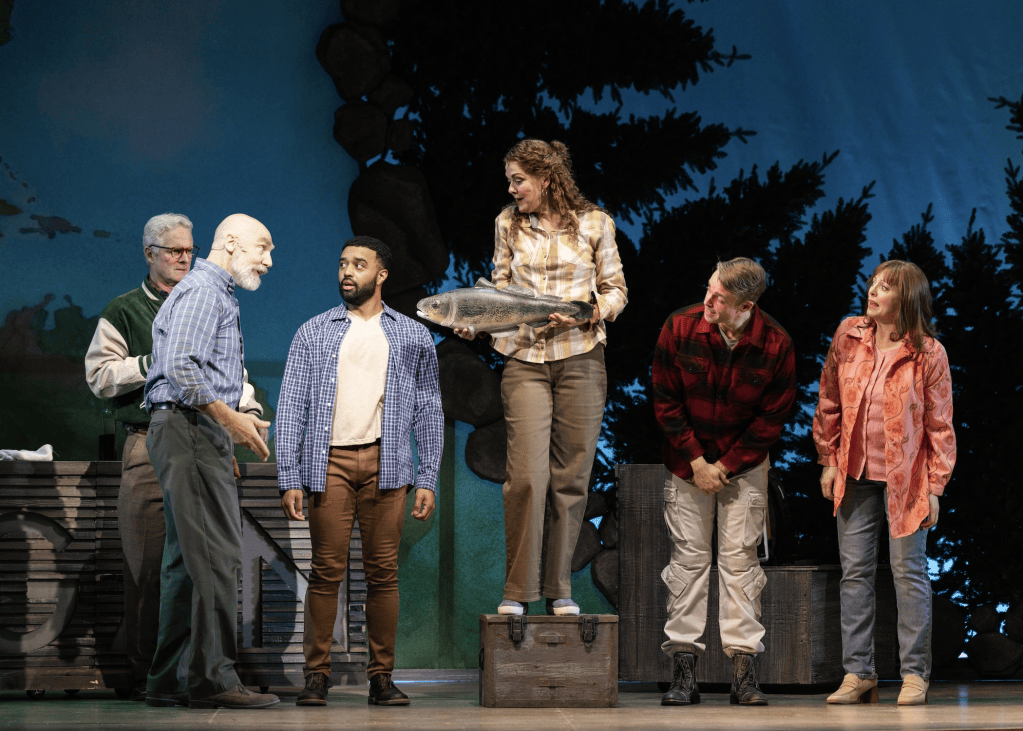
Ensemble & Performances
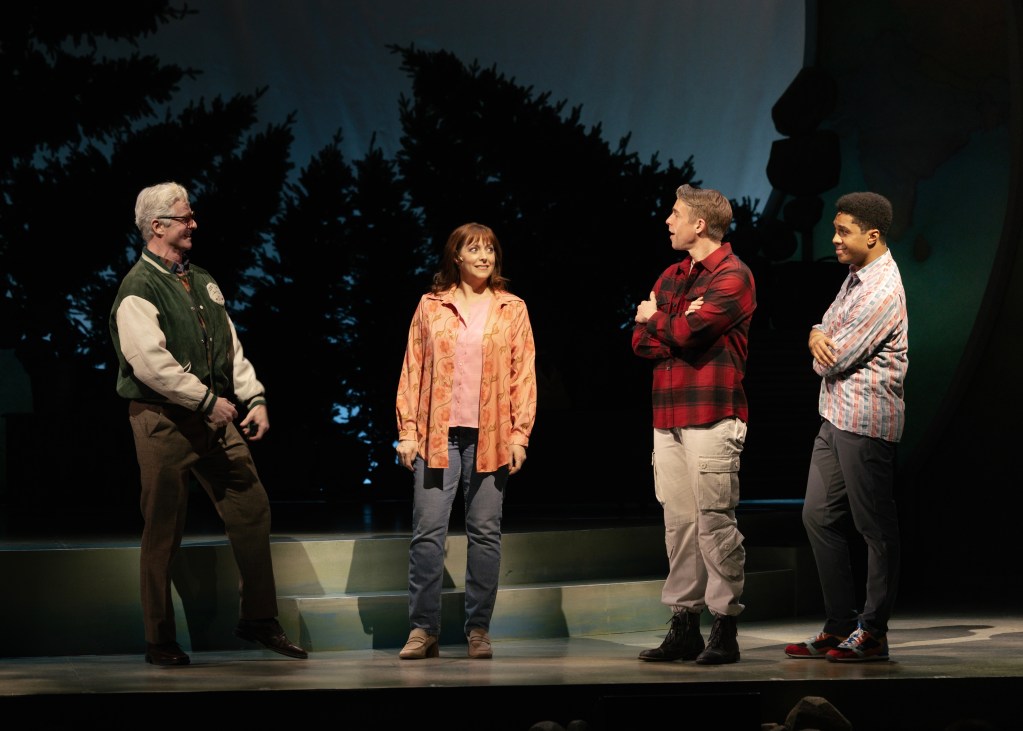
Come From Away is powered by a tightly unified ensemble, transforming character, costume, and accent with remarkable speed and precision. With only fourteen actors portraying dozens of characters, the production relies on precision, physicality, and vocal clarity to move fluidly between perspectives. The effect is not disorienting, but cumulative. Each shift builds a broader sense of shared experience, reinforcing the idea that this story does not belong to any single individual, but to a network of intersecting lives. Even with standout performances, the real star here is the ensemble itself—precise, responsive, and impossible to separate into parts.
That cohesion is no accident. This cast includes performers with Broadway credits such as Pamela Bob (A Gentleman’s Guide to Love and Murder), Mary Fanning Driggs (Natasha, Pierre & The Great Comet of 1812), Brian O’Brien (Chicago), Nic Rouleau (The Book of Mormon), Jessica Rush (Dear Evan Hansen), John Schiappa (Girl from the North Country), Angie Schworer (The Prom), and Matthew Stocke (Titanic), alongside extensive national touring and regional experience from Lucy Anders, Galyana Castillo, Lenny Daniel, Nathan Andrew Riley, and David Rowen. Collectively, the ensemble brings decades of professional performance experience to the stage, and it shows. The rapid transitions feel seamless rather than mechanical, grounded in a level of trust and technical command that allows the storytelling to unfold with clarity and momentum.

While Come From Away resists traditional, star-driven solos, it strategically allows individual voices to emerge at key emotional points. Jessica Rush’s performance of “Me and the Sky” stands as the musical’s most fully realized solo, offering a powerful reflection on the career of Beverley Bass and the sudden rupture brought on by crisis. The number provides a rare moment of sustained focus, grounding the broader narrative in a deeply personal perspective, and Rush delivers a standout performance with this technically and emotionally demanding song.
Similarly, “I Am Here,” led by Galyana Castillo as Hannah, centers grief and uncertainty with striking restraint. Though supported by the ensemble, the emotional weight of the song rests in her presence, creating a moment that feels both intimate and expansive. Castillo’s rich, resonant voice suits the number beautifully, and she delivers a performance that captures the quiet intensity the song requires, allowing the emotion to land without feeling overstated.
Other sequences distribute focus more fluidly. “Prayer” layers multiple voices and languages, briefly foregrounding individual performers within a shared expression of grief and hope. Throughout, the ensemble’s ability to balance humor, tension, and sincerity ensures that the production never settles into a single emotional register. Instead, it reflects the uneven, often contradictory nature of lived experience, where fear and kindness, uncertainty and connection, exist simultaneously.

Themes & Critical Perspective
Come From Away is a story about response—about what happens when ordinary systems fail, and ordinary people are asked to do something extraordinary. Again and again, the production returns to the idea that crisis does not create character so much as reveal it. Faced with uncertainty, both the residents of Gander and the stranded passengers are forced into positions they did not anticipate, navigating not only logistical challenges but emotional ones as well.
What emerges most clearly is that these acts of care are not effortless. The musical resists presenting generosity as automatic or uncomplicated, instead showing how trust must be built across difference—across nationality, language, religion, and personal fear. Examples include passengers confined to planes for nearly 28 hours, suspended in uncertainty; a character admitting, “I need something to do because I can’t watch the news anymore,” capturing the emotional paralysis of the moment; and a bus driver improvising communication across a language barrier by pointing to a passage in a shared text. Each of these moments underscores that connection is not immediate—it is constructed, often awkwardly, through action.
This tension is further complicated by the ways fear operates beneath the surface. A passenger initially expresses concern about his safety and belongings, visibly uneasy in an unfamiliar environment. When he is later asked to help collect barbecues from local homes, the task forces’ direct engagement with the very community he distrusts. What begins as hesitation gradually shifts into connection, culminating in a realization that reframes his earlier fear. The moment does not erase discomfort, but it traces the process through which trust is built.
At the same time, the production ultimately leans toward cohesion. Examples include the national moment of silence observed in Canada for a tragedy centered in the United States, as well as “Prayer,” in which multiple languages overlap in a shared expression of grief and hope. These moments gesture toward a broader sense of global empathy, but they also reveal the production’s selective focus. While it acknowledges unease and division, it does not linger there. The narrative consistently returns to connection, emphasizing generosity and shared humanity over sustained conflict.
Whether this is a limitation or a conscious framing depends on how one approaches the work. What is clear is that Come From Away is less interested in interrogating the full complexity of the moment than in preserving a particular kind of story about it—one centered on kindness, resilience, and the capacity for people to care for one another in the absence of certainty.
In that sense, the production offers not a comprehensive account of crisis, but a selective one. It highlights the moments where individuals step beyond themselves, where ordinary people are called into extraordinary roles. That framing may simplify certain aspects of the historical reality, but it also clarifies the musical’s purpose: not to document everything that happened, but to ensure that these particular acts of care are remembered.
“Stop the World”: Love as Geography
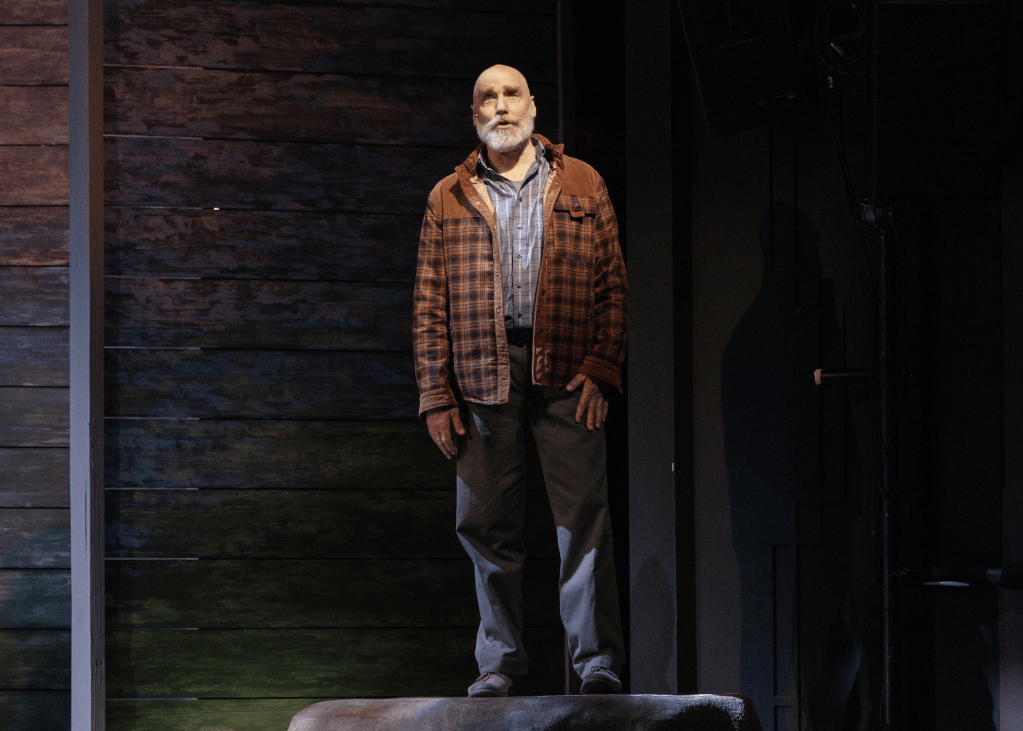
One of the most visually and thematically resonant moments comes during “Stop the World,” performed by Brian O’Brien and Pamela Bob, which frames Nick and Diane’s relationship through the language of geography and time. As the song begins, the pace softens, and the constant motion of the ensemble recedes, allowing a quieter, more intimate space to emerge. Nick and Diane stand at the center, their connection shaped by attention—attention to place, to time, and to one another.
Diane’s reflection on the land beneath them—“five hundred and forty million years ago, the continents… crashed together… and… separated again”—initially feels like a passing observation. Yet the production quietly builds around that idea, allowing it to resonate visually as well as lyrically. The scenic design by Jo Winiarski reinforces this sense of convergence through its circular formation of trees and wood, a space that feels both grounded in Newfoundland and abstracted into something more symbolic. Maps embedded into the environment subtly echo global movement, while the arrangement of the stage suggests a world drawn inward to a single point of contact.
Within this visual framework, Gander becomes more than a geographic location. It reads as a point of intersection—a kind of fault line where lives meet briefly but meaningfully before shifting again. The design does not attempt to replicate realism; instead, it creates a space that feels suspended, as though the characters have stepped outside the forward momentum of the world. The lighting design by José Santiago deepens this effect through soft gradients that evoke sunrise and sunset, holding the stage in a liminal glow that suggests time is passing and pausing all at once.
That sense of suspension is crucial to the emotional structure of the scene. While the staging allows the moment to feel expansive and almost timeless, the song itself resists any illusion of permanence. Diane’s awareness of the moment’s fragility undercuts the romantic impulse to fix the connection in place. Even as the relationship deepens, there is an understanding that it exists within a narrow window—shaped by circumstance, not control. The circularity of the set reinforces this tension, suggesting both unity and eventual separation, much like the continents Diane describes.
In this way, the relationship between Nick and Diane mirrors the larger structure of the musical. Just as the passengers and the people of Gander are brought together under extraordinary circumstances, forming bonds that feel immediate and essential, they are also eventually pulled apart when the world resumes its course. The scenic elements—wood, stone, and shifting structures—underscore this impermanence, constantly reconfiguring to reflect changing needs and fleeting connections. “Stop the World” becomes a meditation on what it means to exist within that convergence, suggesting that even temporary intersections can carry lasting weight long after the moment itself has passed.
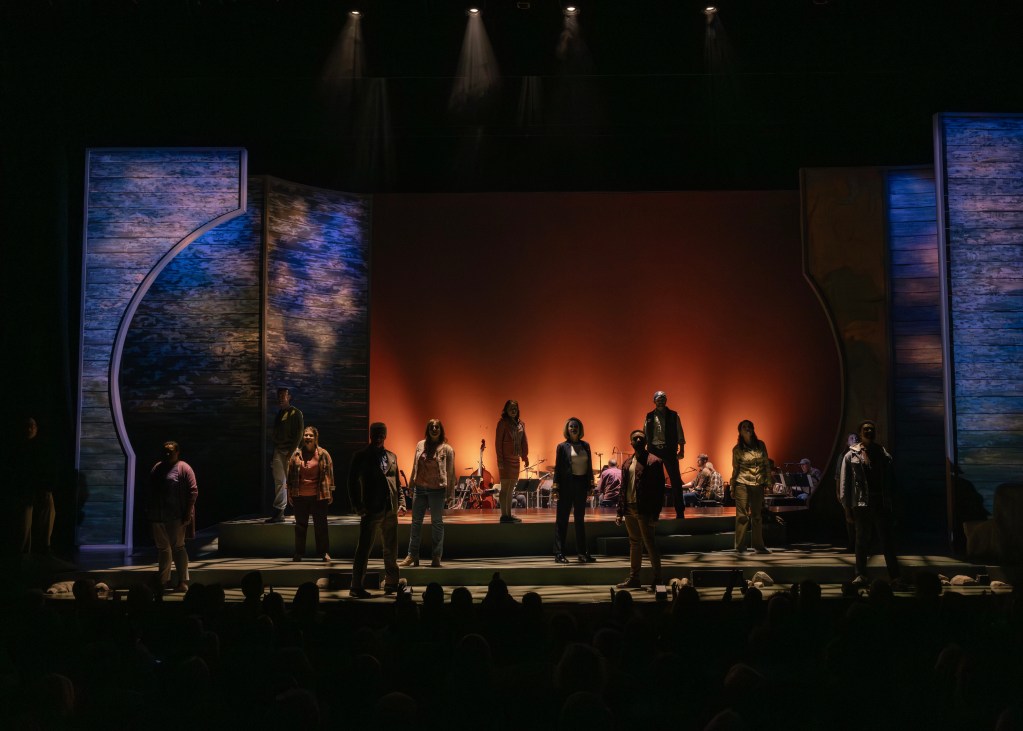
Conclusion
Come From Away is not a story about stopping time, but about what becomes visible within it. Moments of crisis have a way of stripping life down to its essentials, revealing not only what is fragile, but what endures. Throughout the production, characters are repeatedly faced with uncertainty—cut off from information, separated from loved ones, and placed in unfamiliar environments. What emerges is not a single narrative of heroism, but a series of small, deliberate choices to act, to help, and to connect.
Watching the production alongside my son, I was struck by how differently we each arrived at the story, and yet how similarly we experienced it. For him, the events of 9/11 exist as something learned, encountered through reading and retelling. For me, they remain tied to a childhood memory, shaped more by emotion than understanding. And yet, in the space of the theatre, those perspectives converge. The musical does not attempt to recreate the event itself, but instead creates a framework through which it can be felt, considered, and shared across generations. That impulse is captured most clearly where characters attempt to hold onto a fleeting moment. Like the continents in “Stop the World”—and echoed in the set design—colliding, separating, and leaving traces behind—the relationships formed in Gander exist within a temporary convergence. The world does not remain still, but the impact of those intersections persists.
Come From Away ultimately suggests that meaning is not found in the scale of the event, but in the response to it. Sometimes, ordinary people are asked to step into extraordinary positions. What matters is not that they are prepared, but that they choose to act anyway.
| COME FROM AWAY Book, Music, and Lyrics by IRENE SANKOFF and DAVID HEIN Come From Away is presented through special arrangement with Music Theatre International (MTI). All authorized performance materials are also supplied by MTI. www.MTIShows.com WHEN April 24-May 9, 2026 TIMES Monday – Thursday, 7:00 PM Friday and Saturday, 7:30 PM Saturday, 2:00 PM WHERE Come From Away will be performed at Simmons Pioneer Memorial Theatre, 300 South 1400 East, Salt Lake City PRICES $57 – $83Students K – 12 or ages 5-18 are half-price Monday – Thursday Curtain Call for All (“name your own price”) performances: April 24-May 9. Curtain Call for All tickets for Come From Away will be available starting Monday, April 20, at 10:00 AM. ASL-Interpreted performances: Monday, February 9 at 7:00 PM. Discounts are also available for University of Utah students, staff, and faculty. Visit PioneerTheatre.org/UniversityofUtah for more details. MORE INFO The PTC Box Office is located in Simmons Pioneer Memorial Theatre:300 S 1400 E.Box Office: 801-581-6961 Open 10:00 AM – 6:00 PM, Monday – Friday PTC Show Listing: Come From Away CAST Janice & Others: LUCY ANDERS Diane & Others: PAMELA BOB* Hannah & Others: GALYANA CASTILLO* Doug & Others: LENNY DANIEL* Beulah & Others: MARY FANNING DRIGGS* Nick & Others: BRIAN O’BRIEN* Kevin J. & Others: NATHAN ANDREW RILEY* Kevin T. & Others: NIC ROULEAU* Bob & Others: DAVID ROWEN* Beverley & Others: JESSICA RUSH* Claude & Others: JOHN SCHIAPPA* Bonnie & Others: ANGIE SCHWORER* Oz & Others: MATTHEW STOCKE* Micky & Others: JORDAN SOPER CREATIVE TEAM Director/Choreographer: KAREN AZENBERG Musical Director/Conductor: PHIL RENO Scenic Designer: JO WINIARSKI Costume Designer: PATRICK HOLT Lighting Designer: JOSÉ SANTIAGO Sound Designer: AARON HUBBARD Hair & Makeup Designer: KATE CASALINO Dialect Coach: SARAH SHIPPOBOTHAM Dramaturg: ALEXANDRA HARBOLD Associate Director: LENNY DANIEL Casting: BOB CLINE Production Stage Manager: JAMES O. HANSEN* *Member of Actors’ Equity Association, the Union of Professional Actors and Stage Managers in the United States. ABOUT PIONEER THEATRE COMPANY (PTC) Now celebrating its 64th season, the award-winning PTC is Utah’s premier professional theatre company and a leading arts organization of the West. Led by Artistic Director Karen Azenberg and Managing Director Adrian Budhu, PTC presents world-class productions that celebrate diversity in culture and society, and serve as the connecting bridge between art and scholarship as an affiliate of the University of Utah. Notable productions include the regional premieres of Les Misérables, Sting’s The Last Ship, and Frank Wildhorn’s The Count of Monte Cristo, as well as the world premieres of Shucked (the first-ever Broadway tryout in Utah), A Distinct Society by Kareem Fahmy, Alabama Story by Kenneth Jones, The Messenger by Jeff Talbott, and Ass by Ellen Simon. For more information, visit PioneerTheatre.org. |
| Pioneer Theatre Company | 300 South 1400 East, Salt Lake City, Utah 84112801-581-6961 | info@pioneertheatre.org | www.pioneertheatre.org |


Leave a Reply