

Directed and Written by Beth de Araújo | 120 minutes
Produced by David Kaplan, Josh Peters, Beth de Araújo, Marina Stabile, Mark H. Rapaport, and Crystine Zhang.
Cinematography: Greta Zozula · Editing: Anisha Acharya, Nico Leunen, Kyle Reiter
Production Design: Tom Castronovo · Costume Design: Bridget Bruce & Jillian Johns
Music by Miles Ross
Starring Mason Reeves, Channing Tatum, Gemma Chan, Philip Ettinger, Syra McCarthy, and Eleanore Pienta
Park City, UT — Beth de Araújo’s Josephine is one of those films that begins with a rupture and then quietly asks us to sit in the aftershocks. It opens with an ordinary Sunday run in Golden Gate Park—the kind of tender ritual a father and daughter build without thinking. And then, in a matter of seconds, that safety is obliterated when eight-year-old Josephine wanders ahead on the trail and witnesses a violent assault outside a public bathroom.
The film never sensationalizes the rape. Instead, it devotes itself to what comes after—the impossible task of a child trying to comprehend an adult horror with a child’s language, logic, and limitations. That choice is what makes Josephine one of the most devastating portraits of trauma at this year’s Sundance Film Festival.
What de Araújo understands with frightening incisiveness is that children do not process pain through clean narrative arcs. They process through fragments—stray questions, bursts of anger, odd fixations, rehearsals of safety. Josephine repeats her father’s mantra, “Scared doesn’t live here,” even as her body begins telling a different story. She fixates on seatbelts, studies strangers, tries to understand fragments of what she does understand, and reenacts danger with other children in ways that alarm the adults around her.
Mason Reeves gives a career-launching performance—raw, tender, and unsettlingly precise in capturing the moment a child realizes the world is far less safe than she believed.
What elevates Josephine beyond a single traumatic event is how vividly it reveals the everyday terrain of fear that women and girls inhabit long before most men ever recognize it. Watching Josephine re-map her world is watching the logic of rape culture unfold in real time: the rerouted paths, the watchful scanning, the instinctive calculations about safety.
The film becomes a psychological mirror for men—a way to understand the vigilance women must cultivate simply by going for a run, walking through a park, or existing in public.
This is why I hope every man will take the opportunity to watch Josephine.
Her parents—played with aching nuance by Channing Tatum and Gemma Chan—are loving, terrified, and utterly unprepared. Damien (Tatum) tries to “strength-train” fear out of his daughter through drills and toughness. Claire (Chan) tries to talk to her gently toward stability and eventually seeks therapy, which Josephine refuses. Their coping styles clash, and their marriage strains under the weight of two incompatible attempts to fix something they cannot fully understand. The film refuses to villainize either parent; instead, it shows the limits of even the deepest love.
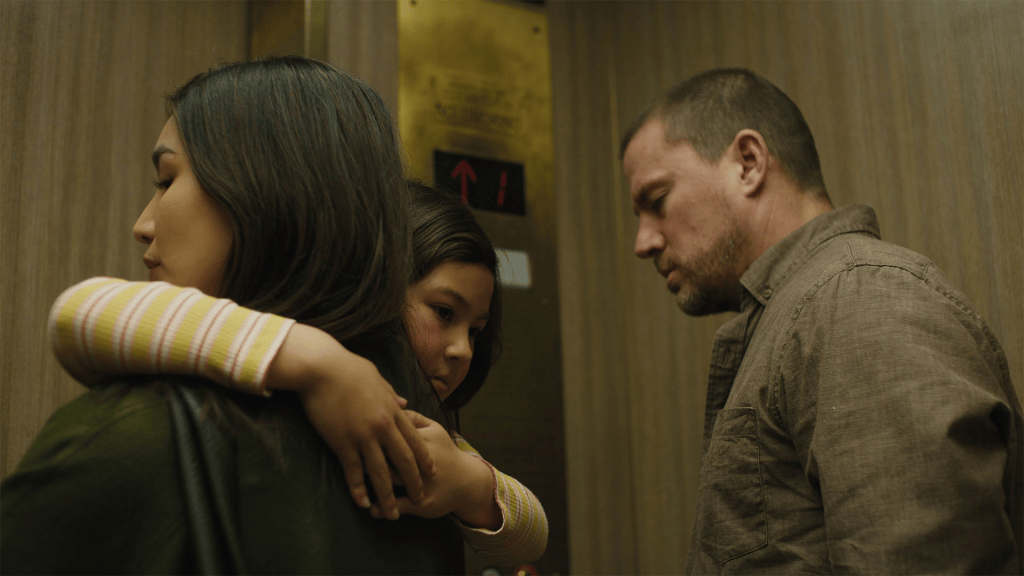
The courtroom sequence is perhaps the most searing part of the film. Josephine—already overwhelmed by what she witnessed—is suddenly expected to recount it with adult precision. She is pressed on distances, motives, eye color—details no eight-year-old could possibly retain in the midst of violence. And then comes the film’s most chilling question, delivered with bureaucratic neutrality and devastating impact:
“Why didn’t you help?”
It is a question that collapses the distance between victim and witness, turning a child’s helplessness into an indictment. In that instant, Josephine exposes the brutal logic of a justice system that demands survivors—children included—to perform their trauma flawlessly, consistently, and without contradiction. It is the moment the film makes clear that the violence did not end in the park; it simply moved into a courtroom.
Throughout the film, Josephine searches for the boundaries of safety and power. She injures a classmate while reenacting “self-defense,” panics when she thinks her mother is in danger, and oscillates between fierce independence and crumpling vulnerability. She remains a child—messy, reactive, confused, impossibly brave.
By the time she returns to the witness stand, Josephine has carried far more than any child should. De Araújo refuses the dishonest comfort of a neatly healed ending. When Josephine tells her father she is not afraid anymore that her heart feels “light,” it is not triumph—it is reprieve. A breath. A small internal shift toward something survivable.
And when her father quietly replies, “I am,” the entire architecture of rape culture crystallizes:
- A child has learned to reclaim her life.
- A father has finally learned what danger feels like.
Josephine is one of the most emotionally exacting and ethically unflinching films of Sundance 2026. It exposes not only the aftermath of trauma but the cultural conditions that frame it: the inherited fear passed from women to girls, the systems that fail survivors, and the blind spots men are allowed to keep.
This film is a gift of clarity—and a call to conscious empathy. It is a film women will recognize instantly, and a film men urgently need to see. Not because it punishes, but because it reveals a truth about the world that too often remains invisible to them.
Josephine stays with you—not for what happened in the park, but for how expertly and compassionately it shows a young girl learning how to live in its aftermath.

Credits
Director & Screenwriter: Beth de Araújo
Producers: David Kaplan, Josh Peters, Beth de Araújo, Marina Stabile, Mark H. Rapaport, Crystine Zhang
Cinematography: Greta Zozula
Production Design: Tom Castronovo
Costume Design: Bridget Bruce, Jillian Johns
Editors: Anisha Acharya, Nico Leunen, Kyle Reiter
Composer: Miles Ross
First Assistant Director: Laura Klein
Post-Producer: Kate Sharp
Content Advisory
Contains sexual assault (rape), child witnessing violence, emotional intensity, and themes related to trauma. Not recommended for audiences 17 and under. For more information, go here
Screenings
- Jan 23, 2:45 PM MST — Eccles Theatre (Park City) — Closed Caption
- Jan 24, 8:30 AM MST — The Ray Theatre (Park City) — Open Caption, ASL (Q&A only)
- Jan 26, 1:00 PM MST — Rose Wagner Center (Salt Lake City) — Closed Caption
- Jan 29, 4:00 PM MST — Megaplex Redstone 1 (Park City) — Closed Caption
- Feb 1, 4:30 PM MST — The Yarrow Theatre (Park City) — Closed Caption
Available in person and online for the public (Jan 29–Feb 1) and for press & industry (Jan 28–Feb 1).


Leave a Reply