

(as defined by the Rhetorical Review)
Actors often say they don’t read reviews, and I completely understand why. Protecting your energy and your sense of self is vital in a field that demands so much vulnerability.
I am writing this post for those looking for advice on how to write reviews thoughtfully and with care. I don’t write to judge; I write to witness—to honor the work being made in our community— and to create an archive of it.
But I also know that not everyone approaches reviewing this way, and that reviews can cause real harm. That’s exactly why I believe thoughtful, responsible criticism matters.
With all that said, this is a guide for writers, critics, and audience members alike—a reminder that reviews can be acts of connection, not combat.
(If I missed something, add it in the comments below.)
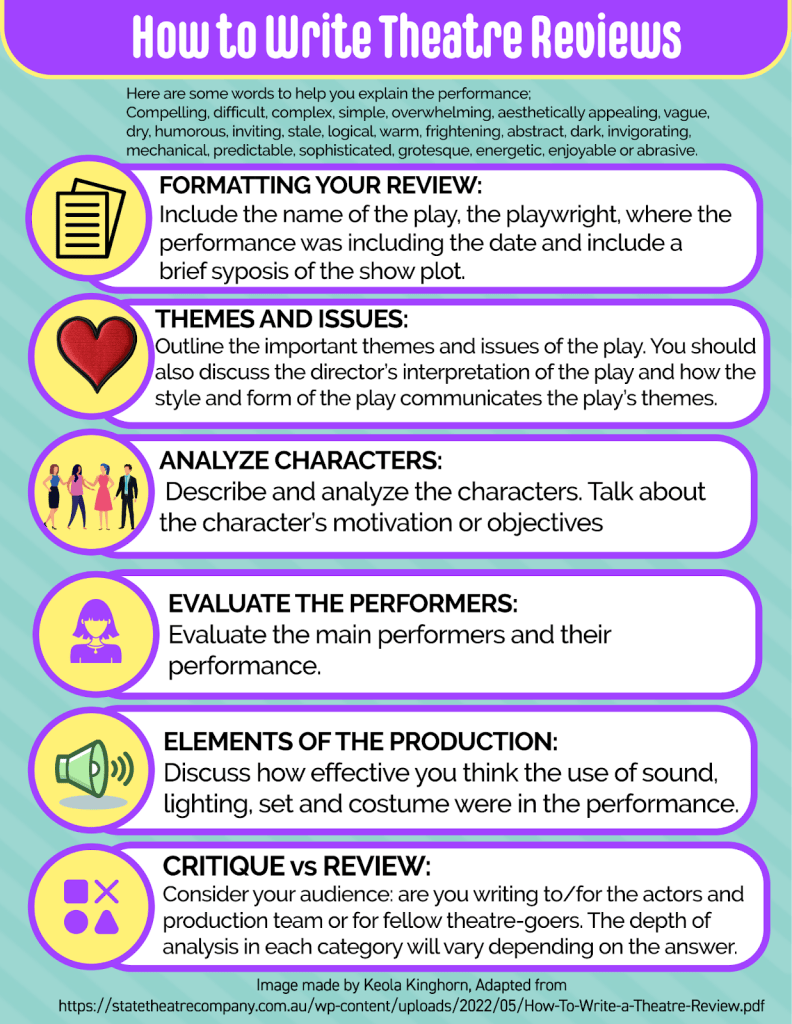
1. DO witness, not judge.
Approach each performance with curiosity and empathy. A review is a record, not a verdict.
2. DO acknowledge your own lens.
Be transparent about your positionality—your background, training, tastes, and biases shape what you see. Awareness doesn’t weaken your authority; it deepens your integrity.
3. DO credit the artists, photographers, and sources you reference
Behind every performance is collective labor—actors, designers, crew, musicians, and the people who document it. Always double-check names, roles, and spelling. If you share an image or quote, credit the photographer or source. Accuracy is care. Don’t let the art or your writing overshadow labor. Honor the craft as much as the concept.
4. Don’t Make it Personal
Critique the work, not the person. Avoid comments about appearance or identity unrelated to performance. The same goes for other subjective or unnecessary remarks like “The actor’s look didn’t match the role” or “She seemed too young/old for the part.” Comments like that say more about bias than about craft. A review should illuminate artistic choices—direction, pacing, design—not an artist’s body or identity.
5. DO ground your impressions in specifics.
Quote a line, describe a gesture, note a lighting cue. Details build credibility and show you were present.
6. DO balance description with interpretation.
A review should do more than record what happened—it should ask what it means. Don’t get lost in retelling; connect what you saw to what it says about community, identity, or the human condition.
7. DON’T rely on clichés.
Be precise. Describe how the actor carried the moment, why the audience reacted, or what the production risks. Original art deserves original language.
8. DO contextualize the production.
Think about scale, intent, and audience—what was the artist trying to do, and how well did they do it?
9. DO reflect on the themes the play or musical is addressing—and how this adaptation engages those themes in its own way.
If you don’t know much about the source material, admit it; your readers will sense it whether you say it or not. Honesty builds trust.
10. DO recognize that humor and opinions are subjective.
Even if it wasn’t your thing, that doesn’t mean other people won’t love it. A good review leaves room for multiple experiences.
11. DON’T use absolute statements like “only,” “always,” or “never.”
Theatre is alive, unpredictable, and constantly evolving—absolutes rarely hold true. Use language that invites reflection: “This version highlights…” or “In this production, pacing sometimes lagged…” Nuance builds credibility.
12. DO bring your personality into it.
Why write if you’re not bringing your own take? A reviewer’s perspective gives life to the piece. Don’t confuse that with gossip or being mean. Your voice should illuminate, not harm.
13. DO pause before posting if something felt off-putting.
If a moment truly didn’t sit right with you, sleep on it. Time brings clarity—and sometimes compassion. A night’s rest can turn a reactive take into a reflective one. Talk with a trusted source before posting. Words can’t be taken back. Remember that words posted online live forever.
14. DO remember why you write.
Theatre criticism is storytelling, too. Write to connect, to preserve, to keep the art—and the people behind it—alive.
15. DON’T forget the joy.
Even in critical moments, hold space for delight. Theatre is made by people who care deeply; reviewing it with care honors that same spirit.


Leave a Reply