

Reviews like this take 10+ hours to research and write. If this one was useful, even $1 helps. Support Rhetorical Review.
Salt Lake City, UT—The Beatrix Potter Defense Society is a poignant and thought-provoking play that examines the gendered constraints on artistic expression. Written by Janine Sobeck Knighton and produced by Plan-B Theatre, the production seamlessly blends historical fiction, with coded text, and an urgent feminist critique, to explore themes of artistic agency, societal erasure, and the power of collective memory. Through compelling performances, incisive dialogue, and immersive staging, the play invites audiences into a deeply personal yet profoundly political conversation.
A poignant and thought-provoking play that examines the gendered constraints on artistic expression.
~Rhetorical Review~

At its core, The Beatrix Potter Defense Society is a meditation on how women navigate systems that seek to diminish their creative agency. The play compellingly explores gender dynamics, particularly societal expectations, women’s autonomy, and the erasure of their contributions. Centering on Beatrix Potter, renowned for her beloved children’s literature, and Edith Rawnsley, a lesser-known but equally talented woman whose artistic ambitions were sacrificed to marriage and domesticity, the narrative unveils the stark realities of historical gender roles. Their interactions offer a timeless reflection on women’s struggles for recognition and autonomy, interrogating how they have been confined—both physically and ideologically—while also celebrating their resilience and creativity as acts of defiance.
Cheryl Ann Cluff’s direction is intentional and intimate, making strong use of the confined performance space to mirror the limitations placed on women artists. Scenes unfold with a measured pacing that allows for the characters’ emotions to build organically, giving weight to every hesitation and every word unspoken.
…A timeless reflection on women’s struggles for recognition and autonomy, interrogating how they have been confined—both physically and ideologically—while also celebrating their resilience and creativity as acts of defiance.
~Rhetorical Review~

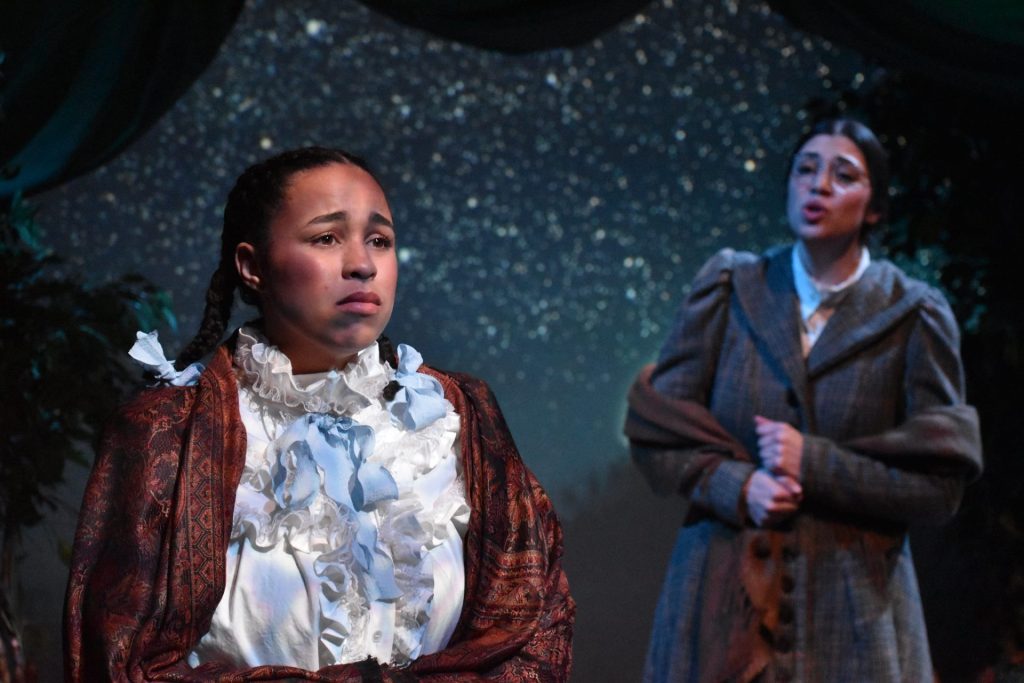
Flo Bravo (Edith Rawnsley) and Sibley Snowden (Beatrix Potter) deliver strikingly nuanced performances. Snowden’s portrayal of Beatrix captures a youthful adolescence that is both brilliant and defiant, embodying Beatrix and her sharp wit with unyielding determination. Her physicality—confident, assertive, at times restless—contrasts with Bravo’s Edith, whose more restrained movements reflect a woman accustomed to suppressing her desires.
Bravo’s performance is a standout, imbuing Edith with a quiet devastation that simmers beneath the surface.
~Rhetorical Review~

Bravo’s performance is a standout, imbuing Edith with a quiet devastation that simmers beneath the surface. Her controlled, deliberate delivery captures the weight of a life marked by unresolved compromise, making her moments of emotional release—particularly her confrontation with Beatrix over the meaning of “choosing” artistic sacrifice—particularly poignant and impactful.
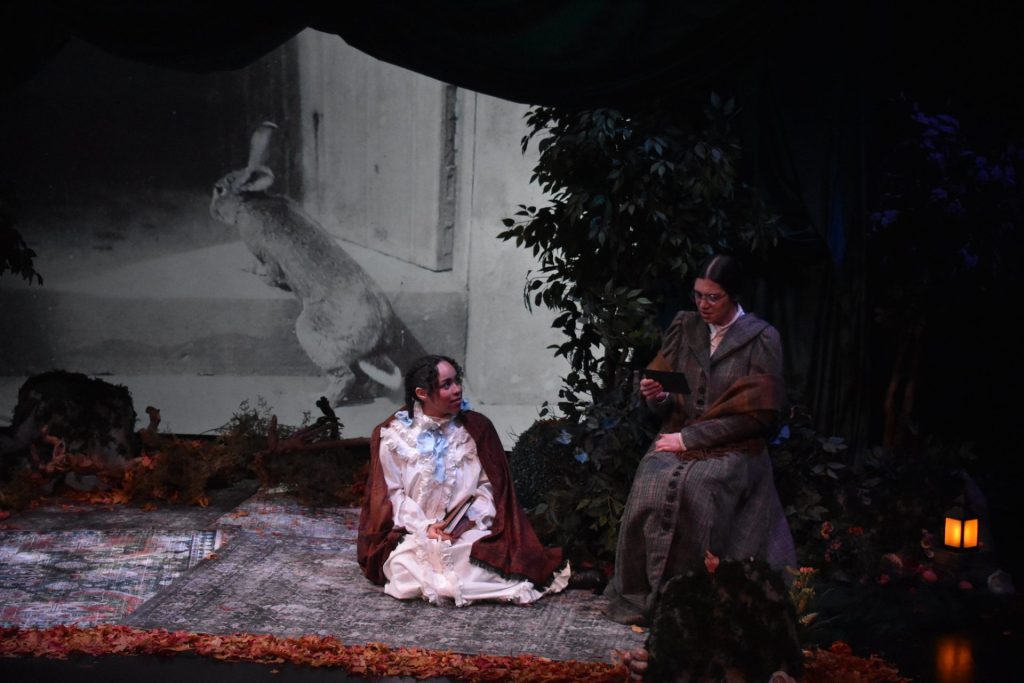
Set Design (Janice Chan): Janice Chan has outdone herself with a breathtaking fairytale woodland design, evoking the magic and wonder of a storybook come to life. Lush shrubs and foliage create a rich, immersive atmosphere, framed by a majestic green curtain draped elegantly across the top, adding a sense of grandeur and enchantment. Delicate cut-out creatures, meticulously crafted to emulate Beatrix Potter’s iconic illustrations, peek from the scenery, further enhancing the whimsical, storybook charm. Every detail feels as if it has been lifted straight from the pages of Potter’s tales, enveloping the audience in a world of nostalgia and wonder.
Janice Chan has outdone herself with a breathtaking fairytale woodland design, evoking the magic and wonder of a storybook come to life.
~Rhetorical Review~

Lighting Design (Emma Belnap): Emma Belnap’s lighting design masterfully enhances Chan’s scenic work, bringing the set to life with striking precision. Throughout the play, Belnap uses lighting to isolate characters at key moments, effectively reinforcing the theme of confinement and underscoring their emotional struggles. Particularly impressive are the delicate lighting effects that create a soft, ethereal glow, with carefully placed spots that evoke the shimmer of starlight. These thoughtful choices not only add visual depth but also contribute to the play’s dreamlike, introspective atmosphere.
Costume Design (Victoria Bird): Victoria Bird’s costumes work well to contrast the protagonists—Beatrix’s slightly unkempt, practical attire reflects her disregard for convention, while Edith’s elegant, structured clothing serves as a metaphor for the societal expectations that constrain her.
Sound Design (Cheryl Ann Cluff): The best sound design seamlessly immerses the audience, often going unnoticed yet profoundly shaping the experience—and this is where Cheryl Ann Cluff excels. A master of her craft, Cluff’s preshow piano score harmonizes beautifully with Chan’s scenic design, setting the tone before the first word is spoken. Throughout the performance, the subtle presence of water and bird sounds enriches the atmosphere, enhancing the play’s world without drawing overt attention to itself.
Projection Design (Daniel Charon): A highlight of the show was the use of projections to bring Beatrix’s sketches to life. At times, the projections mimicked the organic movement of her hand, creating the illusion of her sketches forming in real time. This dynamic interplay between animation and stage action deepened the audience’s connection to Beatrix’s creative process, seamlessly blending art and storytelling. The show also utilizes projections to vividly portray the beauty of the outdoors and the night sky, immersing the audience in Beatrix’s world. Daniel Charon did an exceptional job, seamlessly blending these visuals with the narrative to enhance the play’s atmosphere. The shifting landscapes and starry skies not only evoke a sense of wonder but also underscore Beatrix’s deep connection to nature and her artistic inspiration.
Props Designer (Arika Schockmel): Arika Schockmel’s props played a subtle yet crucial role in supporting the artistic vision of the production. The fact that she recreated all of the art in the projections by hand is impressive, especially considering how much work and precision must have gone into it. Even though these props were “invisible,” their impact helped facilitate the visual continuity between the projected images and the actress that plays Beatrix (Sibley Snowden).
Daniel Charon’s projections breathe life into Beatrix’s sketches—forming in real time, shimmering with starlight, and immersing the audience in a world where art and nature intertwine.
~Rhetorical Review~
Key Themes Explored
Erasure of Women: Invisible Labor and Sacrifices
The play keenly illustrates how women’s labor and sacrifices often go unrecognized, revealing the emotional and personal costs of societal expectations. Edith articulates this burden in a poignant reflection on how marriage and motherhood have consumed her identity:
“I didn’t…understand. How much my choice…my answer of yes, I will marry you, yes, I will stand by your side, yes, I will open my heart and my house to those in need, yes I will bear a child, raise a child, and protect our home…I did not know the cost. I didn’t know…how much I would lose myself in the process.”
Her past as a painter has been relegated to memory, her artistic ambitions buried beneath the weight of domestic life. This erasure reinforces the recurring historical pattern of women’s creative and intellectual contributions being diminished or forgotten.
A meditation on how women navigate systems that seek to diminish and erase their creative agency.
~Rhetorical Review~
Lack of Autonomy for Women
While Edith’s sacrifices reflect the invisibility of women’s labor, Beatrix’s struggles highlight the systemic restrictions placed on women’s autonomy. Confined by her parents’ rigid expectations, she is denied the freedom to explore the world beyond her prescribed role. Beatrix’s lack of autonomy is defined by her parents, whose restrictive control dictates nearly every aspect of her life. They confine her within rigid expectations, denying her the freedom to attend the theater, explore the world, or make independent choices. Their strict oversight reflects the broader societal constraints imposed on women, limiting their ability to shape their own destinies. Beatrix’s limitations serve as a broader critique of how Victorian society constrained women’s agency, stifling their creative and intellectual growth.
Resistance and Reclamation
Yet, within these constraints, both women engage in acts of quiet resistance. Beatrix finds refuge in her art, crafting a world where she—and by extension, other women—can assert control and voice. Edith, despite years of self-denial, rediscovers her artistic passion. When Edith exclaims, ‘I did it!’ after hesitantly taking a pen from Beatrix, it marks a profound moment of transformation, signaling a reclamation of the self she had once abandoned.
These acts of defiance extend beyond individual resistance; they represent a larger historical movement of women using storytelling and art to push against oppressive norms. Beatrix’s sketchbook is not merely an artistic outlet—it is a tool for reclaiming agency. Much like female artists and writers throughout history, she wields creativity as a means of subverting societal expectations.
Beatrix, much like her contemporaries, found refuge in storytelling, constructing worlds where animals had voices and agency—starkly contrasting the muted roles assigned to women in Victorian society.
~Rhetorical Review~
The Power of Storytelling as Resistance
Women of Beatrix’s time often turned to art and literature as means of asserting their intellectual and creative agency. The late 19th and early 20th centuries saw a surge of women illustrators, painters, and writers who carved out spaces for themselves despite restrictive gender norms. Figures such as Kate Greenaway and Mary Cassatt challenged expectations by establishing careers in illustration and fine arts, while writers like Charlotte Perkins Gilman and Edith Nesbit used fiction to critique the limitations placed on women.
For these women, creative work was not just a personal pursuit—it was an act of survival, self-definition, and defiance. Beatrix, much like her contemporaries, found refuge in storytelling, constructing worlds where animals had voices and agency—starkly contrasting the muted roles assigned to women in Victorian society. While traditional education permitted women to copy art, Beatrix pushed beyond these limitations, developing anthropomorphic illustrations that defied realism and subverted expectations.
Collective Resistance: The “Beatrix Potter Defense Society”
Just as women artists and writers historically formed networks to support one another, Beatrix and Edith’s alliance in the play—the formation of the “Beatrix Potter Defense Society”—mirrors this broader movement. Their declaration:
“We are the Beatrix Potter Defense Society. Somehow I will find a way.”
—reflects the rhetoric of feminist collectives that have long fought to carve out spaces for women’s artistic and intellectual contributions. Their determination to preserve women’s autonomy and creativity speaks to the real struggles and triumphs of those who refused to let their artistic legacies be erased.
In this way, the play situates Beatrix within a larger historical continuum of women who used storytelling, art, and literature to assert their presence, resist confinement, and reclaim their voices.
In this way, the play situates Beatrix within a larger historical continuum of women who used storytelling, art, and literature to assert their presence, resist confinement, and reclaim their voices.
~Rhetorical Review~
Both the play and Beatrix Potter’s artistic journey highlight how women have historically used storytelling and art as acts of resistance against societal constraints. Beatrix’s sketchbook is not merely a pastime; it is a tool for reclaiming agency, much like how women throughout history have wielded creativity to challenge oppressive norms. Her decision to stay in the Lake District rather than return to London underscores her defiance against expectations that sought to confine her.
While traditional Victorian education permitted women to copy art, Beatrix pushes beyond these limitations, creating anthropomorphic illustrations that defy realism and subvert societal expectations. Through her imaginative work, she reclaims creative autonomy in a world that sought to restrict women’s intellectual and artistic pursuits.
Final Thoughts
The Beatrix Potter Defense Society succeeds in crafting a powerful feminist critique that feels both historical and immediate. Its performances, particularly Bravo’s portrayal of Edith, anchor the play’s themes in deeply personal stakes. However, while the production’s restraint serves to emphasize the silencing of women, there are moments where a more daring theatrical approach—whether through bolder staging, expanded character perspectives, or heightened dramatic tension—could have elevated its message further.
Ultimately, this play is an essential conversation starter about the ongoing erasure of women’s artistic contributions. While its vision remains somewhat contained, The Beatrix Potter Defense Society is an evocative and necessary piece of theatre that challenges audiences to reflect on whose voices history chooses to preserve—and whose it leaves behind.

A WORLD PREMIERE BY JANINE SOBECK KNIGHTON
March 27-april 13, 2025, IN THE STUDIO THEATRE
Digital Playbill Accessed Here
Study Guide / Accessibility Script Accessed Here
Read more about Beatrix Potter here
Read more about Edith Rawnsley here
60 minutes, no intermission
Times: Thursday, March 27, 2025 – 7:30 PM
Saturday, March 29, 2025 – 4:00 PM
Sunday, March 30, 2025 – 2:00 PM
Thursday, April 3, 2025 – 7:30 PM
Friday, April 4, 2025 – 7:30 PM
Saturday, April 5, 2025 – 4:00 PM
Sunday, April 6, 2025 – 2:00 PM
Thursday, April 10, 2025 – 7:30 PM
Friday, April 11, 2025 – 7:30 PM
Saturday, April 12, 2025 – 4:00 PM
Sunday, April 13, 2025 – 2:00 PM
Ticket Prices: here
- General Admission (Full/Adult) – $25
- Wheelchair – $25
- Student – $15
Venue: 138 W Broadway, Salt Lake City, UT, United States, Utah
Directions here
Contact: (801) 297-4200
THE BEATRIX POTTER DEFENSE SOCIETY explores the early life of Beatrix Potter. And now you’re thinking of Peter Rabbit. As anyone would.
But Beatrix Potter was much more than Peter Rabbit. She was a literary subversive, employing the interplay between the wild and domestic worlds to help her worldwide readership view and interact with the natural world differently.
Meet the Beatrix Potter you didn’t know you didn’t know.
Much of her story lies in the journal where she sketched the artwork that would become synonymous with her name. But her real story lives in the coded text accompanying those sketches, coded text that chronicles both her discovery and harnessing of her personal power, anathema to Victorian gender norms.
Although much is made historically of how Beatrix’s connection to the vicar Hardwicke Drummond Rawnsley enhanced her writing career, there are also hints that his wife Edith was Beatrix’s true guide. Yet it’s virtually impossible to find information about her. It’s as if she’s been erased.
THE BEATRIX POTTER DEFENSE SOCIETY explores that erasure in an attempt to crack the code of how Edith and Beatrix may have set each other on anarchic-for-the-times journeys of artistic independence.

If you enjoyed this review you may enjoy reading…
Fiction & Historical Fiction:
- The Ten Thousand Doors of January – Alix E. Harrow
- A novel about a young woman discovering the power of storytelling and imagination to transcend the limitations of her world.
- The Awakening by Kate Chopin. Full text available at Project Gutenberg and KateChopin.org. A classic feminist novel exploring a woman’s artistic and personal awakening in the late 19th century.
- A Room with a View – E.M. Forster
- A story of a woman navigating societal expectations, travel, and self-discovery in the early 20th century. Accessible via Project Gutenberg.Project Gutenberg+1Project Gutenberg+1
- The Tale of Beatrix Potter: A Biography – Margaret Lane
- A beautifully written biography that explores Potter’s defiance of societal norms and her life as an artist and conservationist.
- Miss Potter: The Novel – Richard Maltby Jr. A novelization of the Miss Potter film, providing a fictional but deeply researched portrayal of her struggles and triumphs.
Non-Fiction & Feminist Literary Criticism:
- A Room of One’s Own by Virginia Woolf. Available through Project Gutenberg Australia.Gutenberg Australia
- Art and Handicraft in the Woman’s Building edited by Maud Howe Elliott. Digitized version at Internet Archive.Smithsonian Libraries+1Internet Archive+1
- How to Suppress Women’s Writing by Joanna Russ. A preview is available on JSTOR.JSTOR
- Claiming the Pen: Women and Intellectual Life in the Early American South by Catherine Kerrison. Limited preview accessible via Project MUSE.Project MUSE
- Women, Art, and Society by Whitney Chadwick. A preview is available on Open Library.Open Library
- Claiming the Bicycle: Women, Rhetoric, and Technology in Nineteenth-Century America by Sarah Hallenbeck. A full-text version is available at the Internet Archive.


Leave a Reply