

Reviews like this take 10+ hours to research and write. If this one was useful, even $1 helps. Support Rhetorical Review.

Photo by Matthew Murphy.
From Wilder’s Film to Broadway Reinvention
When Billy Wilder’s Some Like It Hot premiered in 1959, it quickly became canon. The story of two jazz musicians on the run from gangsters, disguised in an all-female band, combined gangster farce, romantic comedy, and gender-bending hijinks in a way that felt both daring and irresistible. Marilyn Monroe’s turn as Sugar “Kane” Kowalczyk cemented her screen icon status, while Tony Curtis (Joe/Josephine) and Jack Lemmon (Jerry/Daphne) delivered performances that oscillated between screwball comedy and surprising vulnerability.

The film’s cultural impact was seismic. It won the Academy Award for costume design, was banned in Kansas for its risqué content, and is frequently ranked among the funniest films ever made. Its closing line—Osgood’s “Nobody’s perfect”—entered the lexicon as a queer-coded wink, decades ahead of its time. Yet, as critics have noted, the film was also of its era: drag was played largely for laughs, and the treatment of Sugar leaned into the sexist tropes of mid-century Hollywood. As playwright Matthew López explained, “Yesterday’s ahead of the curve is today’s behind the curve.”
Vogue captured the challenge well: “Two men dressing up as women had a very different valence in 1959 than it does today.” The creative team leaned into that truth, amplifying queerness, race, and reinvention. What The New York Times called the Jazz Age’s “energy and excitement in defiance of Prohibition and the Great Depression” becomes here a metaphor for survival, identity, and joy against repression.
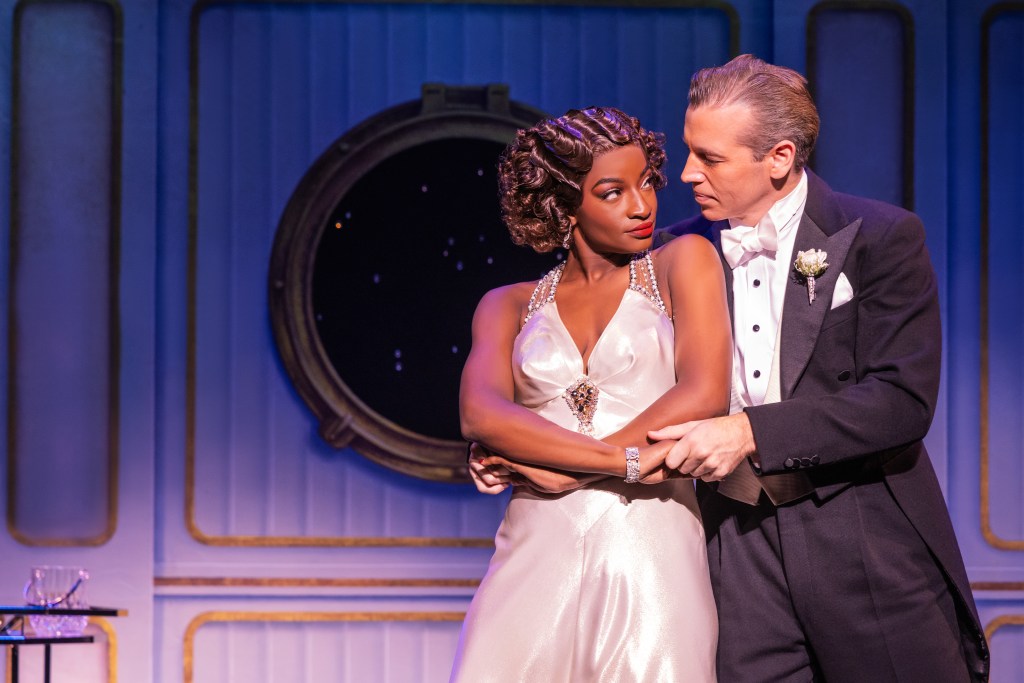
Photo by Matthew Murphy.
Sugar Reframed: A Black Woman at the Center
In the original film, Sugar Kane, immortalized by Marilyn Monroe, remains an icon but also a trap: to imitate Monroe would invite inevitable comparison. On Broadway, Adrianna Hicks originated the role. For the national tour, Leandra Ellis-Gaston (Tina: The Tina Turner Musical, Six) steps into Sugar’s shoes and channels Monroe’s glamour while simultaneously telling the story of Black women in the entertainment industry. She not only makes the role her own but brings striking depth and resonance to the character.
Her standout number, “At the Old Majestic Nickel Mat,” reframes Sugar’s longing for escape through the history of segregation—remembering how cinema once offered fantasy but reinforced exclusion. The lyrics recall her childhood, when she could only sit upstairs in the balcony: “Up in the gallery, dreaming my way down / Watching the silver world spin me around.”
Leandra Ellis-Gaston sings with a voice both velvety and commanding, balancing vulnerability with grace. As Sugar Kane, she turns cinema’s false promise into reclamation.

Photo by Matthew Murphy.
What struck me most is how this song redefines Sugar’s role in the narrative. In the film, Monroe’s Sugar is magnetic but fragile, often trapped by men’s choices. Here, Sugar names her own past and her own struggle. She transforms from the “fuzzy end of the lollipop” into a figure of power and choice. Ellis-Gaston’s delivery carries the weight of generations—of Black women who dreamed despite the balcony, who found in music and performance not just escape but liberation.
In this way, the touring production doesn’t simply reframe the story or replace a performer; it reimagines the character’s core. Representation isn’t an afterthought but the axis of reinvention, giving Sugar’s story the cultural and emotional weight it always deserved.
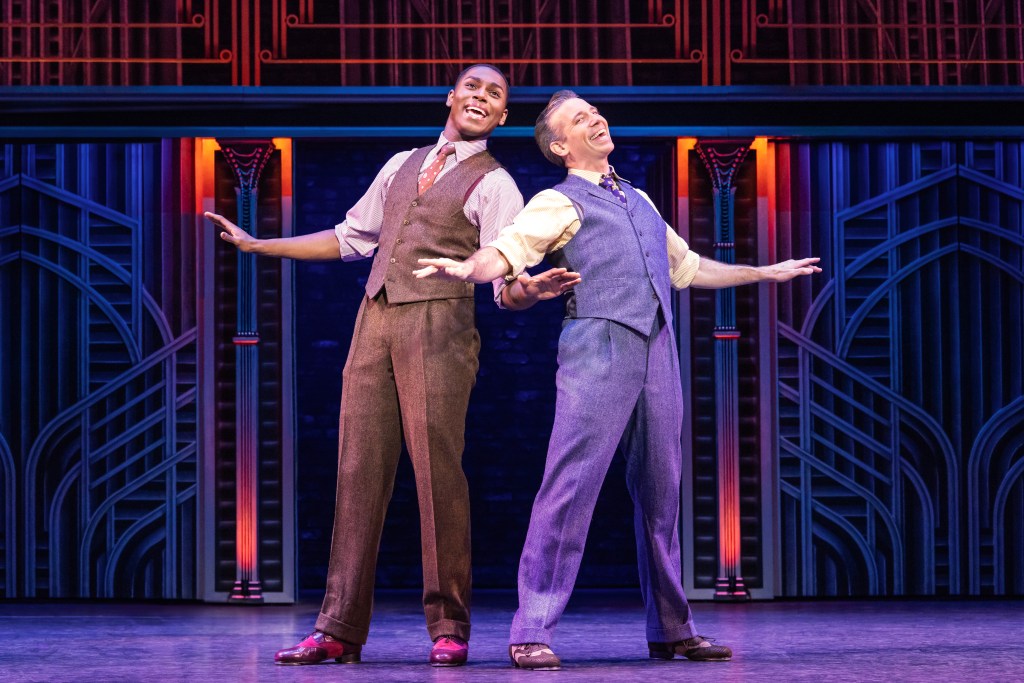
Photo by Matthew Murphy.
Joe/Josephine: Charm and Comic Precision
On Broadway, Christian Borle originated the role of Joe. In the tour, Matt Loehr (MJ The Musical) delivers one of the production’s most versatile turns. His quicksilver shifts between identities—slick jazz musician, affable Josephine, and a faux screenwriter wooing Sugar—anchored the farce with impeccable timing. Loehr’s physical comedy in heels was particularly striking: he moved with enough ease to keep the illusion intact, but also with just enough exaggeration to milk the humor.
Loehr is the kind of performer your your eyes just naturally graviates to; he is intersting to watch and he brought real weight to Joe’s friendship with Jerry/Daphne, letting the humor of disguise deepen into something more tender. Loehr’s performance stitched together the production’s comic and emotional threads, ensuring that the farce never lost its human heart.

Photo by Matthew Murphy
Where Wilder’s film ended with a wink—‘Nobody’s perfect’—Some Like It Hot The Musical lets Daphne insist, ‘Call me Jerry or call me Daphne, as long as it’s with respect.’ A line once played for laughs now lands as a declaration of identity, resonant in a world still tangled in labels.
Daphne’s Arc and the Queer Turn
On Broadway, J. Harrison Ghee originated Daphne, making history as one of the first nonbinary performers to win the Tony Award for Best Lead Actor in a Musical. On tour, Tavis Kordell takes the role with humor, heart, and remarkable stamina.
Kordell’s Daphne blends comedy with sincerity, giving voice to gender fluidity in a way the original film never attempted. This is a role that demands everything: singing in a high register, executing demanding dance routines, and radiating charisma in spades. Kordell met these challenges head-on, making Daphne magnetic and deeply moving.
Edward Juvier (Les Misérables) as Osgood embodied this shift. His pursuit of Daphne could have easily slipped into dated panic, but instead his unflinching acceptance signals a deeper transformation. Osgood’s unflinching acceptance embodies what José Esteban Muñoz might call a queer utopian gesture: not utopia fully realized, but a glimpse of its horizon, turning Osgood into one of the show’s most lovable figures.
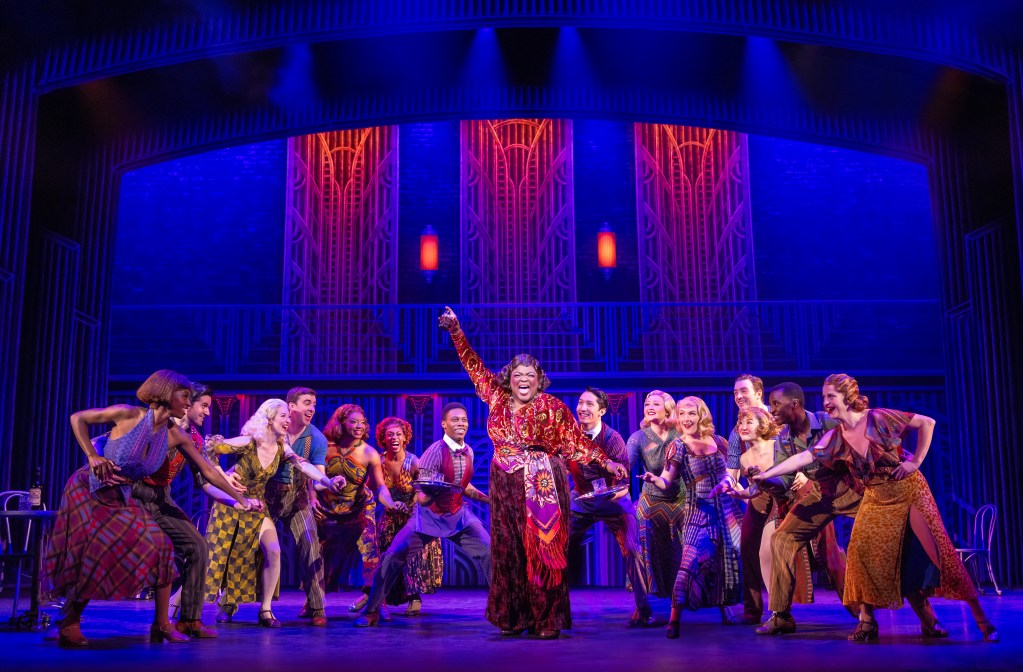
Photo by Matthew Murphy.
Sweet Sue and the Voice of Authority
On Broadway, Natasha Yvette Williams originated Sweet Sue. On tour, DeQuina Moore (Legally Blonde, Little Shop of Horrors) takes up the mantle as the band’s formidable leader. Her opening number, “What Are You Thirsty For?” showcased her powerhouse vocals, immediately establishing authority. But beyond her pipes, Moore carried the role with comic timing and grounded energy, steadying the chaos of the band-in-hiding plot in a believable musical world. Sweet Sue, in many ways, functions as the show’s compass, and Moore played her with effortless command.
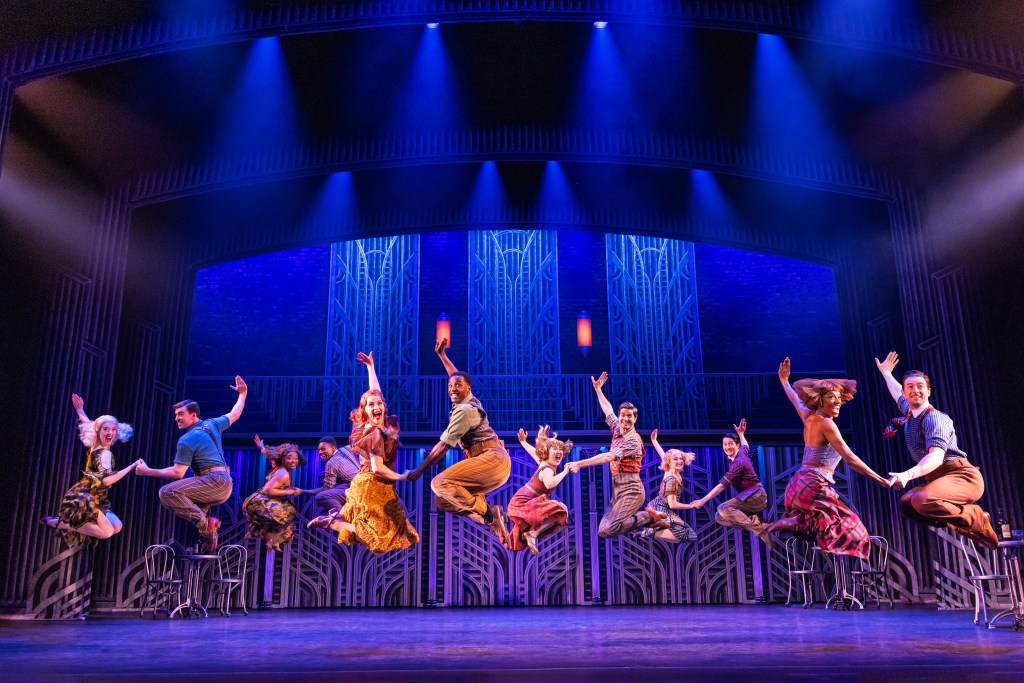
Photo by Matthew Murphy.
Supporting Standouts
The production’s depth extends well beyond its leads. Devon Hadsell is hilarious as Minnie, Sweet Sue’s scatterbrained assistant whose kleptomaniac streak comes from sheer confusion—she barges into other people’s houses and walks off with their belongings, genuinely believing they all belong to Sue. The gag is outrageous but never forced, and Hadsell’s impeccable timing keeps it a comic highlight throughout the show. Jamie LaVerdiere lends dry wit as Mulligan, the exasperated lawman constantly a step behind, while Devon Goffman brings real menace as Spats, the gangster whose violence sets the entire plot in motion. Together, these supporting players ensure that every corner of the stage feels alive and intentional.

Photo by Matthew Murphy.
Ensemble Brilliance and Cinematic Transitions
If the leads provide the narrative heart, the ensemble supplies the kinetic pulse. Their precision and athletic transitions give the show its momentum, seamlessly carrying the audience from one scene to the next. Numbers like the starlet fantasy sequence—where Sugar and Joe’s duet blooms into a glittering tableau of dancers in sparkling gowns—capture the show’s commitment to old-Hollywood spectacle.
Tap sequences became dazzling showcases of precision, one highlight featuring Loehr and Kordell hammering rhythms in counterpoint to the orchestra. These weren’t just dance breaks but musical masterpieces staged through the body.
Director Casey Nicholaw’s staging leaned into cinematic fluidity: a bathroom splitting open into a nightclub, a yacht date blooming into a Busby Berkeley fantasy, and a six-door chase sequence that fused vaudeville slapstick with balletic timing. The results reminded the audience that this was theatre channeling the silver screen in real time.
As the Times piece points out, Shaiman’s music “swings between pastiche and homage,” blending big-band idioms with modern theatrical muscle. That duality—both historic and contemporary—comes alive in Nicholaw’s choreography, where jazz is less a backdrop than an engine of rebellion and reinvention.

Photo by Matthew Murphy.
Orchestral Authenticity in a Musical About Musicians
In musicals where characters inhabit the world of performers (Cabaret, Bandstand, Once), the orchestra carries dramaturgical weight. Here, the pit more than delivers. Conducted from the keys by Mark Binns, the ensemble featured a lean traveling crew augmented by versatile local players. Reed doublers shifted among saxophones, flutes, and clarinets, providing the timbral variety jazz demands.
What impressed was not just technical accuracy but affect: the pit sounded larger than its numbers, producing a fullness that matched the stakes of a story about life-or-death performance. In Some Like It Hot, the orchestra bridges that gap, making its big-band world plausible and emotionally resonant.
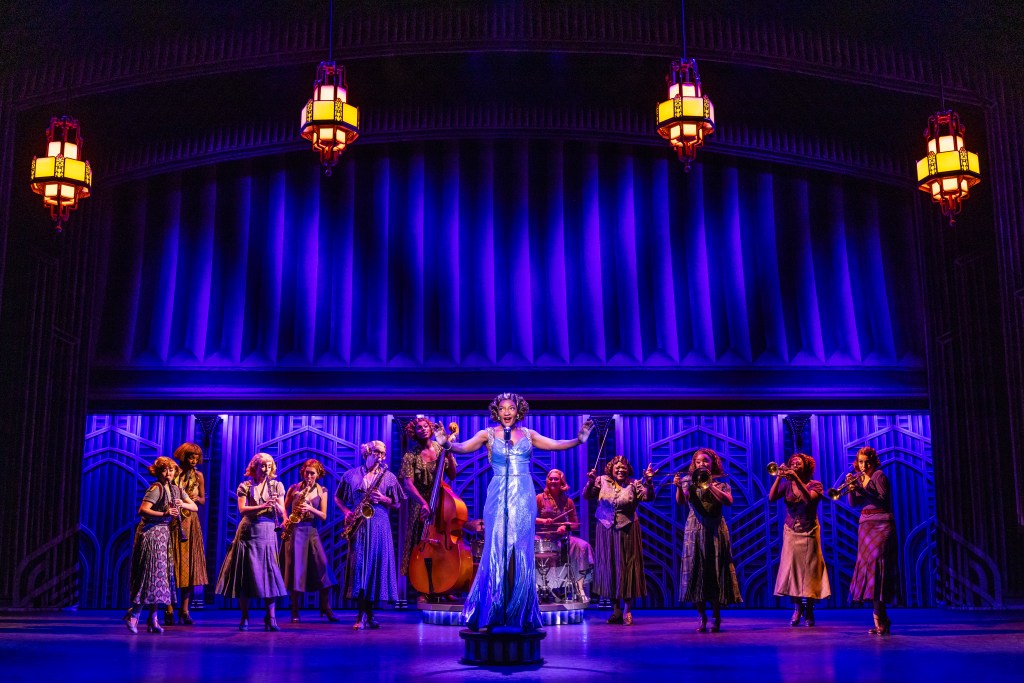
Photo by Matthew Murphy.
A Classic Reborn
Some Like It Hot succeeds because it refuses to be bound by nostalgia. Rather than recreating the past, it reframes it—foregrounding race and gender in ways that resonate with contemporary audiences while honoring the original’s comic heart.
Its jazz-driven energy, dazzling choreography, and nuanced performances make it both spectacle and statement. At its core stand two arcs of transformation: Sugar, reimagined as a Black woman whose agency reclaims a role once confined by sexist tropes, and Daphne, whose journey embodies not just queer identity but trans possibility. Together, they redefine what survival, love, and freedom look like onstage.
This is more than entertainment—it is healing. To see Sugar sing her own story and Daphne claim her own name is to witness Broadway not only catching up to the moment but daring to lead.
By the finale—with modulating vocals, a saxophone soaring underneath, and a chase in heels that defies belief—the show lands not just as joy but as possibility: proof that Broadway can honor its past while blazing a hotter, more inclusive trail into the present.
Show Info & Tickets: Some Like It Hot
VENUE: Eccles Theater, Salt Lake City
DATES: September 30–October 5, 2025
Presented by: Zions Bank Broadway at the Eccles
Tickets: $69–$185 (plus standard booking fees)
- Online: Broadway-at-the-Eccles.com
- Phone: 801-355-2787 (ARTS)
- Groups (10+): 317-632-5183
More Info: SomeLikeItHotMusical.com
Follow SOME LIKE IT HOT on Twitter, Instagram, Facebook
Creative Team
- Book: Matthew López (The Inheritance) & Amber Ruffin (The Amber Ruffin Show)
- Music: Marc Shaiman
- Lyrics: Scott Wittman & Marc Shaiman (Hairspray)
- Direction & Choreography: Casey Nicholaw (The Book of Mormon)
- Scenic Design: Scott Pask
- Costumes: Gregg Barnes
- Lighting: Natasha Katz
- Sound: Brian Ronan
- Hair Design: Josh Marquette
- Makeup Design: Milagros Medina-Cerdeira
- Orchestrations: Charlie Rosen & Bryan Carter
- Music Supervision: Mary-Mitchell Campbell & Darryl Archibald
- Vocal Arrangements: Marc Shaiman
- Dance & Incidental Music Arrangements: Glen Kelly
Orchestra
- Conductor/Keys 1: Mark Binns
- Associate Conductor/Keys 2: Nicholas Michael Johnson
- Trumpet 1: Matt Gallagher
- Drums: Chris Karabelas
Local Orchestra (Salt Lake City engagement):
- Trumpet 2: Reed LeCheminant
- Trombone 1: Donn Schaefer
- Trombone 2 / Bass Trombone: Craig Moore
- Alto Sax, Flute, Clarinet: Daron Bradford
- Tenor Sax 1, Flute, Clarinet: Dave Hall
- Tenor Sax 2, Flute, Clarinet: Keith Parietti
- Baritone Sax, Clarinet, Bass Clarinet: David Asman
- Bass: Denson Angulo
- Local Contractor: Joe Muscolino
Additional Music Production / Support:
- Music Coordinator: Kristy Norter
- Score Supervisor: Samuel Hoad
- Keyboard Programmer: Randy Cohen
- Associate Keyboard Programmers: Sam Starobin, Tim Crook, Nicholas Schenkel, Juan Matos
- Drum Pad Programming: Sean McDaniel
- Playback Engineer: Julianne Merrill (Patchmaster Productions ULC)
- Music Preparation: Russell Bartmus, Charlie Savage, Nathan Serot (7th Avenue Music Service)
- Music Assistant: Lexi Vollero
- Additional Music Production: Larry Saltzman, Mike Morris, Ryan O’Connell, Samuel Hoad
Tour Cast (2025):
- Sugar – Leandra Ellis-Gaston
- Joe/Josephine – Matt Loehr
- Jerry/Daphne – Tavis Kordell
- Osgood – Edward Juvier
- Sweet Sue – DeQuina Moore
- Minnie – Devon Hadsell
- Mulligan – Jamie LaVerdiere
- Spats – Devon Goffman
References & Further Reading
- Darryn King, “How ‘Some Like It Hot’ Tunes In to the Jazz Age”, The New York Times, Feb. 8, 2023.
- Chloe Schama, “On Broadway, Weighing the Risks and Rewards of Staging Some Like It Hot”, Vogue, Oct. 31, 2022. Read here
- Muñoz, José Esteban. Cruising Utopia: The Then and There of Queer Futurity. 10th anniversary ed., edited by Tavia Nyong’o, afterword by Joshua Chambers-Letson, New York University Press, 2019.


Leave a Reply