

A story about “female strength and how men skew our perception of each other.” — Assistant director Sara Goldberg-McRae
SALT LAKE CITY, Utah — Aug. 14, 2026. Somewhere between the party games and the first time someone says “Macbeth” out loud, offstage, MacB*tches stops being a hangout play and starts being a haunted one. That shift is the smartest thing about MadKing Productions’ staging of Sophie McIntosh’s script at MadKing’s Fellowship Theater. It’s also the thing I most wanted the production to trust itself to do more with.
MacB*tches, directed by Stina Madriaga-Stone, is a 90-minute, no-intermission chamber piece set in a single college apartment on the night the cast list for Macbeth is posted. A freshman has just landed Lady Macbeth over four older classmates, one of whom, Rachel, was the program’s presumptive lead until an hour ago. What follows is a “fraught celebration” in the truest sense: gossip, drinking, hero-worship of their director, and a slow, then sudden, turn on each other. McIntosh’s script premiered in New York at the Chain Theatre in 2022 and was named a New York Times Critic’s Pick, with the Times praising its “fantastic understanding of tone and genre.” Stage Buddy called it “bloody brilliant,” arguing that envy and treachery hit harder among college girls than among soldiers and kings. The play is now being produced widely, with separate productions this fall in Healdsburg, Dayton, Hempstead, St. Paul, and Chicago alongside this Salt Lake City run. On the surface, it’s a dark comedy about theatre-kid pettiness. Underneath, it’s a study of how scarcity, hero-worship, and an unchecked man can curdle ambition into something that feels more like a curse than a personality flaw.
A Cast That Earns the Claustrophobia
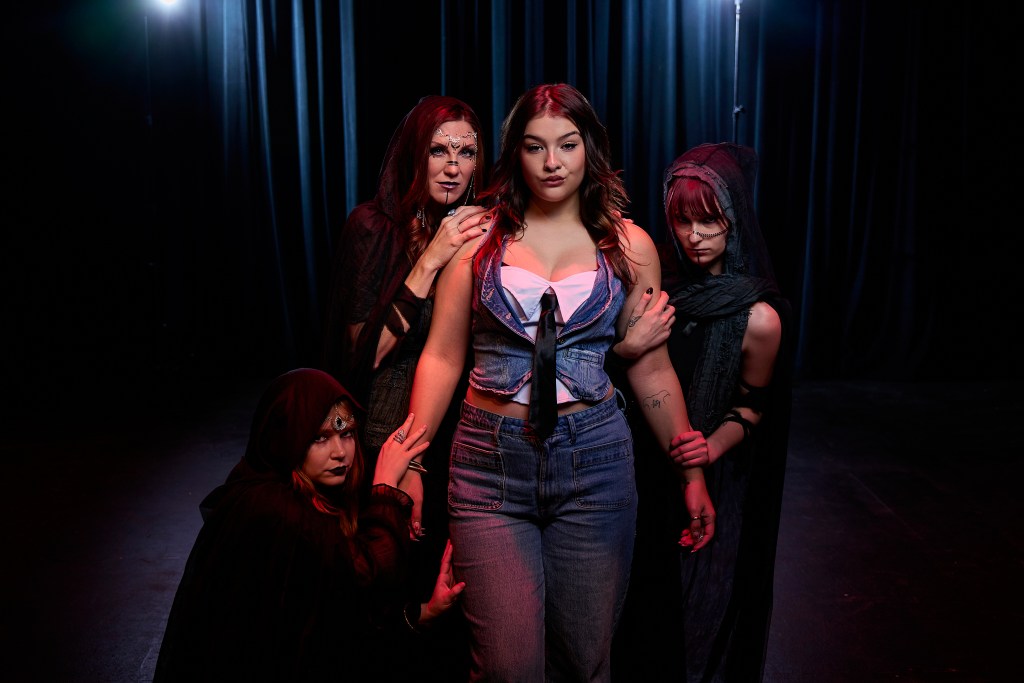
Credit where it’s due up front: this is a demanding ensemble piece, and everyone in it is doing real work under sustained pressure with no break to reset. Alongside the five leads, Stefanie Carr, Savana Lowe, and Genevieve Glissmeyer keep the Weird Sisters unnervingly present all night without a single line of dialogue between them, its own kind of stamina.
Mati Turner anchors the ensemble as Rachel LaBeau, the group’s reigning star gone suddenly obsolete: the former de facto lead, dethroned when a freshman gets the part she assumed was hers. Reviewing the original New York production, critics John R. Ziegler and Leah Richards noted that the actress playing Rachel brought “the intensity of Lady Macbeth herself” to the role without ever playing the part on stage, and that’s the trick this character has always demanded. Turner pulls off the same feat here. Ambitious, commanding, undone by exactly the kind of ruthless hunger the actual character is famous for, she holds two performances at once: the golden girl the group still defers to, and something colder and more wounded underneath, and threads that needle without tipping her hand too early.
Madison Hale plays Hailey Hudson, the sweet, oblivious freshman who wins the role without grasping what it costs everyone else. It’s a hard part to get right: Hale plays her as obtuse in exactly the way that makes you wince, chattering through a room that has clearly stopped wanting her there, missing every social cue at full volume. Her failure to read the room is itself the joke and the tragedy, a harder note to hit than simple sweetness, and she hits it often.
Adalee Grindstaff’s Piper Bell is the innocent one, still working her way out from under a conservative upbringing, less jaded than the rest of the group and visibly unsure how to armor herself the way they have. Grindstaff plays that innocence without making Piper naive exactly, more like someone who hasn’t yet decided whether to become like everyone around her, which makes her the character the audience worries about most as the night goes on.
Sophia Abbott plays Cam Witkowski as the group’s comic relief, and it’s a much harder job than it looks: Cam is also carrying the play’s depression storyline, and Abbott strikes a genuinely difficult balance, funny one minute, quietly devastating the next, without letting either mode undercut the other.
Siena Crivac plays Lexi Lapp as the group’s other pillar, Rachel’s oldest friend and closest rival for the room’s attention, less polished and more authentic. What ultimately sells the play, though, is the chemistry between Turner and Crivac. Critics of the original New York production described Lexi as a woman “compellingly walking a line between loyalty and resentment” as best friend to the one she’s always been second-best to, and that’s exactly the tension Turner and Crivac bring to life here. It’s less warmth than a long-worn groove, two people who know each other’s rhythms too well to hide anything, which makes every scene they share carry a charge the rest of the ensemble can’t quite match.
And then there are the witches. Stefanie Carr, Genevieve Glissmeyer, and Savana Lowe are credited simply as “The Weird Sisters,” and they’re everywhere: a constant, watching presence reinforced by unsettling sound and lighting. This isn’t a subtle choice; it’s a structural one. The witches are furniture in the room all night, which raises the stakes on what they’re actually doing there.

A Room Worth Studying Up Close
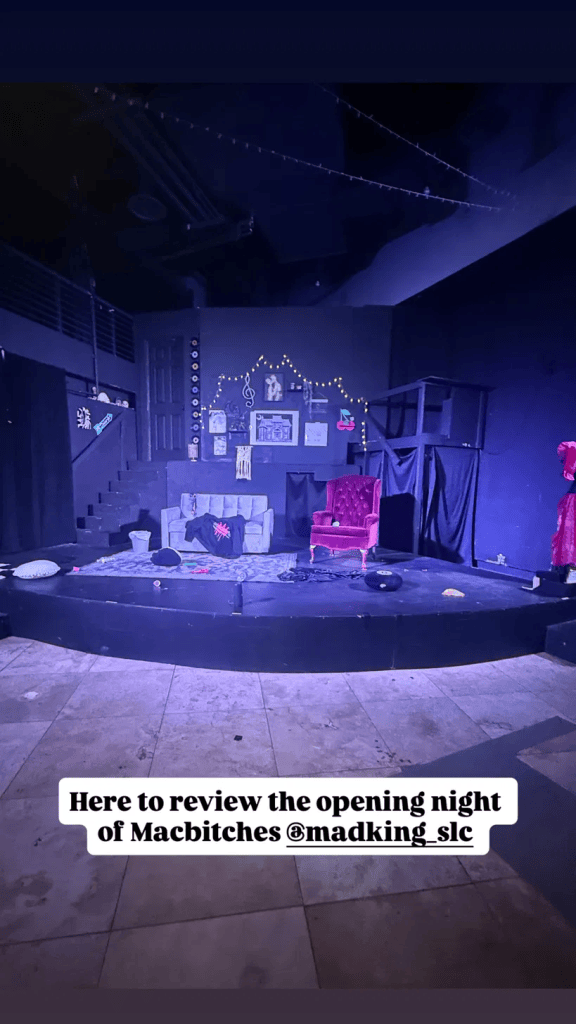
The set, a black platform bathed in blue-violet light, makes the space feel alive. The furniture is convincingly, specifically collegiate: a worn velvet loveseat beside a magenta wingback chair from a completely different household, exactly the mismatched thrift-store combination broke theater majors would actually own. A staircase climbs to a loft dressed with a human skull, a disco ball, and a “Route 66 Drive-In” sign; a black scaffolding tower looms on the other side, one more shadowed place for something to be watching from.
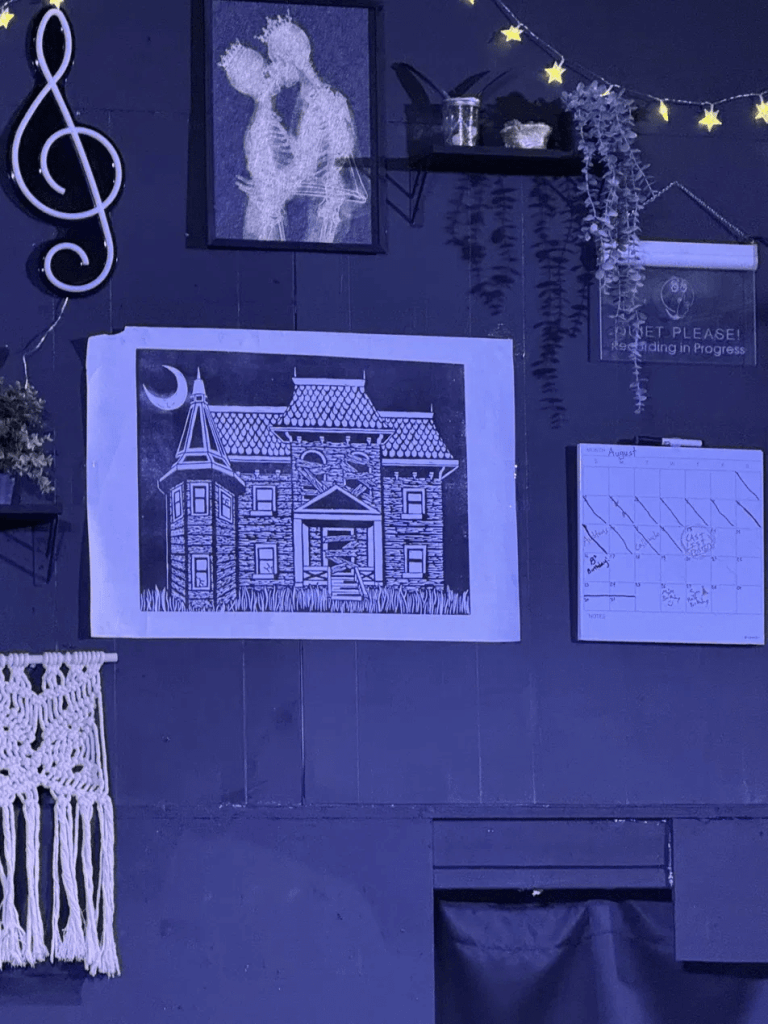
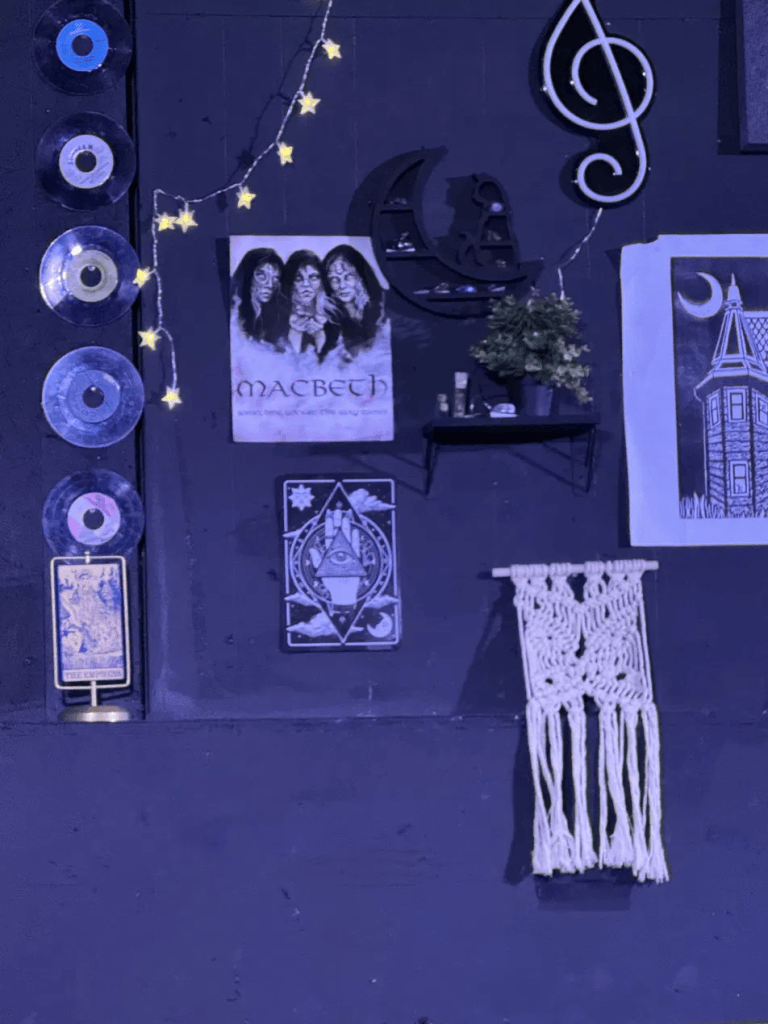
The wall behind the couch is where the design team’s specificity shows. It’s a collage a real theater kid would assemble: mounted vinyl records, star-shaped string lights, an actual Macbeth poster with the three witches on it, tarot cards (The Empress; an eye over a chalice), a moon-shaped curio shelf, a macramé hanging, a haunted Victorian house under a crescent moon, two skeletons kissing, and, dryly, a “Quiet Please, Recording in Progress” sign. It rewards getting close, which most of a 60-seat black box audience will.
Two props do quiet, exact work. A wall calendar tracks the month in-character, “Auditions” and “Callbacks” scrawled in, “CAST LIST POSTED” circled in red on the party’s date, right beside a roommate’s birthday, the detail that makes a prop feel lived-in. A black hoodie draped over the couch reads “MACBETH shall sleep no more” in dripping red letters, real department merch that becomes a perfect visual pun once the violence starts. Off to the side, a pink-and-black corseted gown stands on a headless mannequin, never explained, just present. By the time the party debris (Solo cups, water bottles, an overflowing trash can) is scattered across the rug, the room doesn’t read as a set. It reads as somewhere college students actually live.
Look closer and something else is clear: Macbeth is everywhere in this apartment, not just on the hoodie or the calendar. The poster is a real illustration of the three witches. The tarot cards traffic in the same fate-is-already-written logic the play borrows from Shakespeare. Even the repeated crescent moons echo the witches’ own lunar imagery. None of this is incidental. The room was saturated with the play’s iconography long before the party started, which means the curse the show eventually stages isn’t really arriving from outside. It’s the one thing in the room that was always going to get named out loud.
What Happens When Someone Says the Name
The production’s clearest answer is a simple, superstitious one: don’t say the name. Theatre lore holds that speaking “Macbeth” inside a theatre, outside the context of performing the play, invites bad luck. It plays as harmless color in the moment and as the show’s thesis statement in hindsight. Because every time the word gets said, something answers. The production stages this well: hands and bare nails reaching through black curtains, as if breaching in from beyond the visible world, cued by a piercing jolt of sound. Precise, sudden, effective.
What makes it more than a jump scare is a single exception, set early: the first time it happens, one of the witches walks directly in front of Rachel, and the two of them lock eyes. It’s the only moment all night where a character and a witch seem to actually see each other. Rachel never reacts to the witches again. That one exchanged look plants something the play never explains, and it’s the most interesting choice in the whole production precisely because it’s never explained.
The Gap Between What’s Staged and What’s Said
The witchcraft isn’t separate from the group’s pettiness; it seems to be summoned by it, triggered the moment someone breaks the room’s own taboo. Rachel, marked by that early glance, seems to be the character it was always going to catch. There’s an ugly irony to that once the late confrontation reveals what her relationship with the director actually cost her: three years of keeping the relationship secret from her closest friend, only to have him cast a freshman over her anyway. Her rage at the end isn’t simply a woman defending her power. It’s a woman used twice, first by the director, then by a friend group that never knew what she had given up for nothing.
My hesitation is that the witchcraft’s causal role is mostly staged, not written. The atmosphere does real work: a constant supernatural presence, a rule-bound trigger, one character seemingly marked as complicit. But the dialogue itself remains fully explicable in human terms: gossip, jealousy, hero-worship, normalized abuse. No supernatural explanation is required. I kept waiting for a line that would make the supernatural feel like something the characters themselves understood to be operating on them, and it never arrived. The frame is excellent; the script inside it doesn’t always seem to know the frame is there.
A few other lines land harder than they might on paper. A drunk argument about whether Shakespeare really wrote his own plays turns into an argument about who gets believed capable of genius, echoing the Eric plotline. A quieter aside about theatre as “a ritual, or a prayer” names almost exactly the mechanism the witchcraft thread needs, then never quite uses it. And a conversation about a classmate being told to think harder about “how she’s presenting herself” is delivered by characters who shrug it off as simply how the industry works. It reads less like an oversight than the play showing you the cruelty it wants noticed.
The single best moment in the show is a performed one, and it’s genuinely haunting. Late in the party, the group goads Rachel into Lady Macbeth’s “unsex me here” invocation as a party trick. Turner plays it completely straight, and the staging does the rest: the Weird Sisters close in around her as she speaks, while the room’s reaction curdles from party-game amusement into something closer to a hushed “damn.” It doesn’t stay a solo performance for long. Hailey, the freshman who has the role Rachel wanted, interrupts and joins her, the two of them delivering the invocation together. It’s a strange, charged image: the woman who lost the part and the woman who won it standing side by side inside the same summoning. It suggests these two are bound to each other more powerfully than anything either of them says outright all night.
The words deserve the same weight as the staging. Lady Macbeth isn’t asking to feel powerful; she’s asking to be unmade: stripped of her sex, her blood thickened against remorse, her milk turned to gall. It’s a prayer for the removal of conscience, spoken by someone who knows exactly what she’s asking to give up. Watching Rachel say those words, then watching Hailey step into them without fully understanding what they mean, doesn’t feel incidental to what happens later that night. Twenty minutes before Rachel turns on a friend, she has asked for this by name, with the girl she will turn on standing beside her, unknowingly asking for it too.
It’s the one place where text, staging, and performance line up completely, and the clearest suggestion that the production’s witches are drawn to Rachel specifically, even with Hailey sharing the stage beside her. It’s also the closest they ever come to touching a character, which makes their total absence from the violence at the end even more conspicuous. They’ll gather around a monologue. They won’t intervene when the consequences arrive.
McIntosh’s own paratext offers an intriguing counterpoint to this reading. She’s published a “macbitches” playlist under her name, whose titles include “jealousy, jealousy,” “Hero Worship,” “Playing God,” “Self Esteem,” “Crazy = Genius,” “Salt In The Wound,” and “drinking games.” The emphasis is unmistakably human: jealousy, worship, ego, competition. Witchcraft doesn’t appear to be the subject.
Two Precedents, One Unclaimed Middle Ground
It’s worth putting this production alongside two precedents, and McIntosh’s own script points toward the first. Early in the play, Cam observes that most Macbeth productions cut the Hecate scenes, effectively removing one of the play’s few female roles. It’s a sharp piece of dramaturgical criticism to put in a character’s mouth, and it makes the comparison feel earned.
Utah Shakespeare Festival’s acclaimed 2025 mainstage Macbeth restored those scenes and made Hecate a recurring, visually dominant presence who directly intervenes in the outcome. Critic Jennifer Hoisington went further, arguing that “the witches’ power derives from Hecate herself.” It’s a useful model for taking the witches from atmosphere to engine: not simply present, but causal.
Orson Welles’ 1936 Voodoo Macbeth is the more complicated precedent: a fully embodied supernatural world, restaged with an all-Black cast in Harlem and relocating the play to a Haitian setting, with the Weird Sisters transformed into voodoo figures (read more about it here). Its legacy is complicated; later scholarship has questioned the production’s use of Haitian Vodou imagery and its relationship to the Black artists and culture it drew upon. That history is a reminder that committing more fully to the supernatural can be a structural choice without automatically being a responsible one. But the theatrical precedent remains: decades before Utah Shakespeare Festival’s Hecate took such a commanding role, Welles had already demonstrated how a Macbeth could give the supernatural genuine authorship over its world.
Put those two productions together, and MacB*tches lands in an odd, unclaimed middle ground. It has Voodoo Macbeth‘s appetite for a fully embodied supernatural presence, without reproducing that production’s particular cultural and historical complications, but it hasn’t quite earned Hecate’s payoff: the moment when all that supernatural machinery actually changes what happens onstage. That’s a strange place to land.
The Verdict
None of this stops MacB*tches from working as an evening of theatre. It’s tense, funny, upsetting, well-acted, and its turn into violence genuinely lands as a gut-punch. But sit with it afterward, and the ending feels somewhat disconnected from what gets you there. Up to that point, nothing requires a supernatural explanation to make sense. Then the violence arrives, pitched beyond what the human-scale story seems to have built toward, while the witches, who have been watching all night, remain spectators.
There are two ways to read that absence. The harder critique is a craft problem: spend ninety minutes establishing a rule-bound supernatural force, then let it remain a spectator at the moment when its intervention would seem most consequential, and the ending loses something it seemed to be building toward. Chekhov put it best in an 1889 letter: “One must not put a loaded rifle on the stage if no one is thinking of firing it.” The Weird Sisters are that rifle, hung on the wall for ninety minutes and never fired.
The gentler reading takes its cue from the director’s note, which frames the play as a story about human systems rather than literal curses. Under that reading, the witches’ refusal to intervene is the point. No supernatural force steps in because the danger was always mundane and human.
But that reading raises its own question: if nothing supernatural was ever going to intervene, why build so much apparatus around it? There is a lot of craft devoted to a force whose defining feature is ultimately its inaction. That inaction might be the thesis; it might be a load-bearing wall the production built and then deliberately declined to use. MacB*tches doesn’t quite tell us which, and that’s the question I’d most want to ask McIntosh or Madriaga-Stone directly.
Either way, the human story at the play’s center—scarcity and hero-worship curdling into betrayal—lands cleanly on its own. A production this committed to building a curse owes its audience some clarity about whether that curse was ever meant to strike.
None of this should be read as a reason to skip it. Go see it. It’s dramatic and entertaining from the moment the lights come up, the acting is outstanding across the board, the set rewards a close look, and the “unsex me” scene alone is worth the ticket price. This is a strong production of a good script, wrestling honestly with a difficult question it hasn’t fully answered yet. That’s a more interesting evening than one in which everything has already been figured out.
The Full Company
MadKing Productions, founded by James and Carleigh Naylor, produced this run, continuing a run that’s included She Kills Monsters, Heathers: The Musical, We Are the Tigers, Medea, and Proof. Production photography by Dee and Cory Productions.
MacB*tches, by Sophie McIntosh, directed by Stina Madriaga-Stone, plays at MadKing’s Fellowship Theater (167 S Rio Grande, Salt Lake City) through August 23rd. Performances Thursday through Saturday at 7:30 p.m., Sunday matinees at 3:00 p.m. General admission $27, student admission $17 (valid student ID required at the door). 90 minutes, no intermission. Content warning: profanity, betrayal, violence, substance abuse, and discussions of sexual content and mental illness. Tickets: events.ticketleap.com/tickets/mkpslc/macbitches


Leave a Reply