
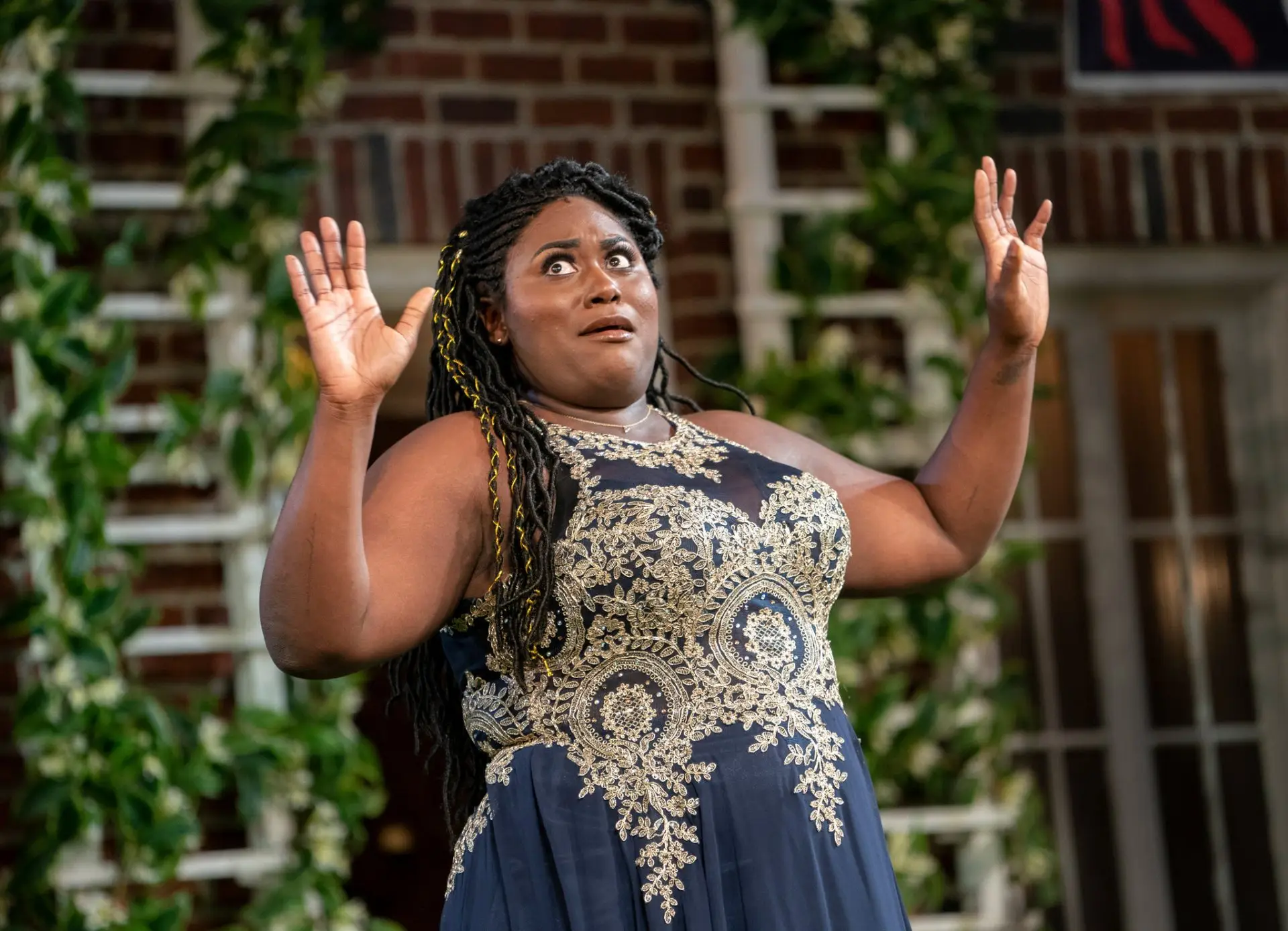
- Full Recording of the Play Available with Subscription: Much Ado About Nothing | About | Great Performances | PBS
- Watch: “All in the Details: Why Much Ado About Nothing is Relevant Today”
- Listen to Shakespeare Unlimited: Episode 133 https://www.folger.edu/shakespeare-unlimited/kenny-leon-much-ado
NEW YORK CITY– Kenny Leon’s production of Much Ado About Nothing satisfies on every level, but it’s the small details and modern flair that set it apart from other productions I’ve seen, adding a rich layer of context to the setting. According to Leon, the production is set in the future, specifically 2020, in Aragon, Georgia, a choice inspired by Don Pedro’s (Billy Eugene Jones) place of origin, Aragon, Spain. From there, Leon builds in an incredible number of thoughtful details, or “Easter eggs,” for viewers to discover: a Stacey Abrams 2020 campaign sign, nods to pop culture, a black SUV parked in the background, and protest signs reading “Now More Than Ever We Must Love,” “I Am a Person,” “Hate Is Not a Family Value,” and “Restore Democracy Now.” Together, these touches root the play firmly in our current cultural and political moment, an approach that matters if Shakespeare is going to stay relevant (Jan Kott’s Shakespeare Our Contemporary). The production also celebrates Black actors and culture through its all-Black cast, making the world of the play feel not just updated, but genuinely inhabited.
The music, the blocking, the dancing, and the attitude with which the play is delivered point specifically to modern Black communities across America today, and unlike many Shakespeare productions, this production will appeal to many audiences. In a review of this show, Atesede Makonnen says, “This production, very simply, loves blackness. From the careful lighting to the beautiful wigs to costuming and props, the creative team deliberately crafts a world that pays attention to and celebrates black actors and culture across the diaspora” (Makonnen 112). Shakespeare’s plays have always been a vessel for directors to experiment with; even back in the 1930s, Orson Welles adapted a very unusual version of Macbeth, now called the “Voodoo” Macbeth, featuring an all-Black cast. But even though Welles was using an all-Black cast, racism ran rampant in the height of the Jim Crow era, and although wildly popular, this play was viewed as more of a spectacle than a celebration of Indigenous culture. The way that Director Leon has envisioned Much Ado, adopting both Black culture and vernacular and utilizing Black actors in a 21st-century set of Much Ado, is the opposite of “Voodoo” Macbeth; The soulful music and dancing throughout the play stand out as distinctly 21st-century and as a symbol of the Black Lives Matter conflict.
Moreover, the central conflict is not a literal war, like Shakespeare’s play, but represents Black oppression in America. The message portrayed is that Black citizens of the United States love their country, and it’s time to reciprocate that love by standing up for them. By featuring an all-Black cast, Leon’s message—Black Lives Matter—could speak in an organic and meaningful way.
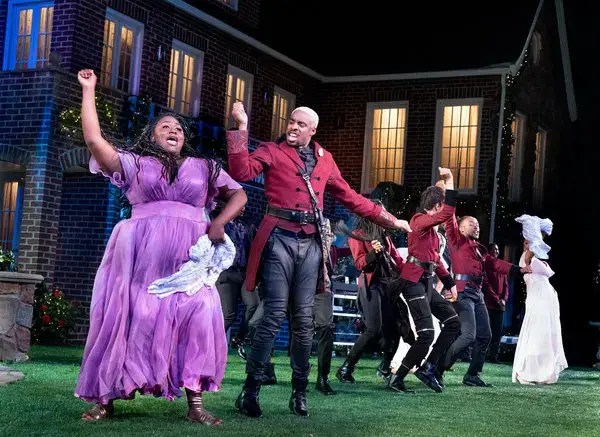
Music plays a significant role in setting the modern scene: Beatrice, played by Danielle Brooks, opens the production singing a beautiful solo and is joined by her friends as they harmonize a medley of Marvin Gaye’s “What’s Going On” and “America the Beautiful.” I found it to be a poignant representation of the delicately balanced identities and loyalties that Black Americans face in the United States today.
The most meaningful scene, in my opinion, was the musical tribute to Hero (who is thought dead) at the end of the play. The soulful music included phrases like, “Please forgive these men that took your child,” “Teach us what to say, to make things right with those who’ve passed away,” “It’s hard to understand,” and “Show us what love is, but most of all forgive.” When hearing these powerful lyrics, it was impossible for me not to reflect on the recent victims of police brutality. Viewed this way, it was incredibly emotional, and Hero (played by Margaret Odette) expresses this emotion perfectly.
Another clever choice was rewriting Shakespeare’s songs, essentially fitting them into a Black, contemporary-sounding musical style. For example, the Shakespeare song “Sigh no more, ladies, sigh no more” is translated as “Heart Get Happy.” And “Then sigh not so, but let them go, / And be you blithe and bonny, / Converting all your sounds of woe / Into Hey nonny, nonny” is turned into the rhythmic and soulful song first sung by Balthazar, and later reprised by Benedict that says, “Pack up all your sad songs, / Trade them in for glad songs, / And sing, na, na, na, na.” The new lyrics are so catchy that audience members can’t help joining in when Benedict breaks into song. It is incredibly effective.
It was interesting to see Dogberry’s character, played by actress Lateefah Holder, minimized in this adaptation. In addition to reducing Dogberry’s lines, the scenes and lines lacked the comedic punch I have become accustomed to. Dogberry can be such a hilarious comedic relief in the play’s serious scenes. Still, in this production, we did not see the full potential of Dogberry, nor did we see a twist or reinterpretation of Dogberry that could have been meaningful amidst calls to “Defund the Police.” While this could be a missed opportunity, it allowed Brooks and Grantham Coleman, who plays her opposite, Benedict, to shine brighter as comedians.
I have never witnessed a production of Much Ado where the success hinged more on Beatrice than Benedict, but this production did just that, and Brooks pulled it off.
Brooks (from Orange Is the New Black) leads this cast in every way: her southern slang and comedic emphasis on words like “Bene-DICK” are essential to making this play feel like a comedy, and she delivers these effortlessly. I have never witnessed a production of Much Ado where the success hinged more on Beatrice than Benedict, but this production did just that, and Brooks pulled it off. It was refreshing to see Benedict step back from the spotlight and allow the leading lady to shine. The fact that Leon chose to showcase Beatrice shows how far the play has come in terms of patriarchy and unrealistic expectations for women in this industry. Not only is Brooks’ interpretation of Beatrice unconventional, it “conveys one of the production’s central themes—the beauty of non-conformity” (Dhillon et al.). Brooks is breaking down gender walls for leading ladies in several ways; she is not the meek, subdued actress we grew up watching, and she is what the industry would call “plus-sized.” A woman’s size should not be a factor in casting, but it is in the theatre and movie business. Brooks said she knew that the chance to play Beatrice was unlikely to come again, so she turned down a paid movie contract for an unpaid part in an outdoor production because she wanted to show girls that “you can be dark-skinned and thick honey-sized 16 . . . and be a Beatrice” (Noah 1:40). Brooks is such a strong actress that Benedict had his work cut out for him.
It was refreshing to see Benedict take a step back from the spotlight and allow the leading lady to shine. The fact that Leon chose to showcase Beatrice shows how far the play has come in terms of patriarchy and unrealistic expectations for women in this industry.
I was skeptical at first if Coleman’s Benedict could step up to Beatrice’s strong personality and wit to fill the part with satisfaction, but Coleman delivers with several standout moments. First, his “Kobe” impression while jumping from one hiding spot to another during the spying scene (45:00) had fellow actors almost laughing on stage. Coleman not only references Black culture, but he also does it almost seamlessly, in moments that the audience can miss if they are not watching closely. Another example is his hilarious interpretive dance while hiding behind a bush, listening to Balthazar (Daniel Croix Henderson) sing (42:35, 43:26). And I cannot forget the moment when Beatrice enters to “Bid him to dinner” (51:10). He quickly falls from a standing position into quick push-ups [1]to impress the lady. Coleman is a physical actor in the best way. And yet, when he needed to be emotional and vulnerable, later on, after Hero was accused, he delivered (1:30:00).
This production makes Shakespeare so modern and relatable in every way, except one: the expectation of womanly fidelity before marriage. To be fair, this is a dated element written into the script, and it is hard to alter because it affects the plot. However, the expectation of Hero’s fidelity before marriage has too much weight to be believable if the year is 2020. While Hero’s betrayal is still upsetting in modern days, it would not warrant death, violence, or outrage in the U.S. [where it is set], the way it did during Shakespearean times. Further, I would hope that Hero would not be immediately blamed and turned on without further proof in 2020. I wish they had altered the script slightly to include a more believable plot. Perhaps even switching the Friar’s (Tyrone Mitchell Henderson) and Leonato’s (Chuck Cooper) lines after Hero’s accusation would help it feel as if Hero’s father did not betray her so easily. I may be alone in this opinion, but I believe this is one aspect of modern Much Ado adaptations that should be updated for modern viewers. However, I acknowledge that this scene can be an opportunity for classrooms to discuss gender equality and human rights in a global setting: there are parts of the world (today) where women do not have the rights that women enjoy in the U.S., and the U.S. has its own history of gender inequality, particularly concerning women of color and enslaved women.
This is a Shakespearean adaptation that beautifully displays the power of a non-hierarchical epistemology, while still using Western words. And yet, many of those Western words of Renaissance origin have been given non-Western meaning through the director’s modern interpretation. It is incredibly creative and liberating.
The ending of this production stands out from other productions of Much Ado, and the message fits diverse audiences. Yes, there is celebration and dancing, but the wedding party is interrupted by police sirens, and Benedict does not wave it off and exclaims, “Think not on [it] til tomorrow . . . Strike up” (5.4.131-33). They cannot forget the realities of Black communities even for one night, and there is no time to waste—no end in sight to the conflict they face. Embracing their loved ones, the men leave again, picking up their signs to return to the protest. And it is Beatrice, not Benedict, who has the last word. Beatrice echoes her first rendition of “What’s Going On,” which opened the show, but this one is different; no one comes in to harmonize with “America the Beautiful.” Instead, Beatrice adds her own words. She sings: “War is not the answer. Only love can conquer hate. What’s going on?” And the lights go down. Having had an incredibly successful run as part of the free Shakespeare in the Park series at Central Park in NYC, it’s no wonder that THIRTEEN’s Great Performances series decided to record this play. It later debuted on the PBS channel for larger audiences to enjoy and is now available to view with a subscription. This is a Shakespearean adaptation that beautifully displays the power of a non-hierarchical epistemology while still using Western words. And yet, many of those Western words of Renaissance origin have been given a non-Western meaning through the director’s modern interpretation. It is incredibly creative and liberating.
[1] You can view a free clip here: https://www.youtube.com/watch?v=BZntvRQFivM at 1:20
Works Cited
Dhillon, Arsh et al. “Black Lives Matter in the Public Theater’s Much Ado About Nothing.” Literary Hub, 14 Aug. 2020, lithub.com/black-lives-matter-in-the-public-theaters-much-ado-about-nothing/.
Kott, Jan. 1964. Shakespeare Our Contemporary. Translated by Boleslaw Taborski.Garden City, NY: Doubleday.
Makonnen, Atesede. “Review of Shakespeare’s Much Ado About Nothing (Directed by Kenny Leon for the Public Theater) at the Delacorte Theatre, 9 June 2019. Streaming as Part of PBS’s Great Performances.” Shakespeare (London, England), vol. 17, no. 1, 2021, pp. 111-115.
Noah, Trevor. “Danielle Brooks – From Orange Is the New Black to Shakespeare in the Park | the Daily Show.” YouTube, 17 June 2019, http://www.youtube.com/watch?v=eT-QGaGnNO0.
Image: “Danielle Brooks as Beatrice in Kenny Leon’s Adaptation of Much Ado About Nothing,” Photo by Sara Krulwich of the New York Times https://www.nytimes.com/2019/06/11/theater/review-in-central-park-a-much-ado-about-something-big.htm


Leave a Reply