

Murray, UT—Director Nolan Mitchell opens his program note with a question: Is Little Shop of Horrors really just a campy musical about a man-eating plant? His answer is yes, and also no. Beneath the doo-wop and the dentist jokes, Mitchell sees a story about a man who can’t stop saying yes, until the things he keeps feeding grow bigger than he is. He even confesses to his own plants: the “too many projects” plant, the “sure, I can take care of that” plant, the ever-hungry “just one more thing” plant.
For Mitchell, this production is also a homecoming. He grew up in Murray, watched movies in this very building as a boy, and dreamed of directing here after attending the first production in the newly renovated Murray Theater. That affection shows. Murray City Cultural Arts’ production, running through October 30, takes both halves of Mitchell’s answer seriously. It’s a gorgeous, wickedly fun night of theatre that also makes a quiet, powerful statement about who gets to stand at the center of the story.
Context
Little Shop of Horrors began as Roger Corman’s 1960 low-budget horror comedy, shot for a reported $30,000. In 1982, Howard Ashman (book and lyrics) and Alan Menken (music) turned it into an off-Broadway musical, a doo-wop and early-rock score set on New York’s Skid Row in the early 1960s. Four years later, Frank Oz adapted it into the 1986 film that made the show a pop-culture staple.
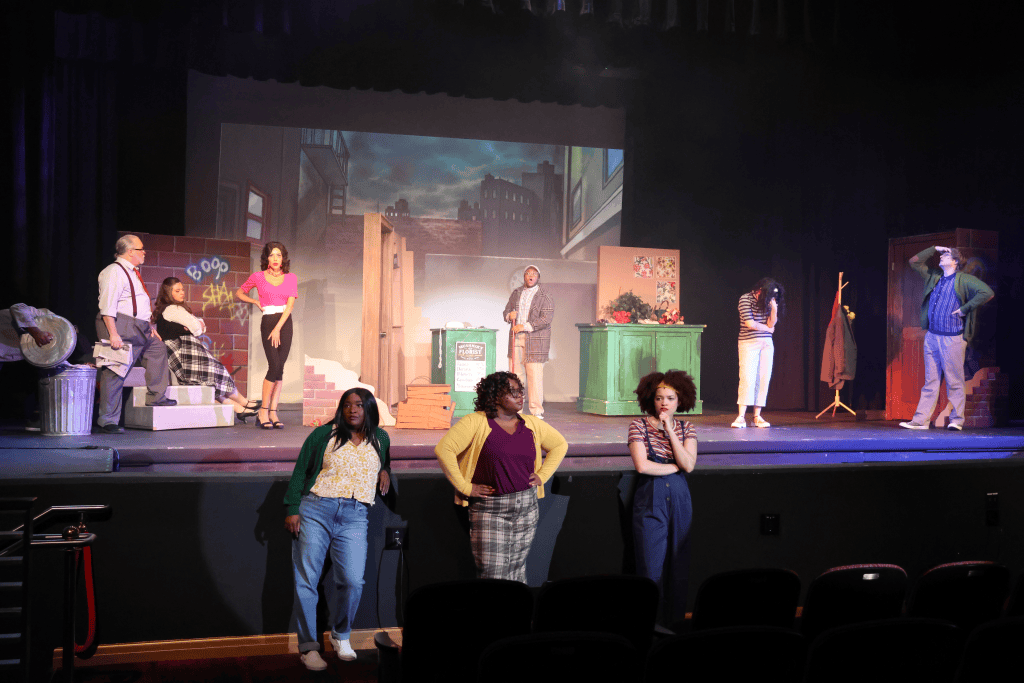
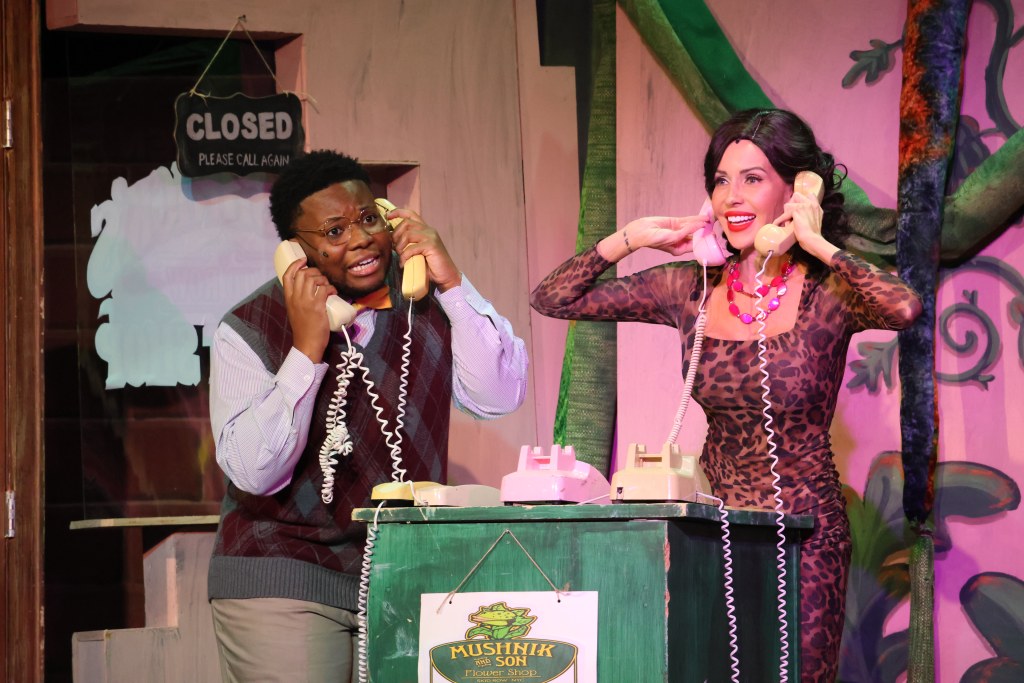
The story follows Seymour Krelborn (Asher Head), a downtrodden assistant in Mr. Mushnik’s (Alan LaFleur) failing flower shop, who discovers a strange plant he names Audrey II (Colton James Kraus) after his coworker and secret crush, Audrey (Deena Manzanares). The plant brings the shop fame and fortune, but it feeds on human blood, and its appetite only grows. Audrey’s sadistic dentist boyfriend, Orin Scrivello (Trevor Snyder), makes her life miserable. Three street-corner singers, Crystal (Rosemay Webster), Ronnette (Rebecca Meats), and Chiffon (Jadyn Coffin), narrate the action like a girl-group Greek chorus.
Murray City Cultural Arts is presenting the Broadway version of the musical, licensed through Music Theatre International, at the Murray Theater on State Street. The production brings together a director and choreographer now based in Oregon, a ten-piece orchestra, and a cast drawn from across the Salt Lake Valley theatre community. It runs October 23 through 30 and is rated PG-13 for violence, language, and its abusive-relationship storyline.

The Performances
As Seymour, Asher Head, making their Murray debut, begins deeply timid: shoulders hunched, voice hesitant, the kind of man who apologizes for taking up space. He’s exactly the Seymour Mitchell describes in his note, someone who says yes to avoid conflict, yes to be liked, yes because no feels impossible. Head, whose previous credits include C.C. White in Dreamgirls at The Grand Theater, never pushes that timidity into caricature. We believe this Seymour has spent his whole life on Skid Row being overlooked.
But Head lets him grow. By Act Two, Seymour starts stepping out of his shell, and Head charts that new confidence so it feels thrilling and unsettling at once. We want him to finally be seen, and we also know exactly what’s feeding it. Seymour is a deceptively hard role, a lead who has to spend most of the show disappearing into himself, and Head makes it look effortless. It’s a thoughtful, beautifully calibrated performance, and a strong Murray debut.
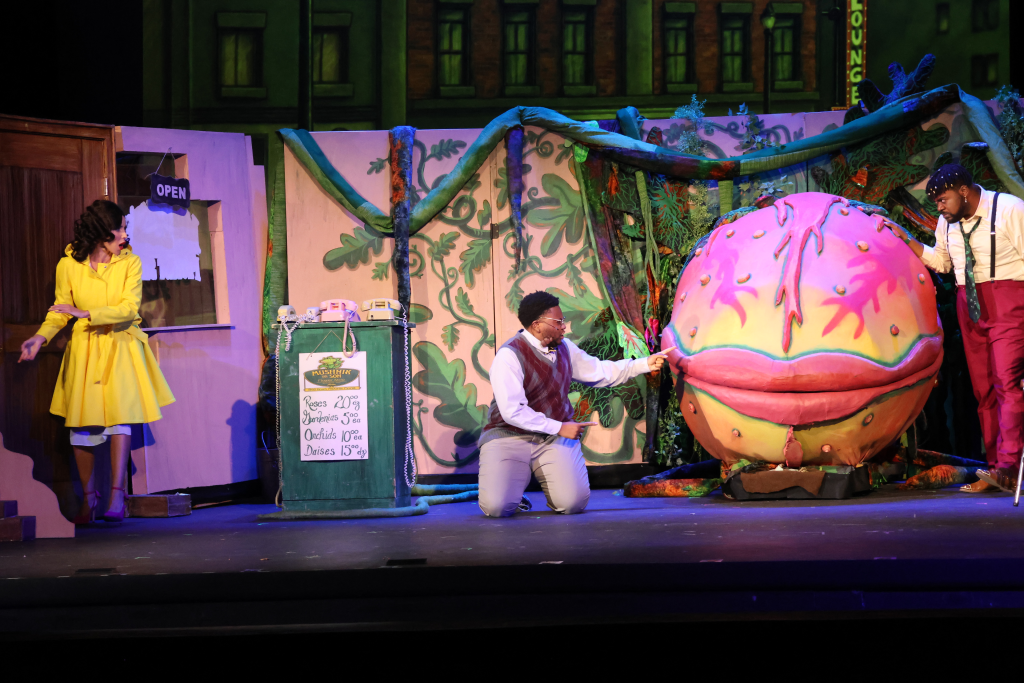
One of the production’s boldest choices is bringing Audrey II’s voice out of the wings, a decision Colton James Kraus told me was made jointly with the creative team. It’s easy to see why. Kraus, a recent Weber State University graduate stepping into what his bio calls his first true villain role, is a remarkably expressive actor. Standing in full view in a purple coat, he bursts with character. Every growl, purr, and demand to be fed comes with swagger and personality, and the plant’s seduction of Seymour almost plays as a relationship between two people rather than a man and a prop.
The choice has a cost, though. Kraus is so compelling that the puppet itself, skillfully operated by Beth Rasmussen and Patrick O’Boyle, often fades into the background. At times I realized I’d barely glanced at the plant at all, which means some of the puppetry’s careful work goes unwatched. It’s a trade-off between spectacle and performance, and while I missed some of the puppet’s menace, I can’t say I regret where my eyes went.


Photo 1: Trevor Snyder (Orin Scrivello) in Murray City Cultural Arts’ Little Shop of Horrors. Photo: Janel Williams Photo 2: Audrey II, voiced onstage by Colton James Kraus and operated by puppeteers Beth Rasmussen and Patrick O’Boyle, in Murray City Cultural Arts’ Little Shop of Horrors. Photo: Janel Williams.
Deena Manzanares, a two-time City Weekly Best Stage Actor returning to a role she calls a dream, does a great job with Audrey. Her accent is right on point, and rather than playing it for easy laughs, she uses it to give Audrey an endearing sincerity. Mitchell’s note describes Audrey as a young woman trapped in an abusive relationship who has been made to believe she doesn’t deserve better, and Manzanares honors that. This Audrey’s longing for something better feels earnest and deeply sympathetic, never a punchline. Her duets with Head, especially “Suddenly Seymour,” are a highlight.
Vocally, Manzanares takes a different path from the brassy belt many audiences know from the 1986 film, singing with a prominent vibrato that initially struck me as an unexpected fit for Audrey. But singers like Audra McDonald have shown that vibrato can carry character in any genre, and I suspect my reaction says as much about the film version living in my head as about her performance.
Alan LaFleur, now in his 54th year of theatre, makes a fine Mushnik: cynical, self-serving, and quick to bend to whoever holds the power. You can tell he cares for Seymour and Audrey, but never quite authentically, which is exactly right for a man who adopts Seymour only once the plant starts paying off. (Fans of Murray’s past seasons may smile to learn LaFleur once played Ursula in the company’s The Little Mermaid, a fitting connection given this score’s ties to that one.)
Trevor Snyder is an absolute standout as Orin the dentist and the show’s parade of other unsavory characters. He has an incredible voice and razor-sharp comic instincts, and I was laughing hard throughout. Orin is a hard role to balance, a sadist who also has to be funny, and Snyder makes the audience laugh while never letting us forget how dangerous he is to Audrey.
The Urchins’ harmonies are tight and polished, giving the score the girl-group sparkle it depends on. Rosemay Webster, Rebecca Meats, and Jadyn Coffin blend beautifully, and they hold the evening together as narrators, commentators, and the closest thing Skid Row has to a conscience.


Photo 1: Trevor Snyder (Orin Scrivello) and Asher Head (Seymour) in Murray City Cultural Arts’ Little Shop of Horrors. Photo: Janel Williams. Photo 2: Alan LaFleur (Mr. Mushnik) in Murray City Cultural Arts’ Little Shop of Horrors. Photo: Janel Williams.
The Design
Visually, this is a feast. Mitchell, who also designed the set, works with Paige Wilson’s costumes, Sarah Barrows’s props and set dressing, and lighting design by Ervin Wyatt, Bethany Haskell, and Audrey McEuen to build a world that slowly turns green and purple. It starts with a few touches around Mushnik’s shop, but as the plant’s appetite grows, so does its reach. By Act Two, the stage has become a forest. Audrey II isn’t just a puppet in the corner anymore; its colors bleed into everything, from Kraus’s purple coat to the glow washing over Skid Row.
Rasmussen, pulling double duty as puppeteer and projections designer, extends that world beyond the set with projections that were a highlight of the night. It’s rare in community theatre to see design this cohesive, where set, costume, light, and projection all seem to be telling the same story about a hunger that slowly takes over the room.
Under the music direction of Dr. BJ Bedont, a ten-piece orchestra gives Menken’s score the full rock-and-doo-wop punch it needs, supported by sound design from Hazel Nielsen, Levi Bach, and Morgan Petersen and technical direction by Robert Wyss. Jann LeVitre’s choreography, brought to life with assistant choreographer Larissa Villers while LeVitre sent notes remotely from Oregon, is great fun, keeping the stage moving with all the snap of a 1960s girl-group number.
Behind the scenes, assistant director and cast liaison Sonia Maritza Inoa-Rosado Maughan and producer Candy Tippetts, Murray City Cultural Arts’ artistic director, helped hold the production together. Intimacy director Kris Peterson’s involvement is a welcome sign of care in a show whose story turns on an abusive relationship. Stage manager DeeDee Smith (Palmer), with assistant stage managers Katie Bauer, Nicholas Ferrone, and Bach, kept the evening running smoothly, while follow spot operators Sydney McEuen and Petersen kept the performers in the light.
The orchestra deserves its own bow: Sara Chatelain and Drew Holland on reeds, John Olshinski and Colton Bettinson on trumpet, Scott Miller on guitar, Larry Montoya on bass, Dave Thalmann on percussion, Jerrick Mitchell on drums, and Carrie Giles and Catherine Cummings on keyboards.

Behind the Score
Hearing the score live, I kept thinking about the two men who wrote it. Menken comes from a family of dentists. His father, grandfather, uncle, and two uncles by marriage all practiced, and Menken has joked that he’s the one who failed to join them. Fittingly, when Little Shop was conceived, his dad was president of the New York chapter of a dental society promoting nitrous oxide as safe. Menken has said that killing off Orin with laughing gas was his idea, and that his parents were less than amused at first. But once the show became a hit, his father supplied the slides of teeth used in the production. It’s a lovely reminder that a son who didn’t become a dentist found another way to honor the family business, if a slightly twisted one.
The words belong to Ashman, who wrote the book and lyrics for Little Shop and later the lyrics for The Little Mermaid. Ashman was a gay artist working in a world often hostile to queer communities, and he died of AIDS-related complications in 1991. In the decades since, Menken has made sure his partner’s legacy lives on. Asked on NPR how he landed at Disney, he credited “my late collaborator, a brilliant collaborator, Howard Ashman.” He shares stories of their collaboration when he performs the Little Shop songs, and he appeared in and scored Howard, Don Hahn’s 2020 Disney+ documentary about Ashman’s life.
Menken’s melodies also resurface across his career, and I caught flourishes here that would bloom in The Little Mermaid. Menken himself has confirmed the kinship. Introducing “Somewhere That’s Green” at an NPR Tiny Desk concert, he called it a classic “I want” song, admitted its melody might sound familiar from The Little Mermaid, and revealed that he and Ashman jokingly nicknamed “Part of Your World” “Somewhere That’s Wet.” Ashman also fought Disney executives to keep “Part of Your World” in the film when they wanted it cut, insisting that a character’s longing was the heart of the story. Knowing all that, “Somewhere That’s Green” and “Part of Your World” sound like sister songs, both aching for a place where you can finally belong.
But the sisters dream on very different scales. Ariel longs for an entire world and gets it. Audrey longs for almost nothing: a tract house, a toaster, a fence, a husband who’s kind to her. Watching Murray’s production, I kept feeling that Little Shop was warning us to dream, but not too big, and to keep those dreams in check. Seymour dares to want more, and the plant is happy to feed that hunger until it threatens everyone he loves. It’s the darker flip side of Mitchell’s “just say no”: in this world, even modest dreams come at a cost, and the bigger ones can swallow you whole. That isn’t cynicism. It was reality for many LGBTQ+ and Black Americans in the early 1980s, when Little Shop opened off-Broadway just as the AIDS crisis was beginning, especially for those living on the margins, where even a small dream of safety could feel out of reach. And honestly? More than forty years later, it still feels real.
Stage vs. Screen (spoilers ahead)
Spoiler warning: this section discusses the endings of both the stage musical and the 1986 film. If you’d rather be surprised, skip ahead to “Why This Production Matters.”
Many audience members will arrive knowing Little Shop from the 1986 film, directed by Oz and starring Rick Moranis, Ellen Greene, and Steve Martin as the dentist. But the story began as Corman’s 1960 low-budget horror comedy, which Ashman and Menken turned into the 1982 off-Broadway musical that Murray is staging here.
The biggest difference is the ending. On stage, Audrey and Seymour are both devoured, and the finale, “Don’t Feed the Plants,” warns that Audrey II’s offspring are taking over the world. Oz and Ashman filmed that ending too, at a reported cost of around $5 million, with giant plants toppling buildings and climbing the Statue of Liberty. But test audiences in San Jose turned on the film the moment Moranis and Greene died. Oz later explained that a stage audience knows the actors will come out for a bow, while a film audience simply loses the people it loves. Ashman rewrote a happy ending: Seymour electrocutes the plant and escapes to the suburbs with Audrey. The original ending was finally restored in a 2012 director’s cut.
The film also reshaped the score. “Ya Never Know” became the calypso-flavored “Some Fun Now,” and “Closed for Renovation,” “Mushnik and Son,” “Now (It’s Just the Gas),” and “Call Back in the Morning” were cut. Ashman and Menken added “Mean Green Mother from Outer Space” for Audrey II, which earned an Oscar nomination. Murray’s production restores every one of the stage songs, along with the reprises of “Suppertime” and “Somewhere That’s Green” and the full, dark finale. Those who only know the movie are in for a shock, and that sharper ending is exactly what gives Mitchell’s “just say no” reading its bite. Here, saying yes one too many times costs Head’s Seymour everything, and Manzanares’s Audrey with him. That ending is also what makes “Somewhere That’s Green” land so much harder. In Act One, it’s a sweet, funny daydream about toasters and plastic-covered furniture. But when Audrey reprises it as she’s dying, asking to be given to the plant so that some part of her can stay with Seymour, the little house she longed for becomes a place she’ll never reach. Knowing the dream won’t come true, the first version aches in retrospect, and the reprise is devastating.
The film also carries a casting history worth naming. Audrey II was voiced by Levi Stubbs of the Four Tops, and the Urchins were played by Tichina Arnold, Tisha Campbell, and Michelle Weeks, three young Black women in their film debuts. Black voices have powered the plant and the chorus from the start.
Why This Production Matters
Little Shop has always been a story about those pushed to the margins. Skid Row is a place where, as the opening number insists, nobody gets out, and its residents are the overlooked and underpaid. Its longing songs, “Grow for Me” and “Somewhere That’s Green,” are about wanting to be seen and wanting a place to belong.
This production lets that longing land in a new way. Murray puts a Black Seymour, Head, at the center and brings Audrey II’s voice onstage in the body of a Black performer, Kraus. Webster, Meats, and Coffin, three Black actresses of different ages, complete the chorus. The overlooked shop boy who finally steps into the light is now played by someone Utah audiences too rarely see in a leading role.
That casting of the Urchins matters on its own. Ashman and Menken named Crystal, Ronnette, and Chiffon after the Crystals, the Ronettes, and the Chiffons, Black girl groups whose sound is the musical DNA of the score. The script describes the Urchins as Black, though the licensing house, Music Theatre International, only encourages, rather than requires, that they be played by actors of color. Productions that cast them otherwise have drawn sharp criticism, from Bay Area stages to Australia to Utah itself, where a Utah Theatre Bloggers review called out another production for exactly this. Murray honors where the music came from, then goes further. With Black performers in five of the show’s eight principal roles, it is so refreshing to see a production embrace that kind of casting right now, and to center a Black Seymour in the process. Well done, Murray.
The production doesn’t reframe the story around race, and it doesn’t need to. It simply asserts that these artists belong in the spotlight of a beloved, mainstream American musical, in a renovated hometown theatre, in front of a Murray audience. That is a strong message for a Utah stage. It is representation as presence rather than argument, and it is powerful. Watching Head, Kraus, Webster, Meats, and Coffin take hold of Ashman and Menken’s story, the show’s ache for belonging felt especially poignant.
What Murray does here isn’t rewriting the show. It changes the lens. The script, the songs, and the plot are all the same, but the body at the heart of the story has changed, and that shifts where our eyes and our sympathies go. Black performance in Little Shop has long lived at the edges of the frame: Stubbs’s voice hidden behind a puppet, the Urchins on the stoop. Here the lens refocuses, moving Black performers from offstage voice to onstage presence, and from the margins to the center. In my own research, I call this kind of work counter-theatre: performance that pushes back against the stories a culture has inherited by changing who gets to carry them. The next time someone in that audience pictures Seymour, it might be Head instead of Moranis.
It also sharpens Mitchell’s own theme. A story about a man who learns too late how to say no hits differently when that man has spent his life being told where he fits. By keeping the stage version’s dark ending, Murray refuses the comforting Hollywood rescue, and it trusts its audience to sit with the cost of Head’s Seymour and his choices.

The Verdict
Mitchell ends his note with a warning: “DON’T FEED THE PLANT!” I’ll end mine with the opposite advice: feed your theatre habit and go. This Little Shop is funny, beautifully designed, and carried by performers who deserve to be seen, from Head, Kraus, and Manzanares to Snyder, LaFleur, and the Urchins, with Madeleine Rodriguez, Megan Pulley, and O’Boyle giving Skid Row its grit and life. Its final performances play at the Murray Theater (4961 S. State Street) through October 30 at 7:30 PM, and the show is rated PG-13.
To the entire cast, crew, orchestra, and production team: well done. You’ve made something funny, gorgeous, and meaningful, and Murray audiences are lucky to have it.
This is exactly the kind of show we should be supporting right now. Go, before the plant eats up the last of the run.
Sources
The production
- Little Shop of Horrors production program. Murray City Cultural Arts, October 2026. Director’s note, cast and production credits, and bios.
- Kraus, Colton James. Personal communication with the author, October 2026.
Menken, Ashman, and the score
- “Disney Composer Alan Menken Plays Not My Job.” Wait Wait… Don’t Tell Me!, NPR, December 18, 2010.
- Rogosin, Josh. “Little Shop of Horrors: Tiny Desk (Home) Concert.” NPR, May 6, 2022.
- Knegt, Peter. “The Remarkable Story of Howard Ashman, Who Changed Disney Forever While Battling AIDS.” CBC Arts, March 11, 2021.
- “‘Beauty and the Beast’ and ‘The Little Mermaid’ Were Actually Queer as Hell.” Vice.
- “‘Howard’ Premieres August 7 on Disney+.” Disney+ press release, July 16, 2020.
- “Howard Ashman Documentary on Disney Plus.” The Luxe Review, July 16, 2020.
- “Pneumocystis Pneumonia, Los Angeles.” Morbidity and Mortality Weekly Report, Centers for Disease Control, June 5, 1981.
Stage and screen
- “Little Shop of Horrors (film).” Wikipedia.
The Urchins and casting
Bay State Banner. Review of New Repertory Theatre’s Little Shop of Horrors, on the Urchins’ girl-group namesakes.
“Little Shop of Horrors: Casting.” Music Theatre International.
“A Bay Area Production of ‘Little Shop of Horrors’ Is Coming Under Fire for Its Casting Choices.” San Francisco Chronicle Datebook.
Peterson, Chris. “Yes, You Can Whitewash ‘Little Shop of Horrors,’ But Please Don’t.” OnStage Blog, August 26, 2024.
“Little Shop of Horrors Is Out of This World Despite Big Misstep.” Utah Theatre Bloggers.


Leave a Reply