

The Unanswered Questions of a Post-Religious Girl in Her 20s (July 25–Aug. 1), written by Tabitha Whittekiend, runtime 45 minutes.
Cast: Tabitha Whittekiend & Madel McKinnon
Crew: Natalie Whittekiend handles stage management, lights, and sound.
Raised in Utah, a girl comes to see the world in firm moral terms, good and bad clearly marked, and then has to figure out how to live once she’s stepped outside the religious community she grew up in, according to the official synopsis. She leans on her journal to make sense of it, working through pointed, often funny questions about swearing, sex, and drug use that the show raises without necessarily resolving.
Salt Lake City, UT—Staging your own doubt in front of the very culture you’re doubting takes a particular kind of vulnerability, especially at a festival built around twenty-seven other shows all vying for the same seats. That vulnerability pays off. Tabitha Whittekiend’s The Unanswered Questions of a Post-Religious Girl in Her 20s earned a standing ovation from a sizable portion of the house on the night I saw it, and by the time the lights came up, it wasn’t hard to see why.
The show announces its whole project in its first minute, and it does it both literally and symbolically. Whittekiend walks out in an old-fashioned dress, framed by a dresser cluttered with Church books and photos, the visual shorthand for the world she grew up in. Then she takes the dress off, right there, physically disrobing from the teachings of her childhood as much as from the garment itself, and underneath is a black tank top and shorts, plain, contemporary, hers. It’s a simple piece of staging, but it does the work a whole scene of exposition might otherwise have to do: here is the costume she was handed, and here is what was underneath it the whole time.
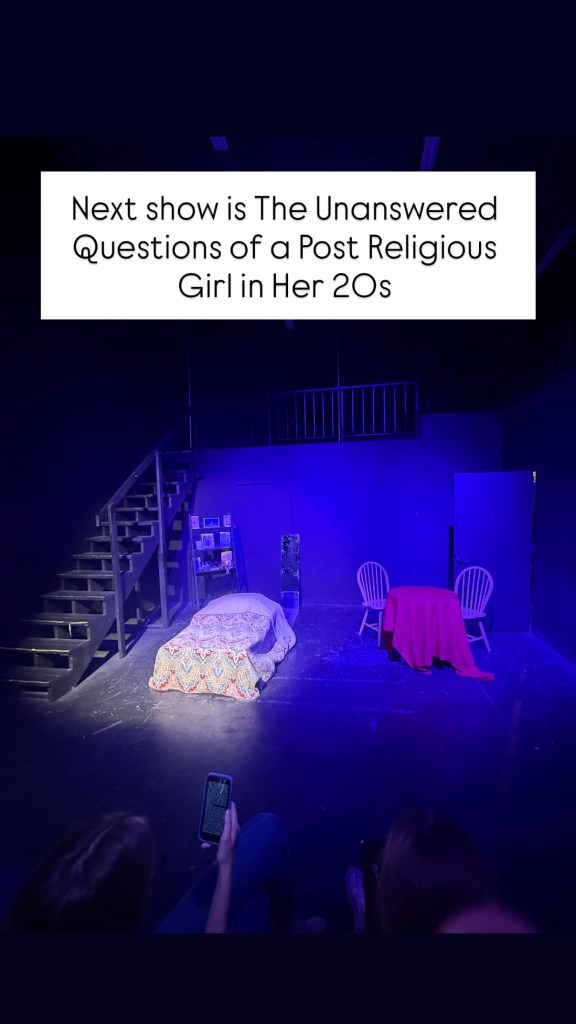
The show is structured as a series of journal entries, each one preceded by a quotation: scripture, a General Conference talk, a line from Church leadership, that sets up the diary passage to follow like a verdict the entry then has to answer to. It’s a simple device, but Whittekiend uses it with real precision. The gap between what she was taught and what she actually lived becomes the engine of the whole piece.
The show opens, fittingly, with Matthew’s teaching on binding and loosing: “Verily I say unto you, whatsoever ye shall bind on earth shall be bound in heaven: and whatsoever ye shall loose on earth shall be loosed in heaven” (Matthew 18:18), a promise of authority and certainty that the rest of the piece spends 45 minutes quietly dismantling. A passage cautioning that marijuana use should be “avoided except under the care of a competent physician” precedes her first house party, where she shows up sober and clutching a cup of juice like a security blanket. A warning against “impure thoughts, words, and acts” precedes the moment she swears for the first time in front of friends and immediately feels caught. A line about chastity precedes her first gynecologist appointment and a friend’s pregnancy scare in a coffee shop bathroom. By the time we get to a talk on eternal perspective ahead of a scene mentioning her grandfather, who has passed, and her cat dying in the same week, the pattern has done its work. We’re primed to feel the collision before it happens, which makes it land harder, not softer.
What’s smart about the device is what it’s actually arguing. This isn’t a show about whether the Church is right or wrong on any given point, and Whittekiend never really litigates doctrine. What she’s after is the feeling of certainty itself, the sense that somewhere there was supposed to be an answer key, and the diary form is her counter-proposal to it. Early on, she says plainly that she never actually felt that certainty herself, not as a kid sitting through the lesson on the Holy Ghost, not since; she’s never been sure whether a decision came from prayer or just from her own gut, and she names that gap without dressing it up as a crisis. The example she reaches for is a strange, vivid one and it sticks with you: a story about a woman who accidentally leaves her baby on the roof of her car and, every time she tries to drive off, feels something stop her. It’s meant as a tidy parable about the Spirit intervening. Whittekiend can’t get past how unsettling it actually is, that the lesson’s proof of a loving God is a baby nearly lost, and that the story leaves her more anxious about certainty than reassured by it. A journal doesn’t hand down verdicts. It just records what happened and how it felt, without needing either to be resolved. Every epigraph promises a bound, settled, “whatsoever ye shall bind on earth” version of the world; every diary entry that follows is proof that most of life doesn’t come pre-bound at all. That’s the actual argument the play is making, gently and without ever saying so directly: not that the answers she was given were wrong, but that needing a given answer was the thing that was always going to fail her.
What keeps the show from being simply an exorcism of Mormon upbringing, a genre Salt Lake audiences have surely seen before, is how funny and how fair it is. Whittekiend isn’t interested in villains. The family members on the other end of her phone calls (a brother who saw the tattoo on Instagram, a grandmother worried about baptism, a cousin offering a cheerful “you can just get re-baptized after you die”) come across as people acting out of love filtered through fear, not cruelty. Even the reunion scene with an old friend who asks Whittekiend to be a bridesmaid resists easy contempt in either direction. That refusal to flatten anyone is the show’s quiet moral center, and it’s what makes the audience’s sympathy expand rather than narrow as the piece goes on.
A lot of that fairness rests on co-star Madel McKinnon, credited simply as playing “everyone” else in Whittekiend’s orbit. It’s a demanding assignment, one performer covering that many relationships across that many years, and McKinnon never lets any of them collapse into a type. The grandmother’s guilt trip and the reunion friend’s genuine warmth come from the same actor within minutes of each other and never feel like the same performance twice. Whittekiend gets to carry the show’s interior voice because McKinnon is doing the less flashy work of making every other person in her life feel specific and real. The two of them have an easy, lived-in rapport on stage, which is probably why the family scenes land the way they do.
The dating material in the back half is the weakest stretch. A few scenes (an oblivious ex asking what dinosaur we evolved from, a Pride Parade non-conversation) lean a little broad, more sketch-comedy than the specificity of the earlier scenes. But even there, Whittekiend’s control of tone rarely slips; she knows exactly when a laugh needs to cut against something sadder underneath it.
The ending earns its ovation honestly. Rather than resolving into a tidy new belief system, the show closes on Whittekiend admitting she still doesn’t know, about God, about death, about whether any of it adds up to a plan, and choosing to be at peace with that anyway. The staging closes the loop it opened.
By the final blackout, new books have taken their place, hers, chosen rather than handed down. It’s a quiet, unfussy image, no big speech attached to it, and it lands harder for that restraint; the shelf was never going to stay empty, it was just going to be hers. She reaches for a Mary Oliver poem to get there [“What Gorgeous Thing,” from Blue Horses], using the image of a bluebird singing without needing anyone to answer for it, and the borrowed language works because she’s earned the right to lean on someone else’s certainty about uncertainty. It’s a smart, generous way to end a show about a culture that prizes certainty above almost everything else.

This is a piece built for exactly this room: a Salt Lake festival audience who will recognize every reference in that opening quote about the Word of Wisdom without needing it explained, and who will laugh in the specific way that only comes from having lived it. But it doesn’t require that context to work; strip away the Utah particulars and what’s left is a genuinely well-built piece about growing into your own uncertainty, and deciding that’s enough. Standing ovation earned.
About the playwright: Tabitha Whittekiend calls Utah Valley home, though she’s moved around plenty. She got her start in theater almost by accident, cast repeatedly as male characters in high school on account of standing nearly six feet tall by sixteen. That experience pushed her toward roles that were more than gender-swapped leads, and she went on to earn a BFA in Acting from Utah Valley University, where she found a particular pull toward complicated female characters. Off stage, she’s an avid birder and outdoor advocate, with a soft spot for the Great Salt Lake. More of her work is at her website.


Leave a Reply