

A fully improvised two-person long-form show built on grief and mythology, with a title that tips its hand early but doesn’t pay off until the very end.
Salt Lake City, UT—Performed by Conrad Carter and Trinity Medina, with lighting design by Isabella Medina, There’s Only Two Left begins with a question that seems to define the entire show: “Who killed Charlie?” The opening is a deliberate aporia—a moment of uncertainty that invites the audience into a problem rather than immediately resolving it. In both rhetorical and philosophical terms, aporia marks the point where familiar answers fail, and deeper inquiry begins. The brilliance of the show is that it recognizes its opening question is not one that can simply be answered; it is one that must be transformed. As the performance unfolds, the mystery becomes less about identifying a culprit and more about understanding grief, memory, and what remains when someone is gone.
Aporia—Greek for “impasse” or “without passage.” Rhetorically, it is a staged expression of doubt that draws an audience into a difficulty rather than simply asserting an answer. Philosophically, it reflects the Socratic sense of a genuine impasse: a moment when a question cannot yet be resolved with the tools currently available. It is not a dead end, but the point where deeper inquiry begins. “Who killed Charlie?” functions as both forms of aporia. The audience cannot answer it with the information they are given, and the show’s central move is realizing that the question itself must be reworked before it can be answered.
The backstage “break a leg / knock him dead” wordplay before the show even starts is a nice piece of foreshadowing that rewards attentive audiences without telegraphing the twist. It is also a smart choice for an unscripted show specifically. A murder-mystery premise hands the performers a built-in question that they keep answering scene by scene. That is the structural anchor two-person long-form needs when there is no ensemble to generate momentum, meaning the question itself has to do the heavy lifting. The maze, Uncle Jerry, and the ghosts each read as progress toward solving it. By the end, the show has quietly redefined what “solving it” even means.
Narrative Arc
What elevates this above a string of funny bits is that the entire show tracked a real arc: setup (grief, distraction, entering the maze), escalation (mythology, prophecy, ghosts, revelation), and turn (Charlie’s true fate, T’s transformation). Sustaining that shape across a fully unscripted two-hander is a genuine display of craft.
Structurally, it resembles what improvisers sometimes call “The Movie” format: built around genre conventions, a recurring central location, and parallel character arcs building to a climactic resolution. The maze functions like the format’s signature recurring set, its “rules” established and paid off like a film’s world-building; T’s escalation into “Aunt Jenny the First” and Charlie’s (CJ’s) parallel arc (obsessive maze-visitor, then doppelganger victim, then trapped-but-alive) both track cleanly as the kind of character arcs the format is built around. This is a critical comparison, not a claim about how the performers themselves would describe their own show, but the parallel is specific enough to be worth naming.

Thematic Weaving
Rather than treating plot beats as one-off jokes, CJ and T kept returning to and deepening a set of core themes throughout. The material didn’t just move forward; it circled back, tightened, and paid off, which is a much harder trick to pull off than pure escalation.
The ghost sequence (past, more recent past, “most recent past,” aka the present) does this work through a device that echoes what’s sometimes called a “Deconstruction”: returning to the same core event, Charlie’s death/disappearance, from different temporal angles, each pass revealing new information (the clone, the fight with the prior Jerry, the 175 mazes). It’s a comic bit on its surface, but structurally it’s doing real narrative labor.
Strongest Structural Choice: The Clone Reveal
Introducing a doppelganger Charlie is smart architecture: it retroactively explains earlier inconsistencies in Charlie’s behavior and lets the “real” Charlie’s fate stay suspended in the finale. Pulling this off with only two performers (no narrator or third voice to seed the twist) meant it had to be planted and paid off entirely through what CJ and T said to each other.
It also does useful emotional work: it lets the show grieve Charlie honestly in the early scenes and then complicate that grief later without undercutting it as a “gotcha.” CJ and T aren’t shown to be wrong to have mourned; they’re shown to have mourned the wrong version of events, which is a more interesting and harder note to land than a simple twist ending.
Strongest Emotional Choice: The Song Game
Using “Twinkle, Twinkle, Little Star” and “Let It Go” as a call-and-response search mechanic is where the show’s comedy and grief blend best: a repeatable bit for laughs that also channels CJ and T’s unspoken mourning. Comedy carrying pathos instead of undercutting it.
The song choices themselves aren’t incidental, either. “Let It Go” is thematically loaded, a song literally about releasing something you can no longer hold onto, sung by two people who are, functionally, trying to let go of a friend. Whether that pairing was a conscious choice in the moment or an instinct born of good scene sense, it’s the kind of detail that makes a runner feel earned rather than arbitrary, and it’s worth calling out explicitly as a highlight.
The Mythology Engine
The “long bloodline of Uncle Jerrys” gives the world scale on a bare stage: no new sets needed, just an escalating institution with rules invented on the fly. The prophecy naming T (not Charlie) as successor gives every scene forward pull toward an inevitable turn.
This is also where the show takes its biggest risk and earns it. Naming a successor upfront means the audience spends the rest of the runtime watching a foregone conclusion approach rather than wondering what will happen, so the tension has to come from how and when the prophecy lands, not whether it will. Charlie’s failed attempt to claim the role first, killing a prior Jerry but not becoming ruler, is what makes that payoff work: it establishes that the prophecy has real teeth and can’t simply be muscled into by ambition alone.
A note on terms: “The Movie” and “Deconstruction,” used above and below, are drawn from commonly taught long-form improv vocabulary, not from any official or governing standard, since improv doesn’t really have one. These format definitions emerged out of the Chicago long-form scene (Del Close, iO/ImprovOlympic lineage) and are taught and described somewhat differently depending on the theater or teacher. Practitioners disagree even on where the boundaries sit. So the comparisons here are offered as a critic’s analytical lens, not as a claim about how the performers themselves would categorize their own show.
Level of Craft
The number of times CJ and T ran in and out of doors to snap into new scenes or characters, was its own demanding layer, essentially doing the work of scene changes and cast turnover that a full ensemble would normally handle, entirely through their own bodies, and functioning like literal jump cuts: no blackout, no formal scene-change convention, just a hard cut executed at speed. What’s most impressive is the combination of speed and invisibility: the transitions were fast, with no visible reset beat between characters, yet none of the physical toll showed. No flagging energy, no breathlessness, no blur between who was who.
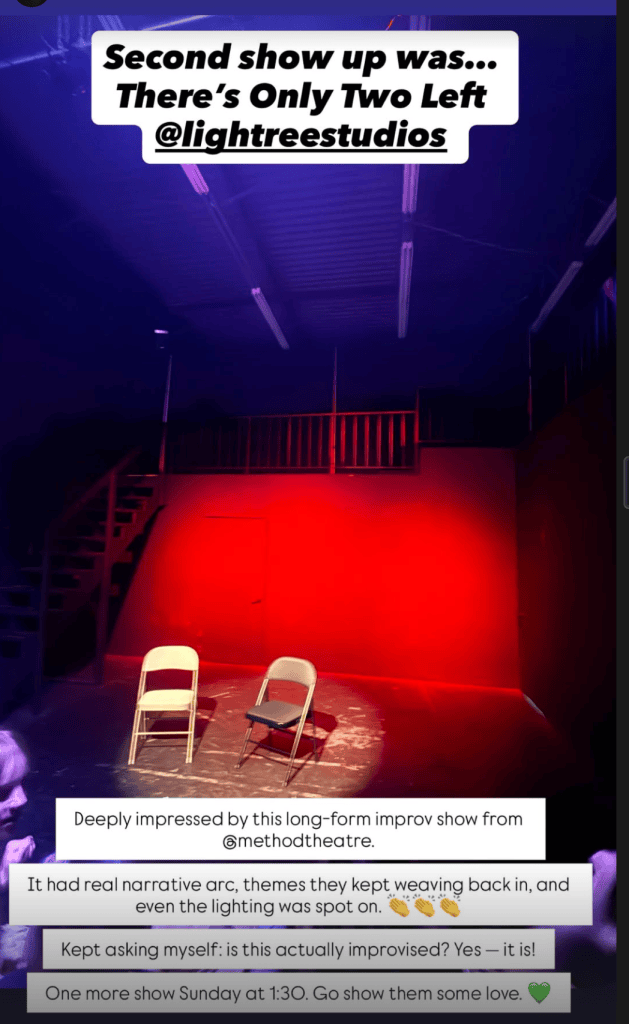
This is what makes two-person long-form so much harder than group improv: there’s no ensemble to lean on for saves or scene breaks. The disciplined callback-editing on the song game, the “yes-and” building of an entire mythology without either performer blocking the other, and a narrative arc tight enough that the lighting design landed in sync with it. All of it built to a show polished enough to genuinely make an audience member ask, more than once, “is this really improvised?” That lighting sync wasn’t incidental: Isabella Medina designed the show’s lighting, meaning the cues that seemed to track the story’s emotional turns were a deliberate creative choice, not a coincidence of a pre-set board.
Why the Title Works
By the final scene, Charlie is trapped in the maze, alive but caught between life and death, and CJ’s fate is left unresolved alongside him. T alone has crossed over, ascending to become “Aunt Jenny the First.” The title reads less like a body count and more like an elegy for the friend group: whatever happens to Charlie and CJ, only T is truly gone, transformed into someone else entirely.
Conclusion
What makes this show worth watching and writing about isn’t the mystery; it’s what the mystery is doing the whole time. “Who killed Charlie?” was never really the question; it was the scaffolding two performers used to build a friend group, a mythology, and an ending, out of nothing but doors, songs, and each other. CJ stays CJ. T doesn’t get to. By the time the aporia resolves, it hasn’t been answered so much as outgrown: the audience arrives at “There’s Only Two Left” having stopped asking who killed Charlie several scenes ago, and started asking something closer to what it costs to keep going without Charlie. That’s a harder thing for unscripted theater to earn than a clean twist, and this show earns it.

The Company
Trinity Medina (she/her) is an incoming senior at Westminster University pursuing a BFA with an Acting Emphasis and a minor in Educational Studies. Educational credits include Accidental Death of an Anarchist (Madman), Ride the Cyclone (Ocean), The Moors (Emilie), The Taming (Pat), Orphans (Helen), and Doomsday Device (Old Gran). Regional credits include Peter and the Starcatcher with Murray Park Amphitheater (Peter Pan/Boy), NUNS (Mother Superior) at the University of Utah, and Improv Salt Lake, Legends, and Wildflowers at SLC Fringe.
Conrad Carter (they/he) is an incoming senior at Salt Lake Community College pursuing a major in English Studies. Extra-curricular credits include guitar and songwriting for SABBÄTAGE, performing at venues including Church and State, One Love Coffee, and Black Lung Society. Regional credits include Curiosity Killed the Cast, Not at the Church Anymore, and Vicious with Method: Theatre, and Legends and Wildflowers at SLC Fringe.
Isabella Medina (she/her), lighting designer, is an incoming junior at Utah Valley University pursuing a BS in Applied Communications. Extra-curricular credits include graphic design (the show’s posters), photography, and marketing. Regional credits include Legends and Wildflowers at SLC Fringe.
Sources
The Improv Archive (improvarchive.org); “Long-Form Improv: The Ultimate Flow” by Brielle Jobe, Medium (medium.com); “What improv forms are there?” by Will Hines, Substack (willhines.substack.com).


Leave a Reply