

Disclosure: Playwright Melissa Leilani Larson paid for me to attend this performance, so I spent extra time on her adaptation specifically. The opinions here, including my criticisms of the script, are my own.
Pleasant Grove, UT—I walked into The Ruth’s Pride and Prejudice—Melissa Leilani Larson’s adaptation, directed by Kymberly Mellen—expecting, as I usually do, a complicated relationship with Mrs. Bennet. She has never been my favorite character: loud, intrusive, often exasperating. So I was intrigued that this production made her Deaf, with Anne Post Fife in the role. It is the kind of adaptation I tend to champion: take a familiar story, make a bold choice, and create space for people the theatrical canon has historically left out.
What I didn’t expect was that a Deaf Mrs. Bennet would make me care about her more.
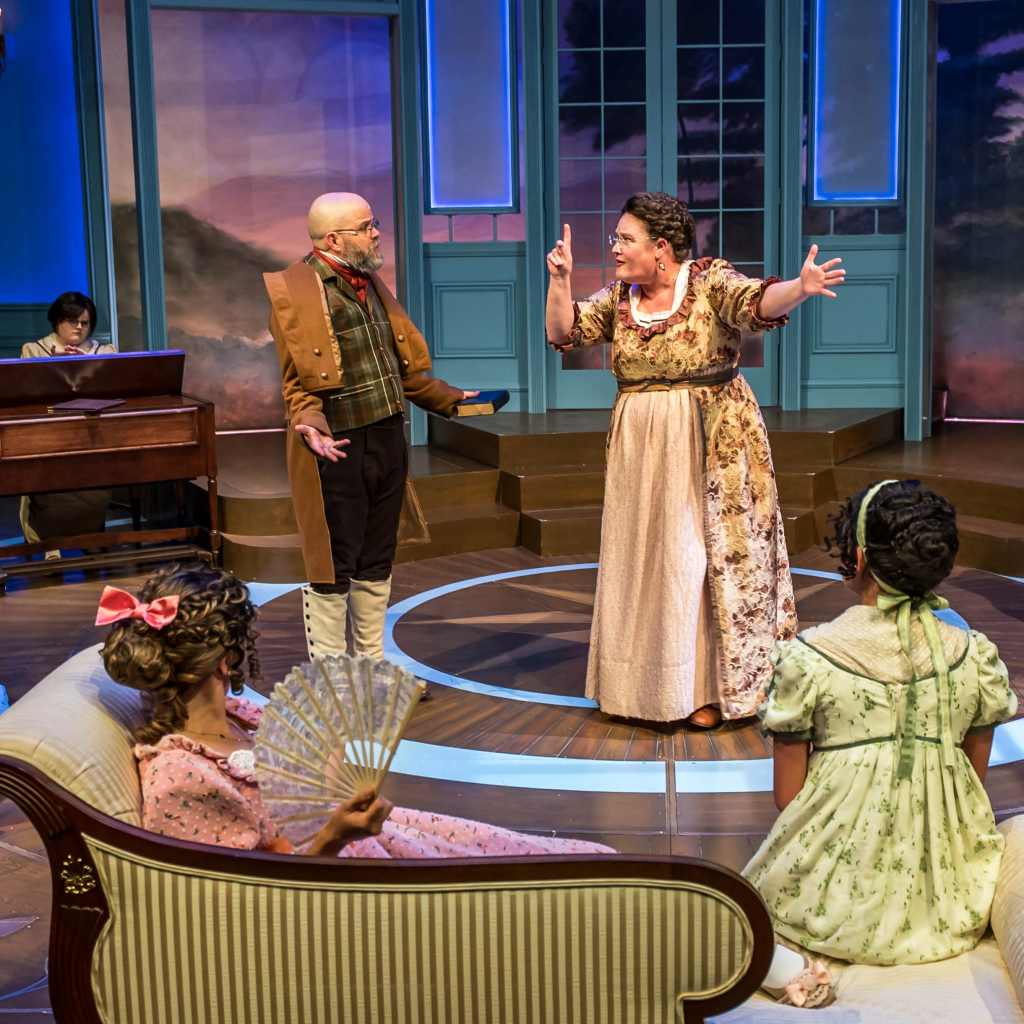
Moving Mrs. Bennet into ASL made me pay closer attention to how she communicates and to whether the people around her are actually listening. Her daughters—Kitty, Mary, and Lydia—take turns voicing for her, and even when someone else is speaking her words, the feeling behind them is unmistakably hers. At first, I caught myself wondering how loud this Mrs. Bennet actually was, a strange question about a character I had always known as the loudest person in the room. Other questions followed: Who was speaking? Was that Mrs. Bennet’s voice or her daughter’s? Why was this daughter interpreting?
Eventually, those questions became more interesting than the mechanics. If Mrs. Bennet’s words reach the room only through the people around her, what does that say about her agency? And if the people closest to her don’t consistently meet her in her language, what does that say about those relationships?
Nowhere was that clearer than at the Netherfield ball, where the Bennets make a spectacle of themselves. Lydia, who seems to be drunk, is speaking for her mother. Darcy overhears Mrs. Bennet’s gossip because her daughter is saying it aloud, and Lydia’s tipsy delivery becomes part of how her mother sounds. Whose embarrassment is this? Mrs. Bennet cannot control who hears her words or how they land, and her daughters end up publicly saying the very things that damage their own prospects. That is where the production became most compelling to me, and where I wished it had gone further.

When Communication Becomes Character
The production’s most successful choice comes near the end, when Darcy returns with Bingley, who has come back for Jane. He goes to Mrs. Bennet, signs to her, and helps her with her chair. It is a small gesture, but within the language the production has built, it carries enormous weight.
The production doesn’t need to explain Darcy’s transformation; we see it in his willingness to meet Mrs. Bennet on her terms. And the contrast is striking: Bingley, standing beside him, makes no such effort. This was the moment Mrs. Bennet’s Deafness felt most fully woven into the storytelling, and it made me wonder why the production didn’t apply the same logic to the rest of the family.
The Silence Around Mrs. Bennet
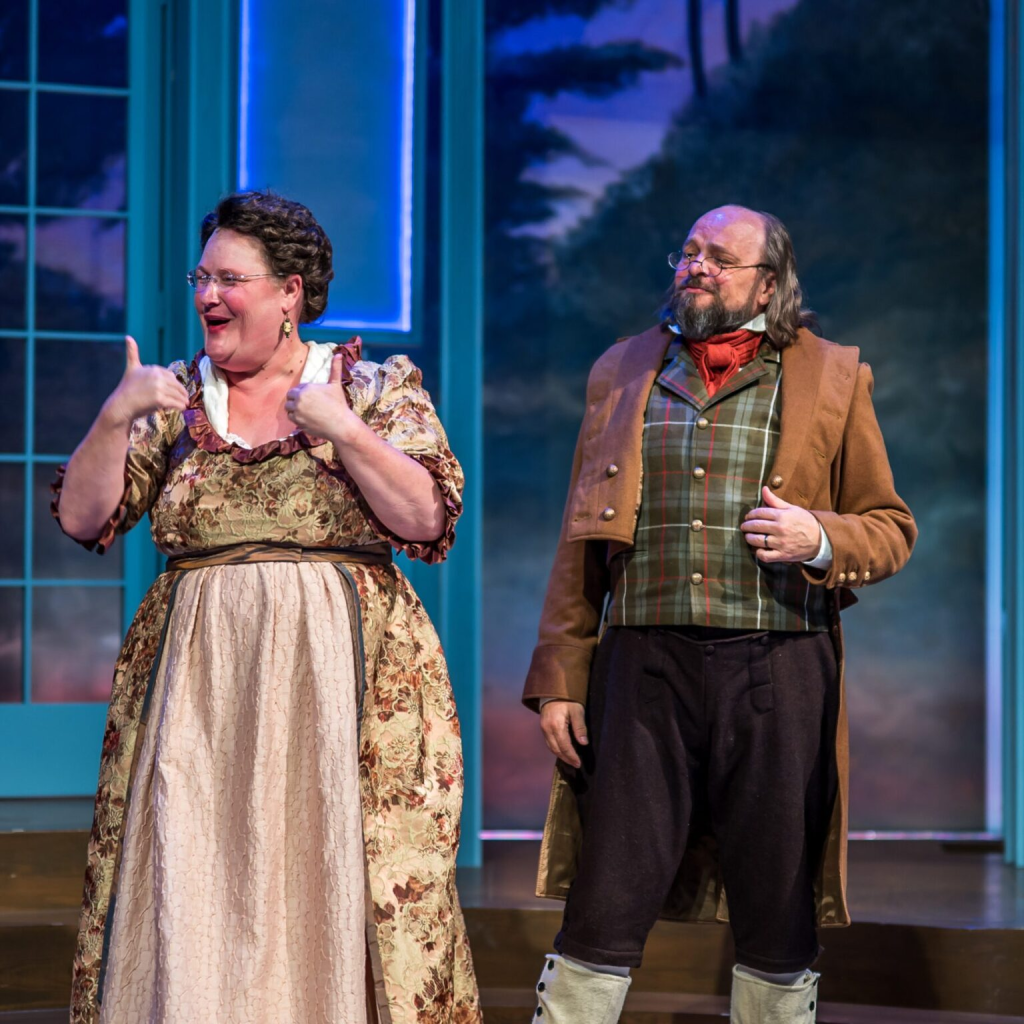
Mr. Bennet signs to his wife only occasionally. The daughters sign more often, but their signing doesn’t always match what they say aloud. There is something beautiful in the idea of her daughters as her voice, but it isn’t carried out evenly: the job falls to the three youngest. Jane, the eldest, never voices her mother but does sign to her; she speaks with Mrs. Bennet rather than for her. Lizzy doesn’t voice her either, which I read as a logistical choice, since she already has more lines than anyone. Yet she rarely signs to her mother, while Jane manages it. Perhaps that’s the point: Austen’s Lizzy has always been closer to her father than her mother, and here that distance becomes visible. But if that’s the intent, it feels extreme. In the novel, she is embarrassed by her mother, not cut off from her, and a daughter who rarely signs to her Deaf mother reads as something much harsher.
I understand the practical challenge; asking an entire cast to learn a full language for one production is no small undertaking. But once ASL becomes Mrs. Bennet’s primary language, the production asks the audience to notice who is—and isn’t—willing to use it.
As someone who has studied ASL, I was especially aware of those gaps. Right after Charlotte and Lizzy debate whether marriage is a business transaction, I found myself asking about the Bennets’ own marriage. How does it actually work? Is Mrs. Bennet constantly lip-reading? Is Mr. Bennet relying on her to accommodate him rather than accommodating her? And is that intentional? The staging does build in practical cues, like Mr. Bennet’s hand on her shoulder or an actor turning so she can lipread, but cues aren’t conversation.
Those questions made Mr. Bennet seem increasingly inconsiderate, almost callous, and I started to resent him, a strange feeling about a character audiences usually adore for his dry wit. Mellen’s director’s note describes him as retreating into sarcasm, and that’s fair to the character. But when his wife’s language is one he rarely uses, retreating into sarcasm means retreating from her. When he jokes that her nerves have been his old friends for twenty years, the laugh lands harder from a man who barely signs to her.
Some screen versions soften the Bennets’ marriage with glimpses of real affection. I didn’t get that here, but Austen never gave it to us either: she writes that his wife’s “weak understanding” had “very early in their marriage put an end to all real affection,” and that Lizzy saw with pain how he exposed “his wife to the contempt of her own children.” Without a softening moment, his limited signing reads less like habit and more like indifference, which may be closer to Austen than the adaptations usually let him be. That is the fascinating, difficult thing about bringing a Deaf character into a familiar story: change how one character communicates, and you change how the audience understands everyone around them.
When the Device Pulls Us Out of the Story
Sometimes, though, the mechanics of voicing Mrs. Bennet took precedence over the relationships onstage. The clearest example is Mr. Collins’s proposal to Lizzy. Mary voices for her mother, even though Mary has feelings for Mr. Collins herself. Mary’s flat voicing of her mother’s most flustered lines is deliberate comedy, and the pairing made sense theatrically, but not within the social world of the story. Instead of watching the scene, I was puzzling over the staging: Why is Mary the one interpreting? Why isn’t Mr. Collins speaking with Mr. Bennet?
If Mrs. Bennet is Deaf in this Pride and Prejudice, her communication has to exist within Regency England as well as within the theatre. And in Regency England, a family like the Bennets had servants. Mrs. Bennet even boasts, in Austen’s words, that they are “very well able to keep a good cook.” So where is the cook? Not a single servant appears onstage, and no one waits on the family or their guests, which leaves her daughters to carry her words even into conversations that decide their own futures. A lady’s maid or companion is the addition I kept wishing for. She wouldn’t automatically be a skilled interpreter, but she could have opened up the production’s real question: who gets to speak for Mrs. Bennet, and who gets to decide what she hears? It wouldn’t even require a new actor. Lady Catherine doesn’t appear until Act Two, so her actor is a natural double for the maid.
Larson’s Adaptation
So far, I’ve focused on how this production uses its premise, so it’s worth stepping back to the story and the script. Austen published Pride and Prejudice in 1813, and more than two centuries later it remains one of the most adapted novels in English, with at least 17 film and television adaptations, from the 1940 Laurence Olivier film to the BBC series of 1980 and 1995 and the 2005 film, plus loose retellings like Bride and Prejudice, The Lizzie Bennet Diaries, and, closer to home, 2003’s Provo-set Pride & Prejudice: A Latter-Day Comedy. An 18th is on the way: Netflix’s six-part series, starring Emma Corrin and Jack Lowden, premieres December 3. Utah playwright Melissa Leilani Larson’s stage version has become a favorite in its own right: it has been produced more than 60 times, and Stage Partners approached her to publish it. Local audiences have had plenty of chances to see it. The Ruth staged it in 2023, when the company was still Hale Center Theater Orem, and I first saw it at the Grand Theatre in a more classic production. What’s new this time is Mrs. Bennet.
The script itself deserves its own credit. Fitting Austen’s novel into two hours and forty minutes, including a fifteen-minute intermission, is no small task, and the script is funny and lands almost every major beat of the book. Of all those versions, two loom largest, and Austen fans tend to fall into two camps: devotees of the 1995 BBC miniseries and fans of the 2005 film with Keira Knightley. Larson strikes a nice balance. Like the miniseries, she stays true to the book, keeps much of Austen’s dialogue, and adds scenes Lizzy isn’t in, letting us see Darcy on his own; like the film, she trims Bingley’s sisters to just Caroline, moves quickly, and delivers more of the emotion from Darcy that we want by the end. She keeps many of Austen’s best-known lines, but her own additions sound closer to how we talk now, and the mannerisms onstage are updated too; Bingley’s laugh-out-loud moment is one example. That mix is part of why the script feels so lively. Larson also quietly drops Darcy’s line that “every savage can dance,” racist language the 1995 miniseries keeps. Her updates aren’t only about pace; she knows which parts of Austen haven’t aged well. The final scene is intimate, full of teasing banter, and closes on a kiss.
Some of my favorite moments are between Jane and Lizzy. Larson adds exchanges that let Jane push back, something we rarely see in the miniseries or the film. When Jane calls Darcy solemn and quiet, as a gentleman ought to be, Lizzy answers, “If he’s the ideal, we are better off alone.” When Lizzy teases Jane for defending the person everyone else finds indefensible, Jane replies, “Lizzy, I do it for you all the time.” It’s one of the funniest and truest lines of the night, the kind that could come from any pair of sisters today, and it hints at the title: Lizzy’s prejudice is already showing, and Jane is the first to call it out. Meanwhile, a comical hunting scene with Bingley and Darcy, one of several scenes outside Lizzy’s point of view, shows Darcy’s cold prejudice toward her family right away. The script gives us both halves of the title early.
Yet Larson softens Darcy for us before Lizzy is ready to see him that way. When Caroline mocks Lizzy’s muddy petticoat, Austen’s Darcy goes along with her when she presses him; Larson’s doesn’t take the bait. He may be proud, but he isn’t petty. When Jane suggests that if Darcy is melancholy, something must have happened to make him so, the scene shifts to Darcy writing to his sister, a hint at the history we’ll learn later. Georgiana stands onstage the whole time, there for us to see but not in the room. (She’s played by the same actor as Kitty, so an actor who spends much of the show speaking for Mrs. Bennet spends this scene silent while someone else speaks to her.) In that letter, Darcy notes that Lizzy reads Wordsworth, shares his sister’s taste in poetry, and has wit, and from there he starts crushing on her, big time. So when he tries to steer their dance at the Netherfield ball toward books, Austen’s “What think you of books?” lands as more than awkward small talk.
Larson gives the Darcy–Bingley friendship a playful, boyish side, too. In one added exchange, Lizzy shrugs that Pemberley is, in the end, just a house, and asks how many rooms a person really needs to be comfortable, a quiet jab at the estate’s excess; Bingley confesses he once got lost in it; Darcy replies that he thought Bingley carried breadcrumbs for that very purpose. It’s charming writing, and it lets us see the Darcy his friends know long before Lizzy does. Larson also wisely keeps one of the book’s best-known exchanges: Lizzy decides Darcy’s defect is “a propensity to hate everybody,” and he answers that hers is “willfully to misunderstand them.” In two lines, Austen names both of their flaws, and the script leaves them intact.
Larson gives the women around Lizzy more dimension, too. When Lizzy protests that Charlotte makes marriage sound like a business transaction, Charlotte doesn’t deny it: love, she says, comes later. It’s the play’s version of Austen’s Charlotte, who insists that “happiness in marriage is entirely a matter of chance.” That’s important context for today’s audiences, who may not realize how much marriage was an economic necessity for women in Austen’s world, and it makes her choice to marry Mr. Collins read as clear-eyed rather than desperate. And while the Bingleys are in London and Charles is torn over whether to hold on to his feelings for Jane or let them go, Caroline doesn’t simply tell him to give up. Her advice is genuinely good, a surprise from the sister who helped keep them apart.
The cost of all that compression is that some stretches feel rushed, and Wickham’s introduction gave me the most trouble. Lizzy prides herself on her discernment (“I, who have prided myself on my discernment!” she cries once she learns the truth), so we need time to believe she would fall for his charm and his story about Darcy. Instead, Wickham walks right up and announces, “Impatience is a great fault of mine, I know, but I must introduce myself.” It was the line I liked least in the whole script. Austen’s Wickham would never admit a fault; his whole act depends on seeming blameless. In Austen’s world, a gentleman didn’t introduce himself to young ladies; it’s partly why Darcy won’t dance at a ball where he knows no one. Wickham all but admits he’s breaking the rule Darcy keeps, and a red flag that obvious should put Lizzy on guard. I didn’t believe she would miss it. In the novel and the 1995 miniseries, his fellow officer Mr. Denny makes the introduction (in Austen, he “entreated permission to introduce his friend”), and the miniseries’ Wickham is so scrupulous that he won’t accept an invitation to a party that evening until the hostess herself extends it. That propriety is what makes him so convincing. Even the 2005 film, which rushes nearly everything and drops Denny, gives Wickham a gallant excuse: he picks up Lydia’s dropped gloves. The film is fast, but not this fast. Mellen’s note calls his charm an “effortless mask,” but here the mask slips with his very first line.
Like the lady’s maid, Denny would cost only a line or two and fix a real problem. And like the maid, he wouldn’t need a new actor: Colonel Fitzwilliam doesn’t appear until Rosings, in Act Two, so that actor could easily double as Denny. As it is, Wickham tells Lizzy his whole story about Darcy in that same first conversation. Austen has him wait until the next evening, and even the film saves it for a later scene that day, when the two are alone. A man who shares family secrets with a woman he has just met is a second red flag. Austen’s Lizzy eventually sees it herself, struck by “the impropriety of such communications to a stranger” and wondering how it escaped her before. Here, it’s even harder to miss. Their relationship moves so fast that her shock at the truth carries less weight.
Pemberley, too, is mostly explained by Lizzy rather than played out. In the novel, the housekeeper’s praise of Darcy (“He is the best landlord, and the best master”) is what first changes Lizzy’s mind; without her, Lizzy’s change of heart has to come entirely from seeing him herself, in a few brief moments. It doesn’t feel like enough time has passed for her to see him so differently. The ending is emotional, and we get the conclusion we want, but the play races to get there. The novel, the miniseries, and the film all keep both the housekeeper and Lizzy’s reconciliation with her father, where she convinces him she truly loves Darcy, and he tells her, “I could not have parted with you, my Lizzy, to any one less worthy.” Larson cuts both, and I’m curious why. In a production that has already made the Bennets’ marriage so uncertain, the omission costs more. The ending doesn’t necessarily need a wedding, but I needed her father to mean more.
Here’s how Larson’s choices line up against Austen’s novel and the two best-known screen versions:

Performances
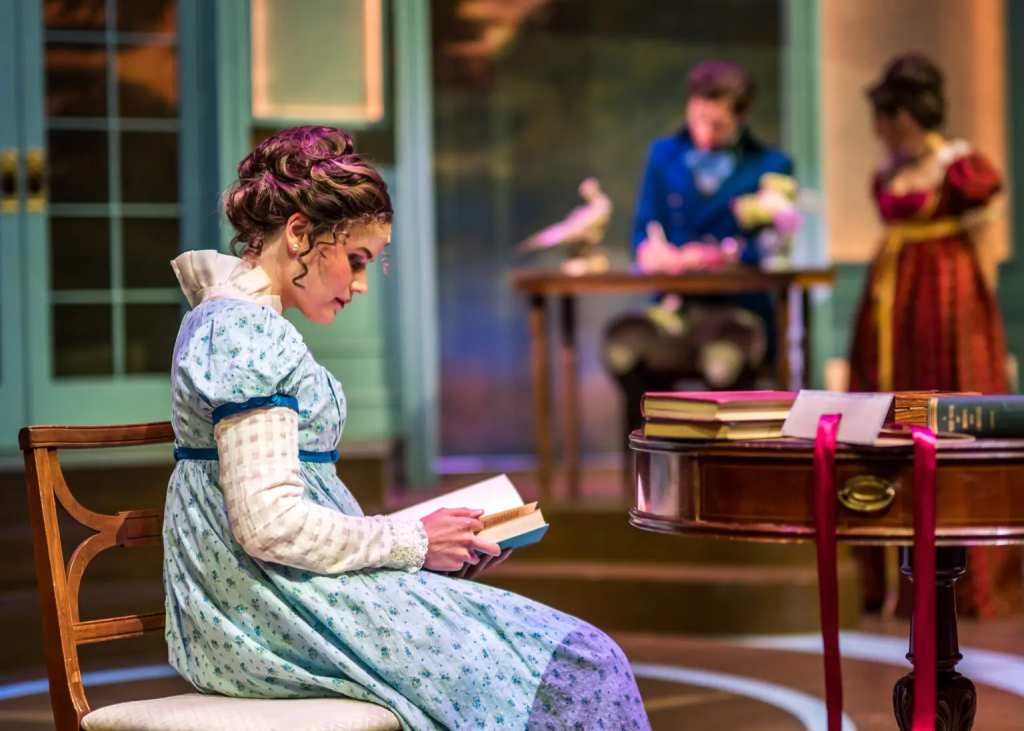
Lizzy is one of the hardest roles in Austen to get right, and Lauren Pope does it full justice. It doesn’t hurt that she could pass for the 1995 miniseries’ Elizabeth.
Jenna Ann Bagley is a lovely Jane, and she and Pope have an easy sisterly rapport that sells every tease, down to Lizzy’s “you have liked many a stupider person.”
James Carter charts Darcy’s transformation with real care, from the aloof guest at Netherfield to the man we watch meet Mrs. Bennet in her language. Pope and Carter spar beautifully, and their chemistry gives Austen’s barbs real bite.
Isaac Gates‘s Bingley radiates easy warmth, and his laugh-out-loud reaction when Lizzy skewers Darcy’s standards for accomplished women is a delight. It’s hardly proper in a Regency drawing room, but I loved it.
Mrs. Bennet is usually played big and loud, and Anne Post Fife is every bit as big without a single spoken word. Her comedy, her frustration, and her fear for her daughters’ futures all come through, and the moment that stayed with me is when she pounds on the piano in exasperation: no words needed. She is the reason a character I have spent years finding hard to love became the one I was most invested in.
Anthony Tibolla is a hilarious scene-stealer as Mr. Collins. He proposes on one knee, squeaking across the floor toward Lizzy so creepily that we understand why she can’t get away fast enough, then checks his notebook for the answer when she turns him down. His delivery of “toil in the soil” killed me, and his physical comedy is just as sharp, right down to a leg cramp that topples him mid-run.
Zöe Wilde‘s Charlotte Lucas is magnetic and earns some of the evening’s biggest laughs. When Lizzy swears she wouldn’t dance with Darcy, Wilde’s Charlotte dryly asks what if he paid her. Her humor is what keeps Charlotte’s pragmatism from turning cold or depressing, so we laugh with her and understand her at the same time.
Like Pope, Merci Collins-Hase could have stepped straight out of the 1995 miniseries, and her Caroline Bingley has a welcome bit of warmth that the character usually lacks. She doubles as Anne de Bourgh, hunched over for much of the show so that her face stays mostly hidden.
Marie Jacobs Aro‘s Mary is a deadpan delight, voicing her mother’s most flustered lines in a perfectly flat monotone while quietly pining for Mr. Collins.
Emily Faith Thurman‘s Kitty keeps pace with Fife’s every sign, and she turns quiet and poised when she doubles as Georgiana.
Sydney Claire Olson‘s loud, sometimes tipsy Lydia is a live wire, and she makes the Netherfield ball scene land.
Matt Kohler‘s Mr. Bennet is wry, funny, and a pleasure to watch, which is part of why his distance from his wife stings; my questions about Mr. Bennet are about the staging, not his performance. Together, Aro, Thurman, and Olson, the three youngest sisters, share a natural chemistry with each other and with their mother that’s endearing to watch. DeLayne Bluth Dayton‘s Lady Catherine, Brae Anderson‘s Wickham, and Thomas Rigby Judd‘s Colonel Fitzwilliam are excellent, too. There isn’t a weak link in this cast.

Design
Jo Winiarski, a veteran of some fifty Utah Shakespeare Festival productions, gives this one a modern edge. Her scenic design uses small, round, lighted platforms on wheels; actors stand on them while the crew rolls them in and out, keeping this long story moving. Occasionally the platforms become a device of their own: Jane and Bingley glide around each other on them in a dreamlike state, one lit pink and one blue, to a string version of “Say Something,” while both are in London yet kept apart. It felt strikingly futuristic, a deliberate pull of Austen into the twenty-first century. Behind it all is a gorgeous painted English countryside on the back wall, from The Ruth’s scenic art team, led by charge artist Morgan Dawn Golightly. Mellen’s staging has subtler touches, too: at Pemberley, Darcy and Georgiana stand framed in a doorway as the portrait Lizzy admires.
Renee Fowler’s lighting is a standout, from the pink and blue that wash over Jane and Bingley to the red that bathes Elizabeth and Darcy as they dance. The score is the Vitamin String Quartet’s covers of contemporary pop songs—very Bridgerton—opening and closing with “Single Ladies,” a cheeky frame for a household of five unmarried daughters. Larson told me the music isn’t written into her script; it’s the production’s choice, and as far as she knows, other local productions haven’t used it. Mellen’s program note calls the songs a nod to that series, meant to bridge the centuries for younger audiences. Shout-out to Richie Trimble’s sound design for making the score pop and handling it all beautifully. Brenda Van der Wiel’s costumes use color to track allegiances and feelings, with beautiful dresses throughout the night and stunning Regency-era clothes.

A Choice Worth Taking Seriously
For all my questions, I want to be clear: the answer is not that Mrs. Bennet shouldn’t be Deaf.
Seeing a Deaf actor at the center of a major production—not as a novelty, but as one of the people carrying the story—matters. So does the response Fife has described from the Deaf community, including people who hadn’t realized theatre could be accessible to them and now want to see more. Even backstage, someone is listening for her: Emily Faith Thurman, who voices much of Mrs. Bennet’s dialogue as Kitty, tells Fife after each scene how the audience reacted, since Fife can’t hear the laughs. None of that should be dismissed because some of the production’s choices raised questions for me.
But representation also creates responsibility. When a production tells a familiar story through a different embodied experience, that experience should reshape the story around it. The most compelling moments here let Mrs. Bennet’s Deafness reveal something new about the people around her: Darcy’s signing shows his growth, Mr. Bennet’s inconsistency raises uncomfortable questions about their marriage, and the daughters’ role as her voices complicates agency, intimacy, and family. I simply wanted more of that.
If you’re going to tell this story through Mrs. Bennet’s language, commit to exploring what that changes—not just for Mrs. Bennet, but for everyone who has spent two centuries talking around her.

Show Info
Pride and Prejudice, adapted by Melissa Leilani Larson from the novel by Jane Austen. Directed by Kymberly Mellen at The Ruth Theater through November 7. The Ruth offers select ASL-interpreted performances; check the website for dates. Tickets at TheRuth.org.
Further reading: Cassidy Wixom, “How a Deaf Mrs. Bennet is enhancing this ‘Pride and Prejudice’ production in Utah County”, KSL, with interviews with Anne Post Fife and Emily Faith Thurman.
A note on casting: Many roles in this production are double-cast, and the alternating schedule varies by role, so check TheRuth.org for the cast for a given date. I attended the Saturday, October 10 performance, and my observations about the Bennet family’s signing reflect that night’s cast.
Single cast: Anne Post Fife (Mrs. Bennet), James Carter (Darcy), Sydney Claire Olson (Lydia), Anthony Tibolla (Mr. Collins), Zöe Wilde (Charlotte Lucas), and Merci Collins-Hase (Caroline Bingley, Anne de Bourgh).
Double cast:
Lady Catherine de Bourgh: Kim Abunuwara (Mon, Wed, Fri); DeLayne Bluth Dayton (Tue, Thu, Sat)
Elizabeth Bennet: Elena Belén Shill (Mon, Wed, Fri); Lauren Pope (Tue, Thu, Sat)
Jane Bennet: Kylee Thurman (Mon, Wed, Fri); Jenna Ann Bagley (Tue, Thu, Sat)
Mary Bennet: Emma Lamm (Tue, Wed, Fri); Marie Jacobs Aro (Mon, Thu, Sat)
Kitty Bennet and Georgiana Darcy: Kim Wille (Mon, Wed, Fri); Emily Faith Thurman (Tue, Thu, Sat)
Mr. Bennet: Marshall Lamm (Mon, Wed, Fri); Matt Kohler (Tue, Thu, Sat)
Charles Bingley: Braden Clement (Mon, Wed, Fri); Isaac Gates (Tue, Thu, Sat)
Colonel Fitzwilliam: Dustin Parmley (Mon, Wed, Fri); Thomas Rigby Judd (Tue, Thu, Sat)
George Wickham: Parley Lambert (Mon, Wed, Fri); Brae Anderson (Tue, Thu, Sat)


Leave a Reply