
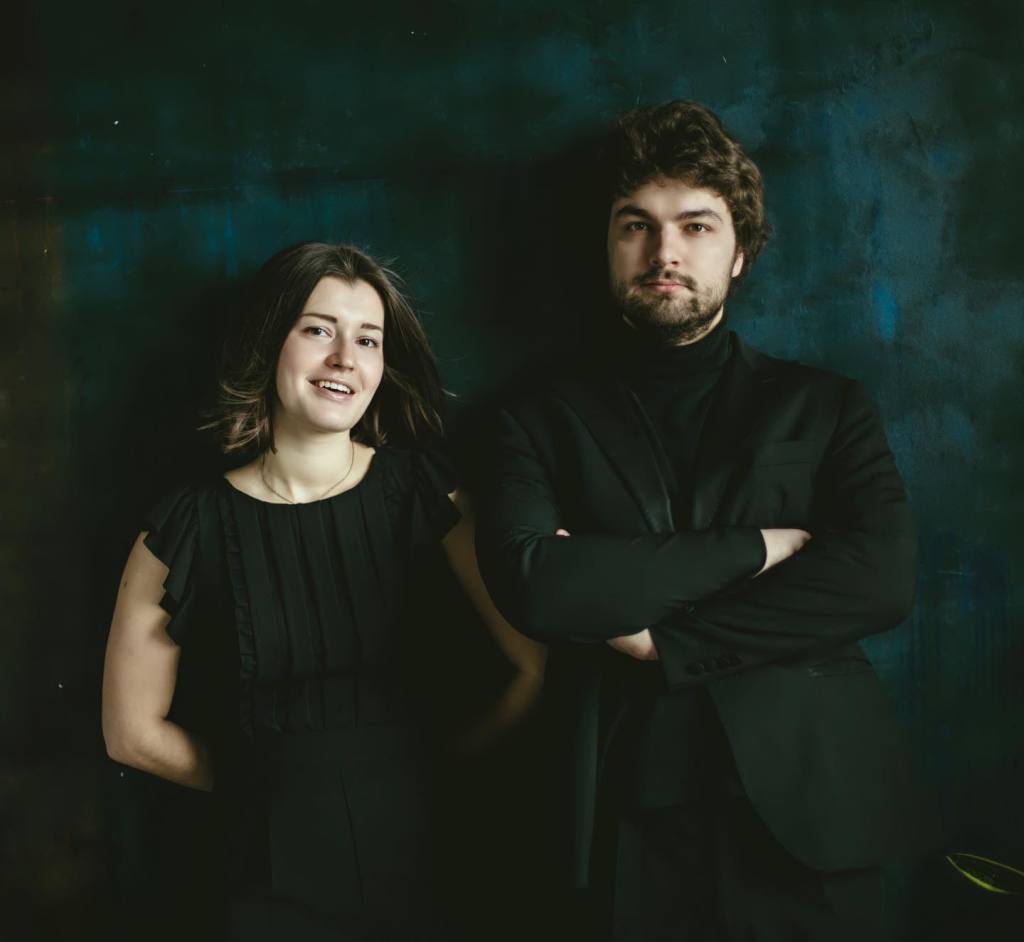
Salt Lake City, UT— The April 13, 2026 concert at the Rose Wagner Performing Arts Center offered something more than a standard recital. Titled Heart to Heart, the program featured husband-and-wife duo Lukas Geniušas and Anna Geniushene—two internationally recognized pianists whose individual careers have earned top honors and whose collaboration has quickly positioned them as one of today’s most compelling piano duos.
As the final concert in the Gina Bachauer International Piano Foundation’s 2025–26 season—and part of its 50th anniversary year—the performance also marks a return of past laureates to the stage where their careers first gained recognition.
Lukas Geniušas, a Bachauer Gold Medalist (2010) and laureate of both the Chopin and Tchaikovsky Competitions, is known for performances marked by technical control and interpretive clarity. Anna Geniushene, Silver Medalist of the 2022 Van Cliburn International Piano Competition in Fort Worth, Texas, has risen rapidly on the international stage, noted for her intensity and range. Together, their partnership reflects a rare level of precision and responsiveness—one that extends beyond performance into a shared, lived musical practice.
Their April 13 program—featuring Symphonic Dances, El Salón México, and Hallelujah Junction—unfolds not simply as a display of skill, but as an exploration of timing, contrast, and attention.

A Ritual of Return: Rachmaninoff’s Symphonic Dances
Before a single note of Symphonic Dances is played, Geniušas and Geniushene pause in complete stillness—heads bowed, bodies aligned. The moment reads less as performance and more as preparation: a shared calibration before entering the work.
The opening carries a subdued melancholy, each phrase weighted and allowed to settle before moving forward. Composed in 1940 as his final major work, Symphonic Dances reflects Sergei Rachmaninoff’s late style—marked by shifting harmonies and a persistent sense of retrospection.
That sense of looking backward is not abstract. The work draws on earlier material, including references to his First Symphony and fragments of liturgical chant, creating a texture that feels layered with memory rather than driven by forward momentum. The piece does not simply progress—it revisits, reconfigures, and reframes, as though composition itself becomes an act of return.
That structure is reflected clearly in performance. The transitions between slower, introspective passages and rapid, technically demanding runs are handled with control, avoiding abruptness while preserving contrast. What emerges most clearly is the sense of exchange between the two pianists. Geniušas’ playing remains contained and grounded, his physical presence minimal. Geniushene, by contrast, is visibly engaged—her gestures larger, her physicality more pronounced. Even her bright red shoes become part of the visual field, a small but persistent detail that echoes the energy of her playing.
The contrast between them does not divide the performance—it structures it. Stability and motion, restraint and expansion operate in constant relation. The final sections, accelerating into tightly packed passages, resolve with a sense of inevitability rather than excess.

Play and Percussion: Copland’s El Salón México
Following intermission, the shift into El Salón México is immediate. Where Rachmaninoff lingers, Aaron Copland moves. Written after his travels to Mexico in the 1930s, the piece draws on folk and popular materials not as a direct transcription, but as an attempt to capture what Copland described as the “spirit” of the place—filtered through the perspective of an outsider.
The opening gestures emphasize attack and rhythm, particularly in the lower register. The sound carries weight—less about sustain, more about impact. Dissonance is not softened; it is presented directly, as part of the piece’s structure rather than something to move past.
That sense of translation is audible throughout the performance. The music does not settle into a single style; instead, it shifts between textures and gestures, assembling an impression rather than reproducing a fixed sound. The result is intentionally unstable—part dance, part reconstruction.
The interaction between the pianists reflects this instability. Phrases pass quickly between them, sometimes cleanly, sometimes with a slight edge that introduces friction. Glances between the two suggest ongoing adjustment rather than a fixed interpretation.
The performance feels looser—not in accuracy, but in attitude. At the same time, the underlying coordination remains exact. The rhythmic complexity requires constant alignment, and the duo maintains it without foregrounding the effort. The result holds tension between control and release, between structure and spontaneity.
Copland himself acknowledged the limits of his approach, noting that the work reflects not the music he heard, but the atmosphere he experienced. That distance remains perceptible. What emerges is not a reproduction of place, but a constructed encounter—one that the performers navigate with clarity and momentum.

Controlled Disruption: Adams’ Hallelujah Junction
While Copland introduces looseness, Hallelujah Junction pushes that instability further. From the opening, rhythmic patterns overlap and slip against one another, creating moments that feel slightly misaligned—close enough to coherence to register, but unsettled enough to resist it. These near-misses accumulate, producing a tension that does not immediately resolve. The effect is deliberate: John Adams builds the piece around interlocking material that is offset just enough to create a sense of echo, as if one piano trails the other by a fraction of a beat.
The texture shifts rapidly. At times, the sound thins into something almost brittle—light, precise, and percussive. Elsewhere, it thickens into clustered attacks that land with force. The contrast is not gradual but abrupt, requiring constant adjustment from the listener.
Harmonically, certain moments stand out for their resistance. Chords appear that refuse to settle—neither fully stable nor entirely dissonant—interrupting the forward motion rather than clarifying it. These interruptions redirect attention, momentarily suspending momentum before the music reasserts itself.
The physical demands of the piece become increasingly visible. Geniushene, in particular, drives into the instrument with growing force, her movements expanding as the intensity builds. At one point, her hairpiece begins to come undone, nearly falling out altogether—a small detail, but one that underscores the level of exertion required to sustain the piece’s pace and precision.
The final section does not resolve so much as press forward. Energy intensifies, rhythmic patterns tighten, and the closing chords land with a kind of blunt finality—less a flourish than a cutoff, as though the piece has reached its limit rather than its conclusion.

Ovation: A Closing Gesture
The audience responds immediately with a standing ovation. When the duo returns to the stage, their remarks are brief but sincere. They speak of how meaningful it is to return to this stage—where Geniušas won Gold—and to share it together.
The encore, a set of waltzes by Polish-Jewish composer Ignaz Friedman, offers a striking contrast to the intensity that precedes it. Where Adams is explosive, Friedman is intimate. The pieces feel like a quiet offering—a closing gesture after the intensity that came before.
Community and Continuity
Throughout the evening, the Bachauer Foundation’s commitment to community remains visible. Its “VIP Studio” program—inviting local music teachers and their students as featured guests—highlights that investment, with the studio of Melinda Barros recognized during the evening.
That emphasis resonates on a personal level. I attend the concert with Dennise Ontiveros, a fellow music major from Brigham Young University–Hawai‘i, where we studied together. Now a music teacher here in Utah, she shared that she had been featured in the program in a previous season. The moment feels unexpectedly full-circle. We now sit in the audience of an international performance, reflecting on the pathways that music education can open.
There is also a quieter shift worth noting. For decades, Daynes Music has served as the primary piano sponsor for Bachauer performances. This evening, however, the instruments are provided by piano technician and sponsor Russell Sorenson, marking a transition following the store’s closure. It is a reminder that while musical traditions endure, the institutions that support them are not guaranteed. Supporting local arts infrastructure remains essential to sustaining moments like these.
Looking Ahead
In the end, the evening functioned on multiple levels. It was a display of extraordinary technical ability, certainly—but it was also a reflection on legacy, partnership, and return. As the Bachauer competition prepares to celebrate its 50th anniversary this June, this performance offered both a look back and a way forward.
For those who wish to witness what comes next, the upcoming competition promises not only remarkable performances, but the possibility of moments like this one—where technique, depth, and human connection converge.
Bachauer 2025–26 Concert Series
Gina Bachauer International Piano Foundation Presents Geniusas Duo in Concert
Monday, April 13th, 2026 at 7:30pm
Jeanné Wagner Theatre
Rose Wagner Performing Arts Center
138 Broadway, Salt Lake City, UT 84101
Keyboard-side Seating $35
Other Seating $25
Students $12
Tickets at: ArtTix
Bachauer Concert Series
Recommended for ages 8 and up. Infants not admitted. All patrons must have a ticket regardless of age.
Bachauer Concert Series 2025/2026
Celebrating 50 Years of Piano Excellence


Leave a Reply