

Plot Overview and Themes
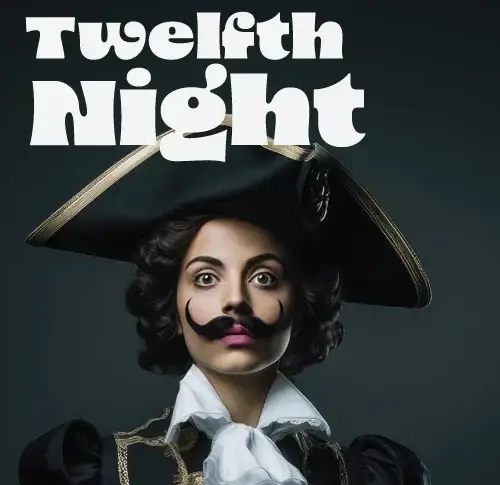
The play starts with a storm, and Viola finds herself shipwrecked and separated from her twin brother, Sebastian. Thinking Sebastian has died, Viola disguises herself as a young man named Cesario. In this guise, she enters the service of Duke Orsino, who is in love with Countess Olivia. However, Olivia falls for Cesario, unaware of his true identity as Viola. Meanwhile, the subplot involves the boisterous Sir Toby Belch and Sir Andrew Aguecheek and the puritanical Malvolio. This adds layers of comic mischief and social commentary.
Director Anthony Buck offers a nuanced take on Twelfth Night with highs and lows. Buck’s direction does not lean too heavily on farcical elements or zaniness within Sir Toby’s drunken entourage. Instead, Buck effectively emphasizes Viola’s journey, which heightens the play’s emotional depth, offering a refreshing take on the comedy’s more poignant aspects.
Lighting design by James B. Parker deserves special mention. The lighting not only enhances the mood but also clarifies the play’s complex structure. From the vivid green and violet hues to yellow gradients, the design adds significant visual dynamism. The meticulous attention to how light shapes the scenes greatly enhances the overall experience.
The set, a collaborative creation by Parker and Caleb Ceran, is equally impressive. It features a multi-level stage with distinct areas, such as a functioning cherub fountain and a tiled entrance. These elements, along with the dramatic movement of a sail to evoke the shipwreck, contribute to a richly textured stage environment that supports the play’s narrative and visual appeal.

Camrey Fox shines as Viola as she skillfully navigates the character’s dual roles with humor and depth. Fox’s portrayal of Viola’s masquerade, particularly her comic timing and physical comedy, provides some of the production’s most memorable moments. Hannah McKinnon, as Olivia, complements this with a portrayal that moves from rigid formality to genuine affection, capturing Olivia’s transformation with delightful precision.
Tyler Oliphant’s performance as Sir Toby is a standout, his robust vocal delivery and physical presence bringing a rugged charm to the character. Scott Buttler as Sir Andrew Aguecheek paired with Oliphant’s Sir Toby were the perfect ridiculous pair that had me laughing hard several times throughout the show. Although less overtly comedic, Jason Hackney’s Duke Orsino adds a layer of earnestness to the proceedings.
Owen Briggs as Feste (the fool of Twelfth Night) offers a charming performance despite his character’s occasional divergence from the traditional fool archetype, which I think is the point of Twelfth Night; Feste is meant to be an atypical fool who offers commentary on the social structures that surround him. Briggs sings throughout the show and has a strong voice that is enjoyable to listen to. Katherine Tietjen’s portrayal of Maria is a highlight, marked by her balance of humor and flawless delivery of Shakespeare’s lines.
The play’s numerous amusing moments, especially involving mistaken identities between Viola and her twin brother Sebastian (played by Alex Glover), are handled with a delightful touch. The mismatches in their appearances become a source of humor rather than confusion, adding to the overall enjoyment.
Historical Context and Reception
Shakespeare wrote Twelfth Night during the English Renaissance, a period characterized by a renewed interest in classical literature and a flourishing of the arts. The play was likely performed at the Middle Temple Hall on February 2, 1602, for the legal profession’s revels (Raffield, P.168-169, 2024). Twelfth Night was a product of its time, reflecting the festive traditions and social hierarchies of Elizabethan society. The play’s comedic elements, such as its use of disguise and cross-dressing, were typical of the period’s theater, where male actors played female roles.
Historically, Twelfth Night has been celebrated for its wit, complex characters, and intricate plotting. Critics have long admired Shakespeare’s ability to blend humor with more serious themes, such as the nature of identity and the folly of ambition. The character of Malvolio, in particular, played by David Johnson, has been a focus of critical attention, with interpretations ranging from seeing him as a comic villain to a tragic figure whose downfall reflects the play’s darker undercurrents.
“Northrop Frye, an important structuralist critic of Shakespeare’s plays, notes that the end of comedy is always tinged with something darker. Frye states, ‘The sense of alienation, which in tragedy is terror, is almost bound to be represented by somebody or something in the play. We seldom consciously feel identified with him…We may even hate or despise him, but he is there.’”
Emma Smith,
Faculty of English Language and Literature,
The University of Oxford Podcast
The above quote attributed to Northrop Frye in The University of Oxford Podcast discusses the crossroads of comedy and tragedy, suggesting that comedy often has a darker, underlying tone. This idea is consistent with Frye’s analysis in Anatomy of Criticism (1957), where he explores the mythic structures and archetypes in literature, including comedy and tragedy. Specifically, Frye discusses the presence of a “scapegoat” or alienated figure in comedies, which parallels the tragic isolation of a hero. Why is it that every one of Shakespeare’s plays is plagued by an underlying current? (Anatomy of Criticism, 1957, “The Mythos of Spring: Comedy,” p. 163-165).
While Twelfth Night is often lauded for its successful blending of comedy with more somber elements, its humor emanates primarily from misunderstandings and mistaken identities, particularly in the romantic entanglements between Viola, Olivia, and Orsino. The subplot involving Malvolio, Sir Toby, and Maria provides additional comic relief, though it also introduces a darker tone to the play.
The play’s ending, while typically seen as a resolution of the romantic entanglements, is tinged with a sense of unease. Malvolio’s vow of revenge and the ambiguous futures of some characters suggest that not all is well beneath the surface of the play’s ostensibly happy conclusion. This tension between the comedic and the tragic elements of Twelfth Night is what gives the play its enduring appeal and complexity.
Conclusion
Shakespeare’s Twelfth Night remains a timeless exploration of love, identity, and the social order. Its rich blend of humor and darker themes has ensured its place as one of the Bard’s most frequently performed and studied plays. Through its exploration of disguise, mistaken identity, and the fluidity of gender roles, the play continues to resonate with modern audiences and scholars alike, offering a compelling commentary on the complexities of human relationships and the social structures that govern them.
 Grab your tickets now and enjoy the show!


Leave a Reply