

SALT LAKE CITY, UT—Shakespeare’s The Tempest is renowned as a masterpiece that skillfully interweaves elements of loss and comedy, magic, and music; yet, it is a reminder now, more than ever, of the tragedy that comes from colonial powers. The University of Utah Theatre Department presents this timeless work in its intimate black box, Babcock Theatre. Under the direction of Melinda Pfundstein and Assistant Director Cam Barrett, the production is a mystical and magical experience that engages all the senses. I found it to be a visually and aurally stunning rendition that successfully catapults this classic play into the technological embrace of the 21st century.

The collaborative efforts of the production team create an immersive experience. Kyle Becker‘s scenic design provides a versatile backdrop featuring elevated cliffs, caves, stairs, and the illusion of floating rocks that maximizes spatial usage. Additionally, the grandeur of the set is heightened by the immersive soundscapes skillfully created by Jennifer Jackson, coupled with the dynamic lighting orchestrated by Nikayla Nielson. Throughout the play, these elements come to life, as smoke wafts from the set at strategic intervals, adding to the overall fantastical ambiance that coincides at times with lightning strikes, thunder, live rhythmic drumming, captivating singing by Ariel, (Laurel Morgan), and erie exhalations of the elements: Tyler Van Oostendorp (Wind), Zachary Harvey (Water), Audrey Pan (Earth), and Tessa Jones (Fire).
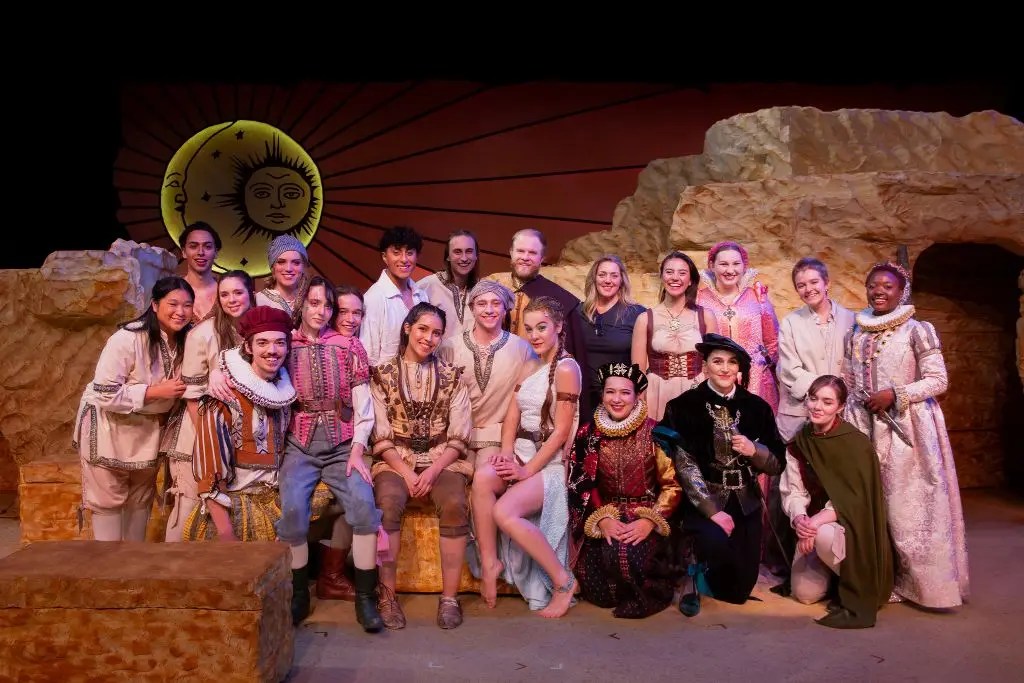
According to Pfundstein, in The Finer Points Blog, “Early on, I knew I wanted to dig into the generational habits and what was being passed on to Miranda (Natalie Ruthven) and the next generation, and what was being burned off or healed,” Pfundstein explained. “[Seaglass] is known to wash up on the shore, smoothed by the ocean, and then becomes this beautiful symbol of transformation. And then the lore around it is that when you wear it, it breaks when it’s been used up…Scenic designer Becker, U Theatre’s technical director, found and incorporated imagery of rising strata. Wiel, costume designer, worked sea glass into the costume pieces. Props master, Arika Schockmel, led students to build sea glass lights that immerse the audience in the sea, then spill onto the stage.” All of these small details add to the layers of meaning behind this Tempest and make it a visual feast for the eyes.

Brenda Van der Wiel’s period costumes skillfully underscore the contrast between the banished and shipwrecked characters to the royals from Europe; however, I was left with a lot of questions about the symbolism of the clothes that Caliban (True Leavitt) and Prospera (Kristen Henriquez) wore and what Indigenous people they represent. In the show program we are told the setting is a “remote Mediterranean island,” yet their costumes reminded me more of Spanish or Native American Indigenous people. It took me quite a lot of time and research to find the Dramaturg notes online referencing a line in the text that refers to Bermuda and ultimately the beginning of European Colonialism:
“When Prospero asks Ariel about the aftermath of the storm in the second scene of The Tempest, Ariel informs his master that the ship is ‘hid’ in the ‘still-vexed Bermudas’ (1.2.229). The airy spirit’s reference to this region makes the play’s connection to the 1609 shipwreck seem likely. This links The Tempest to some of the very first colonial activities that would result in the establishment of the British Empire.” (Dramaturg Notes: Setting)
Henriquez delivered her lines with a dialect and tone that was unusual for Shakespeare; she effectively portrayed an Indigenous islander which brought new light to Shakespeare’s lines. Leavitt brought out a side of Caliban I have not seen before; I found myself drawn to him and able to relate to him in ways that previous versions of The Tempest left me devoid of.

This play starts out with Assistant Director Barrett acknowledging that the land the University’s school stands on is the traditional and ancestral homeland of the Shoshone, Paiute, Goshute, and Ute Tribes, and that The Tempest deals with themes of colonialism. I found this acknowledgement fitting and meaningful. But, I wished Pfundstein had adapted The Tempest further to grapple with the serious themes that colonialism presents, and most especially, to represent the silenced and nameless Indigenous people (Caliban’s people). I appreciated that Caliban was humanized, but did not appreciate that much of the language that dehumanizes him remained: he was called “monster” repeatedly, among other things. This play could have been so much more powerful if it had gone a step further in representing the struggle of an a colonized Indigenous people or tribe and given it a platform to tell their story: showing their values for a new generation, instead of Caliban’s unidentified people that ultimately ended up representing every colonized people.
I would be remiss to not mention Caro Ciet, who takes center stage in the role of Trinculo, delivering a standout comedic performance that serves as a striking contrast to the hierarchical dynamics established on the island. With a natural command of comedic timing and playful banter, Ciet effortlessly embodies the archetype of the Shakespearean “fool.” I was also impressed with Cade Freiermuth and his portal of Stephano. Together Ciet, Freiermuth, and Leavitt make an oddly delightful comedic trio.
All in all, The University of Utah Theatre Department’s The Tempest would serve as an excellent introduction to Shakespeare for both fans and non-fans alike. Pfundstein’s astute directorial choices skillfully emphasize the comedic elements of the play, making it accessible and engaging for a broader audience. The production’s strength lies in its meticulous attention to technical elements, with Ariel’s enchanting singing adding a delightful auditory dimension. Each actor in the show makes a noteworthy contribution, collectively breathing life into this classic work. The University of Utah’s rendition of The Tempest successfully transforms a timeless script: blending tradition with contemporary appeal.

Babcock Theatre, 300 South University Street, lower level of Simmons Pioneer Memorial Theatre, 300 South University Street (1400 East), across the street from Rice-Eccles Stadium.
November 10-19, 2023, 11/18 7:30 PM, Matinees 11/18, 11/19 2:00 PM
Tickets: Other Students: $7.50, Faculty/Staff: $12.50, Regular Admission: $17.50
Contact Main Office: 801-581-6448, Box Office: 80-581-6961
CONTENT ADVISORY
This production contains effects that may have a negative effect on some audience members, including flashing light effects and theatrical fog (or “haze). The content of this production is recommended for ages eight and older. Children under the age of four will not be admitted.
Sources:
https://thetempestuofu.wordpress.com/tag/setting/
https://www.finearts.utah.edu/about/news/the-finer-points-blog/item/1129-an-old-friend-with-modern-lessons


Leave a Reply