

By Kobe Rathsavong, with Oliver and Elisar
SALT LAKE CITY, UT — ThreePenny Theatre Company’s Real, Enough, with book, lyrics, and direction by Marina Altschiller-Gannon and music by Altschiller-Gannon and Michael Freitag (who also arranged it), explores love, grief, hauntings, and what it means to “be.” This ghost story follows Claire, a writer who moves to a small town and gives herself one year to write her next big hit. Once there, she becomes entangled with Sarah, her neighbor across the street, and with the ghost of Alex, Sarah’s late boyfriend. An intimate, romantic musical with plenty of humor, Real, Enough delves into the very human fears and feelings of its three characters.
I’ve seen plenty of plays, but this was my first musical. My friends Oliver and Elisar, who collaborated with me on this review, had been wanting to see more local productions, so I was grateful for the chance not only to attend this one but also to review it for Rhetorical Review.
Design
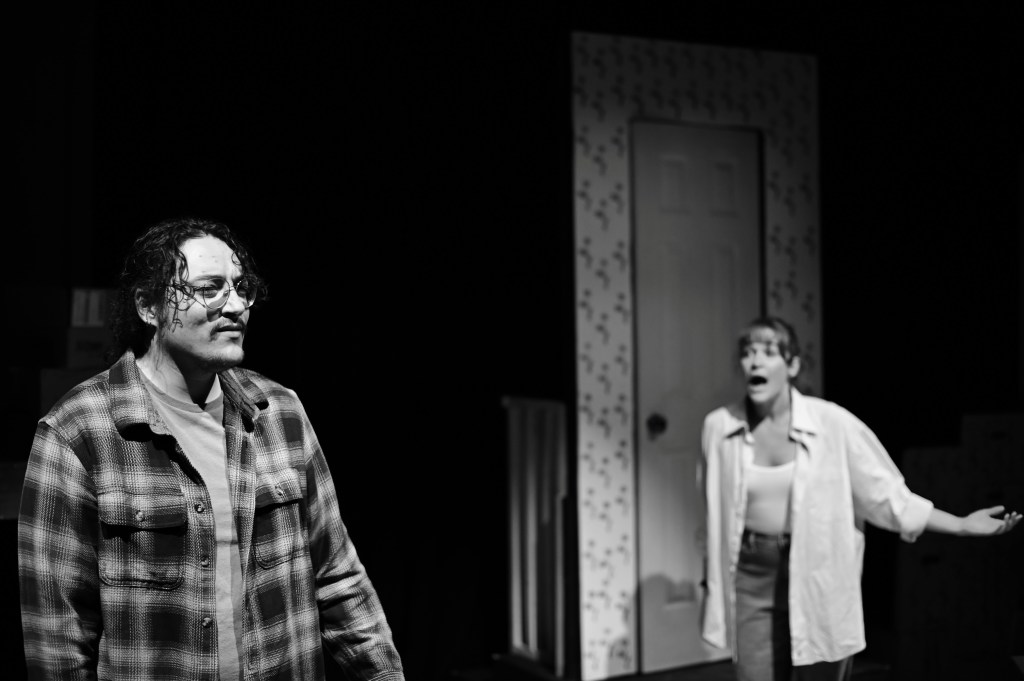
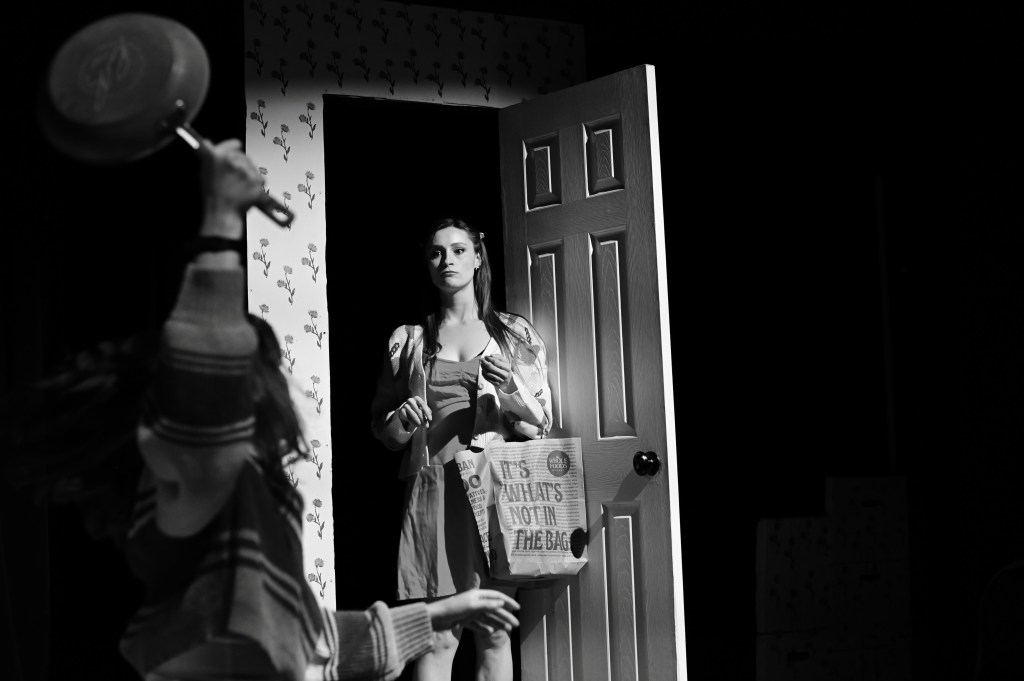
Scenic designer Jill Gordon and prop master Syd Peronnet created a compact set that housed several locations: a door that flipped to signal inside or outside the house, a small couch, a table that doubled as a coffee shop and the kitchen, a bench, and an attic area. The books and notebooks in the actors’ hands were a nice reminder that Claire is a writer. I think the tight-knit set added a sense of intimacy and served the actors and the musical well. Oliver agreed that the minimalist approach works, though he felt the set could have used a little more polish: the paint finish didn’t always feel tied to the story, and the flipping door seemed tricky for the cast to maneuver. It’s worth remembering that ThreePenny is a small, pay-what-you-can company whose cast and crew built this set themselves, and a lighter, easier-swinging door would be a simple fix for future productions.

Costume designer Hannah Orr did a great job with the actors’ outfits. Keeping Alex in the same outfit throughout was a nice touch. And, as Oliver noted, “Sarah’s costuming was delightful.” I agree; you could easily tell that Sarah was a grade-school teacher.
Lighting designer Jonah Kirkhart did excellent work. The lighting often heightened the emotional impact of a scene: reds accompanied Alex’s outbursts, and light blue highlighted his ghostly nature. Scene changes happened under dim violet light, just enough for the actors to see and for us to see them, as one or two actors quickly rearranged the set, disappeared, and suddenly reemerged in new clothes.
Sound designer Cody O’Hare brilliantly used recordings of the cast’s voices to provide context and deliver an emotional punch in the opening and closing scenes. However, Oliver and I both noticed that the sound balance was off: the music often drowned out the cast, which made it hard to catch all the lyrics. I can’t tell whether this was an intentional choice or a technical issue, so it wouldn’t be fair to place the blame on O’Hare.
Performances
All of the actors were incredible, and they built off one another well; as Oliver noted, “the harmonies were stunning.” He also observed that a few of the highest notes were a stretch on the night we attended, which is common early in a run and easy to forgive given how impressive the vocals were overall. Beyond the singing, the actors honored the “show, don’t tell” principle. They built tension scene by scene, slowly developing the story and its emotions and leading the audience along. You could tell Claire and Alex were growing closer, and as the tension mounted, the audience waited to see whether an “I love you” would emerge.
“The harmonies were stunning.”
Oliver
Joshua Sevy excellently portrayed Alex, a mopey, frustrated ghost who meets someone new and is forced to confront his past, present, and future. Sevy conveyed strong emotion throughout; in one fight between Claire and Alex, he let out a booming, frustrated yell that shook the audience.
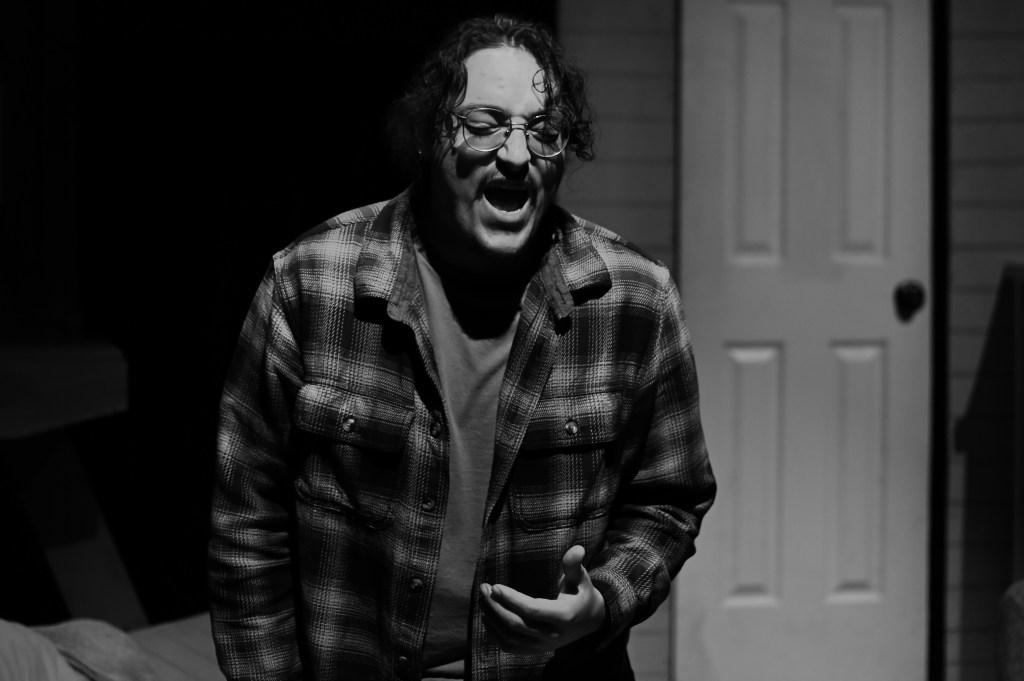
Sam Torres gave a great performance as Claire. Torres used very expressive movement to create humor and build the character. The audience laughed at Claire’s attempts to play it cool, and at her freaking out, during her first meeting with Alex, which added a layer of physical comedy to the show. Torres also has a strong voice that carried through the space and captivated the audience.
Verona Miller was a great supporting presence as Sarah. Sarah plays a small role at the beginning, introducing key plot points, then disappears in the middle before returning in the second half. There, she shines as the anchor for both Claire and Alex and gets her own satisfying arc; Miller excellently portrays someone neither fully consumed by grief nor fully through it. One memorable scene has Sarah rushing to Claire’s aid during a bout of writer’s block, as the two hash out ideas and debate what a love story truly is.
Love, Grief, and the Happy Ending
The musical primarily explores love and grief through Sarah and Alex’s past relationship and Claire and Alex’s present one, as they work to help Alex move on and Claire get past her grief. Love and grief also surface in Claire’s struggle as a writer trying to force a necessary “happy ending” into her story. The back-and-forth as the characters give feedback on Claire’s story, and on the nature of love itself, makes the audience question what a love story even is, and whether it needs a happy ending at all.
“The audience waited to see whether an ‘I love you’ would emerge.”
Kobe Rathsavong
Elisar offered a more critical reading:
The love tropes were very heteronormative, and her falling in love with the ghost … could be seen to contradict the whole purpose of the first song the play opens up with, sung by Claire: here is my dream, will I ever do it, maybe I’m just enough? But [she] ends up so codependent on a man who is a ghost to help her realize her dreams. The man ghost is still at the center of the story; this is a love story, but [it] felt like a conventional one, despite the paranormal elements.
What It Means to “Be”
Another large theme centers on existential questions: Who am I, and what does it mean to be? As the characters process grief and love, they must also figure out whether these experiences define them: a writer who must create something memorable in order to “be,” a woman defined and made a pariah by the death of her boyfriend, and a ghost who can be nothing but a memory yet cannot move on. The use of a ghost and the interweaving of past memories and yet-unwritten futures with personal identity were thought-provoking. These questions surface in the second half, in musical numbers and in dialogue between Claire and Alex as they play a game of chicken to see who will divulge their fears first.
Elisar writes on this theme:
The play seems to hit on things like grief, resolution, reality, identity. With a song highlighting dreaming: Is it enough to just dream? At what point do we make our dreams reality? What are the paths we choose to get there? Is what we feel real, even if we can’t see it? Is what we see or can’t see real, even if we can’t feel it? What does it mean to be seen? For our grief to be seen? To process? What makes us feel enough? Is it being seen? Heard? [It shows] how love can still be felt even after the person is no longer in your life, whether through a breakup, distance, or death. Love can remain; does love always remain? The resistance of writing in life (the typical writer’s struggle) and how writing plays a role in this play is something to be considered, in the sense of reality and creating our life narratives.
“Is what we feel real, even if we can’t see it?”
Elisar
Final Thoughts
Real, Enough is a strong, fun musical that explores love, grief, and being. The musical numbers were fun, the actors tied it all together, and the jokes landed with the audience. Ultimately, this musical is not just about romance or grief but something more philosophical. Altschiller-Gannon asks the audience what it means to “be,” which is perhaps defined not by your past or by another person, but by recognizing your fears so you can live unburdened by unwanted and unrealistic expectations.

Oliver: While nothing about the story surprised me as it unfolded, I found it enjoyable overall. The music was well done, and the vocals were quite strong. It was a fun production, and much of it impressed me.
Elisar: Real, Enough was led by a group of pretty incredible actors. As small as the room was (truly a box, with a set piled high with moving boxes), and as close as we all were to one another, they made me feel as though we were as invisible as the ghost in the story. They each played their roles very well.

Show info
- Show: Real, Enough (world premiere musical)
- Company: ThreePenny Theatre Company
- Book and lyrics: Marina Altschiller-Gannon (also director)
- Music: Marina Altschiller-Gannon and Michael Freitag; arrangements by Michael Freitag
- Cast: Sam Torres (Claire), Joshua Sevy (Alex), Verona Miller (Sarah)
- Creative team: Emma Swanson (music director), Jill Gordon (scenic), Syd Peronnet (props), Hannah Orr (costumes), Jonah Kirkhart (lighting), Cody O’Hare (sound)
- Photography: Courtesy of ThreePenny Theatre Company and @realenoughmusical; production photos by @mw.aperture
- Dates: November 13–22, 2026. Fridays and Saturdays at 7:30 p.m., Sundays at 2:30 p.m.
- Venue: Alliance Theater Black Box, Trolley Square, Salt Lake City
- Tickets: Pay what you can at zeffy.com/en-US/ticketing/real-enough
About the reviewer

Kobe Rathsavong recently graduated from the University of Utah with his master’s degree in writing and rhetoric. His interests are in decolonial studies and postcolonial histories. He is a big fan of nerdy hobbies like Magic: The Gathering and video games.


Leave a Reply