

Reviews like this take 10+ hours to research and write. If this one was useful, even $1 helps. Support Rhetorical Review.
For nearly one hundred years, The Death of Nero existed only on paper: a single surviving script by Mikhail Kuzmin, a queer Russian Silver Age poet whose work was largely destroyed by Soviet censors. It survived, as far as anyone can tell, because one person quietly kept an archive of Kuzmin’s papers, a fact rediscovered only in the 1980s. It has never been staged. Not in Russia, not anywhere.
That changes September 4, when ThreePenny Theatre Company opens what it’s billing as the play’s world premiere at the Alliance Theater Main Hall in Trolley Square, for six performances only, running through September 13. Co-founder Jonah Kirkhart still sounds a little amazed by how it came together.
“It’s kind of crazy, actually. The whole story of it is kind of nuts.” — Jonah Kirkhart
What the Play Is
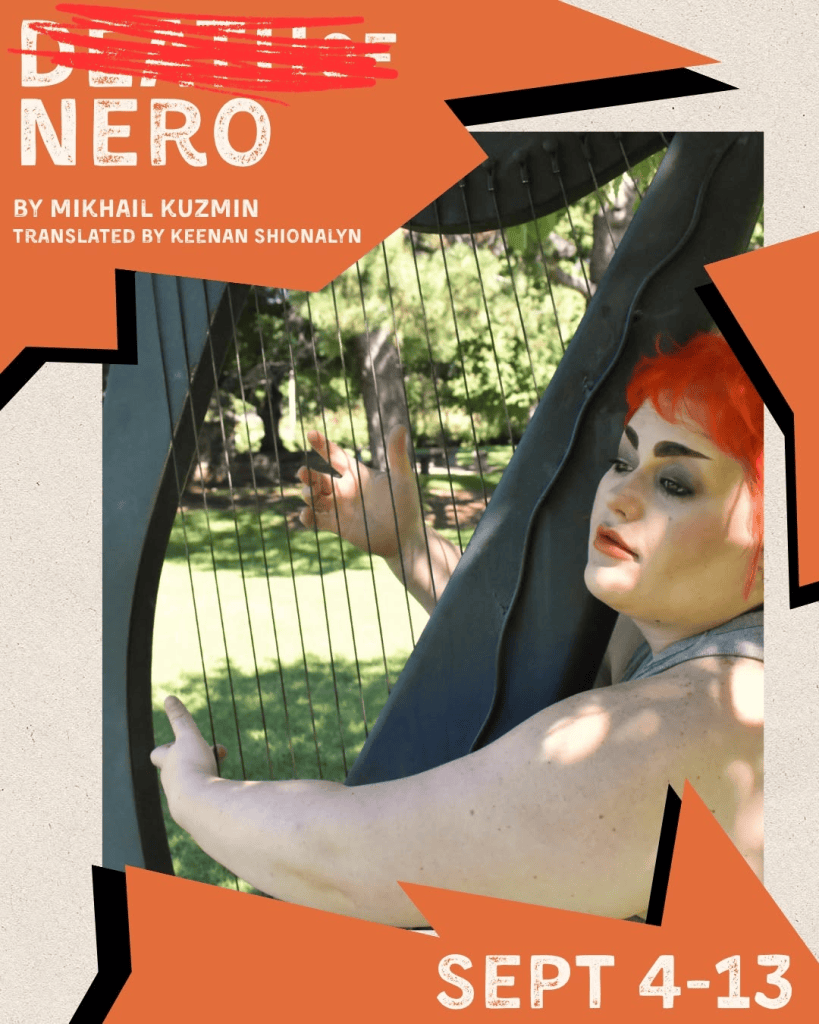
The Death of Nero braids two timelines together: a fictional Russian poet named Pavel, visiting Rome in 1919 with a biographical play about the emperor Nero that his critics dismiss as too modern and too hysterical, intercut with dramatized scenes from Nero’s own rise, cruelty, and collapse. Kuzmin wrote it in 1929, his only full-length drama, as the Soviet artistic establishment was closing in on the kind of experimentation he represented.
Director Syd Peronnet has described the resulting show as “a queer, Russian, anti-realist, anti-authoritarian, play-within-a-play, murder mystery,” with actors exploring gender expression through drag, layered on top of what Kirkhart calls an “Epic style theatre” sensibility.
It is, by ThreePenny’s own account, not a small or easy show. “It’ll have really goofy nonsense with, like, cardboard cutout props and play-on-words, some potty humor jokes in there, too,” said co-founder Cody O’Hare. “But it also has very highbrow intellectual metaphor and theme… it will truly have something that anyone can find interesting.”
Who’s Behind It
None of this is the work of a company chasing a trend. Kirkhart and O’Hare met studying theater at Kansas State University, in a general BA program, Kirkhart said, that forced them into every discipline the stage requires. “If you could kind of list a piece of theater, there’s a chance Cody and I together have probably done that piece,” he said. That range is baked into how ThreePenny runs today: Kirkhart calls himself “part artistic director, part technical director,” while O’Hare handles stage management, sound design, and the company’s marketing.
Their first production together was a stage adaptation of Rime of the Ancient Mariner, mounted at Salt Lake City’s Fringe Festival in 2021. ThreePenny has been staging unconventional, frequently under-produced work ever since, guided, they say, by a mission of bringing underserved communities into theater as participants, not just audiences.
The company’s signature policy follows from that mission: every ticket, to every show, is pay-what-you-can.
“If you’ve got three pennies, you can see a show. And that has happened.” — Cody O’Hare
What Sets ThreePenny Apart
ThreePenny isn’t a first-time group that stumbled into an obscure find. The company has mounted at least 15 productions since 2022, including The Bald Soprano, Duchess of Malfi, Night, Mother, My Name Is Rachel Corrie, and The Life of Galileo, with prior coverage from the Salt Lake Tribune and ABC4. It runs on donor support through a “Founders Club.”
What distinguishes it, though, isn’t the track record so much as the model behind it. That pricing structure is only part of the mission; ThreePenny also pays its performers a stipend, unusual for community theater, on the reasoning that showing up to rehearsal is itself a cost most people can’t easily absorb. “Performing is also, to a certain extent, a luxury or a privilege,” Kirkhart said. “It is important for us that people be compensated for the work that they put in.”
The company has also built recurring community events around its shows, including a BIPOC-specific performance night in their last show, and what Kirkhart called a “really, really free market,” where audience members can bring items to give away and take others in return. “Theatre was made for everybody,” O’Hare said. “It was always for people of all stripes.”
That ethos extends to programming choices. O’Hare and Kirkhart said ThreePenny has likely staged several first productions of obscure or forgotten works before Nero, though they’ve stopped short of formally billing those as world premieres. Finding scripts through personal relationships rather than established channels is, by design, how the company operates. “We will never presume to always have the best, most creative, and unique ideas,” O’Hare said. “By being able to really work with our community… a lot of times, we want people to be able to hear a show that hasn’t happened in 50 years, or in some cases has never happened.”
Put simply: this is the kind of theater company where you’re going to see a play you haven’t seen before, because chances are, almost nobody has.
How a Lost Russian Play Found Salt Lake City
Nero is the clearest proof of that pattern yet. The path from Kuzmin’s archive to a Trolley Square stage runs through Keenan Shionalyn, a translator and dramaturg currently pursuing a doctorate in theatre studies at the University of Birmingham, where his dissertation, “The Theatrical Potentiality of Mikhail Kuzmin’s Queer Dramas,” makes this production part of his active academic research, not separate from it. About two years ago, Shionalyn organized a reading of several of Kuzmin’s shorter plays with friends in Salt Lake’s theater community, among them Peronnet, who would go on to direct Nero.
Kirkhart recalled how the pitch reached them: Shionalyn told friends in the theater community about a play he wanted to translate and stage, and that conversation eventually reached Syd Peronnet, who brought it to ThreePenny during the company’s annual call for directorial proposals, alongside a statement of intent from Shionalyn as both dramaturg and co-producer.
“That’s kind of the circuitous route where something that is, to a certain extent, become Keenan’s life work has kind of found its way into this little theater company in Salt Lake City,” Kirkhart said.
Translating an Unfinished Text
An existing English translation of The Death of Nero already existed before Shionalyn’s, but Kuzmin is remembered in Russian literature pAn existing English translation of The Death of Nero already existed before Shionalyn’s, but Kuzmin is remembered in Russian literature primarily as a poet, and that earlier version reflected it: a “much more poetic translation,” as Kirkhart put it. Shionalyn’s approach diverges deliberately. Kirkhart described it as closer to “that punk rock ethos,” an attempt to push the same boundaries in English that Kuzmin was pushing in Russian a century ago.
It’s a fitting way to think about it: the translation isn’t really finished until the show has been performed. Put that framing to O’Hare directly, and he agreed, tying it back to Shionalyn’s own stated philosophy of the work.
“Every translation… is naturally going to be through the lens of the person who is doing it in the time that they are doing it.” — Cody O’Hare, on Keenan Shionalyn’s translation philosophy
O’Hare went further: the process, in Shionalyn’s view, isn’t finished “until it has existed in reality and got on its feet, and you hear the words out loud, and you can see where a joke can be, or where the language is too stiff to make sense.”
Shionalyn has made the same point himself, in his own words, calling the project “more of an adaptation” than a strict translation. “I don’t believe translations should simply live in one time, but rather are shared across time,” he said. “We are in conversation with Kuzmin, sharing our stories together. So our play is both ours and Kuzmin’s, both Russian and American.”
One example: a monologue near the end of the play contains a line about a moment “when all of these conventions are removed.” Is it social convention, or theatrical convention? The cast brought the question to Shionalyn directly. “He’s like, yeah, I mean, that’s a perfectly valid reading of that translation,” Kirkhart said. “The actual [Russian] word can mean, like, seven different things,” leaving the company to choose whichever reading best serves the show’s themes and offers the strongest theatrical moment.
Some of that ambiguity is structural, too: several cast members are effectively playing a dozen or more minor characters apiece, some with only a line or two of dialogue, requiring natural connective material that Shionalyn plans to fold back into a final translated text only after the run ends.
Queerness, History, and “the Queer Utopia”
Much of Nero‘s treatment of gender and sexuality, the co-founders said, is drawn from how fluidly those categories were understood in the wThe words aren’t the only thing being translated across a century. Much of Nero‘s treatment of gender and sexuality, the co-founders said, is drawn from how fluidly those categories were understood in the world Kuzmin was writing from and about: identity as something contextual and momentary rather than fixed. That shows up in costume and drag work built, deliberately, to look assembled from whatever was on hand, and in scenes where characters discuss exes and current partners in the same breath, without the modern vocabulary of orientation to sort it into categories.
Kirkhart credited Shionalyn with a framing he called “queering history,” the idea that any staging of the past is inevitably viewed through the present, and that ThreePenny’s Rome isn’t an attempt at historical accuracy so much as a deliberately “slanted” mirror.
“We are producing a Rome that is… this ultimate anti-version of the queer utopia.” — Jonah Kirkhart
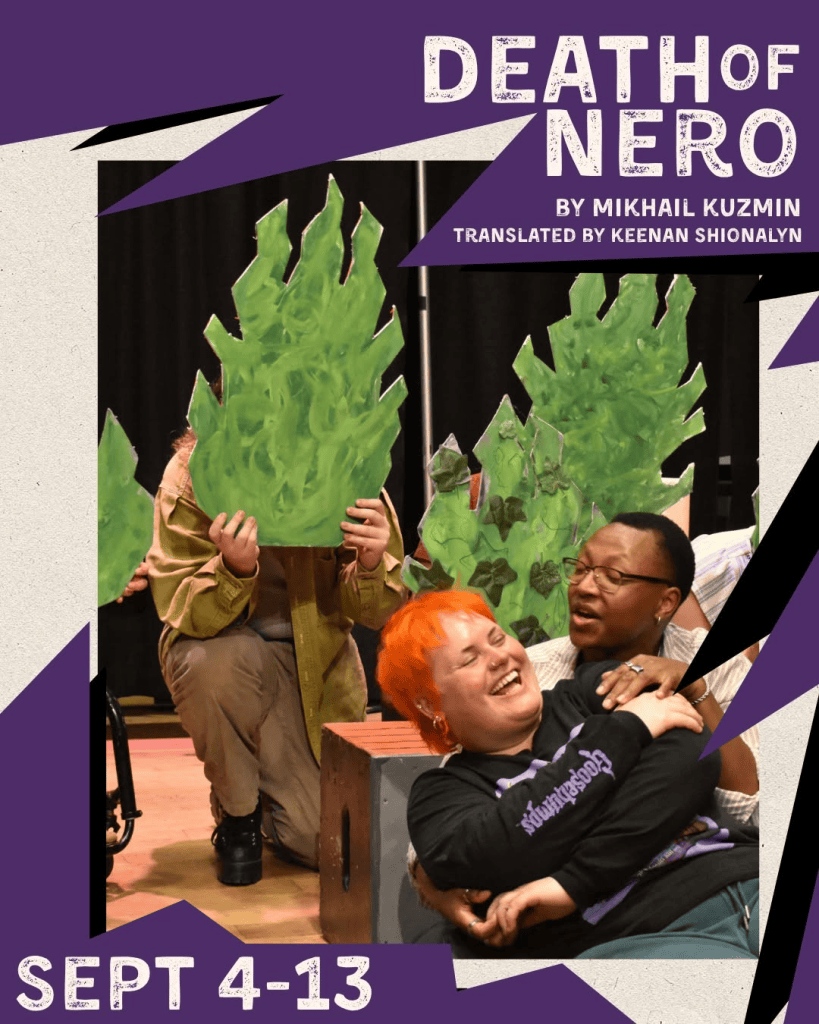
“So that then, we can kind of start talking about the idea of how do we get to a queer utopia where people can be whoever they want to be,” Kirkhart said. By the end of the show, that includes literally burning effigies of political leaders on stage.
Cast members describe that arc as the emotional center of the show. Viviane Turman, who plays Nero, called the production a way of reaching back to Kuzmin’s own generation directly: “There is queer joy nearly a hundred years later and you were a part of ensuring that was possible.” Camas, who plays one of the ensemble’s jester roles, put it differently: “The word ‘queer’ has many synonyms: strange, odd, eccentric, abnormal, funny. For me, this is a queer play in all the most exciting ways.”
The Political Mirror (Warning: Spoilers)
Kuzmin wrote Nero as a stand-in for Stalin, a charismatic figure obsessed with gold, grandiose palaces, and rambling, self-mythologizing speeches, surrThe queer utopia at the end of the show has an opposite number at the start of it. Kuzmin wrote Nero as a stand-in for Stalin, a charismatic figure obsessed with gold, grandiose palaces, and rambling, self-mythologizing speeches, surrounded by people who affirm him not out of love but fear or ambition. ThreePenny isn’t shy about extending that comparison to the present. Director Syd Peronnet made the connection explicit: “While the titular Nero was originally a criticism of Stalin, we’ve realized he acts and sounds eerily similar to America’s current dictator. The show is meant to encapsulate queer joy, while also serving as an Aesopian fable, showing us a mirror and how easily we risk going down the slippery slope of becoming the next Nero.”
“I’m not going to dance around the subject that our current political establishment also seems to have some similar obsessions with the aesthetics of power,” Kirkhart said, pointing to Stalin’s broken Five-Year-Plan promises as a parallel to modern political rhetoric that asks people to wait for a better future that keeps receding. He framed it, too, as a broader critique of authoritarianism itself: the idea that unchecked power corrupts “basically anyone,” regardless of their intentions, and poisons even the relationships of people who genuinely care about the person in power.
Asked whether Trump or Putin would recognize themselves in Nero if they saw the show, both co-founders were skeptical they’d even make it that far.
“I would expect either Trump or Putin would probably walk out after the first act.” — Cody O’Hare
Kirkhart agreed: “I don’t know that either of them are self-reflective enough to identify themselves in a metaphor.”
Still, a Party
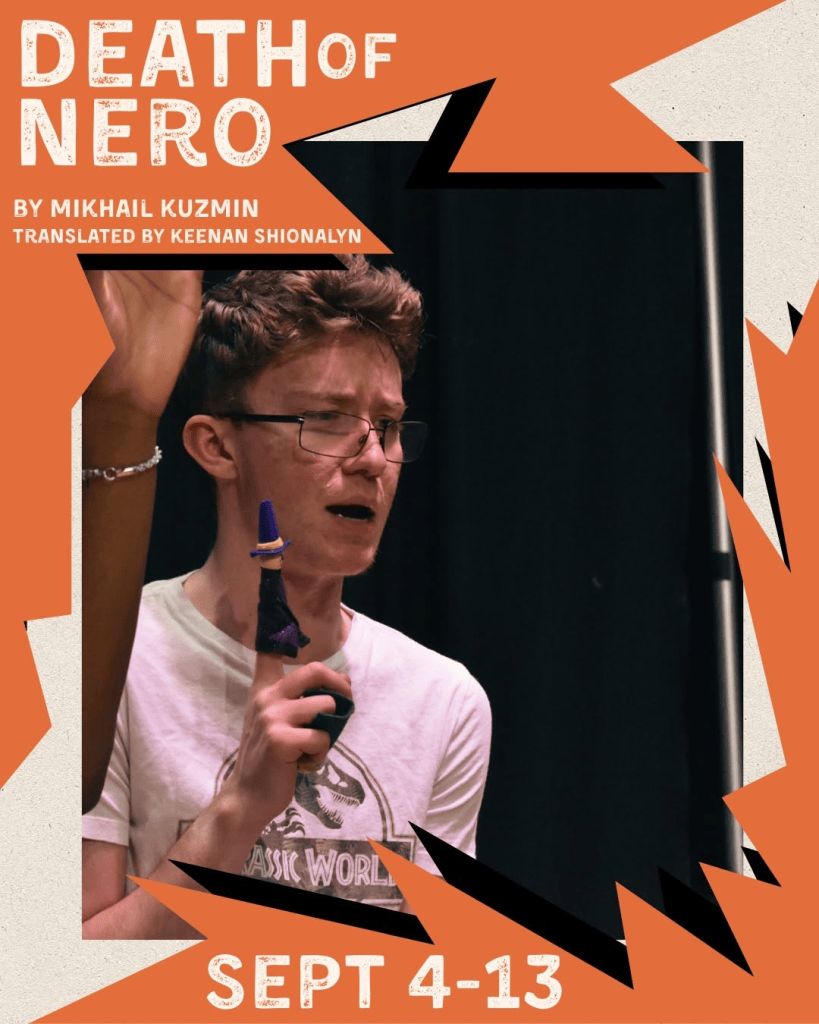
None of that weight is meant to sit heavy in the room. Both founders were emphatic that The Death of Nero isn’t a lecture. “This show is very fun,” Kirkhart said. “It’s got puppets, it’s got a musical number, it’s got all sorts of stuff.” O’Hare hopes the takeaway is simpler than any single theme: “I hope that they get whatever they feel like they have needed to hear or experience… that the way that they feel about things, and the way that they are internally, that those are okay ways to be.”
O’Hare put the same idea in broader terms:
“The problems that humanity always faces are the same stripe, just different colors.” — Cody O’Hare
Kirkhart sees something hopeful in the play’s very survival, that a body of work nearly erased by censorship still reached an audience, a century later, in a small storefront theater in Utah. It’s worth noting, too, what that survival means going forward: the more widely a text like this gets performed and translated, the harder it becomes for anyone to erase it again.
There’s a quieter fact sitting underneath all of it, one nobody on the call said out loud: this is Kuzmin’s premiere, not just ThreePenny’s. Kuzmin was a St. Petersburg poet and composer, one of the first openly gay literary figures in Russia, whose 1906 novel Wings is often cited as one of the earliest Russian works to portray homosexuality candidly. He wrote music for Meyerhold’s landmark 1906 staging of Blok’s The Fair Show Booth and sang his own songs in the city’s salons and cabarets before the Soviet regime turned hostile to the kind of art he made. He died in Leningrad in 1936, seven years after he finished The Death of Nero, having never seen it staged, and having no way of knowing whether it ever would be. Whatever else The Death of Nero is this September, in a theater in Trolley Square, it’s also a hundred-year-late opening night for a playwright who isn’t there to see it. And while that is sad, it is also hopeful, because it means it’s never too late, and there are countless stories still waiting to be staged.
Show Info
The Death of Nero runs September 4 to 13 at the Alliance Theater Main Hall, Trolley Square, Salt Lake City. Performances are Friday and Saturday at 7:30 p.m., with a 2:30 p.m. matinee on Sundays. All tickets are pay-what-you-can, available through Eventbrite, threepennytheatre.com, or at the door.
Learn more about Threepenny Theatre Company at https://www.threepennytheatre.com/about

Want to watch the entire interview?


Leave a Reply