
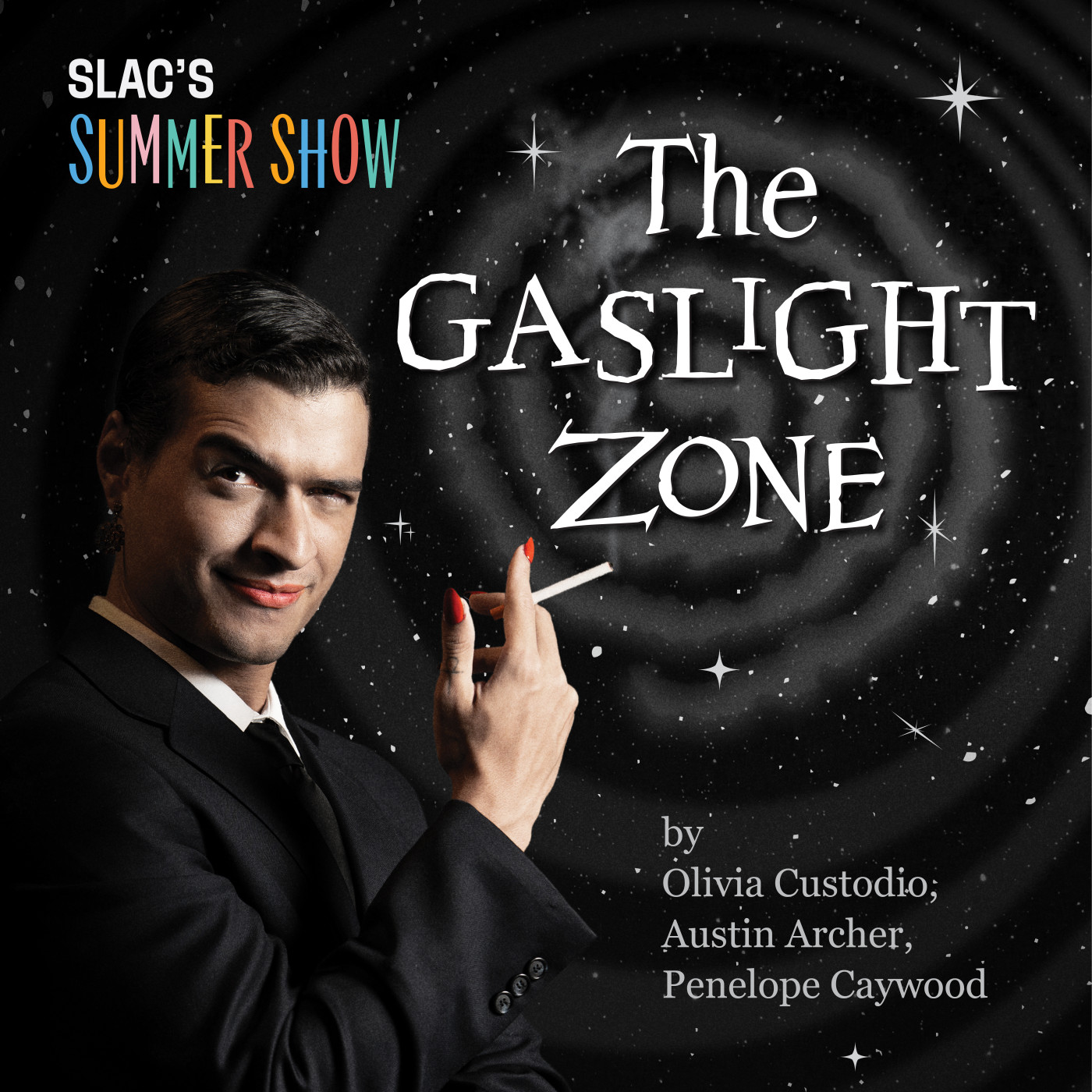
Two hours of laughter-filled f-bombs you didn’t know you needed, including the most cathartic cursing out of Governor Cox you’ll see all year.
Salt Lake City, UT — Salt Lake Acting Company’s annual Summer Show has been a beloved Utah institution for over forty years, but with The Gaslight Zone, the company has outdone itself. Having attended the last three Summer Shows and reviewed the past two for this publication, I can say with some authority that this world-premiere revue, written by Olivia Custodio, Austin Archer, and Penelope Caywood and directed and choreographed by Executive Artistic Director Cynthia Fleming, is the most ambitious, most fully realized, and flat-out funniest Summer Show in recent memory, a two-hour tour through the American political dumpster fire that somehow manages to leave its audience feeling not defeated but galvanized.
The show announces its intentions immediately. There is a fifth dimension, we are told by our host early on, that lies “between thoughts and prayers and I did my own research using ChatGPT,” a realm where democracy hangs by an acrylic nail, the Wi-Fi signal of humanity flickers in the hurricane winds of climate change, and every white man has a podcast. It is exactly the world we are all currently living in, and The Gaslight Zone holds a funhouse mirror up to it and dares its audience to laugh until the laughter curdles slightly into recognition. This year’s edition is, by Fleming’s own admission from the stage, “on steroids from every single department.” She is not wrong.
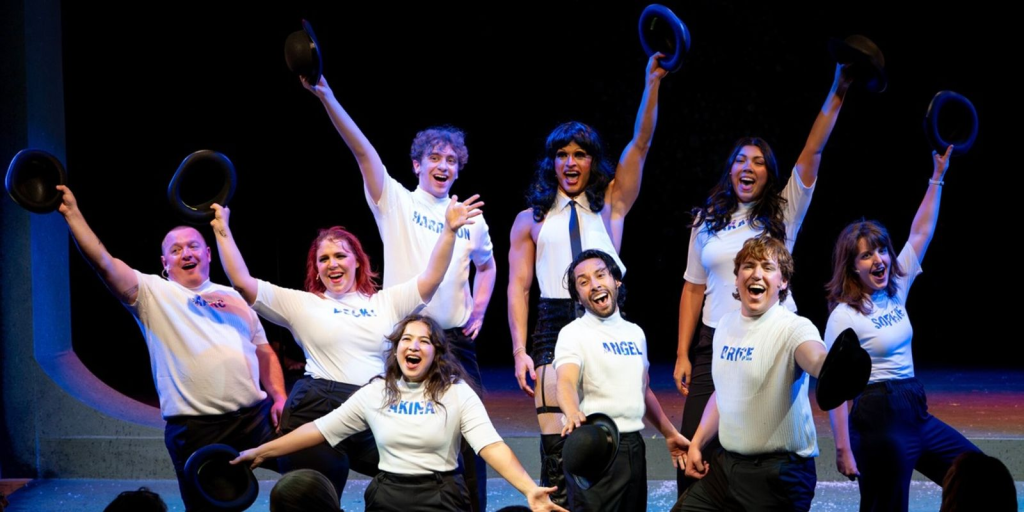
Meet the Company
The show opens with a cast introduction so warm and disarming it recalls a Brady Bunch or Full House title sequence, each pair of performers introduced by name with their names literally on their shirts, except that each duo enters doing something ridiculous or borderline inappropriate, signaling immediately and hilariously exactly what kind of evening lies ahead. It is a brilliant directorial choice by Fleming: a show about gaslighting and manipulation that opens with the most straightforward, honest gesture imaginable, as if to say hello, here we are, these are our names, and now the real fun begins.
The Host: Broad Sterling
The show belongs, first and foremost, to Scotty Fletcher, or rather to Broad Sterling, the drag queen hostess version of The Twilight Zone‘s Rod Serling, who guides us through these dimly lit corridors of modern madness. It is a conceit that is explicit and thoroughly earned. Broad Sterling is simultaneously your narrator, your conscience, and your hype woman, introducing herself with the disarming declaration: “Yes, I have an incredible body, and you’ll be seeing it the whole show. But I need you focused.” She means it on both counts. Fletcher returns between every sketch in a new costume, each one more spectacular than the last, giving the whole enterprise the glamorous sweep of a Ziegfeld Follies production, all glamour and intention and theatrical command, and if one of those costumes happens to have the word “fuck” emblazoned across it, well, consider that your content warning for the evening. Costume designer Dennis Hassan has outdone himself here because dressing a drag host who must be funny, authoritative, and breathtaking in rapid succession is no small feat, and every single look lands. Fletcher commands the room with the effortless authority of a performer who has found in this role a perfect vehicle, and the callbacks to Serling’s actual language, including a direct quote from the 1963 Twilight Zone episode “He’s Alive,” land with surprising weight late in the evening.
The Clips: Invisible Seams, Maximum Laughs
Before diving into the sketches themselves, one production choice deserves its own paragraph: the interstitial video clips displayed on large screens framed by old-fashioned TV frames that run between scenes. These short filmed segments, a Redact-O-Pen 5000 infomercial, a TISM-Free Tylenol ad, and a Stretch Johnson toy commercial, are doing triple duty simultaneously. They are independently hilarious, with the Redact-O-Pen’s tagline “the courts can’t punish what the courts can’t see” standing as perhaps the sharpest single joke in the entire show. They reinforce the central theme of gaslighting delivered through the most American of formats, the infomercial. And crucially, they buy time for the company to execute costume and scene changes without the audience ever feeling the seams, because the audience is laughing too hard to notice the curtain moving. It is an elegant structural solution that feels effortless precisely because it has been so carefully engineered.
The clips were shot and edited by Kenny Riches, a Salt Lake City filmmaker whose feature The Strongest Man premiered at the Sundance Film Festival in 2015 and whose upcoming film Mouse won Best Feature Film and the Grand Jury Award at the Brooklyn Film Festival. That a filmmaker of his caliber brought his eye to these short satirical segments shows in every frame, and it is worth noting that what might have been a utilitarian production solution in lesser hands becomes, under Riches, some of the sharpest and most polished comedy in the show.
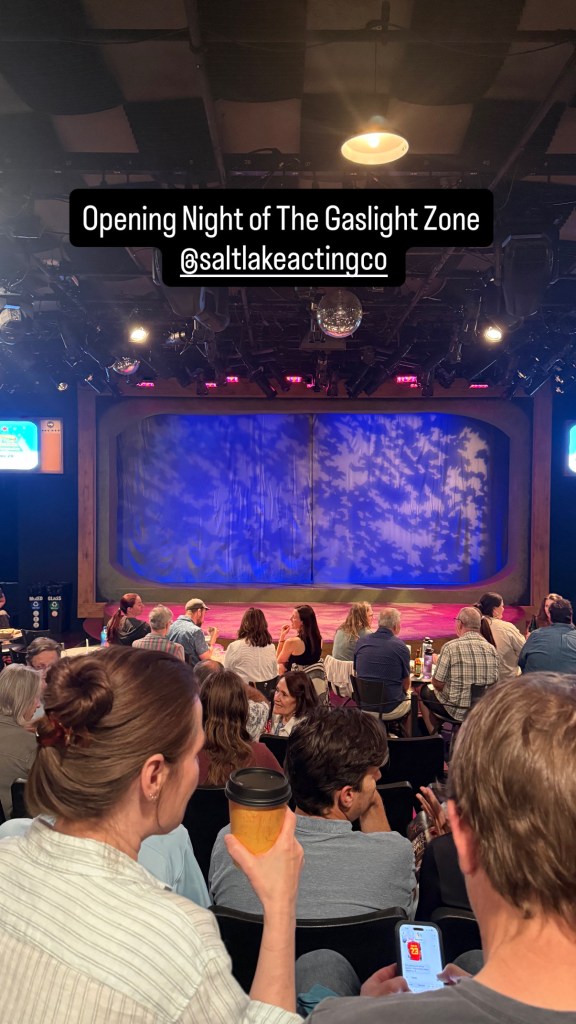
Act One: A Tour Through the Dumpster Fire
The first act is a full sprint through the American id, opening on Vermilion Drive, a fictional Utah suburb of conspicuous virtue and simmering xenophobia where neighbors with names like Canyon, Braylee, and Kynsington trade pleasant inanities while an unfamiliar truck sits ominously on the street. The truck, they quickly conclude, must be ICE, and what follows is one of the sharpest pieces of writing in the show, a suburban paranoia sketch that escalates from mild discomfort to outright ugliness with deeply uncomfortable precision. The sequence closes with “Revolting Neighbors,” a parody of “Revolting Children” from Matilda that is one of the show’s cleverest musical choices. The original song is already about children rising up against oppressive adults, and flipping it into a number about xenophobic suburbanites is a sharp inversion that works because the word “revolting” does double duty, meaning both “disgusting” and “in revolt,” capturing exactly the show’s satirical method. These people are revolting in every sense of the word, and the number makes sure you feel both meanings simultaneously.
From there, the show moves through the Kensington beauty clinic, a plastic surgery dystopia where women are evaluated for “spiritual symmetry” and dispatched to California when their “Republican makeup doesn’t take.” Makayla Palos Rodriguez, making her SLAC debut through the Professional Theatre Program for Emerging Artists, takes Kensington from frightened patient to desperate supplicant to deliriously unhinged with razor-sharp comic instinct. Her strong vocals, easy confidence, and complete command of the stage leave no doubt: she knows exactly what she’s doing up there.
Akina Yamazaki brings a different but equally valuable quality to the ensemble; she is that rare performer who is genuinely excellent across every scene she inhabits, from the Harvard-educated lawyer being racially profiled on Vermilion Drive to the Makeup Artist unable to set Spencer Cox’s foundation in 83-degree December heat to the Immigrant welcomed with open arms in the utopian finale. In a show this densely packed, the team players are as essential as anyone, and Yamazaki is the finest example of that.
The Act 1 finale, built on Green Day’s “American Idiot,” carries real historical weight because Green Day wrote that song in 2004 as a response to the Bush era, the rise of media manipulation, and the weaponization of patriotism. Deploying it here, two decades later, against an eerily similar political landscape, carries an implicit and damning argument that we have been here before and we did not learn, and the company tears into it with an energy that brings the first half to a genuinely rousing close.
The Trump Scene
The first act’s most ambitious sequence puts us inside Trump’s inner circle, and Marc Nielson’s portrayal finds the comedy not in mimicry but in the structural absurdity of a room organized entirely around one man’s ego. Notably, this is Nielson’s second year bringing Trump to the SLAC stage, and the impression has only sharpened with time, the vocal inflections so precisely calibrated that director and playwright Morag Shepherd, attending as my guest and no easy audience, leaned over mid-performance to note that they were spot on.
The sequence’s richest moment, however, belongs to the entire ensemble. Bryce Romleski’s gloriously unhinged RFK Jr., Sophie Jean White’s Caroline Levitt, Harrison Timm’s dead-eyed Stephen Miller, and Becky Jeanne Knowles’ Marjorie Taylor Greene, played not as a true believer but as a pure opportunist simply calibrating a brand, are united by a single defining quality: none of them are loyal so much as trapped, performing devotion to someone who could erase them without a second thought.
Bryce Romleski’s RFK Jr. is a marvel of committed physical and vocal grotesquerie, nailing the Secretary of Health’s distinctive damaged voice with an accuracy that is simultaneously impressive and deeply unsettling. It is the kind of impression that works not because it flatters its subject but because it doesn’t, finding in that gravelly, strained instrument exactly the right vehicle for a character the script describes as having “a severed raccoon penis and bear carcass concealed on his person.” Romleski leans into every bit of it without apology.
Harrison Timm’s range across the evening is the show’s most striking acting achievement. As Stephen Miller he is all dead-eyed stillness and cold reptilian patience, a man who has made his peace with what he is and requires no validation from anyone in the room. That the same actor will later bring the house down repeatedly as the sweating, thundering, worm-doing Pastor Johnson at the MAGA funeral is something to behold.
Sophie Jean White’s versatility is one of the evening’s quiet revelations. She is as convincing as an eight-year-old, a genuinely demanding physical and vocal transformation, as she is playing suburban mothers, sometimes within minutes of each other, and in the Trump inner circle scene she delivers a sharply observed portrait of White House Press Secretary Caroline Levitt, capturing what the script aptly describes as “Daddy TradWife Barbie” energy with an uncanny precision because Levitt is already a performance, White simply has to find the seams. On top of all of that, her work in the video clips is equally assured, particularly her turn as the credulous suburban mom in the TISM-Free Tylenol ad, buying into RFK Jr.’s vaccine misinformation with wide-eyed sincerity. Getting that calibration right on camera requires a completely different skill set than live performance, and White demonstrates she has both.
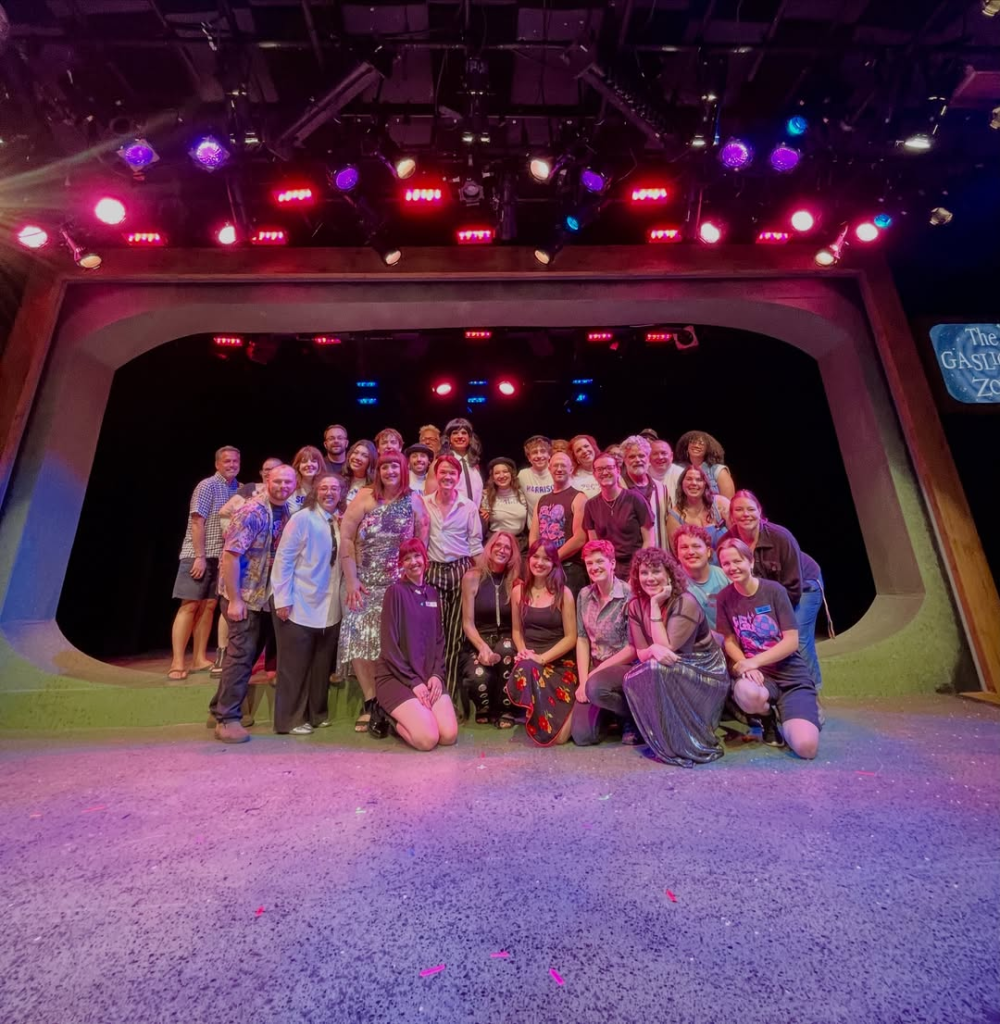
Act Two: From Gaslight to Great Salt Lake
The second act pivots from national to local, and the writing sharpens considerably. Salt Lake City, December 2034, 83 degrees: Utah is preparing to host the Winter Olympics with no snow, a dried-up Great Salt Lake, and a governor who consults ChatGPT for spin advice on how to rebrand toxic dust as “naturally occurring particulate matter.” Nielson’s Spencer Cox, sweating through his makeup in 83-degree December heat, is a tour de force of comic desperation in a completely different register than his Trump, a man so thoroughly committed to managing perceptions that he has lost the ability to perceive reality at all. The scene’s staging is inspired: Cox hunched over his phone consulting an AI, Romleski’s voice emanating from the speaker with perfectly calibrated algorithmic pleasantness, a man alone on a stage talking to his phone and asking it to help him lie more convincingly. You could not write a more perfect image for 2026.
When Jesus himself appears, played by Angel Martinez with complete and utter commitment, the scene achieves something rare. Martinez plays Jesus delivering his divine ultimatums with the straightforward, unbothered impatience of someone who has genuinely had enough, which lands just right. It is a completely sacrilegious performance that works precisely because Martinez never winks at the audience, treating the appearance of the Almighty as a completely logical plot development and letting the comedy take care of itself. When Cox asks whether he can use “some gentle, murky language” in his confession, Jesus is unmoved. “You’ve already been doing that,” he tells him. “That’s why I’m here, and the lake isn’t.” It is one of the funniest exchanges in the show and one of its most damning.
The funeral sequence is the show’s most formally ambitious section and its funniest. A podcaster named Buddy Smirk has died in an act of patriotic duty, and his memorial is a masterclass in the monetization of grief. Timm’s Pastor Johnson is a complete revelation, a televangelist so overcome with the Holy Spirit, and so transparently besotted with the widow, that he ends up on the floor doing the worm. He plays it at full throttle, all sweating evangelical fervor and thunderous rhetorical flourish, delivering lines like “the deep, penetrative honor” of praying with Erica “sometimes very late at night by candlelight” with an absolutely straight face, and the combination of sanctimonious language and unhinged physical commitment brings the house down repeatedly.
Becky Jeanne Knowles, playing Buddy’s widow Erica, delivers a speech about being “a tool” married to “a massive tool” who created “even more tools” that work on so many layers simultaneously, and Knowles’ delivery is spot on and some of the best acting of the show. Her musical number, a parody of “Be a Man” from Mulan rewritten as “Be a Wife,” is the show’s most surgically precise song parody, performed, again with some of the strongest singing of the night—Knowles was on fire. The original is a song about coercive gender conformity, a soldier forced to perform masculinity under threat of shame, and the rewrite maps that same coercive energy directly onto tradwife ideology with a precision that makes it more than a funny swap, just really clever writing from Custodio, Archer, and Caywood. The source material means something in its new context, and that is the difference between clever parody and lazy parody.
A Note on the Song Parodies
The musical numbers are where the writing most openly displays its craft, and the craft is considerable. A good parody has to work on multiple levels simultaneously, with lyrics that fit the meter, land the joke, and advance the satire all at once, and Custodio, Archer, and Caywood are consistently excellent at all three. “Revolting Neighbors” turns Matilda‘s children’s rebellion anthem into a xenophobia indictment. “Be a Wife” weaponizes Mulan‘s coercive masculinity song against tradwife culture. The Act 1 finale repurposes Green Day’s “American Idiot,” written in 2004 and apparently still tragically relevant, as a MAGA takedown. And the closing number builds on “We’re All in This Together” from High School Musical, a choice that rewards local knowledge because High School Musical was filmed right here in Salt Lake City at East High School, making it not just a crowd-pleasing earworm but a genuinely hometown anthem reclaimed for a genuinely hometown show. None of these choices is accidental, and every source song means something in its new context, which is what separates this writing from lesser political revue work.
The Turn
The show’s final movement is where it risks the most and earns the most. Broad Sterling steps out of character briefly, acknowledges that the vibes have been “apocalyptic,” and then invites the audience to imagine the future that MAGA most fears: a world where pronouns are respected without drama, abortions are scheduled like dental appointments, immigrants are welcomed, athletes are judged on performance alone, healthcare is free, and billionaires give their money away. The sketches are deliberately simple, almost naive in their gentleness, and it is almost disarming to imagine a future when all the current toxicity simply goes away. What the show proposes is not radical, just decent, which turns out to feel quietly radical after everything that has come before it.
Performances & Creative Team
The nine-person ensemble, Fletcher, Knowles, Martinez, Nielson, Rodriguez, Romleski, Timm, White, and Yamazaki, operates as a precision comic machine with no weak links, and the fact that every actor is in every scene, a logistical achievement that Fleming noted is “unheard of” in the show’s history, speaks to both the ambition of the production and the stamina of the cast.
The production team is equally impressive. Erik Reichert’s set and Joshua Legate’s video programming work in seamless concert, creating a visual world that moves as fast as the comedy demands. Jesse Portillo’s lighting design does the quiet but essential work of making every scene transition feel intentional rather than incidental. Dennis Hassan’s costumes, the most numerous in the show’s history, with headdresses that are achievements unto themselves, have already been discussed at length in the context of Broad Sterling’s Follies-worthy wardrobe, but the entire cast benefits from his work throughout. Erika Ahlin Bird’s props design deserves its own mention, particularly given that the show has never before featured a Stretch Johnson on its stage, a detail Fleming called out from the stage with evident pride. Calvin Vinson’s sound design keeps the whole enterprise crisp and clean, no small feat in a show this densely packed. Adriana Lemke’s fight and intimacy direction brings physical precision to the show’s more outrageous moments, ensuring that the comedy lands safely and exactly where it should. The hand-painted scrims, the work of Abish Noble over a full week, remain a visual accomplishment that the speed of the show threatens to undersell.
Behind the scenes, Production Stage Manager Bridgette Lehman and Assistant Stage Manager Tahra Veasley are the unsung architects of an evening that requires military-level coordination, and Assistant Director and Choreographer Ella Mei Williamson brings Fleming’s vision to life with a precision that speaks well of her own emerging directorial instincts. The Professional Theatre Program’s emerging artists, Assistant Props Designer Abigail “Gabi” Cottam and Assistant Costume Designer Natalie Pulsipher, round out a creative team that is firing on every cylinder.
Verdict
The Gaslight Zone is not subtle, and it is not trying to be. It is trying to make a room full of strangers laugh together at things that are genuinely frightening, and then remind them that the laughter itself is the point, that showing up is the point, that being in a room together and choosing joy is not escapism but the work itself. At this particular moment in history, when the gap between official narrative and lived reality feels wider than the shrinking Great Salt Lake, SLAC has once again done what it does best, which is to make its audience feel, for two hours, less alone and perhaps, against all reasonable odds, a little more hopeful about the future.
Show Details
SLAC’s Summer Show: The Gaslight Zone
Written by Olivia Custodio, Austin Archer & Penelope Caywood
Directed and Choreographed by Cynthia Fleming
Salt Lake Acting Company
Running now through August 16, 2026
Tickets from $45 | Season subscriptions available
Box Office: (801) 363-7522
Online: SaltLakeActingCompany.org
Box Office Hours: Monday through Friday, 11 am to 5 pm, with extended hours during the run
Accessibility accommodations available, including ASL-interpreted performances, open captioning, audio description, and sensory-friendly performances. Visit SaltLakeActingCompany.org for full details.
Cast
Scotty Fletcher — Broad Sterling (host throughout)
Becky Jeanne Knowles — McKartynee, Nurse Rutter, Redact-O-Pen Spokesperson, Marjorie, Model #3, Woman 1, Erika, Mom
Angel Martinez — Miguel, Nurse Smith, JD Vance, TISM-Free Spokesperson, Model #1, Jesus, Funeral Dancer, Billionaire 1
Marc Nielson — Delivery Driver, Doctor Benson, Trump, Spencer Cox, Dancer 4, Customer 3, Announcer
Makayla Palos Rodriguez — Tayslee Jo, Kynsington, Aide 2, Child 2, Stage Manager, Dancer 1, Woman 1, Gun Salesman
Bryce Romleski — Canyon, Nurse Brigham, RFK Jr., Child 1, ChatGPT, Funeral Dancer, Receptionist, Billionaire 2
Harrison Timm — Jaxxton, Nurse Padmore, Stephen, Child #3, Man 1, Pastor Johnson, Customer 2, Man 2, Creep
Sophie Jean White — Braylynne, Nurse Karlov, Karoline, Jane, Child, Dancer 3, Kid, Patient
Akina Yamazaki — Emily, Nurse Adams, Aide 1, Model #2, Makeup Artist, Dancer 2, Customer 1, Immigrant, Doctor
Creative Team
Director/Choreographer: Cynthia Fleming
Music Director: Zach Hansen
Set Designer: Erik Reichert
Lighting Designer: Jesse Portillo
Costume Designer: Dennis Hassan
Props Designer: Erika Ahlin Bird
Sound Designer & Engineer: Calvin J. Vinson
Videographer & Editor: Kenny Riches
Video Programmer: Joshua Legate
Fight/Intimacy Director: Adriana Lemke
Assistant Stage Manager: Tahra Veasley
Production Stage Manager: Bridgette Lehman
Assistant Director & Assistant Choreographer: Ella Mei Williamson
Professional Theatre Program (Emerging Artists)
Assistant Props Designer: Abigail “Gabi” Cottam
Assistant Costume Designer: Natalie Pulsipher
Actor: Makayla Palos Rodriguez
Assistant Director & Assistant Choreographer: Ella Mei Williamson
The Band
Keyboard: Zach Hansen
Woodwinds & Guitar: Spencer Kellogg


Leave a Reply