
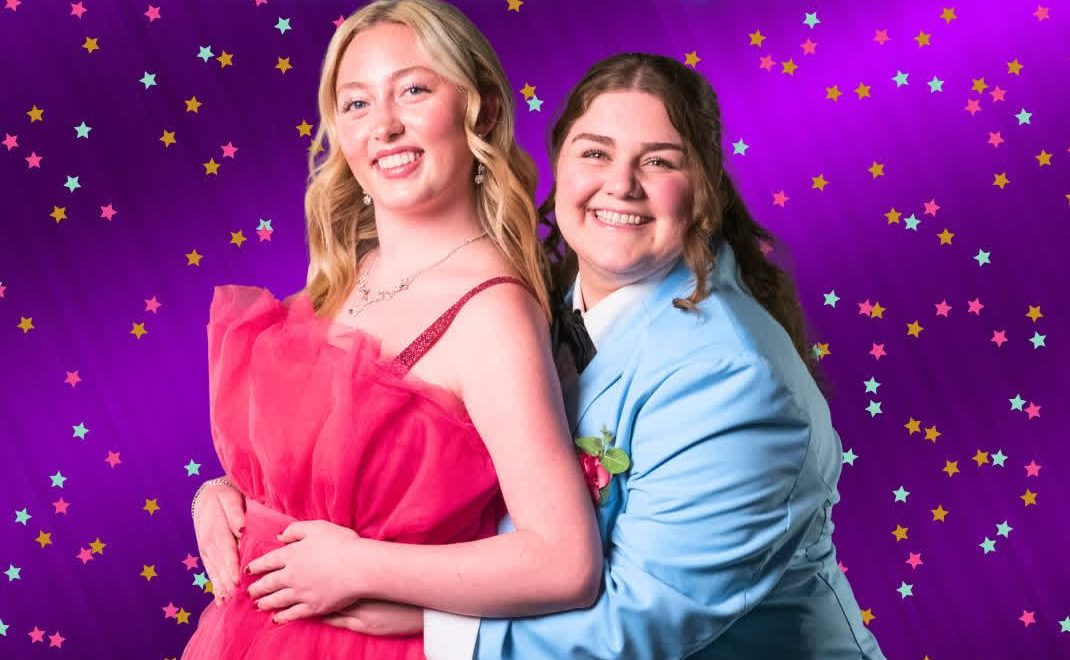
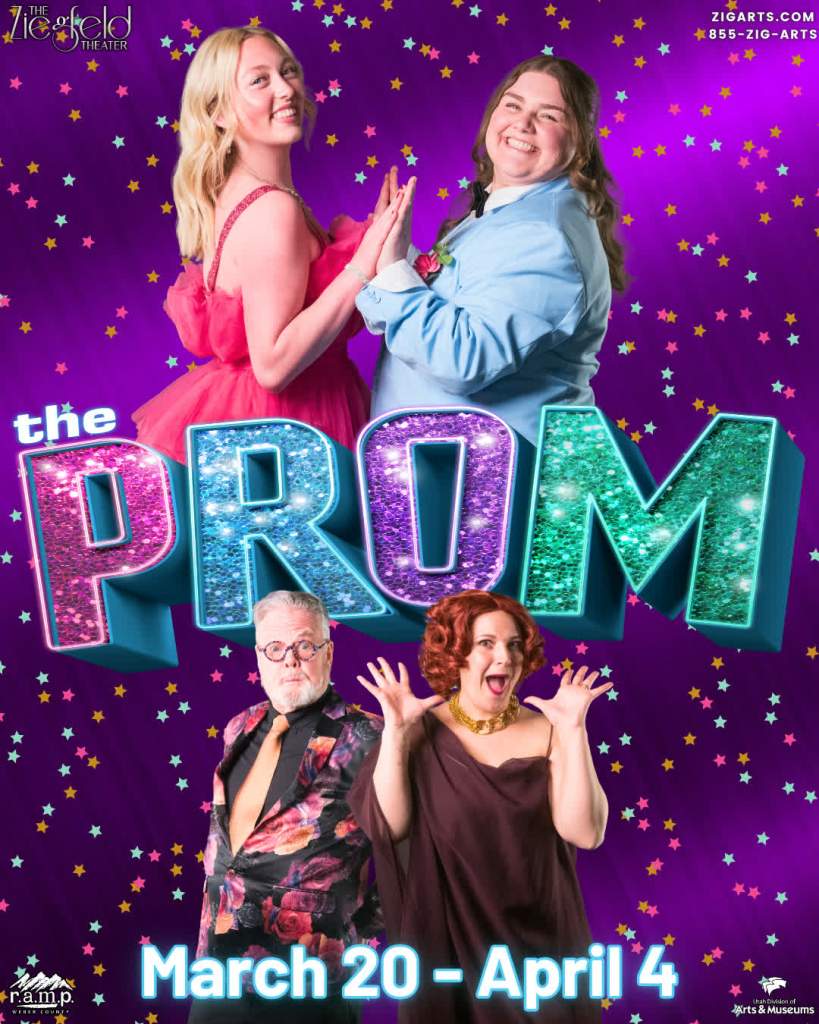
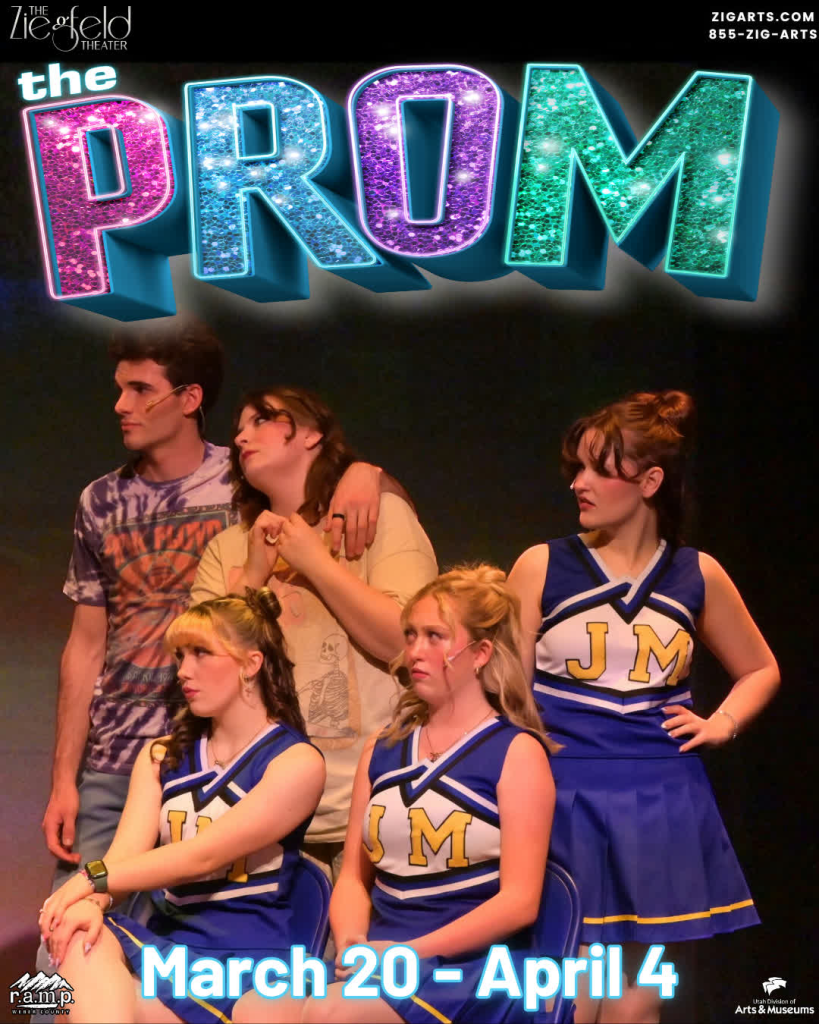
Ogden, UT — Running March 20 through April 4 at the Ziegfeld Theater in Ogden, The Prom arrives as both a vibrant musical comedy and a pointed reflection on belonging, visibility, and community. Directed by Caleb Parry, this production leans fully into the show’s humor while never losing sight of its emotional stakes. I attended on March 27th, where an engaged and responsive audience mirrored the show’s own shifting tone—moving from laughter to recognition in real time.
At first glance, The Prom presents itself as a high-energy, comedic musical about a high school dance gone wrong. But beneath its humor and spectacle lies a sharper question: who gets to belong, and who gets to decide? What unfolds on stage is not simply a story about inclusion, but a layered confrontation between institutional power, public narrative, and the lived realities of queer youth.
When a lesbian student, Emma Nolan, is barred from attending prom, the decision is framed by school authorities and parents as a matter of “safety”—a justification that quickly reveals itself as a rhetorical shield for exclusion. As one character explains, the community believed she would not be safe attending, even as that logic effectively removes her from the very space she seeks to enter. The result is a familiar but deeply unsettling contradiction: harm is recast as protection, and exclusion becomes policy.
What makes The Prom particularly effective is its self-awareness. The show invites us to laugh at everyone—the self-absorbed Broadway actors, the rigidity of small-town politics, even the absurdity of its own musical theatre conventions. But that laughter doesn’t exist in a vacuum. It lands in a cultural moment where the stakes remain very real. As recently as 2025, the Supreme Court declined to revisit challenges connected to Obergefell v. Hodges, the landmark decision that recognized same-sex marriage as a constitutional right—a ruling that continues to be contested in both legal and cultural arenas. The reminder is subtle but unavoidable: while The Prom may feel heightened and comedic, the tensions it stages—between belief, law, and lived experience—are ongoing. The show’s humor disarms, but what follows is something much sharper.
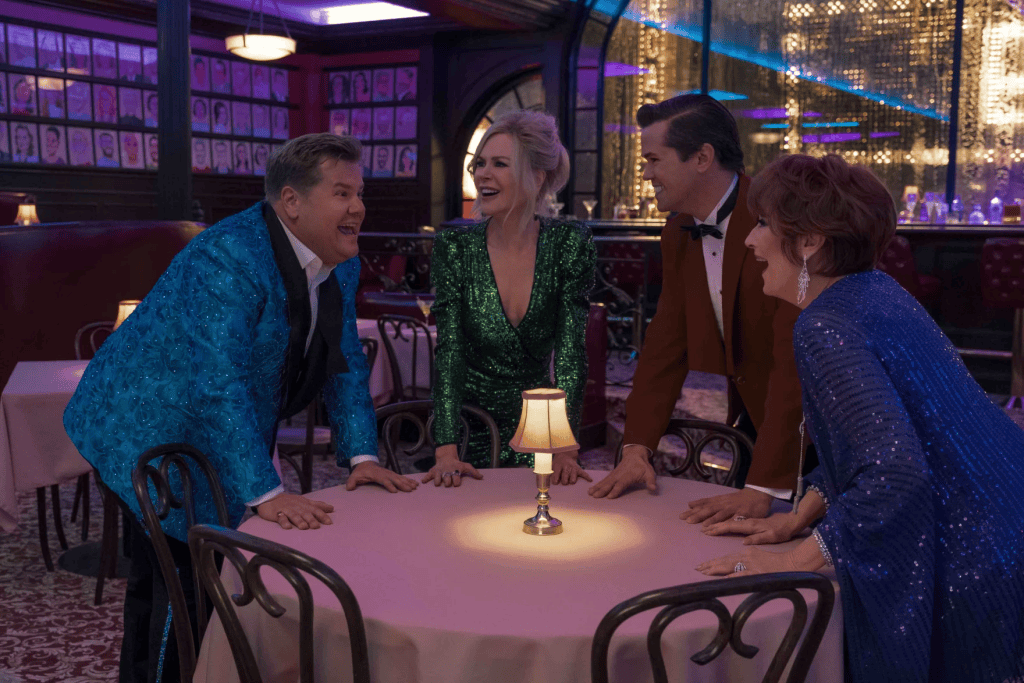
(L to R) JAMES CORDEN as BARRY GLICKMAN, NICOLE KIDMAN as ANGIE DICKINSON, ANDREW RANNELLS as TRENT OLIVER, MERYL STREEP as DEE DEE ALLEN in THE PROM
Context
Originally debuting on Broadway in 2018, The Prom quickly gained national attention for its blend of musical comedy and timely social commentary. The story was later adapted into a 2020 film directed by Ryan Murphy and released on Netflix, featuring a star-studded cast including Meryl Streep, Nicole Kidman, and James Corden. While the film brought broader visibility to the story, it also sparked conversation around representation and tone, particularly in its portrayal of queer identity. At its core, the narrative remains grounded in a real-world-inspired controversy: a high school student barred from attending prom with her girlfriend, setting off a larger cultural debate about belonging, visibility, and who gets to define community values.
For me, this story carries a more personal resonance—I first saw The Prom with my daughter at Pioneer Theatre Company in 2023, and it became a defining moment for her as a queer young person. Since then, we’ve watched the film more times than we can count, and this musical has held a special place for us both, making each new production feel not just entertaining but deeply meaningful.
Performance Highlights
What makes this production at Ziegfeld Theater particularly compelling is how fully the cast leans into the show’s tonal duality—balancing sharp satire with genuine emotional depth.
From the opening moments, the ensemble establishes the musical’s self-aware humor. The Broadway troupe’s initial desperation for relevance is played with exaggerated flair, landing some of the show’s biggest laughs. A standout early moment comes when Angie Dickinson (Maggie Gadd) bluntly identifies “the electoral college” as the biggest problem in America, only for the others to dismiss it as too complex. Gadd’s delivery is sharp, grounded, and effortlessly funny, setting the tone for a production that understands exactly how to wield satire without losing its footing.
Among the Broadway quartet, Erica Choffel as Dee Dee Allen commands the stage with undeniable presence. Her vocals carry both power and texture, with a rich, controlled growl that underscores the character’s larger-than-life persona. Choffel doesn’t just play a diva—she embodies one, fully inhabiting the spotlight while still allowing moments of vulnerability to break through.
As Trent Oliver, Dallin Patton delivers one of the production’s most memorable performances. His exuberance—equal parts theatrical bravado and unapologetic queer joy—infuses the role with a vibrant energy that feels both celebratory and self-aware. Patton leans into the character’s performative activism with comedic precision, while still grounding the role in a sincere belief in acceptance. The result is a portrayal that is not only hilarious but deeply affirming.
Tim Behunin’s Barry serves as the emotional anchor of the production. Warm, tender, and effortlessly likable, his performance brings heart to a show that could easily tip into spectacle. His chemistry with Ellie Swapp’s Emma is particularly affecting—together, they create moments of mentorship and connection that feel authentic and earned. Their scenes offer a quiet counterbalance to the musical’s larger comedic beats.
At the center of it all, Ellie Swapp delivers a standout performance as Emma Nolan. Vocally strong and emotionally grounded, Swapp brings a sincerity to the role and to “Dance With You” that resonates deeply. Her portrayal is grounded and captures the hopefulness of a teenager navigating an impossible situation. Notably, the production embraces body diversity in its casting, allowing Emma to exist on stage in a way that feels both authentic and necessary. Swapp’s performance captures not only the character’s struggle but also her quiet resilience.
Opposite her, Mylee Heiser’s Alyssa Green begins with the expected cheerleader polish, but gradually reveals a layered and conflicted interior. Her solo, “Alyssa Greene,” marks a turning point in the production, and Heiser rises to the moment with emotional clarity and vocal strength. What could easily be a one-dimensional role becomes, in her hands, a nuanced portrayal of pressure, fear, and longing. Morgan Parry (Mrs. Greene) and Kevin Ireland (Mr. Hawkins) round out the production with grounded, compelling performances that anchor the show’s central conflict.
The supporting ensemble further enriches the production. Jacob Eich as Sheldon, Emily Thompson as Kaylee, and Thom Cox as Kevin each bring distinct energy and specificity to their roles. Even in smaller moments, these performers create fully realized characters, contributing to a world that feels dynamic and lived-in. Collectively, the cast demonstrates a strong understanding of the musical’s balance—leaning into its humor while never losing sight of its emotional stakes. The result is a production that feels both entertaining and grounded.
Behind the scenes, the creative team at Ziegfeld Theater brings a cohesive vision that supports both the spectacle and sincerity of The Prom. Director Caleb Parry guides the production with a clear understanding of its tonal balance, allowing humor and heart to coexist without undercutting either. Mejai Perry’s choreography keeps the energy high and dynamic, particularly in the ensemble numbers, while Maggie Gadd’s music direction ensures the vocals remain a standout strength throughout the show. The design elements further ground the production: Erica Choffel’s set design offers a flexible and engaging playing space, complemented by Maria Menlove’s colorful and exuberant costumes that help define character and tone. Together with Troy Martell’s technical direction and the broader crew, the production runs smoothly and with intention, reflecting a company deeply invested in both craft and community.
Song Analysis: Where the Show Actually Shifts
The Prom begins with a promise to “change lives”—and immediately reveals what that promise entails.
In “Changing Lives (Reprise),” the Broadway actors declare, “We’re gonna prove… being gay isn’t a crime… to change the world one lesbian at a time.” The phrasing is telling. From the outset, Emma is not addressed as a person but reduced to a category—“one lesbian”—something to be acted upon, improved, or saved. Even the escalation feels mechanical, as if change can be scaled and performed in units.
That logic becomes even clearer in “We’re gonna help that little lesbian / whether she likes it or not.” The contradiction is immediate: help that ignores consent, care that overrides agency. The song doesn’t just joke about performative activism—it enacts it. Emma is positioned as an object of intervention, not a participant in her own story.
The satire sharpens further in the language used to describe the town—“where the necks are red and lack of dentistry thrives.” The actors frame themselves as enlightened outsiders, but in doing so reproduce the very logic they claim to resist, flattening an entire community into a stereotype. Even their vision of change—“We’re gonna teach ’em to be more PC”—is framed as correction rather than relation.
What’s striking is how fully the number commits to this structure. The humor lands, but it also exposes a model of engagement built on visibility, control, and performance for an audience rather than relation. That is the world Emma has to move through.
When “Dance With You” arrives, it does not argue against this—it refuses it. Emma’s language shifts entirely. Where the earlier song generalizes and categorizes, Emma narrows. She speaks in conditional phrasing—“If I could…”—grounded in uncertainty and risk. The scale collapses from “changing the world” to simply existing within it.
“Alyssa Greene” extends this tension inward. Lines like “Your feelings have to be concealed” accumulate, building a structure of pressure that feels inescapable. The repetition doesn’t just describe constraint—it produces it. Silence becomes something maintained, not chosen.
And then “Unruly Heart” breaks that structure through articulation. “No one gets to define the life I’m meant to lead” marks a shift from conditional language to declaration. Emma is no longer being spoken about—she is speaking.
Taken together, these songs trace a shift: from language that reduces and categorizes, to language shaped by constraint, to language that claims presence.
Emma’s Journey
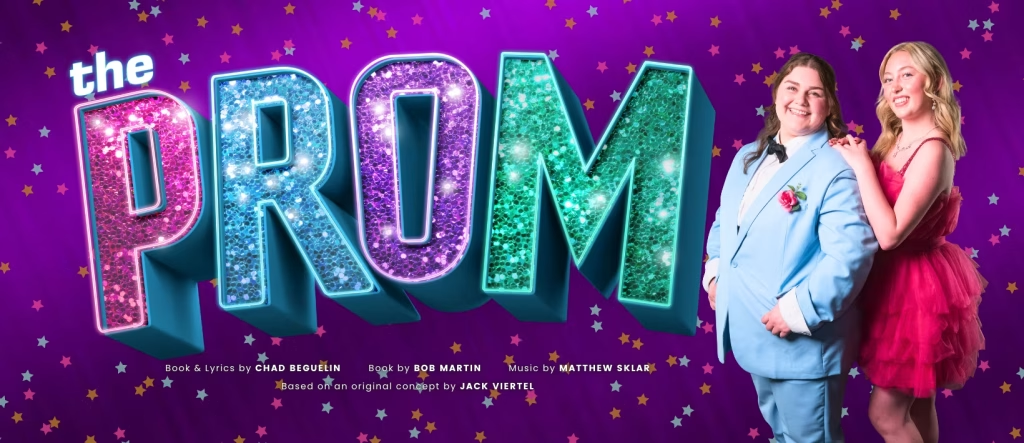
Emma’s journey shifts the terms of the show. Unlike the adults around her, she resists becoming a symbol, refusing the activist role imposed upon her. She does not want to “change the world”—she wants something far more immediate: to attend prom, to be seen, to exist without negotiation. That refusal matters. It rejects the scale of the debate surrounding her and returns the focus to lived experience.
Instead of stepping into institutional platforms—television appearances, public debates, mediated narratives—Emma reclaims the terms of her own story. She tells her story on her own terms. Her video, centered on what she calls her “unruly heart,” does not seek approval or permission. It offers something else: a self-articulated account of feeling, risk, and presence that moves beyond argument and into relation. In doing so, she shifts from being spoken about to speaking for herself.
Critical Reflection
What The Prom ultimately reveals is that not all performances operate in the same way. Some reinforce power by stabilizing familiar narratives. Others expose where those narratives begin to fracture.
The PTA’s language—“community values,” “safety,” “tradition”—works to stabilize exclusion, presenting it as reasonable, even protective. But Emma’s presence disrupts that logic. Not through argument or authority, but through embodiment. Through the undeniable reality of her experience.
Change in this production does not emerge from institutional intervention or public visibility alone. It emerges through recognition—when others begin to encounter Emma not as an issue to be managed, but as a person to be met.
In this sense, The Prom stages more than a conflict over a school dance. It stages a struggle over narrative authority: who gets to define reality, whose stories are heard, and what becomes possible when those at the margins refuse to be spoken for.

Closing
By the time the final prom arrives, it feels less like a resolution and more like a reconfiguration. The space has changed—not because power willingly yielded, but because it was challenged. Inclusion is not a given—it remains contested, negotiated, and, at times, actively resisted. A story centered on a queer student wanting to attend prom still has the potential to provoke controversy in communities today.
We laugh until the distance between stage and reality begins to collapse. Even now, the legal ground beneath LGBTQ+ rights remains unsettled, with ongoing challenges tied to Obergefell v. Hodges reminding us how fragile those protections can feel. What The Prom frames through humor is not hypothetical—it is present, ongoing, and unresolved. It is not something we can take for granted—but like Emma, it is something we must continue to fight for, sing for, and dance for—together.

Show Info & Tickets
Show: The Prom
Venue: Ziegfeld Theater
Dates: March 20 – April 4
Location: Ogden, Utah
Tickets are available through the Ziegfeld Theater box office and website. Performances are expected to draw strong local audiences, so advance purchase is recommended.
Showtimes:
Evening productions begin at 7:30 p.m., seating begins at 7:00 p.m.
Matinees begin at 2:00 p.m., seating begins at 1:30 p.m.
Box Office Information:
- Phone box office hours
- Mon, Tues, and Thurs: 1pm – 6pm.
- Fri and Sat: 1pm – 7pm
- Phone number
- Address
- 3934 S Washington Bvld, Ogden, Utah


Leave a Reply