

CEDAR CITY, UT—Patrick Barlow’s adaptation, The 39 Steps, at the Utah Shakespeare Festival (USF), hosted by Southern Utah University, is an impressively fast-paced and family-friendly comedy that children will adore. This adaptation is based on the John Buchan novel and Alfred Hitchcock film and masterfully blends mystery and comedy. While you might think that this play is an odd choice for a Shakespeare Festival, USF often offers a light-hearted comedy to appeal to broader audiences.
The 39 Steps was featured in USF’s 2010 season and has often been requested to return ever since. Directed by an actor from the 2010 run, Aaron Galligan-Stierle, this family-friendly favorite is a polished production that unifies the best elements of theater.
Daniel Frezza’s article, “The 39 Steps Times Four Equals Hilarious,” explores the art of adaptation, particularly focusing on Patrick Barlow’s comedic stage adaptation of Alfred Hitchcock’s 1935 film, which itself is based on John Buchan’s 1915 novel, The Thirty-Nine Steps. Frezza explains how each adaptation retains essential elements while introducing changes to suit new formats and audiences. Buchan’s original novel is a light-hearted thriller where the protagonist, Richard Hannay, prevents a German plot to start a war. Hitchcock’s film adapts this into a fast-paced chase narrative, adding a romantic subplot and comedic elements while avoiding political sensitivities of the time by omitting references to Germans.

Daniel Frezza‘s article, “The 39 Steps Times Four Equals Hilarious,” explores the
many adaptations of The 39 Steps, mainly focusing on Patrick Barlow‘s comedic stage adaptation of Alfred Hitchcock’s 1935 film, which itself is based on Buchan’s 1915 novel, The Thirty-Nine Steps. Frezza explains how each adaptation retains essential elements while introducing changes to suit new formats and audiences.
Buchan’s original novel is a light-hearted thriller where the protagonist, Richard Hannay, prevents a German plot to start a war. Hitchcock’s film adapts this into a fast-paced chase narrative, adding a romantic subplot and comedic elements while avoiding political sensitivities of the time by omitting references to Germans.
The stage version by Simon Corble and Nobby Dimon in 1996, and later Patrick Barlow’s adaptation, further condenses the story into a play for four actors, who portray over 150 characters using minimal props and inventive staging. This approach emphasizes theatrical creativity and humor, drawing on the spirit of postmodernism by blending old and new elements and engaging in self-referential storytelling. Barlow’s version follows Hitchcock’s film closely but adds unique touches, such as bringing back German spies and incorporating an airplane chase, which Hitchcock only introduced in North by Northwest. The play has been praised for its inventive staging, rapid character changes, and successful blending of comedy and suspense, appealing to modern audiences through its sheer absurdity and clever homage to both its source material and the art of theater itself.
The 39 Steps is a parody of a 1930s-era mystery that delightfully entertains and skillfully blends mystery thriller elements with situational comedy. The plot follows Richard Hannay, a middle-aged bachelor whose life lacks excitement. This changes dramatically when he gets entangled in a perilous spy mission, is falsely accused of murder, and must flee from enemy agents. Along the way, a straight-laced woman named Pamela gets caught up with the fugitive Hannay, leading to an unlikely romance as they work to uncover the mystery of the 39 Steps before time runs out. The play, a farce within a parody within a mystery, is brilliantly written, requiring only four actors to perform over—an astounding—150 roles. Much of the humor arises from rapid character changes, often with simple on-stage props or costume swaps.
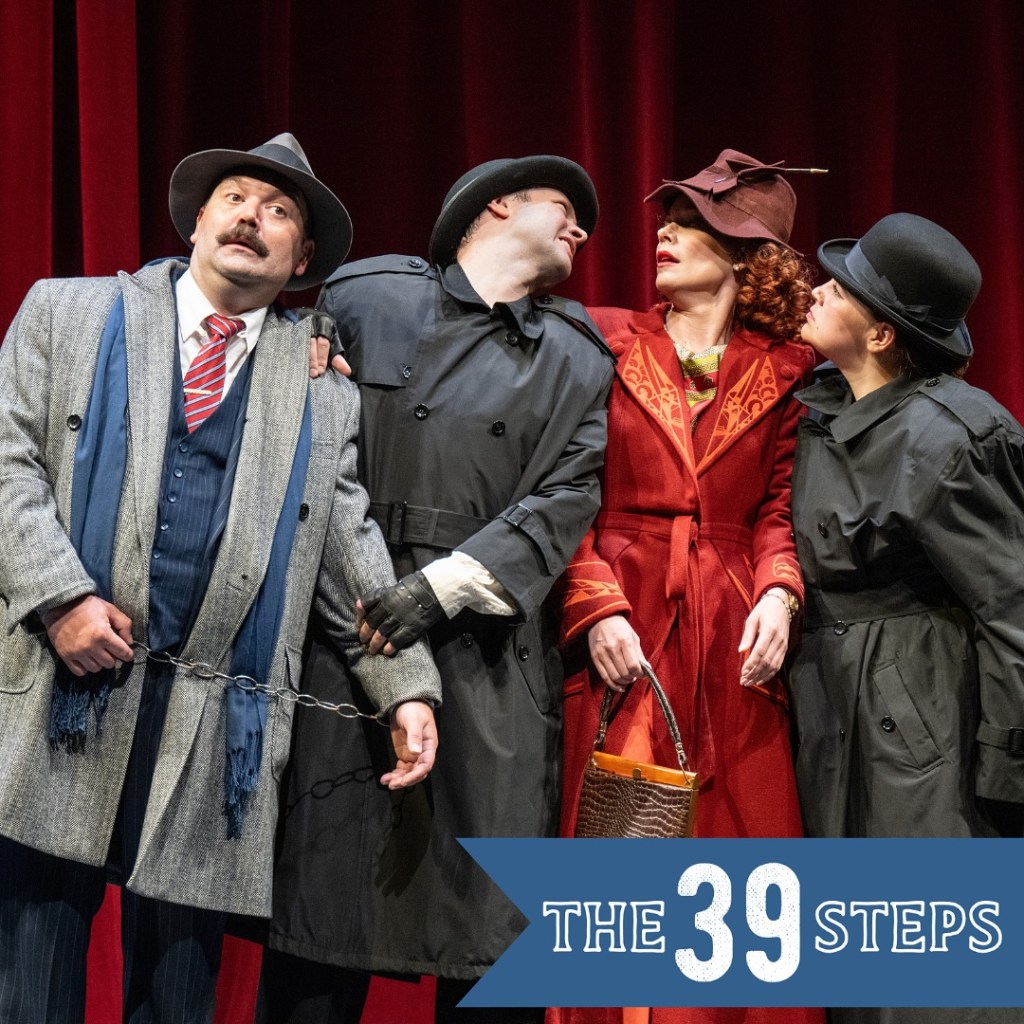
The most impressive and comedic aspect of the performance is its four-member cast, who masterfully execute quick costume changes (kudos to Costume Designer Matthew Pedersen) and create vivid characterizations that keep the audience in stitches. The actors’ versatility, switching seamlessly between characters with lightning-fast changes, is nothing short of spectacular. Their physical comedy, sharp wit, and ability to bring each character to life make the show an absolute joy to watch. The palpable chemistry among the cast members enhances the play’s enjoyment, as does their commitment to its farcical elements.
Tom Coiner stars as Richard Hannay, the only actor to stick to one role. Coiner embodies the British hero with comedic flair, capturing the nuance of a character who wants to be a ladies’ man but is too much of a gentleman to really be one. Tracie Lane, playing Annabella, Margaret, and Pamela, impresses with her physical comedy and her ability to play such varied love interests throughout the play. Lane’s Pamela is fiery and sincere, with comical expressions and reactions that keep the audience entertained.

The clowns are played by Michael Doherty (Clown 1) and Bailey Savage (Clown 2), whose physical comedy and timing are superb. Traditionally played by two men, I loved seeing a woman play the part of the Clown 2. It reminded me that just because something has traditionally been done a particular way, it does not mean it is the best way to do it. Doherty and Savage are a solid pair, and Doherty’s improvisation brings comedic gold to every performance. Their chemistry and playfulness add genuine moments of hilarity, especially in their portrayal of the inn couple. Doherty, as a woman in the nightdress, had me in a fit of giggles, and his improvisation makes each performance unique. At the same time, Savage’s portrayal of Mr. Memory is truly impressive. I want to credit Josh ‘J’ F.S. Moser, who worked with this cast as the Voice/Text/Dialect Coach, because there were 150 roles, and this cast constantly switched between accents from different countries; I don’t think any of those accents were American.

Director Galligan-Stierle sets the production in “an empty theatre space in London,” where actors decide to put on a show using available props and costumes. Much of the set and props were indeed pulled from the festival’s extensive stock. Upon entering the theatre, we notice that the stage is full of a rack full of clothes and a small antique radio downstage; we seem to be backstage. The show begins informally, with the actors casually interacting with props and each other, transitioning smoothly into the play’s start with a humorous pre-show announcement by Doherty, setting the tone for the ensuing chaos that is about to begin.
The production’s design is deceptively simple: yes, the items used are simple—trunks and a podium, among other things—but the amount of sound and lighting cues used in the show are anything but simple. Jason Lajka‘s scenic design, Chrzan’s lighting design, and Jennifer Jackson’s sound design are brilliant! In one scene, in particular, the actors compel the audience to believe that four trunks are a train in a police chase scene; this is only possible because of the incredible sound and lighting effects. Galligan-Stierle apparently spent the last year workshopping these scenes with his theatre classes he teaches at Slippery Rock University Theatre (according to an after-the-show seminar with Dramaturg Isabel Smith-Bernstein).
The costuming for this show looked anything but simple. The designs by Matthew Pedersen were fantastic, especially for Lane’s characters. I was again impressed by the sheer amount of designs needed for some 150 roles and the backstage crew working tirelessly to make such quick scene changes for the four-person cast. Shout out to Terence Orleans Alexander, who stage-managed this show.
USF’s The 39 Steps leans heavily into farce, on the verge of sheer absurdity. A normal production of The 39 Steps is physically demanding, but taking into account the large stage, the number of costume changes, and the fact that one of the cast members is running around the stage wearing a costume made of wool, well, it is even more impressive. The pacing is fast, preventing any dragging moments but sometimes causing the dialogue and details to be lost in the chaos, especially during the train sequence. I think the train scene is perfect—I wish I had thought of it—but it happened so quickly, and there was so much going on that I was not able to take everything in. I wish I could see it again. I think some moments could benefit from slightly slower pacing or perhaps a slow-motion scene in the middle of it to allow audience members to take in all of the brilliant elements—lighting, props, costumes, unique angles of the trunks, etc.

Some believe that the heart of The 39 Steps is a love story between Hannay and Pamela. However, this particular adaptation definitely feels centered around comedy, with the romance secondary to the frenetic humor, and I don’t mind it one bit. Further, the constant high level of physical comedy can sometimes make the production one-dimensional. While enjoyable, this might feel excessive to some. However, I personally enjoyed it immensely. The play succeeds in entertaining audiences of all ages, especially children whose laughter filled the theatre the entire night.
Get your tickets for an unforgettable experience with The 39 Steps at the Utah Shakespeare Festival! #the39stepsusf
Utah Shakespeare Festival presents The 39 Steps by Patrick Barlow.
Randall L. Jones Theatre, 35 S 300 W, Cedar City, UT 84720
Plays on select dates until October 5, 2024, at 2:00 PM and 8:00 PM
Tickets: $30–85 bard.org
Contact: 435-586-7878 or 1-800-PLAYTIX
Where: Utah Shakespeare Festival, 35 S 300 W, Cedar City, UT 84720
Approx Run Time: 2 hours & 30 minutes, including intermission
Content Advisory
A heightened comedic version of a murder mystery, this play contains taut suspense and thematic elements of crime. Mild adult themes, some language, and violence will be portrayed.
Sources
Frezza, D. (2024). The 39 Steps times four equals hilarious. Utah Shakespeare Festival.
https://www.bard.org/study-guides/the-39-steps-times-four-equals-hilarious/


Leave a Reply