

Reviews like this take 10+ hours to research and write. If this one was useful, even $1 helps. Support Rhetorical Review.
American Fork, UT—There is still something reverent and compelling at the heart of The Fantasticks—a sincerity in its meditation on love, longing, and experience that continues to resonate. Yet that resonance exists alongside the show’s more complicated roots. The same simplicity that gives the piece its emotional clarity also exposes elements that sometimes feel dated or unresolved for contemporary audiences, creating a tension the production engages with, but cannot fully resolve.
Directed by Kacey Spadafora, The Fantasticks, presented by the Timpanogos Arts Foundation in American Fork, Utah, is a minimalist production that explores illusion, empathy, and the complexities of a lasting theatrical classic. Through its intimate staging and emphasis on storytelling, it invites audiences to consider not just the romance at its center, but what is revealed when fantasy gives way to experience.
Premiering in 1960 at the Sullivan Street Playhouse, The Fantasticks went on to become the longest-running musical (and one of the longest-running shows). Its minimalist staging, small cast, and reliance on suggestion rather than spectacle marked a departure from the large-scale Broadway musicals of its time, positioning it as a landmark of early Off-Broadway minimalism. Often described as a theatrical fable, the work draws loosely from commedia dell’arte (European storytelling traditions) and the play Les Romanesques by Edmond Rostand, blending simplicity with symbolic structure. Its enduring legacy lies not only in its longevity but in its ability to invite each generation to reconsider its themes of love, illusion, and experience, however unevenly those themes may land over time.
That simplicity is especially effective in Act I, which captures the heightened absurdity of infatuation with humor and clarity. Luisa’s whimsical, often erratic declarations—paired with Matt’s immediate and unquestioning devotion—create a dynamic that feels both funny and familiar. Their early exchanges, filled with exaggerated romantic language and literary references, highlight how quickly affection can become projection. Matt does not fall in love with Luisa as she is, but as Juliet, as Helen, as an idea. Meanwhile, Luisa’s desire for “much more than keeping house” gestures toward a longing that initially feels expansive, even radical. But as the play unfolds, that expansiveness narrows into something more complicated.
This tension becomes most apparent in the musical number, Act II’s “Round and Round,” one of the production’s most striking and unsettling sequences. In this staging, Luisa moves in and out of stylized dance patterns with El Gallo, observing Matt from a distance. Each time she notices him, his suffering has intensified. At first, she is disturbed—concerned by what she sees. But when El Gallo instructs her to “put on the mask,” her perspective shifts. Once distanced, she begins to rationalize his pain, dismissing it as deserved, even necessary. It is a chilling transformation. The effect is not just unsettling to witness, but implicates the audience as participants in that shifting perspective.

The moment exposes one of the show’s central—and more troubling—ideas: how easily empathy can erode when we frame suffering as part of a larger narrative. The theatricality of the scene—the mask, the choreography, the repetition—creates emotional distance not only for Luisa, but for the audience. We are asked to watch, to understand, and perhaps even to accept what is happening. It is here that the show’s thematic ambition is most visible—and where its complications are hardest to ignore.
Because while The Fantasticks ultimately argues for growth through experience, it does so through structures that feel uneven by today’s standards. The staged “abduction” that initiates the central romance, the Mute’s historically complicated portrayal, and the reliance on exaggerated gender binaries all linger beneath the surface. Luisa’s characterization in particular reflects this tension—introduced as someone who has suddenly become desirable and simultaneously “strange,” she is often positioned within extremes rather than allowed full complexity. Her prayer—“Please God, please, don’t let me be normal!”—captures both her yearning and the narrow framework through which that yearning is defined.
And yet, the show persists.
Act II offers a tonal shift that, while abrupt, carries emotional weight. The illusions of the first act give way to disillusionment, and both Matt and Luisa are forced to confront a world that does not conform to their expectations. Songs like “I Can See It” and “Beyond That Road” reflect this growing awareness, while the final duet, “They Were You,” brings the narrative full circle. Here, love is no longer an abstract ideal, but a conscious choice—one made with the knowledge of what lies beyond the fantasy.
The production’s small cast and intimate musical arrangement—led by piano and harp—support this transition beautifully. The layering of voices and rhythmic interplay throughout the score adds texture to an otherwise minimal framework, allowing emotional complexity to emerge through sound even when the narrative structure falters.
In the end, The Fantasticks does not offer a clean resolution. Instead, it returns to where it began. The wall, we are reminded, was never the point. What matters is what was learned in crossing it. There is beauty in that idea. But there is also friction.
This production embraces the former while grappling, at times uneasily, with the latter. What emerges is a work that still speaks—though not always in a language that lands as seamlessly as it once did.

Performance Highlights
The strength of this production ultimately rests in its performances, which ground the show’s abstraction in something emotionally tangible.
Will Gardner, as El Gallo, anchors the production with a performance that is both controlled and magnetic. Moving fluidly between narrator and manipulator, he carries an authority that shapes the rhythm of the entire piece. His physicality—enhanced by the production’s magician-like costuming choices—reinforces his role as orchestrator, while his vocal performance brings a smooth, assured presence to numbers like “Try to Remember.” There is a calculated distance in his portrayal that serves the character well, particularly in moments where charm gives way to something more unsettling.
As Luisa, Brynn Hartley delivers a standout performance, marked by a voice that is both captivating and expressive. She leans fully into the character’s heightened, almost erratic language in Act I, allowing the humor of Luisa’s whimsical logic to land without sacrificing emotional sincerity. Her performance becomes especially compelling as the narrative darkens, with moments like “Round and Round” revealing a more complex and conflicted interiority. Hartley navigates Luisa’s shifting perspective with clarity, capturing both her vulnerability and the troubling ease with which her empathy begins to erode. Vocally, her rich tone and distinctive vibrato bring warmth and depth to the score, elevating even the simplest musical phrases.

Jensen Bean‘s Matt effectively captures the character’s early naivety, particularly through his exaggerated romantic declarations and rapid-fire literary references. His infatuation feels immediate and unfiltered, making the contrast of Act II all the more striking. As Matt moves beyond illusion, Bean allows a grounded stillness to emerge in his performance, most notably in “I Can See It,” where the character’s intellectual confidence gives way to a more honest reckoning with experience.
The fathers, Scott Mason (Hucklebee) and Wayne Keller III (Bellomy), bring strong comedic timing and a sense of playful absurdity to “Never Say No,” leaning fully into the exaggerated logic of their reverse-psychology scheme.
As Henry and Mortimer, Justin Anderson and Eliza Stevenson embrace the production’s theatricality through bold physical comedy and stylized performance choices, particularly in “An Episode.”
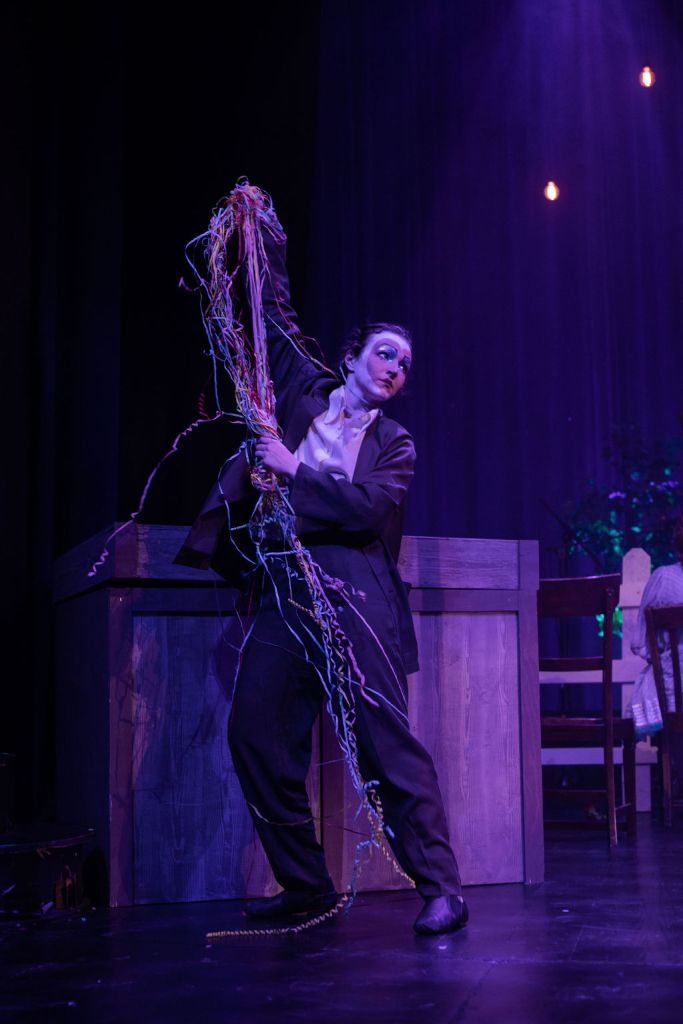
The role of the Mute, portrayed by Addilynn Bowler, is equally noteworthy, though silent. Through movement, gesture, and precise timing, Bowler helps construct the world of the play while also subtly unsettling it, reinforcing the sense that what unfolds is both carefully orchestrated and emotionally distant.

Production Highlights
This production leans fully into the minimalist aesthetic that defines The Fantasticks. Scenic and lighting design by Caleb Wallengren centers on a simple but highly versatile stage, anchored by large trunks on either side from which characters emerge and retreat. These trunks function not only as practical set pieces but as symbolic devices, reinforcing the sense that the story is being constructed in real time rather than presented as a fixed reality.
The use of haze and soft, shifting lighting enhances this atmosphere, creating a visual language that moves fluidly between dream and reality. Transitions feel intentionally seamless, allowing the narrative to unfold with a kind of storybook continuity while still maintaining moments of emotional disorientation—particularly in sequences like “Round and Round,” where design and movement work in tandem to reflect the characters’ shifting perceptions.
Choreography by Chantelle Wells makes strong use of repetition and circular movement, reinforcing the show’s thematic emphasis on cycles of desire, disillusionment, and return. Movement often operates as narrative, particularly in moments where dialogue gives way to physical expression. A standout moment comes in the dance between Matt and Luisa, where the choreography shifts into fully realized, formal dance. In one particularly striking sequence, Jensen Bean (Matt) executes a controlled lift of Brynn Hartley (Luisa), showcasing both performers’ strength, balance, and precision. This technically demanding moment drew a palpable sense of awe from the audience. The sequence highlights the performers’ training while deepening the emotional arc of the scene, allowing the relationship to be expressed through embodied technique rather than text alone.
Costume design by Emma Ashton supports the show’s timeless, undefined setting, avoiding strict historical specificity in favor of a more generalized, fable-like aesthetic. Luisa’s dress in Act I is particularly striking—flowing and luminous, it feels lifted straight out of a fable, reinforcing the heightened, almost dreamlike quality of the world the characters inhabit. In Act II, that visual polish gives way to something more disheveled, with costumes reflecting the wear of experience and the unraveling of illusion. The shift is subtle but effective, mirroring the characters’ movement from romantic fantasy into a more grounded and often harsher reality.
The live music is especially noteworthy. Led by Kimberly Harolds (piano) and Kari Rundlett (harp), the accompaniment brings a richness and immediacy to the production that elevates even its simplest moments. The intimacy of the instrumentation allows for a responsiveness that feels both grounded and fluid, shaping the emotional rhythm of the performance in real time and adding depth to an otherwise restrained theatrical environment. This is not an easy score, and Harolds and Rundlett handle it with impressive control and nuance.
Conclusion
In the end, The Fantasticks remains a work defined by contradiction—sincere and uneven, charming and complicated. This production embraces those tensions rather than resolving them, allowing the audience to sit with both the beauty and the friction.
What lingers is not the illusion the show constructs, but what remains after it dissolves.
The Fantasticks is not a show audiences encounter every season, and perhaps that rarity is part of its appeal. For all its complications, it remains a work that invites reflection—and one worth seeing while the chance presents itself, if only to sit with the tension of what it reveals.
Tickets
Tickets for The Fantasticks are priced between $15–$25 (plus fees) and are available through the producing organization’s box office and website.
Performance Dates: April 16–25, 2026
Location: Valentine Theater
Address: 839 E 9th N, American Fork, UT 84003

Show Information
The Fantasticks
Book and Lyrics by Tom Jones
Music by Harvey Schmidt
Suggested by Les Romanesques by Edmond Rostand
Directed by Kacey Spadafora
Music Direction by Ashley Murillo Coombs
Choreography by Chantelle Wells
About the Playwrights
The Fantasticks features book and lyrics by Tom Jones (1928–2023) and music by Harvey Schmidt (1929–2018), a longtime collaborative duo whose work helped define Off-Broadway musical theatre in the mid-20th century. Premiering in 1960 at the Sullivan Street Playhouse, their partnership produced what would become the longest-running musical in American theatre history.
Jones’s lyrics are known for their simplicity and poetic clarity, often drawing on archetypal storytelling and fable-like structures, while Schmidt’s score blends lyrical melody with understated orchestration. Together, their work on The Fantasticks reflects a deliberate move away from spectacle, favoring intimacy, suggestion, and emotional resonance over large-scale production.
The musical itself was inspired by Les Romanesques by Edmond Rostand (1868–1918), though Jones and Schmidt reframe the original satire into a more reflective exploration of love, illusion, and experience—qualities that continue to invite reinterpretation, even as the work’s cultural assumptions remain open to critique.


Leave a Reply