

Centerville, UT—At the center of The Keeping Place, a senior capstone project by Colton Kraus, is a striking premise: theatre can be a space where people store—and, at times, share—memories. In this project, approximately twenty individual stories are shared, sometimes altered, and held with care. At times, these memories have become too difficult to carry alone. Through performance, the production reframes memory not as something simply owned or shared, but as something held—with the possibility of being offered, received, or kept.
Premiering at Spotlight Performing Arts, the piece unfolds across four seasonal acts—Spring (Identity), Summer (Growth), Fall (Nostalgia), and Winter (Gratitude). Built from approximately twenty real-life stories gathered through interviews, alongside fragments of Kraus’s own experiences, the production resists a singular narrative. Instead, it assembles a series of vignettes—humorous, painful, and reflective—that trace the uneven process of growing up.
The production draws on verbatim theatre, a documentary form that uses interviews and lived testimony as the basis for its script. Rather than inventing dialogue, it adapts participants’ words—editing and combining them for performance while preserving their core meaning. This approach aligns with performance studies scholar Dwight Conquergood, who, borrowing Amanda Kemp’s phrasing, describes performance as “both a way of knowing and a way of showing” (Conquergood 152), and with Norman K. Denzin’s understanding of performance as a form of critical inquiry.
The project is shaped by Kraus’s interdisciplinary background at Weber State University, where he is pursuing a Bachelor of Interdisciplinary Studies with a focus in Theatre, English, and Education. Drawing from oral history, poetic writing, and performance practice, The Keeping Place reflects a synthesis of these fields. His theatrical experience is evident in both the production’s structure and its guiding intention: to hold memory with care—whether preserving it or, at times, setting it aside. This commitment extends beyond the stage through a companion lesson plan designed to engage young audiences in conversations about empathy, identity, and shared experience.
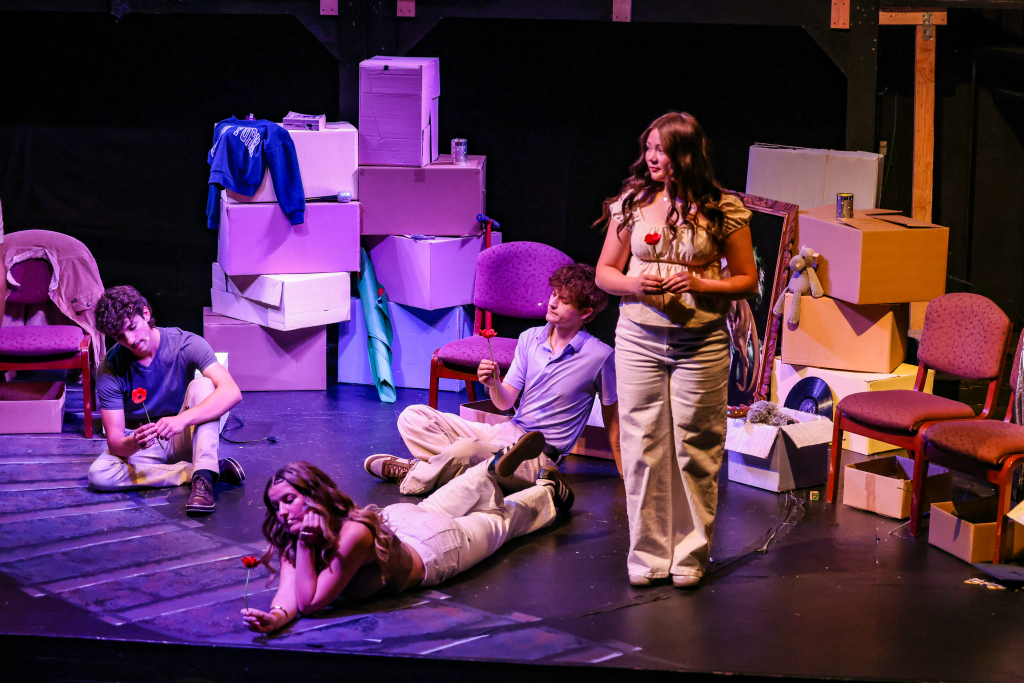
From its opening moments, the production establishes its visual language. The stage resembles an attic-like archive: scattered objects, old records, VHS tapes—Aladdin, The Little Mermaid—books, and instruments, each suggesting fragments of the past. As overlapping recorded voices fill the space, performers enter carrying everyday objects and gather around illuminated boxes placed throughout the stage. These boxes function as literal “keeping places,” giving physical form to memory. Each time an object is lifted, a story emerges, reinforcing the sense that memory is held not only in things, but in bodies and shared space. The effect is less like watching a story unfold and more like moving through a space of accumulated memory.
ACT I: Spring (Identity)
ACT I introduces moments of childhood and early self-awareness, where imagination and discovery coexist with the first pressures of conformity. The act is structured through object-based storytelling, as performers pull items from the central boxes—bottles, tools, everyday objects—and build narratives around them. In one early vignette, a “magic” ring gradually loses its power, capturing the subtle shift from childhood belief to adult awareness. In another, a microwave becomes the center of a family memory, reframed as something almost miraculous in its ability to bring people together. These moments begin in humor and familiarity, but gradually give way to something more vulnerable, as speakers reflect not only on how they grew, but on how they learned to adapt, conceal, and reinterpret themselves.

In conversation, Kraus described how deeply he experiences memory, noting his tendency to tie specific objects and sensations to particular people and moments. He referenced a recurring image from Avatar: The Last Airbender, in which the character Katara touches her necklace when speaking about her mother—a gesture that has become shorthand for memory and emotional association. For Kraus, this dynamic is not ironic but deeply felt: a smell, an object, or a phrase can immediately call forth a person, a relationship, or a past version of the self. This sensibility shapes The Keeping Place, where objects function not as simple props, but as anchors for memory. While rooted in his own experience, Kraus emphasized that this approach was intentional—an acknowledgment that such associative connections are widely shared.
This same logic extends into the production’s confessional sequences, particularly in “Behind Closed Doors,” where memory becomes not only associative, but fragmentary, unfolding through brief, discontinuous admissions. The scene carries an intimacy reminiscent of a pillow book—a form of personal writing associated with Sei Shōnagon’s The Pillow Book (c. 1000 CE). Like these texts, it resists linear narrative, instead assembling meaning through accumulation, juxtaposition, and emotional proximity, where fragments gain significance through their relation to one another.
This form invites a kind of quiet solidarity: the act of encountering fragments that are candid, partial, and at times unguarded. The Keeping Place does not ask the audience to fully know or resolve these experiences, but to sit with them—to recognize something of themselves within what is shared, even when it remains incomplete. As Kraus noted, this section was written as an interstitial piece shaped by the interviews, designed to hold reflections that audiences could broadly relate to. The result is a form that is both personal and collective: individual in voice, but expansive in reach.
This sense of guarded intimacy is further reinforced by the way Kraus has collected and structured the interviews themselves. By allowing for anonymity, the production preserves a layer of protection for its contributors, reflecting an ethic of care that prioritizes the well-being of those sharing their stories. The result is a space where vulnerability can emerge without full exposure, aligning with the production’s broader commitment to listening, respect, and relational responsibility.
Here, performers articulate the gap between the self as lived and the self as presented, offering glimpses of identity that exist outside of social expectation. Many of these moments center on gender and sexuality, tracing how individuals come to understand themselves through reaction rather than instinct. In one vignette, a boy recalls recognizing his attraction to other boys, only to learn embarrassment through his mother’s response. In another, a speaker questions whether a task requires “a boy” or simply “an able body,” exposing the arbitrariness of gendered expectations. Across these moments, identity emerges not as something freely expressed, but as something negotiated—shaped through pressure, correction, and the quiet realization of what must be hidden.

ACT II: Summer (Growth)
ACT II expands these concerns, shifting from identity formation into pressure, expectation, and consequence. In “Bright for Your Age,” the production examines how early praise can evolve into a burden, as being labeled “special” gradually becomes a form of comparison. What begins as affirmation transforms into an ongoing measurement against others and against an imagined standard of success. The scene critiques a broader culture of comparison, suggesting that identity built on external validation is inherently unstable. These tensions feel particularly resonant within a Utah context, where cultural expectations around achievement, behavior, and identity shape how individuals come to understand themselves.
Alongside this, the production introduces reflections on substance use—drinking and marijuana—not as moral cautionary tales, but as part of a more complex exploration of coping and belonging. What begins as connection reveals its limits, as moments of relief give way to dependency or disorientation.
Throughout these acts, a recurring question emerges: when do individuals “stop feeling like a kid”? The production reframes coming of age not as a single milestone, but as a series of interruptions—moments where innocence is reshaped by awareness, loss, or responsibility. In one particularly stark vignette, a speaker recalls being fourteen when their father stole their wallet to buy drugs, collapsing the boundary between childhood and adulthood in an instant. These stories make clear that growing up is not always gradual; it can be abrupt, uneven, and deeply personal.
ACT III: Fall (Nostalgia)
ACT III marks a tonal shift toward reflection, where memory becomes sensory, fragmented, and often bittersweet. Rather than attempting to recreate the past, the production leans into how memory is experienced—through small details, textures, and fleeting impressions. References to cultural touchstones—Hannah Montana, trips to Blockbuster—anchor these memories in a specific generational and regional experience, reinforcing how nostalgia operates not only individually, but collectively.
Performers enter holding poppies, evoking a sense of collective remembrance, while scenes unfold through fragments of recollection that feel both intimate and disjointed. In one quietly powerful moment, a voice reflects, “I remember when I didn’t have to pretend,” capturing not only the loss of childhood innocence, but the loss of creative freedom—the ability to move through the world without self-consciousness. This movement culminates as the ensemble reveals childhood photographs of themselves. After an extended reliance on anonymity and shared narrative, the images reintroduce specificity, grounding the production in lived experience. Memory, which has been fragmented and distributed across voices, suddenly resolves into something unmistakably personal. The effect is not sentimental, but clarifying: what is remembered is not simply what happened, but who we were when it did.
This tension between beauty and loss is echoed in the production’s underlying structure. Kraus noted that several moments in the piece originate from poems he wrote prior to the show, which helped shape its thematic focus on memory and nostalgia. As one of his lines suggests, “Sometimes pain is the price you pay, plucking past pretties from back in the day,” a phrase that encapsulates the emotional logic of the act. Here, memory is not simply something to revisit, but something to reckon with—an act that brings comfort and discomfort in equal measure.
The production’s visual language reinforces this thematic work. The recurring use of poppies and medical-style face masks creates both structural breaks and symbolic commentary. These masks—reminiscent of those worn during the COVID-19 pandemic—gesture toward forms of protection, distance, and containment, while also suggesting the ways individuals mediate what is revealed and what is withheld. Rather than traditional theatrical masks that signify character, these coverings emphasize the tension between visibility and concealment in everyday life. Together, these elements transform the stage into a kind of living archive, where memory is not simply told, but managed, filtered, and made visible on shifting terms.

ACT IV: Winter (Gratitude)
ACT IV gathers the production into a shared space of reflection, though not in a way that offers simple resolution. In one of its most affecting sequences, the ensemble sings “Silent Night” while reflecting on Christmas traditions and the things they miss. The moment draws on a shared cultural ritual, grounding the piece in familiarity while allowing space for personal variation and absence. The ensemble’s singing—particularly the layered harmonies in “Silent Night”—is gentle and controlled, creating a sense of collective stillness that deepens the emotional resonance of the scene.
Yet immediately following this warmth, the production takes a stark turn, introducing references to suicide. The abruptness of this shift underscores the production’s commitment to representing the full range of lived experience, but also highlights the need for clearer content awareness. Given the emotional weight of the material, a trigger warning would allow audiences to engage more safely and intentionally. This tension—between comfort and rupture—becomes central to the act’s emotional logic.
This tension between beauty and difficulty is further explored in a striking dance sequence that becomes one of the production’s most visually and emotionally layered moments. Referencing The Nutcracker, an ensemble member reflects on dance while holding a ballet slipper as the familiar music plays. The imagery—graceful, disciplined, culturally celebrated—remains intact, but is fundamentally reframed through a narrative of abuse. The speaker describes finding beauty in dancing while trying to survive, a juxtaposition that is both lovely and deeply unsettling.
This thematic complexity is deepened through the choreography itself. In a sequence featuring Kyla Rounds, movement becomes a form of storytelling in its own right. The way the male ensemble supports and frames her body creates a visual dynamic that underscores both strength and vulnerability, reinforcing the emotional weight of the narrative rather than distracting from it. In this moment, the production resists idealizing memory, instead revealing how even the most cherished traditions can carry more difficult, unspoken realities. Here, beauty does not erase harm—it exists alongside it.
Throughout the production, sound design by Kraus plays a subtle but important role in shaping the audience’s experience. Recurring chime effects punctuate transitions between scenes, creating a rhythmic structure that helps guide the audience through the otherwise fragmented sequence of vignettes. Each chime signals a shift—into a new memory, a new voice, or a new emotional register—reinforcing the sense that the audience is moving through a curated space rather than a linear narrative.
At one point, the production turns toward a broader philosophical question: why, if everything needed has been given, do people still feel lost? The answer it offers is not theological, but relational: “Maybe if we were there for one another… maybe we wouldn’t feel so lost.” This line does not resolve the tensions presented, but reframes them, suggesting that what is missing is not understanding, but presence.
Performance
The strength of the production ultimately rests in its ensemble, whose performances carry the emotional weight of the piece with care and restraint. The cast—Noah West (Finder 1), Veah Johnson (Finder 2), Christian Anglesy (Finder 3), Elsha MacKay (Finder 4), Caden Feller (Finder 5), and Kyla Rounds (Finder 6), with Kayleigh Eagle as the Finder 4 understudy—moves fluidly between individual storytelling and collective presence, navigating a wide range of tones—from humor and nostalgia to vulnerability and grief—without overstatement. Each performer contributes to a shared sense of trust, ensuring that the stories feel both personal and held in common.

Audience
At several points throughout the performance, the emotional impact is palpable. I could hear audience members sniffling, a quiet but telling response that speaks to how effectively the production meets people where they are. These are not distant or abstract stories—they resonate, often deeply, with lived experience. That immediacy is one of the production’s greatest strengths, allowing audiences to see themselves reflected in moments of joy, confusion, and pain. At the same time, the intensity of that connection—particularly in scenes addressing trauma, abuse, and suicide—reinforces the importance of clear content awareness. Preparing audiences for these shifts would not diminish the work’s impact, but rather support a more intentional and sustainable engagement with it.
The production also suggests that performance itself functions as a space of processing. As one story reflects, the stage is “the only time [they] don’t have to be [themselves],” a statement that introduces a striking paradox. In a piece so concerned with authenticity, performance becomes not concealment, but release—a space where identity can be set aside rather than managed. For some, the stage offers not just expression, but relief.

Conclusion
By the final moments of the production, The Keeping Place begins to articulate what has been building across its many narratives. After stories of identity, pressure, loss, and reflection, it offers a quiet but expansive gesture outward: “Maybe if we were there for one another… maybe we wouldn’t feel so lost.” Within the piece, this is not a simple resolution, but a reframing. The preceding stories make clear that confusion and isolation are not individual failures, but shared conditions—often unspoken, yet deeply felt. The production does not suggest that these experiences can be fully understood or resolved. Instead, it proposes something more grounded: presence.
In this way, The Keeping Place also gestures toward the broader potential of verbatim and oral history-based theatre, particularly in educational spaces. Grounded in community-based oral histories—stories drawn from friends, family, and local relationships—the production centers real voices and lived experiences in a way that remains relational rather than extractive. In doing so, it models how storytelling can foster empathy—not through abstraction, but through recognition. As both a capstone project and a pedagogical tool, the work raises an important question: how might theatre not only represent experience, but actively shape how communities listen to one another?
Works Cited
Conquergood, Dwight. “Performance Studies: Interventions and Radical Research.” The Drama Review, vol. 46, no. 2, 2002, pp. 145–156.
Denzin, Norman K. “Performance Ethnography: Critical Pedagogy and the Politics of Culture.” Sociological Theory, vol. 21, no. 3, 2003, pp. 257–277.

About the Playwright
Colton Kraus is a theatre artist and student at Weber State University, where he is pursuing a Bachelor of Interdisciplinary Studies with a focus in Theatre, English, and Education. A storyteller at heart, Kraus works across multiple mediums—including acting, directing, photography, videography, design, choreography, and poetry—drawn to the ways art can foster connection and express what words alone sometimes cannot.
Originally from Brigham City, Utah, Kraus has been actively involved in theatre from a young age. He began directing and teaching at the Brigham City Fine Arts Center at just fifteen, where he also wrote and directed an original twenty-minute adaptation of Pinocchio. By the age of twenty, he served as the theatre program director for several years, further developing his commitment to collaborative and community-based performance. Across his work, he has remained engaged in all aspects of theatre-making, including performance, choreography, lighting design, costuming, and directing, with experience directing numerous productions as well as musical reviews and concerts.
As a performer, Kraus has appeared in a range of productions, including Buddy the Elf in Elf the Musical at the Ziegfeld Theatre, Seaweed in Hairspray, Mr. Cromer in Finding Neverland, and a Brother in Joseph and the Amazing Technicolor Dreamcoat. These experiences inform his approach to theatre as both a creative and relational practice.His work on The Keeping Place reflects this interdisciplinary background, bringing together oral history, poetic writing, and performance. Developed as a senior capstone project, the piece also reflects Kraus’s investment in education and pedagogy. Alongside the production, he created a companion lesson plan exploring how verbatim theatre and storytelling can foster empathy among young people, particularly within their own communities. In this way, The Keeping Place extends beyond performance, positioning theatre as both an artistic and educational practice grounded in connection, emotion, and community.
Contact: cjkraus22@gmail.com Instagram: @c.j.kraus


Leave a Reply