

In “Very Like a Whale,” a family inherits a hoax and a dying lake
Very Like a Whale, by Troy Deutsch. Directed by Alexandra Harbold. Salt Lake Acting Company, in collaboration with Flying Bobcat Theatrical Laboratory, 168 West 500 North, Salt Lake City. Through Oct. 25. About 105 minutes, no intermission.
Salt Lake City, UT—In 1890 the Utah Enquirer reported that an English gentleman named James Wickham had shipped two Australian whales by rail from San Francisco and loosed them in Great Salt Lake, where they broke through his wire pen and began to breed. None of it was true. As Spencer Neuharth recounted in a 2019 fact-check for MeatEater, the Deseret News found no record of Wickham at all, and the article gave itself away by claiming that whales live 400 years and lay eggs.
Out of that tall tale, Troy Deutsch has written a witty play about something that matters: a lake that is dying. Kudos to him, Salt Lake Acting Company, and Flying Bobcat Theatrical Laboratory for backing artists who care about our land and water. We should all care this much.

Directed by Alexandra Harbold, Deutsch’s new comedy, receiving a co-world premiere at Salt Lake Acting Company with Cadence Theatre Company of Richmond, Virginia, asks what happens if you take the hoax at its word. The answer is a loud, quick, very funny evening, and I liked it a great deal. The Sharps, the family at its center, kept putting me in mind of the Roses of Schitt’s Creek. Yet the play is unlike anything else I have seen on a local stage, and it could not be better fitted to this city: the lake, a few miles from the theatre, really is disappearing, and somebody is going to have to be responsible for what is left.
The Sharp family arrives at a cluttered, nautical-themed house on the lakeshore straight from burying its patriarch, Bernie. They come in out of a dust storm, coughing up the exposed lakebed. Megan (Olivia Custodio) wants the place scrubbed and sold before her brother can leave town again. Greg (Robert Scott Smith), a choreographer whose dance company exists mostly in the future tense, has flown in too late to say goodbye. Megan’s husband Chester (M. Scott McLean) wants everyone to calm down. Their daughter, Max (Devoree Ellis), and Max’s girlfriend, Sophia (Mack Barr), want lunch.

Then a woman rides up on a horse. Miss Penelope Dickinson (Sarah Shippobotham), emissary of the Wickham family of the Cotswolds, has brought flowers and news. The whales are real. The Sharps have been their paid, secret keepers for generations. Bernie died without naming a successor, and Penelope is not leaving until one is chosen.
What gives the comedy its weight is the lake. Penelope’s account of the keeper’s duties begins as whimsy and ends somewhere colder: the water is being diverted, the lakebed is turning to toxic dust, and the next keeper’s final duty will be to run Wickham’s experiment in reverse, sending the surviving whales back to the ocean by rail before their home dries up. Megan hears a leftist cabal. Max hears a calling; her mother may hate the word environmentalist, she says, but “it’s not a bad word, and I should know, because I am one.” Yet it is Megan, of all people, who snaps, “You cannot plan your life betting on the lake’s imminent destruction.” Each Sharp wants something different from the job. Greg wants free rent and an audience, Max wants a cause, and Chester wants, for once, to be trusted with something.
Deutsch builds the first hour as farce, and its engine is Megan. She is grieving, devout, furious at being the sibling who stayed, and unable to let a sentence pass without correcting it. “Our parents’ parenting, Greg, was not a victimless crime,” she informs her brother. Custodio, the longtime head writer of the company’s summer show, is outstanding: a firecracker, and the production runs on her fuse. She meets her match in Shippobotham’s Penelope, quirky, eccentric, and enormous fun to watch, with a crisp English delivery that is no accident: Shippobotham teaches acting and dialects at the University of Utah. Their best scene together has Penelope reading the 1890 article aloud, whale eggs and all, while Megan heckles and Chester slowly realizes he believes it.
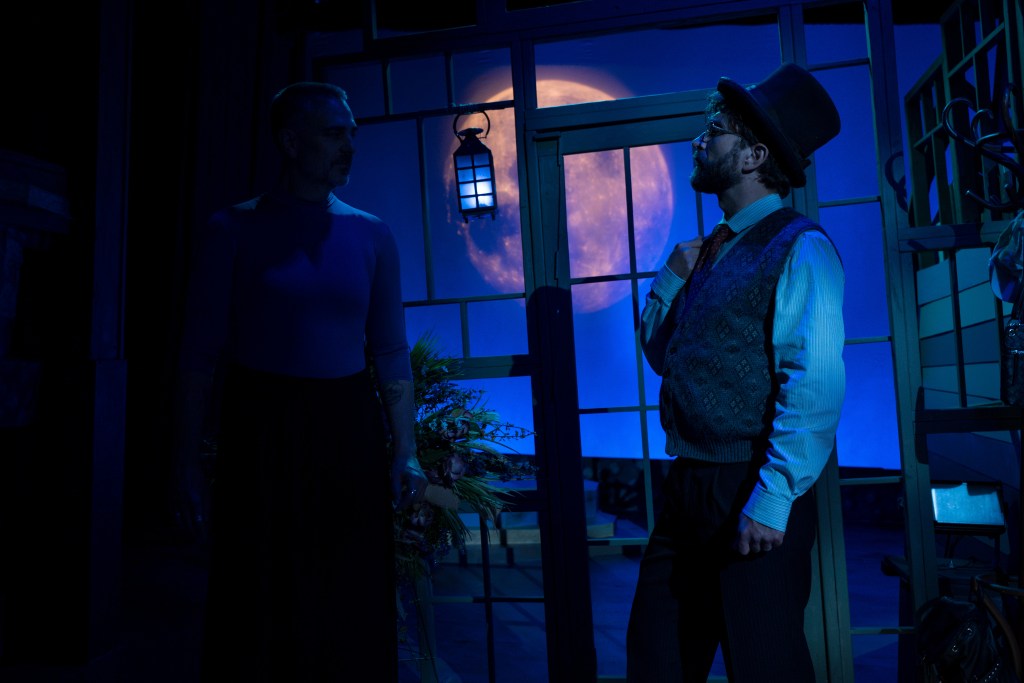
Chester is the quiet one, and McLean makes him the gentlest person on stage and the easiest to root for, a peacemaker with more going on underneath than his family notices. He used to walk the lakebed with Bernie, he says, and out there “it’s like you’re walking on the surface of another planet.”
The younger generation gets the best running gag. Every time Uncle Greg accidentally bumps Bernie’s rocking chair and it creaks, Max is convinced her grandfather has come back, wails “Grandpa!” and falls apart, with Megan not far behind. Ellis, who is making her professional stage debut, throws herself into it without a trace of caution, and she gives Max a conviction that keeps the character from being only the punchline. Barr, a recent University of Utah acting graduate in her first show with the company, is a delightfully quirky Sophia, the outsider in this family who turns out to be every bit as odd as they are.
Then there is Greg (Smith), who is strongly reminiscent of David Rose from Schitt’s Creek and who gets the evening’s other showstopper: a monologue declaring himself a visionary that the world has not yet noticed. “There is a fire burning inside me, hot and blue,” he says, and the speech builds until words fail and he has to dance, stripped down to electric-blue spandex. Smith commits completely, and I was laughing hard; he makes the scene funnier than it is on the page.
The scene also left me with two thoughts, and I mean both as compliments. Just before the dance, Greg breaks the fourth wall and plays to us directly. It is a bold choice that gets its laugh, and as the one moment all evening when the play turns to face us, it made me curious what might happen if that door were opened a little more often. The play also leaves it open whether Greg is as gifted as he believes. So many artists with real gifts never get their break, and I wondered how Megan’s verdict on her brother might land if the script let us glimpse, even briefly, that he has the goods. Those are questions for the play’s future life, and they take nothing away from what Smith does here.
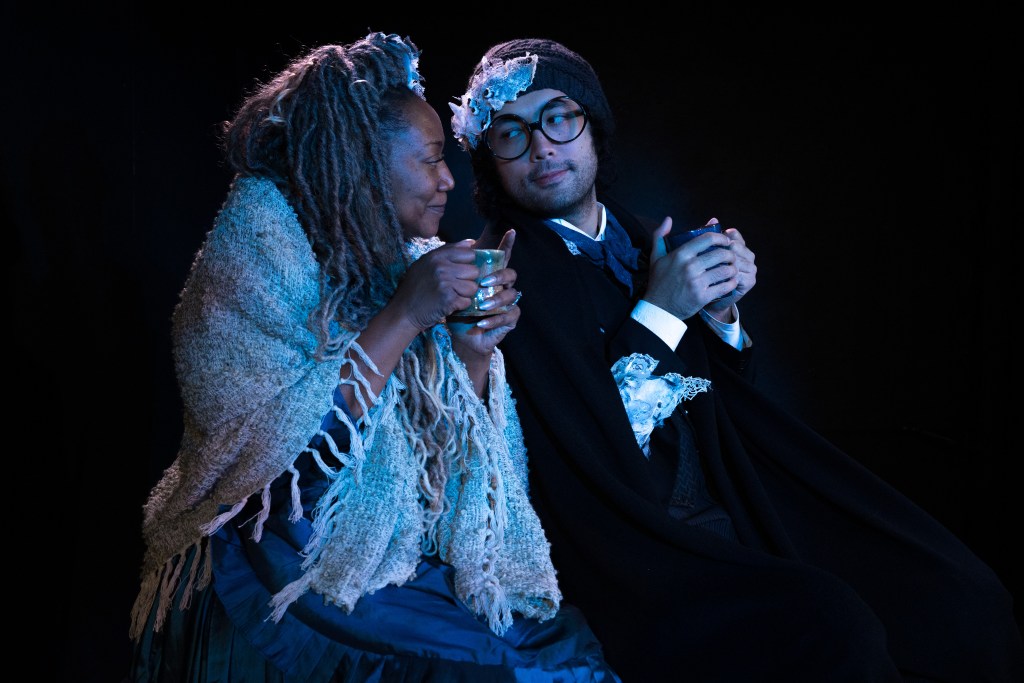
Framing all of this, Harbold places an Old Woman and an Old Man (Yolanda Stange and Ben Young), who sit in chairs on a ledge, looking out over the lake, watching the Sharps over afternoon tea and grumbling about the noise. “What a spectacle they are,” one of them says. Stange and Young are a lovely double act, unhurried and dry, and their short, oddly tender scenes give the evening its shape.
Erik Reichert‘s set is outstanding. Bernie’s house, built on several levels and entered through saloon doors, is crammed with so many delicious details, the whale sculpture among them, that it feels like a character of its own; props designer Arika Schockmel shares the credit. Cynthia L. Kehr Rees’s sound design gives the rocking chair its creak and Penelope’s horse its neigh, and Timothy Swenson’s lighting finds a spotlight for Greg the moment he starts to dance. A shout-out, too, to costume designer Niamh Helwig, the only student graduating this year from the U’s performing arts design program with a costume design emphasis. She designed every look and built some pieces herself, Penelope’s blue skirt among them. Elsewhere, the production trusts our imagination: there is no dust on stage, only actors coughing and squinting through it, and we never see the mermaid portrait the characters keep admiring.

Midway through, Penelope explains what the Wickhams have wanted all along: “They just want to keep magic alive in the world.” If whales can live in a landlocked lake ringed by mountains, she asks, then what else is possible? For most of the evening, Deutsch makes you believe it. Toward the end, the arguing piles up until it is somewhat exhausting, but the play needs that tension to get where it is going, and the ending makes sense after everything that has happened. My wish is about how it leaves us. I will not say where it goes, only that I left the theatre feeling less than optimistic. I think that is true to where we are with the lake, but it is a bleak note to leave on. After 105 minutes of bringing wonderment to the Great Salt Lake, I wanted the play to send me out still asking what else is possible, and with something to do about it. Where I would love to see the script reach for a little more of that magic.
The real 1890 article predicted that Mr. Wickham would earn the thanks of mankind. Deutsch’s play is funnier than that, and it knows the whales were never there. But the lake is. It is still out there, a few miles from the theatre, and that is the thought I keep returning to. Very Like a Whale spends most of its length reminding us how much there is to wonder at. Go see it. If we want a real chance of saving Great Salt Lake, we have to stop talking about it as if it is already gone and start talking about it like we believe it can survive. And then we have to do something about it.
Show info
- What: Very Like a Whale, by Troy Deutsch, directed by Alexandra Harbold
- Where: Salt Lake Acting Company, 168 West 500 North, Salt Lake City, UT 84103
- When: Sept. 30 – Oct. 25, 2026
- Running time: about 105 minutes, no intermission
- Tickets: $37 – $45, at saltlakeactingcompany.org or from the box office at (801) 363-7522
- Accessible performances:
- Open captioned: Sunday, Oct. 18 at 6 p.m.
- Sensory friendly and ASL interpreted: Saturday, Oct. 24 at 2 p.m.
- Audio described: Sunday, Oct. 25 at 6 p.m.
Creative team
- Playwright: Troy Deutsch
- Director: Alexandra Harbold
- Assistant director, fight and intimacy director: Adriana Lemke
- Set: Erik Reichert
- Lighting: Timothy Swenson
- Sound: Cynthia L. Kehr Rees
- Costumes: Niamh Helwig
- Props: Arika Schockmel
- Production stage manager: Bridgette Lehman
Cast
Ben Young as Old Man
Olivia Custodio as Megan
Robert Scott Smith as Greg
M. Scott McLean as Chester
Devoree Ellis as Max
Mack Barr as Sophia
Sarah Shippobotham as Miss Penelope Dickinson
Yolanda Stange as Old Woman
About the playwright
Troy Deutsch is a playwright and filmmaker from rural Minnesota who lives in New York City. He holds a BFA from the University of Utah’s Actor Training Program and studied playwriting with Nicky Silver through the Vineyard Theatre’s Fall Playwriting Workshop.
Very Like a Whale is his third world premiere at Salt Lake Acting Company, after Bull Shark Attack and Climbing With Tigers, the latter also made with Flying Bobcat Theatrical Laboratory. His other plays include Lake Water and the one-act collection In a Tilted Place, both premiered at IRT Theater in New York, and the one-woman show Orangutan, which won a Best of the Broadwater Award at the Hollywood Fringe. The Rose Garden and Lake Water were semi-finalists for the O’Neill Playwriting Conference. His short film Brown Fish won awards at the Blackbird and Adirondack film festivals. As an actor, he understudied Rabbit Hole on Broadway for Manhattan Theatre Club.
Announcing the new play, Deutsch said his writing has grown more absurd as the world has, and that he hopes audiences will “grapple with how we can save the rapidly disappearing Great Salt Lake” and laugh along the way.


Leave a Reply