

Reviews like this take 10+ hours to research and write. If this one was useful, even $1 helps. Support Rhetorical Review.
SALT LAKE CITY, UT—Voodoo Theatre Company’s latest production, The Antipodes, written by Pulitzer Prize-winner Annie Baker, is an exploration of storytelling, the pressures of creative production, and the existential struggles of the modern workforce. Directed by Jack Cobabe with assistance from Jax Jackman, the production is both a reflection and a critique of the elusive search for the “perfect story,” offering a thought-provoking meditation on the creative process itself.

The cast delivers performances that feel natural, with actors remaining present even when not speaking, engaging subtly with their surroundings in a way that enhances the realism of the piece.
~Rhetorical Review~
Set in a sterile yet intimate corporate-style boardroom, the play follows a group of writers trapped in an endless brainstorming session, wrestling with the pressure to create a groundbreaking narrative. The ensemble cast, led by Matthew Ivan Bennett as Sandy, captures the suffocating atmosphere of creative stagnation with performances that bring raw authenticity to their characters’ existential and professional dilemmas.
The cast delivers performances that feel natural, with actors remaining present even when not speaking, engaging subtly with their surroundings in a way that enhances the realism of the piece. Each character is given a moment to shine, sharing deeply personal monologues that reveal their struggles, motivations, and fears. This is an exceptionally strong group of actors who genuinely connect on stage, which allowed their characters to feel like they could easily be friends, despite the tension and competition that the play explores. The subtle ways each cast member bounced off each other in both humorous and tense moments makes their relationships feel authentic and layered.
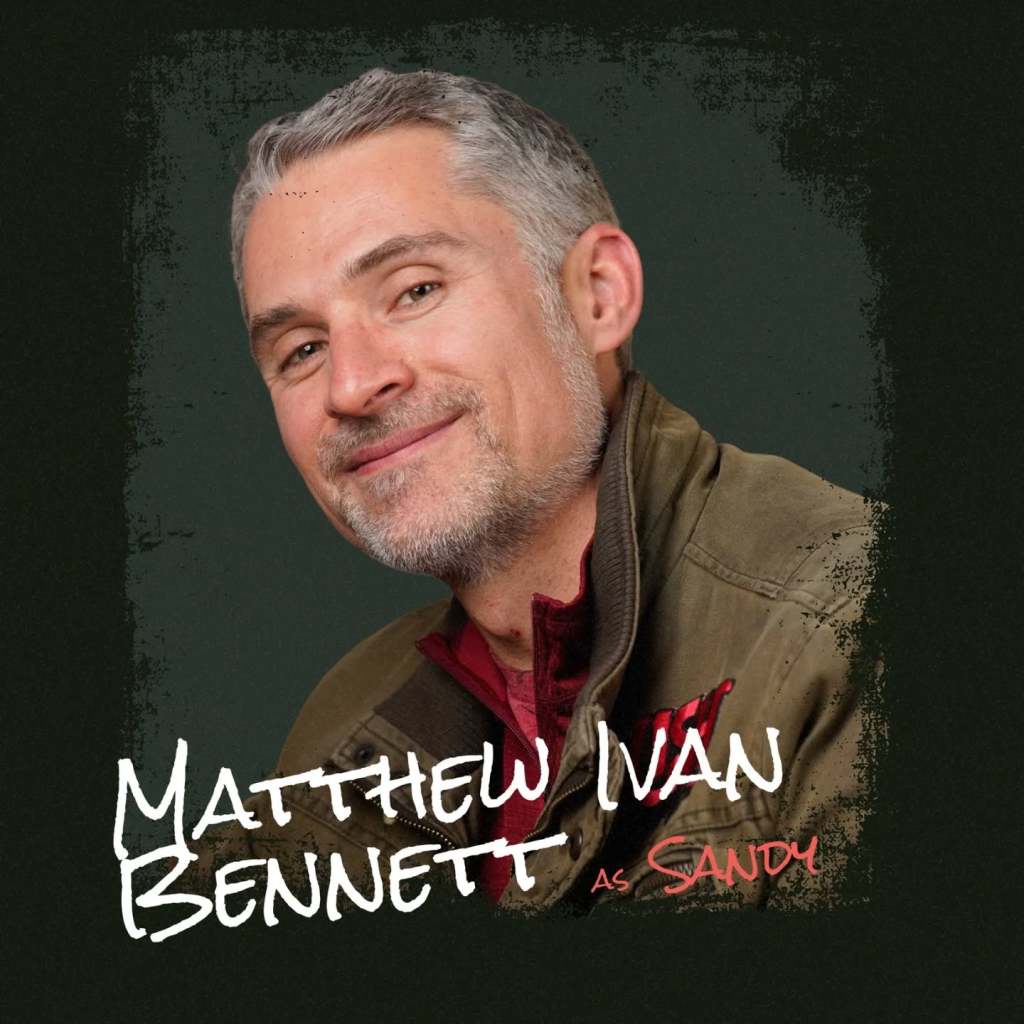
As the enigmatic leader of the writers’ room, Matthew Bennett delivered a controlled performance, balancing authority with an unsettling detachment. His measured pacing and understated delivery added to Sandy’s mystique.

Zoe Fossen’s performance brought much-needed warmth and nuance to Sarah, making her a compelling counterpoint to the often-overwhelming male energy in the room. She effectively conveyed Sarah’s growing frustration and exhaustion, particularly in moments of silence and hesitation. Fossen’s Sarah serves as the enigmatic heart of the production, navigating between observer and participant, adding layers of intrigue to the overarching narrative.

Olivia Custodio’s portrayal of Eleanor was one of the production’s comedic highlights. Custodio’s Eleanor delivers a resonant performance, linking childhood storytelling to adult narrative structures in a way that underscores the play’s central themes. Her sharp timing and expressive reactions brought levity to the tense environment, making her an audience favorite.
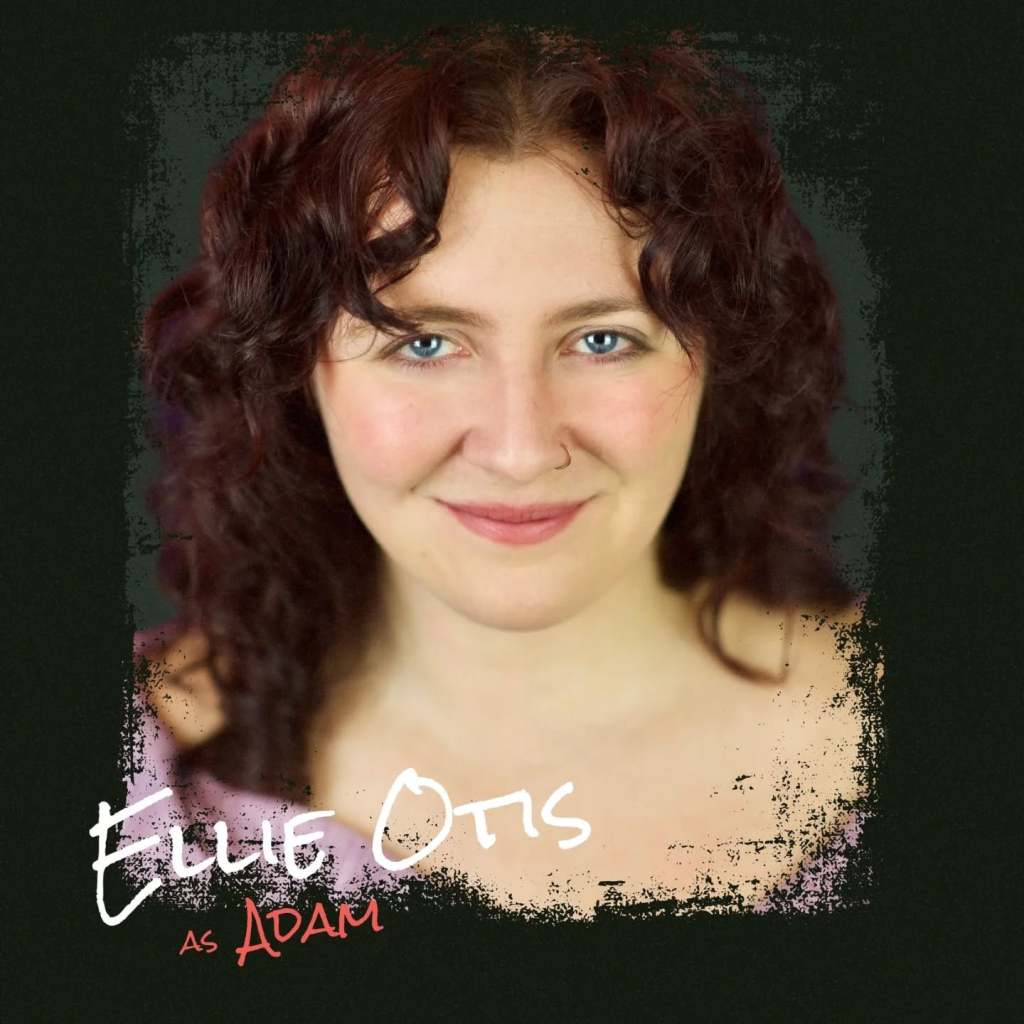
Ellie Otis delivered an energetic and dynamic performance as Adam, perfectly capturing the eager yet insecure energy of someone desperate to impress. Their physicality—shifting between confident posturing and nervous fidgeting—enhanced the character’s inner turmoil. Adam provides a much-needed breakthrough moment in the narrative, drawing upon ancient mythology to reignite the creative spark in an impressively long monologue at the end of the play. Their story suggests perhaps we don’t need to come up with new stories but instead remember and draw from stories of the past.

Kelly Branan’s portrayal of Danny M1 was delightfully offbeat, adding layers of unpredictability to the role. Branan’s ability to navigate Baker’s naturalistic dialogue was particularly impressive, making every pause and stumble feel intentional.

Jared Kamauu’s performance as Josh was a slow burn, making his descent into frustration and paranoia all the more effective. His ability to maintain a grounded presence amidst the chaos helped anchor the play’s more surreal elements.

Pedro Flores brought an intimidating, no-nonsense energy to Dave, perfectly embodying his complex pesona. His delivery was sharp and commanding.

Jaden Richards’ take on Brian was deeply relatable, portraying the wide-eyed naïveté of a young creative with charm. His comedic instincts were strong, especially in moments of awkwardness.
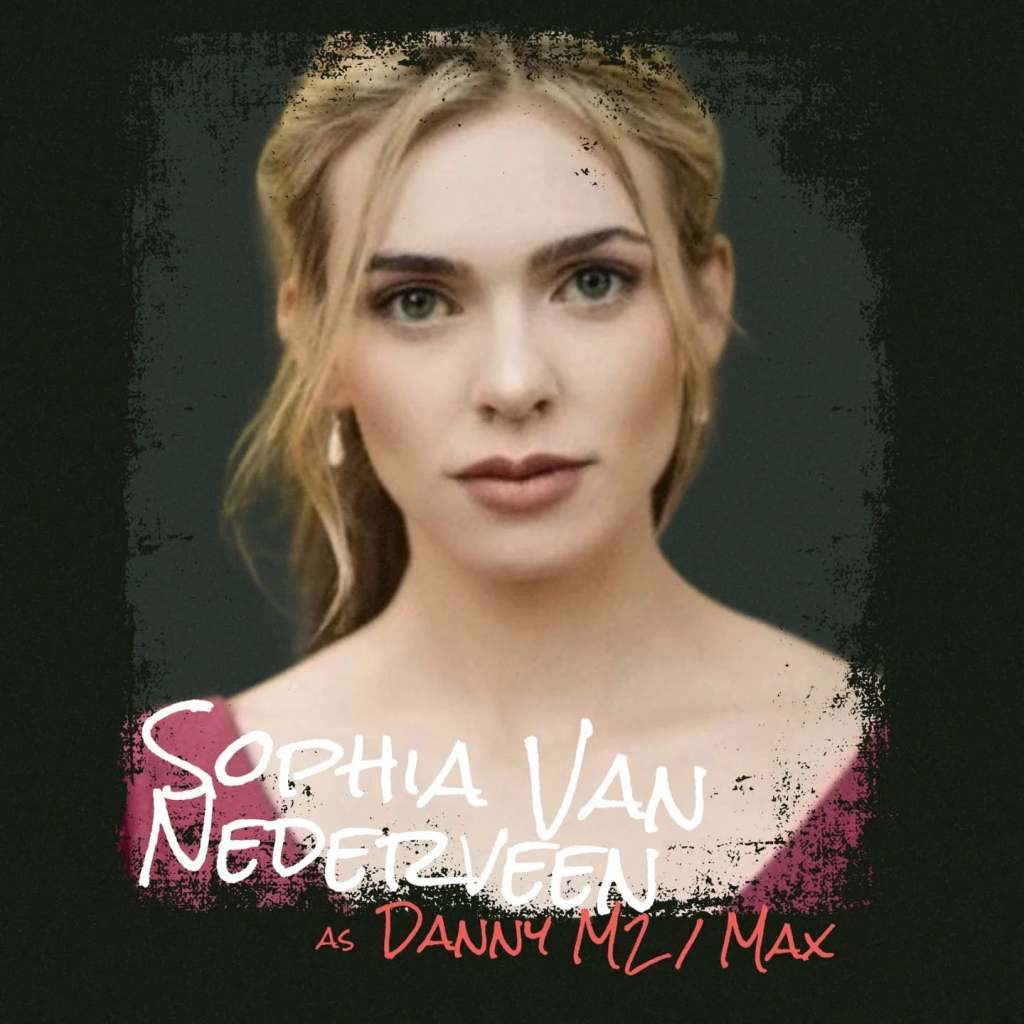
Sophia Van Nederveen’s ability to shift seamlessly between Danny M2 and the voice of Max was nothing short of impressive. Their physical and vocal choices for each character showcased remarkable versatility, making each role feel distinct. Their presence added layers to the storytelling, and their commitment to each role’s unique rhythms brought great texture to the ensemble. Their delivery helped cement the significant themes in Baker’s play.
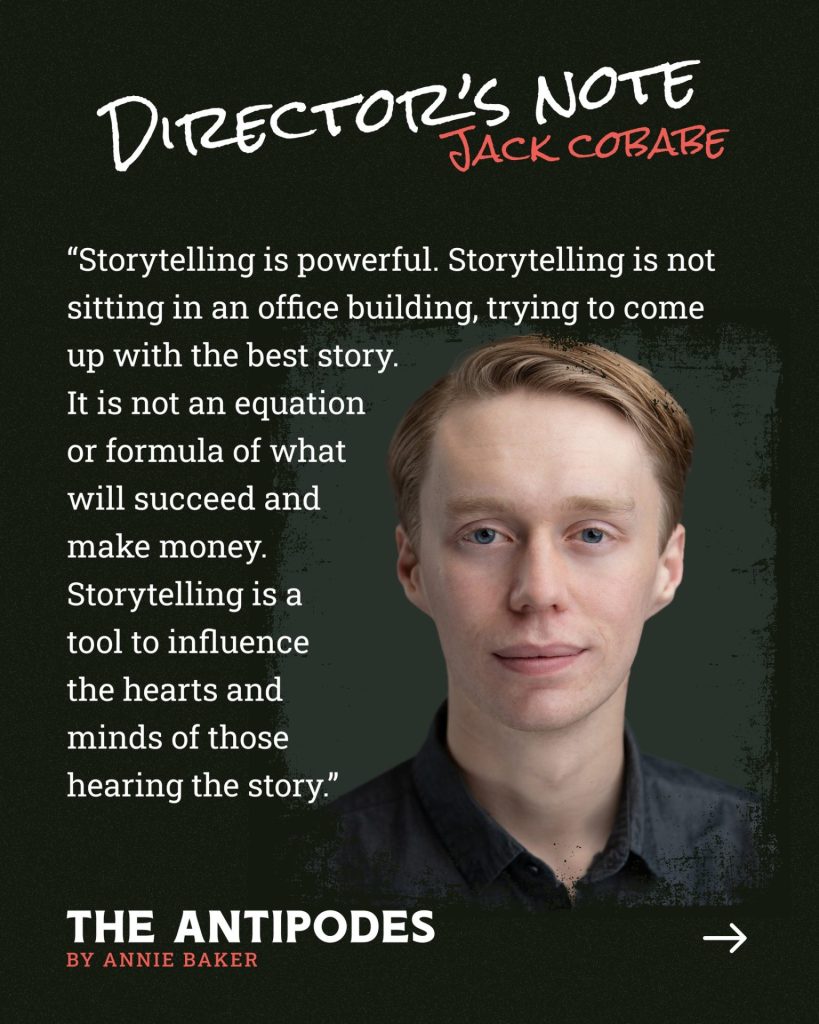
Under Jack Cobabe’s direction, the production successfully captured The Antipodes’ blend of the mundane and the surreal. The gradual transformation of the boardroom—from a pristine workspace to a chaotic mess—was effectively staged, reinforcing the play’s themes of creative unraveling. The pacing was generally strong. Jax Jackman‘s contributions as assistant director were evident in the seamless ensemble work, ensuring that even the most subtle interactions carried weight.
Technical Excellence Enhances the Narrative
Designer Parker Thompson crafts a visual landscape that complements the emotional highs and lows of the production. The subtle shifts in lighting intensify key moments, particularly during Zoe Fossen’s monologue as Sarah, a performance that is both restrained and deeply affecting. As Sarah recounts what seems at first to be a deeply personal childhood memory, but midway through suddenly the music and lighting change, and the memory blurs into into an inbetween state, where the audience is left wondering what is real and what is a story. Sarah’s memory has turned performative in many ways, and the details seem fantastical. Sarah’s story has become an exploration of memory, perspective, and the subjective nature of storytelling.

Props and Assistant Stage Manager Gail Wright ensures that the set remains dynamic, providing actors with meaningful interactions that keep the space feeling lived-in and purposeful. This attention to detail helps ground the play in reality, even as the script delves into abstract and surreal territory.
The La Croix tower serves as a metaphor for the growing desperation of the creatives, the absurdity of corporate storytelling, and the fragile nature of meaning-making. At the start, the boardroom is neat and orderly, but as the writers struggle to find “the right” story, the space becomes increasingly chaotic, mirroring their mounting anxiety. The tower grows alongside their desperation, giving the illusion of progress even as their creative process becomes more stagnant and futile. Just as the tower is precarious and built from empty cans, their brainstorming feels increasingly hollow, emphasizing the tension between substance and emptiness in their work. La Croix, a trendy, perhaps overhyped and insubstantial drink, further symbolizes capitalist consumption and burnout, as they sustain themselves on something that ultimately lacks nourishment. The ritualistic act of stacking the cans reflects their attempt to impose structure on an increasingly unstructured process, highlighting the futility of their efforts. In this way, the La Croix tower becomes both a symbol of shared struggle and an ironic critique of the creative industry’s relentless demand for new stories and perhaps a symbol for Sandy.
A Critique of Hustle Culture, Marginalization, and Corporate
In The Antipodes, storytelling is not just an art form—it is a commodity, mined and exploited under the guise of creative innovation. Baker’s script critiques corporate creative culture, exposing how the relentless pursuit of “great” stories leads to a toxic environment where marginalized voices are undervalued and dismissed. Sandy, both mentor and oppressor, fosters a space where personal trauma is not just encouraged but demanded, blurring the lines between artistic expression and exploitative labor. The pressure to contribute something memorable turns storytelling into an act of self-sacrifice, where pain is not just revealed but commodified. Baker critiques this culture of extraction, forcing audiences to question whether the pursuit of a “good” story ultimately erodes the humanity of the storyteller.
The monologue delivered with skill by Pedro Flores about cyclical family trauma exemplifies this dynamic, as characters begin to reach a breaking point, sharing something that arguably should not be shared in a professional setting. Yet, in this space, boundaries between personal and professional, performance and authenticity, blur. This tension is crystallized in Danny M2’s character’s confession:
I really heard what you said on the first day about our stories—about our personal stories being the material for—being part of the inspiration for the work—
I really understand that. I think.
But uh—
Sometimes when I tell personal stories to you guys—
Like just now.
It doesn’t feel real. It feels misleading...Danny M2 (Sophia Van Nederveen)
This moment captures the growing discomfort among the writers, as storytelling shifts from an act of creativity to an act of self-exposure. The anxiety over how their personal stories are perceived—whether they are seen as “good material” or as an authentic expression of self—becomes central to the play’s critique of the entertainment industry’s exploitative tendencies. The tension builds further in another confession:
There’s not enough context or—I’m telling a story because I think you want me to tell a story. And then I’m trying to figure out how you all see me in relation to the story. And I can tell the way you’re seeing me is not the way I am.
Pause.
It just gets so personal. And I guess I’ve always felt like my personal life is the part of my life that I don’t want to turn into a story.
Long pause.
I also just want to add that I feel really lucky to be here and I really respect everyone in this room. And I really respect what we’re doing.Danny M2 (Sophia Van Nederveen)
These admissions underscore the play’s central paradox: while storytelling is meant to be an act of creation, it becomes an act of self-destruction. The pressure to expose oneself in order to be seen and valued creates a deep dissonance—one where storytellers recognize they are being reshaped by the very act of telling.
At one point, Sandy goes on an endless spiel about his mentor and boss, praising him as “perfect” despite admitting that “he loved women but didn’t want them in the workplace.” This moment encapsulates the way figures like Sandy rationalize exclusionary and harmful behaviors while positioning themselves as champions of creativity and progress.
Baker also highlights the marginalization of women and maginalized creators within these spaces. This is evident in how Josh (Jared Kamauu) is denied an ID tag and goes unpaid for months, only to be told he should be grateful for the opportunity. The lack of recognition for his labor reflects a broader industry pattern where some creators (whether of a certain age or race) are expected to endure systemic inequities in exchange for a seat at the table. Similarly, the women in the group—particularly Sarah and Eleanor—are expected to perform emotional labor while simultaneously being sidelined in creative discussions.
The motif of Alejandra—a woman from a previous creative group who worked with Sandy and Danny M1—illustrates the erasure of marginalized voices. Labeled “batshit crazy” after reporting a growing hostility in the workplace to HR, she becomes the subject of a false narrative when Danny M1 mistakenly defends Sandy by claiming, “But she was also in love with Sandy.” Her fate takes a darker turn when Sandy confronts the group, demanding that whoever reported to HR come forward and share their grievances publicly. Alejandra never returns. Later, we learn she is missing, with suicide implied but never explicitly stated.
SANDY: That’s it. She disappeared. She never came back. ADAM. What?
DANNY M1. She evaporated.
ELEANOR. Was she murdered?!
SANDY. No one ever found any evidence of it. No body.
DAVE. I think she just took off. She was batshit crazy and then she took off.
DANNY M1. Also remember how she was obsessed with Bora Bora?
DAVE. Yeah maybe she’s like sitting on a beach in Bora Bora.
Alejandra’s gradual disappearance from the group’s memory serves as a chilling metaphor for how women—particularly women of color—are often erased from narratives and stripped of agency. Throughout the show, subtle hints reveal just how toxic Sandy is, and the fact that no one challenges him—instead, they idolize him—says volumes about the industry’s power dynamics and complicity in perpetuating harmful systems.
And later I say to Jeff: this is why you shouldn’t make me hire a woman or a … or a Chinese person or whatever…unless I meet that person and want to hire them. Don’t strong-arm me into hiring people I don’t want to hire. Because they could tum out to be crazy and that doesn’t do any of us any good. ~Sandy
Perhaps Baker’s play serves as a warning that creators like Sandy are the most dangerous of all—not because they outright reject marginalized voices, but because they hide behind the guise of artistic integrity. Figures like Sandy champion “the arts,” “creation,” and “storytelling” as beautiful, life-changing forces while simultaneously fostering exploitative and toxic environments for those outside the dominant cultural narrative. Baker’s play ultimately suggests that true creativity does not come from forced storytelling but from reclaiming lost narratives and recognizing the voices that have long been silenced.
Strengths and Limitations of the Production
While The Antipodes excels in its performances and thematic depth, its structure may be challenging for audiences unfamiliar with Baker’s style. The lack of a conventional plot progression and resolution can feel frustrating, particularly for those expecting a more traditional theatrical experience. However, for those willing to engage with the play’s introspective nature, the rewards are significant.
Additionally, the play’s runtime and deliberately calculated pacing may test the patience of some viewers. The cyclical nature of the conversations and the absence of clear answers can feel repetitive, mirroring the frustrations of real-world creative endeavors. Whether this serves as a brilliant artistic choice or an endurance test depends on the perspective of the audience.
Voodoo Theatre Company’s The Antipodes is an intellectually stimulating production that offers a raw, unfiltered look at the struggles of storytelling. It is a must-see for those interested in the creative process, artistic labor, and the intersection of capitalism and creativity. While its pacing, language, and abstract narrative may not appeal to all, the production’s stellar performances, meticulous direction, and thought-provoking themes make it a compelling theatrical experience.
For audiences willing to embrace its meditative nature, The Antipodes is not just a play about storytelling—it is a meta-commentary on why we tell stories at all. Voodoo Theater Company Presents The Antipodes by Annie Baker Mid-Valley Performing Arts Center, 2525 Taylorsville Blvd, Taylorsville, UT 84129 March 7-9, 14-16, 2025 Tickets: $10 Student, $20 for non-students Contact: info@voodootheatrecompany.com, 801-355-2787 Please be advised, this script discusses various adult themes including sex, suicide, & strong language.


SHOW INFORMATION
📅 Dates: March 7, 8 & 9 March 13, 14, 15, 2025
⏰ Showtimes: Times Vary
🎟️ Tickets: $10 Student, $20 for non-students (General Admission)
📞 Box Office: (801)355-2787
📧 Email: arttix@slco.org, events@artsaltlake.org, info@voodootheatrecompany.com
🌐 Website: Salt Lake County Arts & Culture Events, https://www.voodootheatrecompany.com/
📍 Venue: Studio 5400, Mid-Valley Performing Arts Center, Taylorsville, Utah 84129
🚗 Directions & Parking: Visit Here
⏳ Run Time: Run time: 115 minutes, includes 15 minute intermission.
♿ Accessibility Information: https://www.saltlakecountyarts.org/plan-your-visit?section=accessibility
- Age Recommendation: Suitable for ages 8 and up; all attendees require a ticket, and infants in arms are not permitted
- Please note that The Antipodes contains mature content.


Leave a Reply