

Salt Lake City, UT — Not every musical needs a flawless script to work. Some works use bodies, rhythm, and a visual language to compensate for a lack of narrative depth. The national tour of PigPen Theatre Co. and Rick Elice’s Water for Elephants rolls into town with a company of acrobats, aerialists, and puppeteers capable of turning a theater into a big top circus, a train, and a living, breathing elephant. It is, above all else, a triumph of staging.
I’d heard mixed reviews going in and wasn’t sure what to expect, so the talent and unique elements were a pleasant surprise in the show. Based on Sara Gruen‘s bestselling novel and adapted by Rick Elice with music and lyrics by PigPen Theatre Co., the tour is directed by Ryan Emmons, following the original Broadway staging by Jessica Stone. The show unfolds as a memory: an elderly Jacob Jankowski (Robert Tully) looks back on the season he spent with the Benzini Brothers Circus as a young man (Zachary Keller), the star performer Marlena (Helen Krushinski) he fell for, and the volatile ringmaster August (Connor Sullivan, who also plays the show’s latter-day circus owner Charlie in a dual role) who ran the show. That frame gives the piece a wistful quality even at its most chaotic, a reminder that we’re watching a memory, one the older Jacob himself admits isn’t entirely reliable.
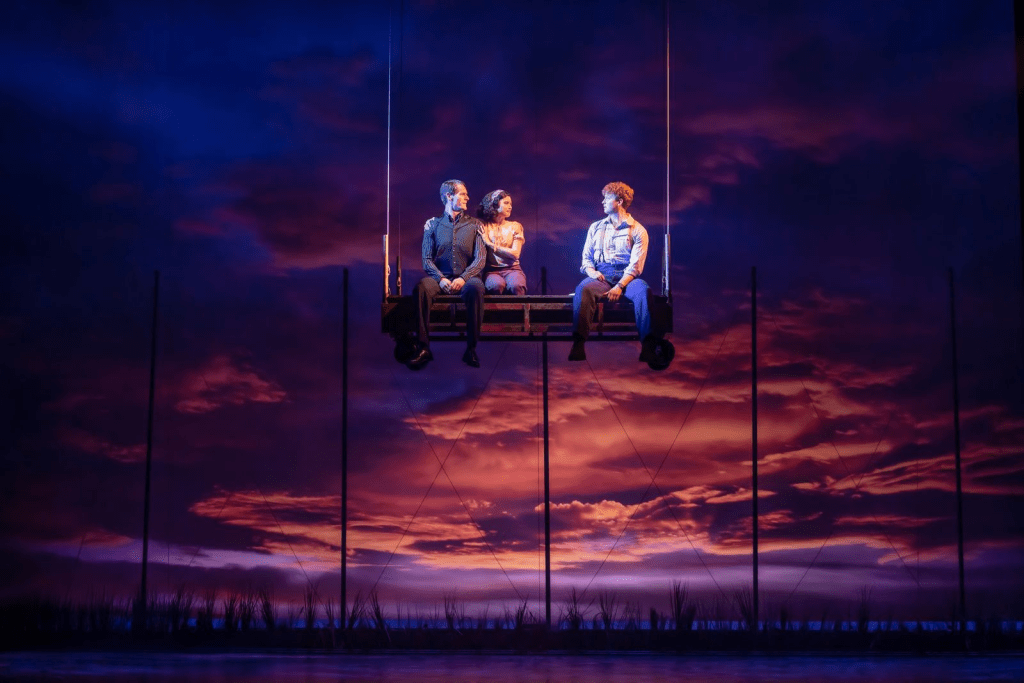
Circus as Storytelling
I’ll admit my notes from this one are thinner than usual, and that’s the highest compliment I can pay it: there was so much happening on stage that stopping to write meant missing something.
Circus designer Shana Carroll, whose background includes Cirque du Soleil, works with co-choreographer Jesse Robb and associate circus designer Antoine Boissereau to turn the ensemble into the entire visual world of the show. Human pyramids become train cars, aerialists become galloping horses, and every scene change is a feat of acrobatics rather than a lighting cue. Just when one trick feels like the high point, the next tops it.
That approach peaks with Rosie, the elephant at the story’s emotional center. Designed by Ray Wetmore, JR Goodman, and Camille LaBarre and guided by a team of puppeteers (accounts vary between three and five performers depending on the sequence), Rosie is built from movement rather than mechanics. Her breathing, her hesitation, the way she leans into the people who are kind to her, all of it is constructed live, in full view. Her first reveal, arriving at first as just an expressive, nuzzling trunk before the rest of her comes into view, is one of the most delightful moments of the evening, and by the time she’s central to the story’s climax, you’ve fully forgotten she isn’t real.

A Company Built for This
PigPen Theatre Co.‘s score gives it all a soaring, folk-inflected backbone. Zachary Keller and Helen Krushinski get the show’s biggest emotional moments, Krushinski pairing a gorgeous vocal turn with an aerial performance, Keller’s belt filling the Eccles Theater with a power that never once felt strained. Connor Sullivan‘s August supplies the darker current underneath the wonder, a ringmaster whose charm curdles quickly. The ensemble, credited collectively as “Kinker & Roust,” carries the entire production, and their stamina across two hours is remarkable. Shout-out as well to Ruby Gibbs as the sassy, savvy Barbara, who rounds out the circus’s cast with real charisma, and to Tyler West, playing Walter (and his beloved dog puppet Queenie) with clown-adjacent charm that’s a highlight of the whole evening. Elsewhere, Javier Garcia‘s kindly Camel and John Neurohr’s brutish foreman Wade round out the circus family Jacob has to win over.
The production also doesn’t shy away from the story’s darker threads: its producers have partnered with organizations supporting elephant sanctuaries and domestic violence survivors, a real care in how those elements of the novel made it to the stage.
Standout Sequences
The show opens mid-action, fog rolling across a half-struck circus lot as an old man wanders through, reminiscing about traveling by train. We’re inside Jacob’s memory before we’ve even settled in, and the device pays off all evening, letting the show cut between his older and younger selves without ever feeling like a gimmick.
Soon after comes a train car number, sung with great harmonies while the ensemble bounces in rhythm on the set piece itself, so precisely timed you feel the rocking motion of a moving train without any of it moving. It recalled, for me, the “Rock Island” opening of The Music Man, staged here with circus vocabulary instead of patter but carrying that same infectious momentum.
An early equestrian number, in which circus performer Yves Artières embodies the emotional depth of the horse Silver Star (seen only from the neck up, but fully realized through performance), is a small marvel of suggestion over literalism and might be the single most brilliant scene in the show. It also introduces the story’s harder edge, a glimpse at the mistreatment of animals under the Benzini banner, and gives the score one of its few quiet moments in “Easy,” Marlena’s soothing solo sung to Silver Star. The choreography throughout is relentlessly inventive, with flips and tumbling worked directly into the trunks and set pieces. That inventiveness peaks in “Zoltan,” a full-company dance break built around individual ensemble stepouts, and in the sharp, high-energy “The Lion Has Got No Teeth,” which pulls back the curtain on August’s true nature as a man with contempt for everyone under his charge.
Late in the second act, as Jacob is knocked unconscious, the show gets formally strange: an abstract, dreamlike sequence blending his childhood trauma with his present circumstances, staged inside a nightmarish ring of whips, hoops, and aerial work. It’s a bold swing that earns its place as the emotional low point right before the story’s turning point.
One more image deserves its own mention: the raising of the big top, built live in front of the audience, its center pole rising with a performer riding it all the way up. It’s a fitting emblem for a production that keeps insisting the circus can be built out of nothing but bodies, will, and a little rope.

Behind the Scenes: The Creative Team
The production’s visual world is the product of a deep bench of designers working in concert. Scenic designer Takeshi Kata builds a space flexible enough to become a train yard, a big top, and a nursing home in the space of a scene change, while costume designer David I. Reynoso dresses the ensemble in pieces that read as both period-appropriate circus garb and functional acrobatic wear, a balancing act that’s easy to take for granted until you notice how seamlessly a performer transitions from a dance number into a lift. Lighting designer Bradley King does much of the emotional heavy lifting in the show’s quieter moments, washing the stage in warm gold for memory and hard white for the present-day scenes with elderly Jacob, while projection designer David Bengali adds texture without ever overwhelming the live performers in front of it.
On the musical side, Mary-Mitchell Campbell and Benedict Braxton-Smith share arranging duties, with Braxton-Smith also serving as co-music supervisor alongside co-orchestrators Daryl Waters and August Eriksmoen. Music director Sarah Pool keeps PigPen Theatre Co.’s folk-inflected score tight even as it has to breathe underneath acrobatics, no small feat when a vocal line has to land at the exact moment a performer is airborne.
Scenic designer Takeshi Kata‘s set makes room for real, tangible pieces amid all the illusion, too. Three actual metal train cars sit on stage as part of the physical set, grounding the show’s more abstract, ensemble-built imagery (the human pyramids and aerial work standing in for the rest of the train) in something solid and real, and giving the production a visual anchor to return to between its more inventive flights of stagecraft.
Keeping all of that safe and on schedule falls to production stage manager Kathleen Carragee, stage manager Riley Gibson, and circus-specific assistant stage manager Maris Keller, alongside fight director John Mezzio, whose work is easy to miss precisely because it’s so well integrated into the show’s more violent beats. It’s worth pausing on this team, because a show built this heavily on acrobatics lives or dies on the people making sure nobody gets hurt doing it.
Themes: What the Circus Is Really Carrying
Underneath the spectacle, Water for Elephants is telling a fairly unadorned story about found family and the cost of belonging somewhere. Jacob loses his own family in the show’s opening minutes and spends the rest of the story building a replacement out of circus performers, roustabouts, and, eventually, an elephant. The show doesn’t dwell on this theme so much as let the staging embody it: the same ensemble that plays hostile strangers to Jacob early on becomes, quite literally, the ground he stands on and the walls around him by the end, an elegant piece of physical storytelling that says more than the book ever could in dialogue alone.
The production is also unflinching, in its own PG-13 way, about the abuse running underneath the wonder of the Benzini Brothers show, both toward Marlena and toward the animals in August’s care. It would have been easy for a show this focused on spectacle to soften or skip past that material, and to its credit, it doesn’t. The partnerships noted above, with organizations supporting elephant sanctuaries and domestic violence survivors, suggest that care wasn’t an afterthought.

Who This Show Is For
Best suited to audiences who love circus arts, movement-based theater, and puppetry as much as a traditional book musical, since the staging here does as much storytelling as the script and score. Fans of Cirque du Soleil-style showmanship, or shows like Life of Pi and Pippin, will find a lot to love, as will anyone drawn to coming-of-age stories about found family and reinvention later in life. Given the content below (domestic violence, animal cruelty, and infidelity as a plot thread), it’s less suited to those wanting a purely lighthearted circus romp, or musicals rooted more in dialogue than visual storytelling.
A Critical Counterpoint
Not every critic has been as won over by the staging as I was. Maryland Theatre Guide’s review of the tour argued that the book and score ultimately let the production down, pointing out that the show sets up ideas it never follows through on, most notably establishing August early on as a con man (that’s what “The Lion Has Got No Teeth” is doing) only to drop the idea entirely once the number ends. That critique lines up with something I noticed too: the character work overall feels compressed to make room for the acrobatics, and anyone going in expecting the emotional density of Gruen’s novel may come away wanting more from the book itself, even while loving what’s happening around it physically.
I’d still land in a different place than that review overall; the staging carries enough emotional weight on its own that I didn’t feel the thinner character work as a major drawback, but it’s a fair point, and worth knowing going in if a tightly plotted book matters more to you than the visuals.
Audience reaction has been split too, not just critics. One frequently discussed fan account from the original Broadway run at the Imperial Theatre described real disappointment, mainly with the score, finding most of the songs unmemorable and oddly out of step with the scenes they were in, with one solo sung to a horse as a rare standout. That same account also found the puppetry underwhelming outside of Rosie herself, and felt the scenic design was too minimal to be visually satisfying, concluding that even the acrobatics and aerial work couldn’t rescue the evening for them. It’s a useful reminder that this show leans so heavily on its physical showmanship that anyone who doesn’t connect with the acrobatics and puppetry in the moment is left with comparatively little else to hold onto, since the score and sets aren’t doing much heavy lifting on their own. My experience with this touring production didn’t match that account at all, but it’s worth flagging as a real minority opinion rather than pretending the reception has been universally rapturous.
Looking at the broader critical landscape backs that up: BroadwayWorld’s aggregate of reviews from across the tour’s stops sits at a strongly positive 8.18 out of 10, with the large majority landing as thumbs-up and only a handful mixed, and none outright negative. The recurring critique among that minority tends to echo what I noted above: the story sometimes gets set up and abandoned, the score isn’t uniformly strong from song to song, and in larger houses especially, the sheer amount happening visually can occasionally crowd out the lyrics and quieter character beats. But the consensus, and my own take along with it, is that the circus craft carries the evening regardless.

Final Verdict: A Show Worth Stepping Right Up For
Water for Elephants is, first and foremost, a triumph of staging, and should be seen for that reason alone. What struck me most, watching it, was how embodied it felt: the lighting, the movement, and the music aren’t separate elements competing for attention, they’re speaking the same emotional language through the performers’ bodies themselves, so a shift in Bradley King’s lighting or a turn in PigPen’s score lands with the same clarity as a lift or a drop in the choreography. And it’s not just atmosphere; there’s real intellectual work happening in the color choices and the aerial work specifically, using them to signal memory versus present, safety versus danger, before a single line of dialogue tells you which is which. That said, it all moved fast, fast enough that some of those cues register more on a second viewing (or in retrospect) than they do in the moment, since the show rarely pauses to let any one image sit before launching into the next. The emotional through-line of Jacob and Marlena’s story gives all that wonder somewhere to land, and the show deserves credit for not letting the circus’s charm paper over its darker material.
If there’s a caveat, it’s one shared by most staging-forward adaptations: the scale of the visual storytelling occasionally outpaces the book’s quieter character work. That’s a fair trade for what the show gains in exchange. For a production this reliant on acrobatics, it never tips into showing off for its own sake or anything that felt actually dangerous to watch; the tricks feel controlled and purposeful, with spotters visibly present throughout, which makes the real risk feel safe rather than reckless. I never once had to look away. By the time the lights came up, I was completely won over; this is the kind of production that reminds you why live theater can do things film and television can’t.
Show info
Running Time: Approximately 2 hours and 20 minutes, including one 20-minute intermission.
Content Note: The show deals frankly with domestic violence and animal abuse, including a ringmaster physically and emotionally abusing his wife, intense animal cruelty, and a violent death near the climax. Infidelity is also a central plot thread. There’s some innuendo, mild language, and smoke/haze/gunshot effects; infants aren’t admitted. Everything is handled tastefully, more emotional than hard to watch, but the emotional weight and a loud stampede sequence may still be intense for younger or sensitive viewers. Official recommendation is ages 8 and up; I’d personally lean toward the higher end of that range.
Venue & Tickets: Runs August 25–30, 2026 at Delta Hall at the Eccles Theater in Salt Lake City, presented by Zions Bank & Broadway at the Eccles. Accessible performances (ASL-interpreted, audio description, captioned) are available this run. Tickets via Broadway at the Eccles / ArtTix.


Leave a Reply