

Reviews like this take 10+ hours to research and write. If this one was useful, even $1 helps. Support Rhetorical Review.
Provo, UT — In the world premiere of Paper Weight, the latest original work from Vicariously Staged Productions, writer-director Skyler Denfeld and assistant director Melanie Kamauu invite audiences into the tender, unraveling world of a woman’s fading mind. At the heart of the story is Rosie, caught in the slow drift of early-onset Alzheimer’s, grasping at the scattered remnants of her identity—her family, her past, her sense of self. Through flickering images, fractured memories, and fragments of poetry, Paper Weight delicately traces the contours of a life slipping away. In its most intimate moments, the play reveals not only the quiet devastation of forgetting, but also the fierce, fragile beauty of being remembered.

Company and Context: VSP’s Mission
Produced by Vicariously Staged Productions (VSP), Paper Weight is the latest chapter in a growing legacy of emotionally resonant theatre. Founded by Jared Kamauu in 2024, VSP made its debut with Every Brilliant Thing, staged at The Hive Collaborative in Provo. That production introduced audiences to the company’s distinctive blend of poetic staging, thematic depth, and intimate storytelling. With a focus on mental health, caregiving, and underrepresented human experiences, VSP is quickly carving out a vital space in Utah’s theatrical landscape. Paper Weight deepens that vision, offering a powerful meditation on presence, memory, and human connection.
Structure and Staging: Memory as Form
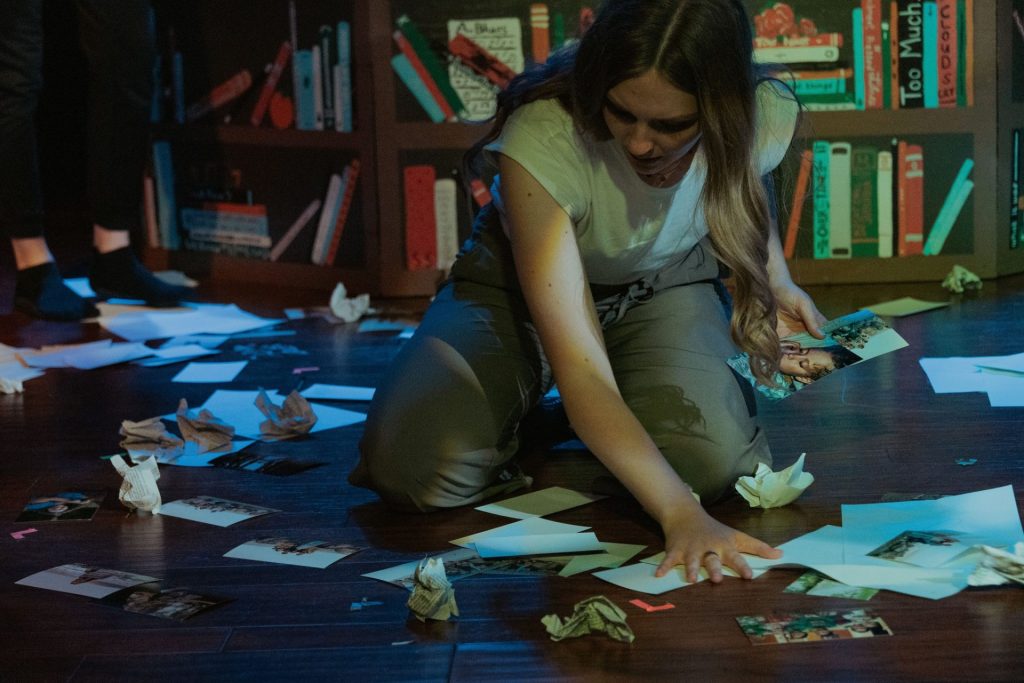
A non-linear memory play, Paper Weight follows Rosie in her final moments, navigating the dissolution of self as Alzheimer’s takes hold. The narrative unfolds not chronologically, but within her fading consciousness, where time loops, moments repeat, and memory fragments blur with reality. Rather than clarify, the play seeks to evoke the rhythms and distortions of memory, drawing viewers into a disorienting but emotionally rich space. Denfeld’s staging leans into abstraction—through lyrical monologues, devised movement, and fluid transitions—to mirror the cognitive confusion Rosie faces. Paper—torn, brushed, scattered—becomes a recurring metaphor for what is lost or left behind.
Everyday objects are transformed into hospital beds, gravestones, or childhood forts, suggesting that memory lives not in grand gestures but in the ordinary. Performers use minimal costume changes, relying instead on posture, gesture, and breath to convey shifting identities. Memory here is rendered through the body, not realism.
Origins and Creative Process
Paper Weight has been three years in the making. Denfeld first developed it as a student-devised piece at BYU under the title Full of Too Many Unnamed Things. The inspiration came from his grandmother’s struggle with Alzheimer’s and a poem he wrote in her memory. That poem became the emotional spine of the play—so central that it is recited aloud by a character throughout the performance.
As Denfeld explains in an interview with UTBA, the original concept was to explore “what we leave behind”—an “autobiography of humanity.” Over time, this became a deeply personal exploration of memory, loss, and love.
The show also carries a love story behind the scenes: during its early iteration, Jared Kamauu and Melanie Kamauu met for the first time as actor and stage manager. The rehearsal space thus became not only a site of creation but a space of beginnings, infusing the production with even more emotional depth.
Sound, Light, and Emotional Resonance
Much of the play’s emotional resonance stems from the deep personal investment of its creator. The design elements—particularly sound and lighting—enhance this intimacy with subtle, immersive precision. Joey Wright’s sound design and Taylor Tew Nelson’s lighting work in quiet harmony, gently guiding the audience through the blurred boundaries of memory and the present. Their work flows seamlessly with Brandon Merrill’s expressive piano-based score, which weaves together original and reimagined compositions. Inspired by research on how music can revive long-dormant memories in those with dementia, Merrill’s music becomes a powerful part of Rosie’s inner world—echoing its ruptures, rhythms, and rare moments of clarity.
As a musician who has also lost a grandparent to Alzheimer’s, I found this aspect especially moving. In my own experience, music provided one of the final connections I had with my grandfather. The score in Paper Weight captures that fragile, profound power of music to tether us—if only briefly—to those we are losing.

A Stage Littered with Memory
A defining feature of the production is its use of physical repetition—gestures like tearing paper, brushing away invisible dust, or tracing invisible marks in the air. These aren’t just choreographic flourishes; they embody the rituals of forgetting and remembering, the small, often unnoticed motions through which memory is stored—and lost. Rather than following a traditional plot, the play invites the audience to inhabit its rhythm, to feel the ebb and pull of cognitive decline in their own bodies.
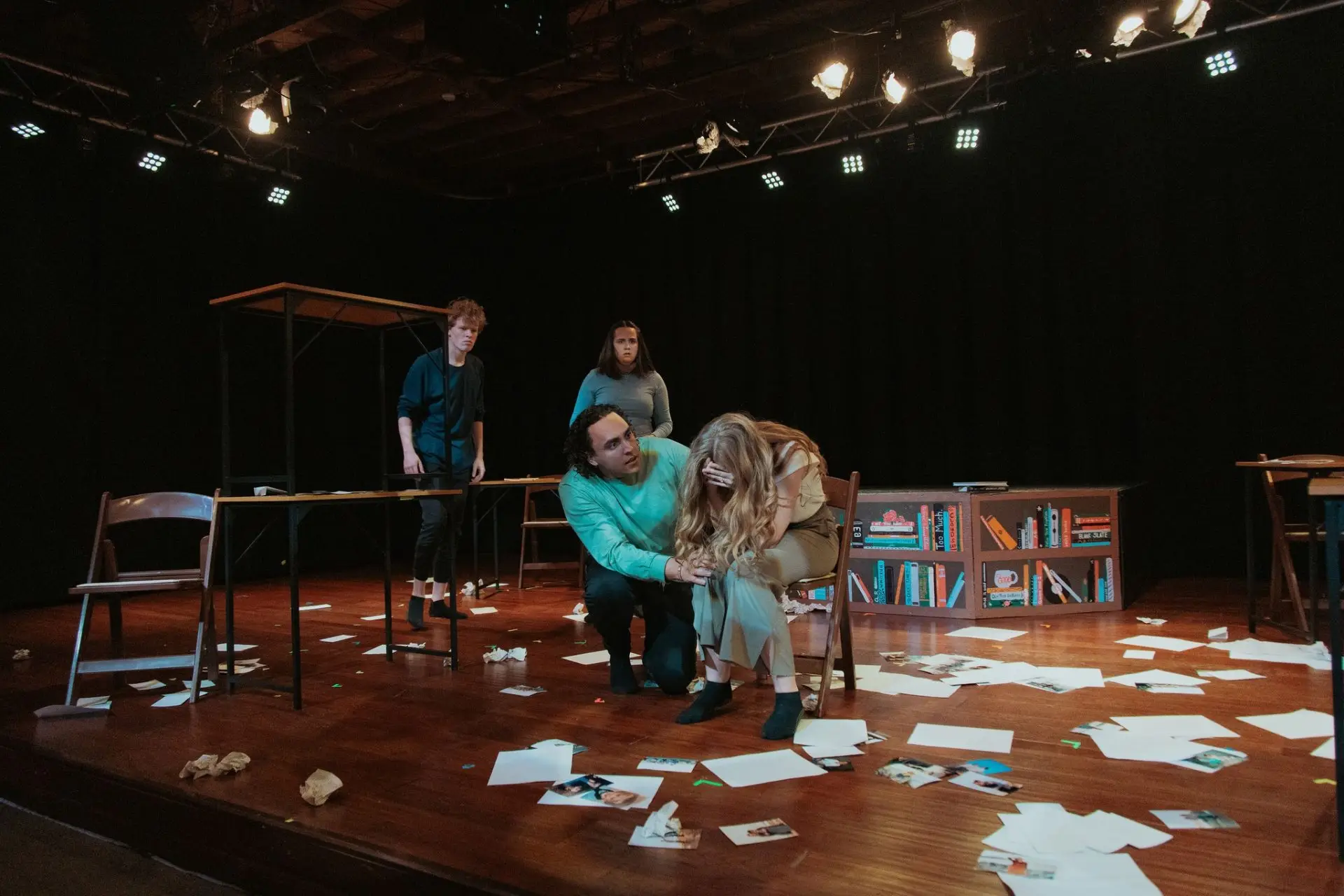
Paper itself becomes both symbol and substance. From the opening moments, pages are torn from books and scattered across the stage—fragments of thought, identity, and history that slowly accumulate. The paper is never cleared. By the end, the stage is layered in a growing landscape of discarded pages, visually evoking the weight and chaos of memory in decay. The effect is both haunting and beautiful.

At times, the literal messiness of this accumulation introduces a slight tension; during some of the more physical sequences, I found myself worried an actor might slip or lose footing on the increasingly unstable ground. Yet this unease only heightens the thematic resonance. Memory, like the paper beneath the performers, can be slippery—cluttered, fragile, and impossible to fully contain. The decision to let the stage become a growing archive of loss mirrors the way memory lingers, overwhelms, and resists erasure.
This is not a play in a rush. Its pacing asks for stillness and attentiveness. But when the emotional threads come together—especially in the latter half—they strike with clarity and depth. What may at first feel disorienting ultimately gives way to something profoundly human: a shared recognition of how memory unravels, and how meaning can still be made from what remains.
Performance Highlights
From the moment the lights dim in Paper Weight, it’s clear that this is a production rooted in emotional precision and artistic trust. The piece is carried by a unified ensemble, cohesive design, and a bold willingness to dwell in ambiguity. The show invites the audience to sit with discomfort, to witness unraveling, and to reflect on the ephemeral nature of memory itself.
Eden Bostrom’s portrayal of Rosie is mesmerizing. Without relying on costume changes or dramatic exits, she communicates shifts in time and identity with striking clarity. Her embodiment of Rosie across different life stages is achieved through posture, voice, breath, and gaze. But what impressed me most was how she captured the profound isolation of a woman surrounded by loved ones yet utterly alone in her mind—a reality all too common for those living with Alzheimer’s.
Eden Bostrom’s portrayal of Rosie is mesmerizing—effectively portraying the profound isolation of a woman surrounded by loved ones yet utterly alone in her mind—a reality all too common for those living with Alzheimer’s.
~Rhetorical Review~

As Oliver, Jared Kamauu balances grief and warmth in a performance that never feels performative. He approaches the emotional terrain with sensitivity, navigating the role of caretaker with an understated honesty. In moments of levity, he brings ease; in moments of despair, his honest approach makes the heartbreak all the more palpable.
In one of the show’s most powerful scenes, Aunah Johnson’s August confronts her father, played by Jared Kamauu, about the painful next step of contacting a funeral home. It’s a raw and emotionally charged moment where the boundaries between parent and child begin to blur. Johnson and Kamauu bring everything to the table, delivering a performance that is both unflinchingly honest and deeply human. Johnson’s August is never static—she listens with intensity, responds with conviction, and fills every moment with emotional urgency. Her dialogue feels lived-in, not performed, and her interactions with both Rosie and Oliver are layered with unspoken history. As the character who straddles the space between memory and reality, August becomes the emotional bridge of the play, and Johnson carries that weight with remarkable grace and power.
Aunah Johnson’s August is the emotional bridge of the play—never static, always listening, responding, and carrying the weight of memory.
~Rhetorical Review~

Alex Glover steps into dual roles with seamless generosity—a task that’s far from easy. Whether comforting a child as Papa or bearing the emotional weight of another character’s unraveling as Rosie’s father. Glover radiates stability and kindness, qualities that become emotional anchors for both Rosie and the audience.
Sydney Southwick lights up the stage as Juniper, delivering one of the show’s most vibrant and memorable performances, an essential counterweight to its heavier emotional themes. Southwick is fiery, funny, and full of life, embodying the sister we all wish we had—loyal, chaotic, and impossibly endearing. Her childhood scene battling invisible “bad guys” with imaginary tasers is a comedic standout, balancing playfulness with emotional depth. And in a particularly hilarious moment, she enters with a half-eaten pickle lodged in her mouth, struggling to get through her lines until she finishes chewing—a perfectly human detail that grounds the show’s more abstract moments in lived, believable sisterhood. Through these small but impactful choices, Southwick helps anchor the story in familial authenticity and brings joy and warmth to even its heaviest moments.
Sydney Southwick lights up the stage as Juniper in one of the show’s most vibrant and memorable performances—an essential counterweight to its heavier emotional themes.
~Rhetorical Review~
On the night I attended, the role of Quinn was performed by swing Maddie Halliday, who stepped in with grace and clarity. Her performance blended seamlessly with the ensemble, offering a grounded and emotionally resonant portrayal that honored the arc of Rosie’s best friend.
Alex Russon as Thomas, August’s husband, brings both emotional support and musical depth to the world of the play. Russon’s presence is gentle and steady, offering a quiet counterbalance to the emotional volatility of the central family. As the onstage pianist, he becomes not just a character but part of the play’s emotional architecture, underscoring moments of tension and tenderness with subtlety and care. His dynamic with August is full of quiet affection, and though his role is more reserved, his contributions—both musically and relationally—help root the production in a sense of lived-in love and chosen family.
Paper Weight embraces visual simplicity, allowing the actors’ movements and presence to carry the emotional weight of the story. The ensemble remains onstage throughout, barefoot and in minimal costume, navigating shifts in time and identity not through spectacle but through subtle changes in posture, breath, and gesture.
Critique: When Abstraction Both Elevates and Obscures
Denfeld’s script draws on physical theatre, poetic monologue, and choreographed abstraction. The result is a production that often feels less like a traditional play and more like a memory ballet—a sequence of soft collisions, emotional ruptures, and shifting rhythms. At its best, Paper Weight evokes the disorientation and fragility of memory loss with lyrical beauty. Scenes flow in and out like tides, characters blur between timelines, and the script moves fluidly from silence to song. It is brave, deeply personal, and visually poetic. However, this ambition occasionally teeters under its own weight. The first act in particular lingers heavily in abstraction, with extended sequences that—though visually interesting—struggle to sustain dramatic momentum. While these stretches are likely intended to mirror Rosie’s cognitive drift, they sometimes veer into repetition without furthering the emotional arc. A few poignant scenes risk being buried in the haze, their impact softened by a slow and overly diffuse buildup.
At its best, Paper Weight evokes the disorientation and fragility of memory loss with lyrical beauty.
~Rhetorical Review~
As someone who typically embraces experimental structures, I found myself questioning if the abstraction felt more gestural than grounded. There’s a sense that the production wants to stage every emotional thread and alluded memory—but not every scene benefits from full embodiment. Sometimes, restraint can evoke more than elaboration.

That said, the second act makes a notable shift. The storytelling tightens, and the emotional center begins to cohere. There’s a clarity in both text and performance that emerges with real force. The audience’s energy changed palpably—there was a collective leaning-in, a quiet recognition that the core of the piece had arrived. Denfeld’s writing finds its emotional pulse here, with moments that feel both earned and affecting.
Much of the production’s strength lies in its ability to balance restraint with vulnerability. The design elements—particularly the interplay of paper, sound, and light—do much of the heavy lifting in guiding the audience through time and space.
This is not a show in a hurry; its pacing demands patience. But when the emotional stakes fully arrive, they hit with undeniable force.
~Rhetorical Review~
While an experimental full-length, two-act format might catch some theatregoers off guard for a new work, especially given the genre’s tendency toward shorter, more fragmented works, this structure ultimately gives the piece space to breathe and evolve. Paper Weight is not in a hurry. It asks for patience. And in return, it delivers moments of real, resonant clarity.
What might serve the piece in future stagings is a gentle trim to act one—not to reduce its complexity, but to distill it. The ideas are there. The emotional core is solid. Trusting the audience to intuit meaning without over-explaining or re-staging every thread might make the experience all the more impactful.
Paper Weight asks us to reflect on what we carry, what we let go of, and what remains when language and time begin to slip away.
~Rhetorical Review~
Final Thoughts: The Fragile Beauty of Remembering
Paper Weight is not just a story about forgetting—it is a meditation on the quiet, persistent beauty of remembering. It asks us to reflect on what we carry, what we let go of, and what remains when language and time begin to slip away. This production is a reminder of presence, of care, and of how deeply we need one another to make meaning out of memory. Just as the pages littering the stage remain when the lights go down, so too do the memories we hold—torn, imperfect, but still present.
This review is dedicated to my grandfather, Richard LaVon Church, who passed away in 2008 from Alzheimer’s. My experience with his loss echoes the message in Paper Weight, that even when words and memories fade, love endures.
Ticket Information for Paper Weight
Presented by Vicariously Staged Productions
📍 The Hive Collaborative, 290 W. 600 S., Provo, UT, Directions
📅 May 15–17 & 22–24, 2025, 7:30 pm
🕒 Matinee every Saturday | Select performances live-streamed
- General Admission: $25.00
- Livestream Access: $20.00
- 3% credit card fee will be applied to all paid ticket orders.
🎟️ Purchase tickets here: ticketleap.events/paperweight
📸 Instagram: @vicariouslystaged
🌐 Website: https://vicariouslystaged.com/
📧 Email: vicariouslystagedproductions@gmail.com
Paper Weight is recommended for ages 13 and up due to mild language and discussions about mental and physical health. The production addresses these themes with sensitivity, aiming to foster understanding and provide a platform for meaningful conversations.
Creative Team
Producer – Jared Kamauu
Director/Playwright – Skyler Denfeld
Stage Manager/ Assistant Director – Melanie Kamauu
Lighting Designer – Taylor Tew Nelson
Sound Designer – Joey Wright
Composer – Brandon Merill
Scenic Designer – Taylynn Rushton
Head of Marketing – Mari Joy
Social Media Specialist – Emmaline Joy
Official Cast Photos – Castal Creative Company
Cast
Rosie – Eden Bostrom
Oliver – Jared Kamauu
August – Aunah Johnson
Quinn – Natalie Green
Juniper – Sydney Southwick
Clarence – Alex Glover
Thomas – Alex Russon
Swing – Maddie Halliday


Leave a Reply