

CEDAR CITY, UT—The Utah Shakespeare Festival’s 2024 production of “Much Ado About Nothing“ is a delightful and engaging interpretation of one of Shakespeare’s most beloved comedies. Playing at the indoor Randall L. Jones Theatre, the actors have plenty of room to work with, the audience is able to escape the heat, and the sets are impressive. This adaptation stays true to Shakespeare’s classic script, set in the countryside of Italy, and adds some delightful new interpretations to the quarrels between the leads.
Director Brad Carroll meant this production to be set in the whimsical Italian countryside, although the setting and time period are less critical to this particular adaptation. Much Ado’s plot begins right after a war, but what war is not clear from the scenery or costume; this is a choice by Carroll that allows the comedic elements of Much Ado to shine. Witty-word is a landmark of this particular Shakespeare play; with nearly ¾ of it being prose, Much Ado is engaging and, for this reason, seems to be a good play for those who are new to Shakespeare. This adaptation is particularly interactive with the audience, with leads breaking the fourth wall several times and Beatriace (Melinda Parrett) even coming out into the audience to approach, talk to, and embrace audience members.
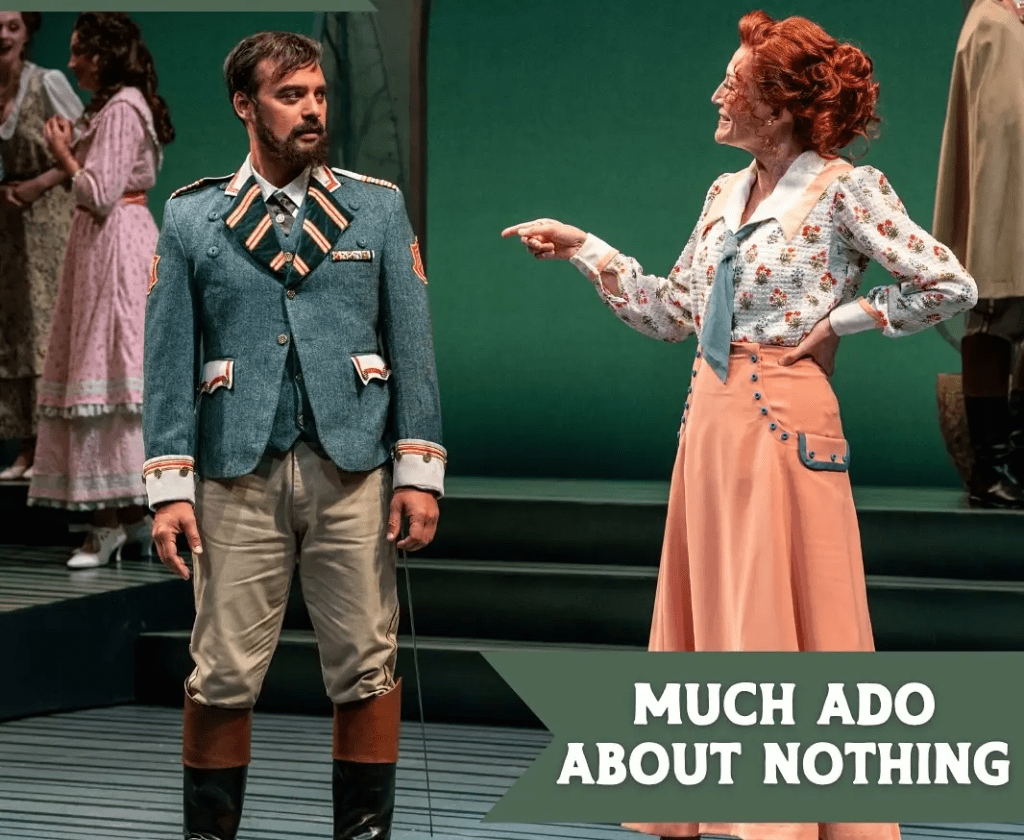
The cast is uniformly excellent, bringing depth and nuance to their roles. I was particularly impressed by Beatrice (played by Parrett). Parrett is an experienced actress who brings new meaning to Shakespeare’s lines. Parrett’s Beatrice is fiery and quick-witted, delivering her lines with impeccable timing and a hint of vulnerability. Benedick (played by Walter Kmiec) is similarly excellent, capturing the playful banter and underlying affection that defines their relationship. I love how Kmiec stuttered the word husband, unable even to mutter the word toward the beginning of the play. Kmiec’s Benedick is equally compelling, his comedic prowess matched by moments of sincere emotion. Audiences particularly seemed to love Kmiec’s playful scene with a bucket in the field.
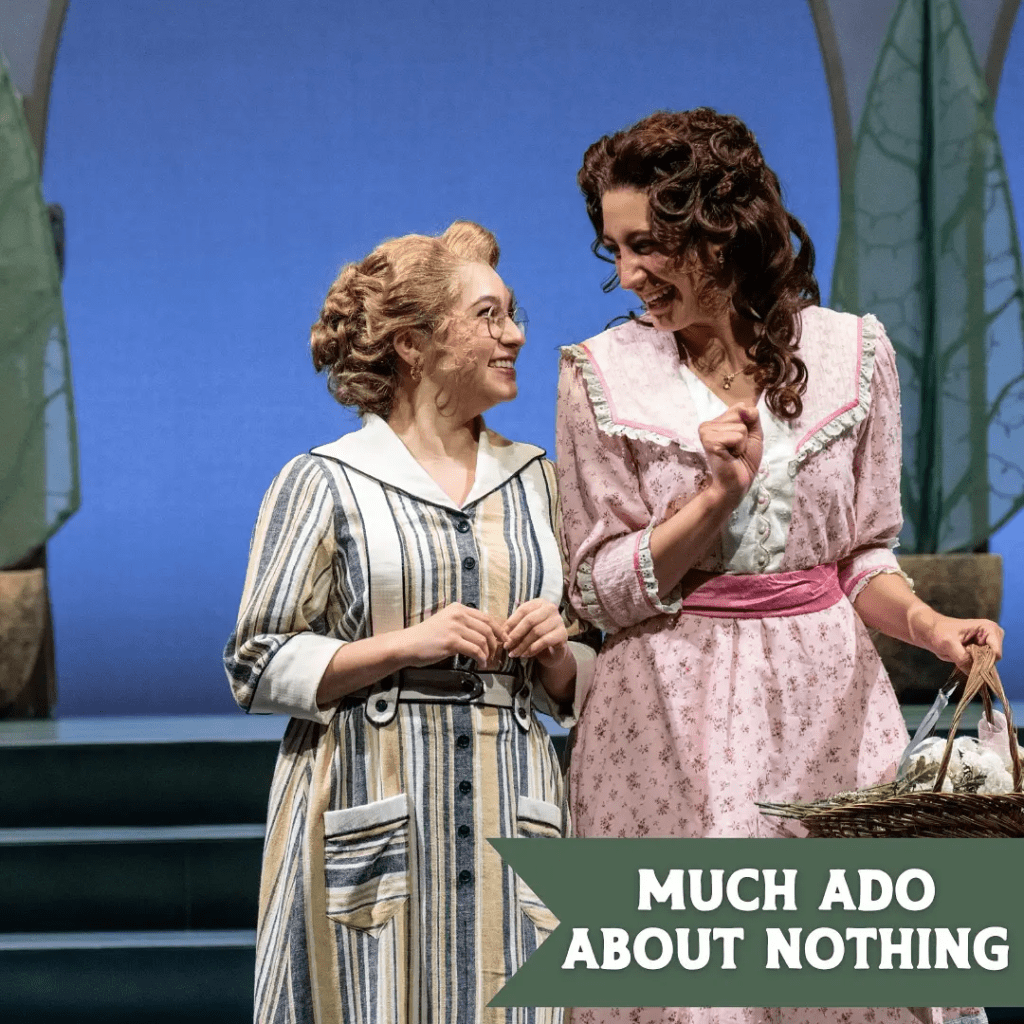
Claudio (Jimmy Nguyen) and Hero (Dariana Elise Pérez) are well-paired, with Nguyen portraying Claudio’s youthful sincerity, passion, and impetuousness convincingly, while Perez’s Hero exudes grace and innocence. Their subplot, driven by jealousy and deception, is handled with sensitivity, highlighting the play’s darker themes without overshadowing its overall lighthearted tone.
Supporting roles are also strong, particularly Don Pedro (Rodney Lizcano), whose commanding presence and charismatic performance anchor the ensemble. The villainous Don John (Marco Antonio Vega) is suitably ominous, and his scheming provides the necessary tension that propels the plot forward.
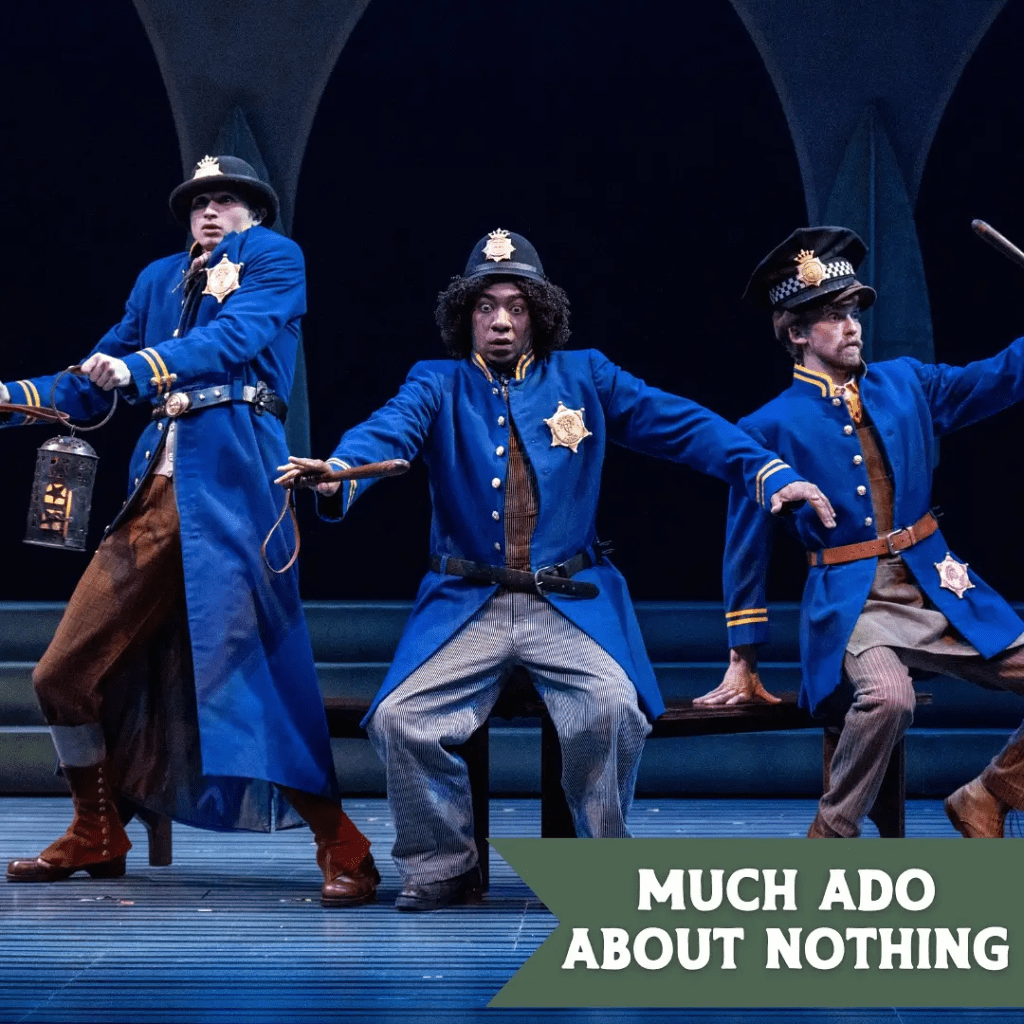
A new element of this play is the relationship between Dogberry (Blake Henri) and Verges (Evelyn Carol Case), who are mother and son in this production of Much Ado. The result is effective when Henri suddenly breaks out crying, “Moooom,” once the rest of the Watch is gone. The two of them provide comic relief, their antics eliciting genuine laughter from the audience, along with the rest of the watch members (Darin F. Earl II, Matthew Wangemann, and Braedon Young). Verges becoming Dogberry’s mother is another director’s choice that the actors ran with, according to Dramaturg Isabel Smith-Bernstein (at an after-the-play seminar).
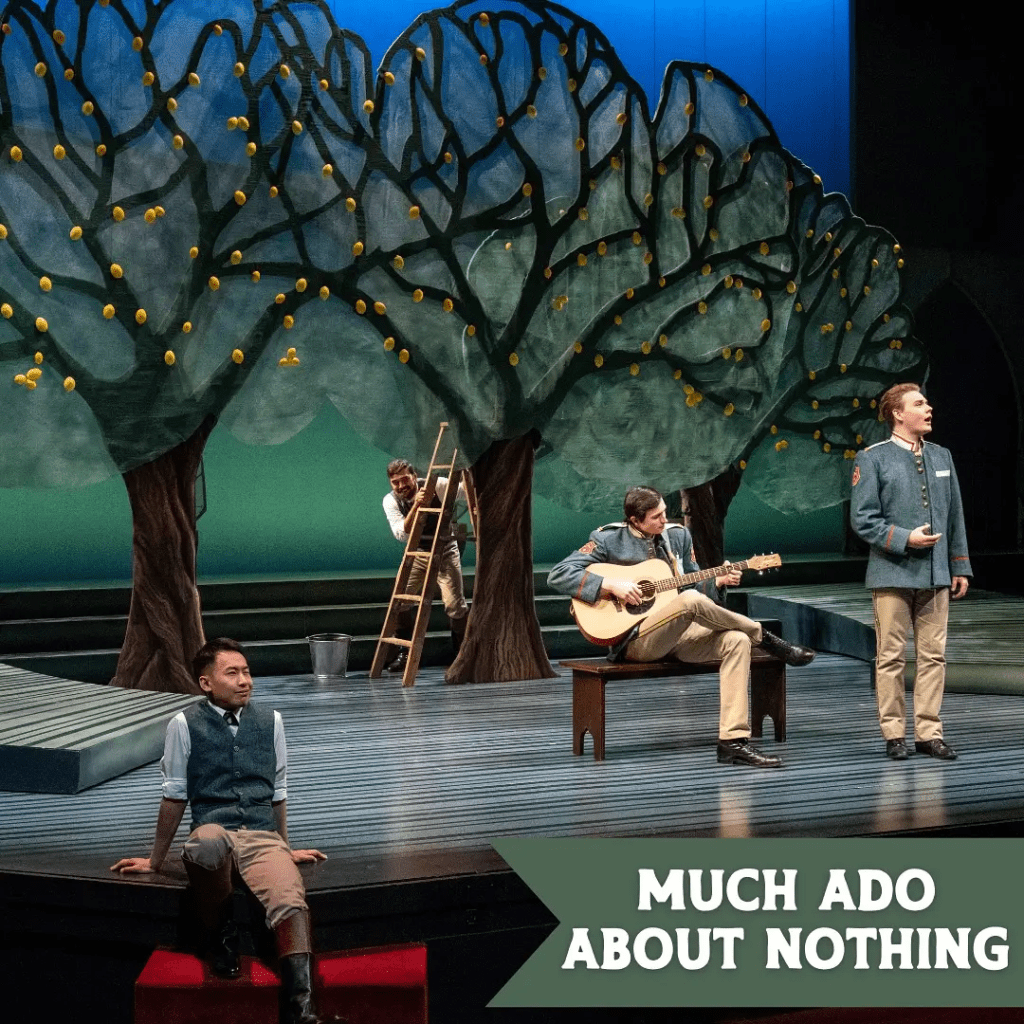
The production’s design elements are a visual feast. The scenic design by Jason Lajka utilizes the indoor stage to its fullest, with impressively large trees and twinkling lights, creating an idyllic setting. Costume designer Brenda Van der Wiel‘s attire is both stylish and period-appropriate, enhancing the characters’ personalities and the overall aesthetic of the production.
The lighting and sound design are equally impressive. The lighting by Claire Chrzan enhances the mood of each scene, whether romantic or dramatic confrontations. Sound and music designer Jennifer Jackson ensures that every line is heard clearly, and the music and singing by Spencer Watson (Balthasar) add to the ambiance and transport the audience to another time and place.
My biggest quibble with Much Ado is the unjust treatment of Hero by her own father, Leonato (portrayed with skill by Henry Woronicz), after she is wrongfully accused of infidelity. It is both perplexing and disheartening that the Friar (played by Darin F. Earl II) is the only man who listens to and believes Hero and has to be the one to reason with her father. In Act Four, the Friar says:
“Hear me a little; For I have only been silent so long And given way unto this course of fortune, By noting of the lady” (4.1.155-158).~Friar Francis (played by Darin F. Earl II)~
The word “noting” is significant because the entire plot hinges on the fact that nothing actually happened, which is why it is titled Much Ado About Nothing. The drama could have been avoided by paying closer attention to Hero and her truth, which is the central point. Although I find it difficult to watch and think it could be toned down, this aspect has nothing to do with the talented group of actors assembled. Leonato’s extreme reaction to Hero is inherent to Shakespeare’s play. While I would prefer to see the play updated to lessen the severity of this scene for modern audiences, I understand that it serves as the climax of Much Ado.
Overall, the Utah Shakespeare Festival’s 2024 production of Much Ado About Nothing is a joyous and captivating rendition of Shakespeare’s classic comedy. With standout performances, exquisite design, and fun updates to this timeless tale of love, mischief, and redemption, this show is a testament to the enduring appeal of Shakespeare’s work and the talent of those who bring it to life on the Festival stage.
When: Now through October 5, 2024, in the Randall L. Jones Theatre
Where: Utah Shakespeare Festival, 35 S 300 W, Cedar City, UT 84720
Approx Run Time: 2 hours & 30 minutes, including intermission
Tickets: $40-$120 at 800-PLAYTIX and bard.org.
References
Bard.org. (2024). Meet the cast: Much Ado About Nothing. https://www.bard.org/news/meet-the-cast-much-ado-about-nothing/
Bard.org. (2024). Ten fun facts: What you may not know about Shakespeare’s Much Ado About Nothing. https://www.bard.org/news/ten-fun-facts-what-you-may-not-know-about-shakespeares-much-ado-about-nothing/


Leave a Reply