

Salt Lake City, UT—Jen Silverman’s Witch opens with a monologue. Elizabeth Sawyer, the woman her village calls a witch, played by Stephanie Howell, tells us she isn’t arguing for the end of the world, then admits that maybe she is. She knows we might think she is kidding or crazy. Those, she says, are not the right questions. The one she leaves hanging over the room is the one the whole evening keeps returning to: Do you still have hope that things can get better?
PYGmalion Productions’ staging, directed by Morag Shepherd in the Black Box at the Rose Wagner Performing Arts Center, takes that question seriously and has a great deal of fun on the way to it. Silverman’s 2018 play retells a 1621 tragicomedy about a real woman hanged for witchcraft, in the language of right now. This production adds an idea of its own: stark light and frozen tableaux borrowed from Rembrandt. On opening night, it was funny, strange, and, by the end, resonated uncomfortably close to home for a play written about the 1600s.

Silverman’s play reaches back to The Witch of Edmonton, written by William Rowley, Thomas Dekker, and John Ford within months of the real Elizabeth Sawyer’s execution on April 19, 1621, and drawn partly from a pamphlet by Henry Goodcole, who questioned her in prison. For its time, the original was unusually sympathetic: its Sawyer turns to witchcraft only after her neighbors have already accused her of it. Silverman keeps that idea, that the villagers don’t need much help from the devil to do damage, and rewrites nearly everything else. In 1621, the devil is a black dog named Tom, and Sawyer sells him her soul. Here, the devil, Scratch, is a junior salesman chasing year-end numbers, and Elizabeth is the one soul he can’t close on. (His story about a client who asked to be turned into a dog plays like a wink at the original.) The old Cuddy Banks is a Morris-dancing clown too innocent to corrupt; the new one is among the first to make a deal.
The characters dress for the 1600s and talk like right now, swearing included. That is by design: the script sets the play “Then-ish. But equally of our moment,” and asks for no fake period accents. I liked it. The modern language makes a 400-year-old story accessible, and much of the humor comes from the clash.
The immersion starts at the door. The Black Box had no air conditioning, so the company handed out cold bottled water and joked in the curtain speech that the heat was part of the experience; the original played the Cockpit in Drury Lane without AC either. Allen Smith’s rich, detailed set does the rest of the time travel, anchored by Tamara MacGruder’s massive framed portrait of Sir Arthur’s late wife, whom he still talks to.
That portrait is a clue to the production’s concept, though audiences won’t know it going in: the program has no director’s note. Director Morag Shepherd told me her idea for the whole show was Rembrandt paintings. “I recreated a lot of the paintings in the tableaux and blips,” she said, “and that’s why the lighting was so stark and from the sides.” Rembrandt used light to bring focus to his subjects’ minds, and he was a teenager when The Witch of Edmonton premiered, so the look belongs to the period as much as the costumes do.
You can see the concept in Savannah Garlick’s lighting. Throughout the play, the action pauses: the stage goes black, then flashes up on the characters frozen in a new arrangement. These moments play less like events than thoughts, glimpses of what the characters imagine or premonitions of what is coming. After Scratch meets Frank, for instance, the lights come up on Scratch holding Frank in a chokehold, a picture of the force pushing Frank to sell his soul. Silverman’s script asks for a single “moment from the future” in Elizabeth’s opening speech; carrying it through the whole evening is this production’s idea. “Savannah and I work really well together,” Shepherd told me.
Shepherd also designed the sound, and the double duty pays off. The score is contemporary and rhythmic, layered like fragments of songs (no singing) over a pounding pulse, and it runs under the monologues instead of waiting for scene changes. Inside the layers, you can pick out a flutter like locusts, piano, and lots of beats. Shepherd said she layered most of it herself, “and it did take forever.” In several scenes, the actors move and pace their speeches to it, so direction and sound are woven together in a way you rarely see.

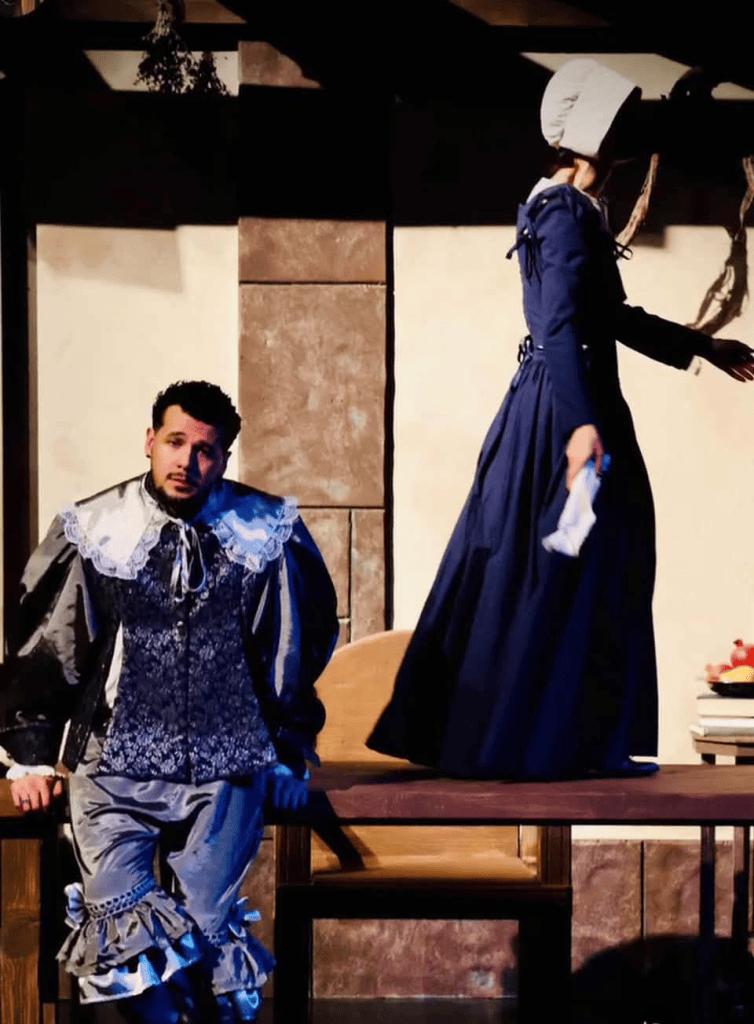
Sofia Nyquist’s extravagant costumes tell you who is wearing them. Cuddy, the play’s queer character, wears peach with breeches that stop just below the knee, announcing his sensibilities well before his Morris dance. Frank is in plain gray and dark blue; Sir Arthur gets the fanciest suit, a textured light blue paisley. That paisley runs through all four men: on the vests of Scratch and Frank, nearly from head to ankle on Sir Arthur and Cuddy. Scratch tops his with a long, sparkling black tailcoat. Elizabeth wears a corset and ruffled skirt that still reads very much as a witch. Winnifred, the maid, wears a plain dress from the era, fitting for a maid.
Howell is a standout in a strong ensemble, letting Elizabeth thaw by degrees. When the devil comes to visit, she makes it clear that “Nobody sits in my cabin but me.” A few visits later, she pours two drinks and offers him a seat. The chair is the first thing she gives him, and she gives it freely. Elizabeth and Scratch end up as something like love interests, or maybe confidants. He claims to have no favorites minutes after admitting she is the only person he has ever come back to visit. And Elizabeth explains why she won’t sell her soul to him: the town looks through her like empty air and mishears her on purpose, and the one thing she has is whatever inside her makes them so uncomfortable. If that is her soul and she gives it away, they win. The devil rests his head in her lap and says he has never felt this way about anyone. “It’ll pass,” she tells him.
As Scratch, McKell Rae is perfectly cast: an animated devil, always in motion, with a face as expressive as the body, which tracks with a program bio listing the title role in Hamlet and “many clown productions.” Rae uses they/them pronouns, and the casting suits a devil who chooses his own shape; this one has chosen a young man, so the other characters call him “he.” A highlight is the potluck pitch, which sells a soul as a friendly exchange, modeled on a custom from the future in which people eat each other’s food on a patio with too many bugs and want to go home long before they do.
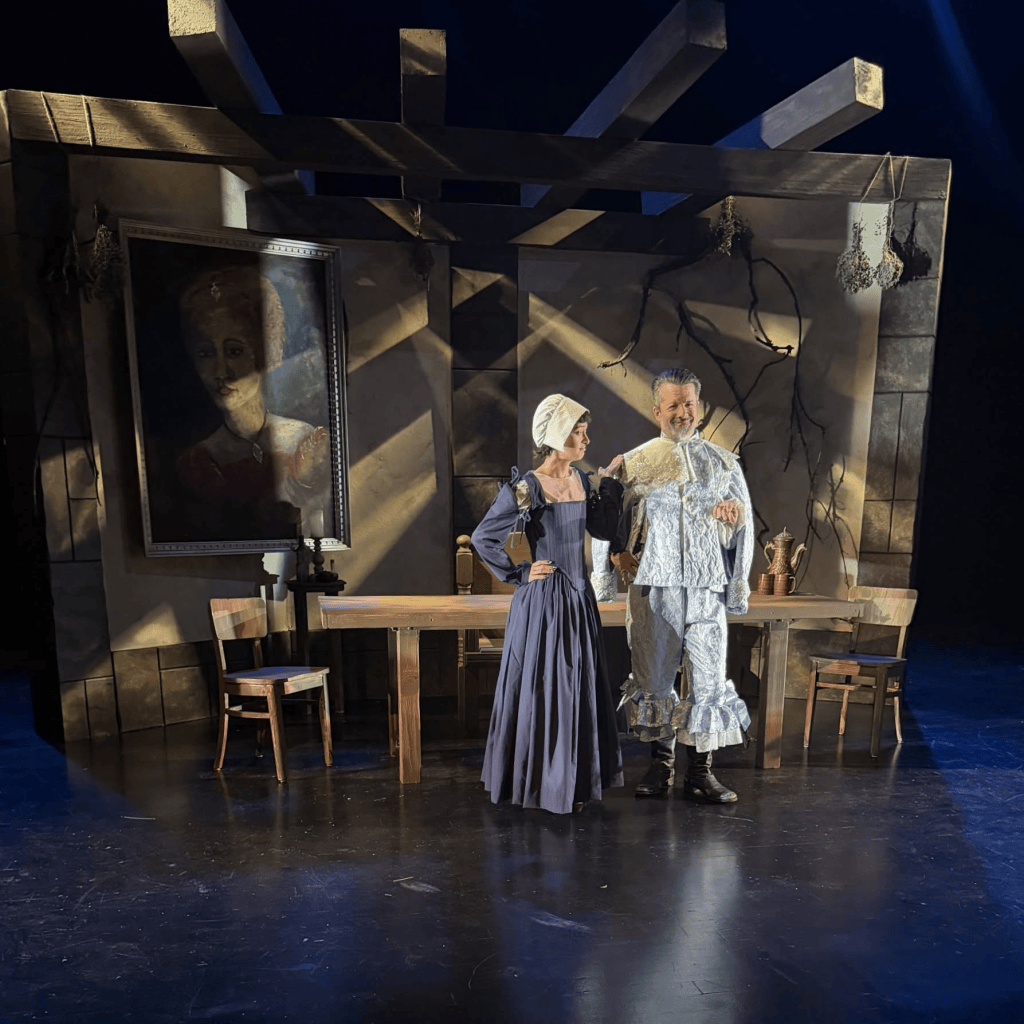
Barrett Ogden’s Sir Arthur is hilarious, never more than at full melodrama alone with his wife’s portrait, confessing that he doesn’t know how to raise a boy in this world and can talk to Frank in a way he can’t talk to his own son. It feels pertinent at a moment when many men seem unsure how to square emotion and respect for women with old standards of masculinity, and Ogden still lands the laugh when Sir Arthur admits he sometimes feels like he is dying, and knows he isn’t.
Amona Faatau’s Cuddy gets some of the night’s biggest laughs, most of them in his scenes with Pedro Flores’s Frank. Cuddy insists that Morris dancing, the English folk dance done with bells and handkerchiefs, is not a hobby but his life. His monologue about Frank riding past on the horse Sir Arthur gave him starts as a list of grievances, builds to a fantasy of knocking Frank off it, and tips into something that sounds a lot like desire. Later, he asks Winnifred whether wanting to put his hands around Frank’s throat and also be as close to him as possible is love or hate. Faatau and Flores play every exchange between the two young men for maximum friction, and it pays off in their wrestle, choreographed by A.J. Neushwander, which had the room laughing harder than at anything else all night. It is cleverly built: Cuddy starts out just poking Frank, a great character choice from Faatau, and the scuffle slides from fight to dance to fight, so that the whole tangle of what Cuddy feels for Frank plays out in a single physical sequence.
Pedro Flores makes Frank easy to dislike, which is exactly what the play needs: a self-declared favorite child, all polish and ambition, certain he is destined for greatness, with a pretty-boy accent that fits perfectly. Cuddy sees through him, warning that philanthropy was in vogue when Sir Arthur plucked Frank out of a field, and it is going out of style. Whatever is between them, sexual or close to it, runs hot enough that Juls Marino gives Winnifred, the maid devoted to Frank, real attitude, a fitting choice for a character the household neglects and silences: she may be ignored, but she is never meek.
What makes Witch more than a clever update is how precisely it tracks who gets offered what. The devil’s pitch to Elizabeth is revenge on the villagers who have tormented her, and it starts small: crickets, lice, a pox on somebody’s cow. Wholesale slaughter, he concedes, is usually reserved for men. So she asks to be pitched the way a man would be, and the offer turns to power, conquerors, and a place in history. The devil knows the difference firsthand: he used to appear as a woman, and gave it up because he didn’t like the way people looked at him. At Sir Arthur’s table, meanwhile, Winnifred has served for five years without once being seen. The men sell for the castle, the title, the land. When the women are asked what they want, their answers expose how little the world has left them to want.
I won’t spoil the ending; there are intense twists you will have to see for yourself. What I can say is that the play closes a loop. Early on, the devil tells Elizabeth that if she refuses him, he will simply leave and that she will one day regret it. Near the end, she hands that speech back to him almost word for word. I loved that mirror. The last word goes to the devil, sleepless, unsure whether anything better is coming or whether a person loving a person could be enough, and admitting how hard it is to have hope right now. My one reservation is that the play ends abruptly.
Final Thoughts
We learn in the play that Elizabeth wasn’t always a witch, but that her reputation was ruined. For the woman this play is based on, a village’s judgment was a matter of life and death: the real Elizabeth Sawyer was hanged. Four centuries later, women are still shamed for claiming autonomy over their own bodies, and the shaming only seems to grow louder. For a company that has spent three decades centering women’s stories, Witch is a pointed choice: a recovered archival figure who refuses the story written for her, staged by a company navigating its own funding cuts under Utah’s anti-DEI law. The parallel is hard to miss. Edmonton decides who counts by deciding whom it will see and hear, and Utah now decides which stories count by deciding which ones it will fund. Elizabeth’s refusal to give up the very thing that makes people uncomfortable lands differently in light of that. So does the timing at the ballot box: there have been repeated attempts to pass a federal bill now before the Senate that would require proof of citizenship to register to vote in every state, with extra paperwork for anyone who has changed their name, a burden critics warn could fall hardest on married women. Meanwhile, a prominent pastor has called the 19th Amendment “a bad idea,” and pastors in his church network argue openly for “household voting,” in which the husband casts the family’s vote. In Edmonton, Elizabeth is looked through and misheard on purpose; the methods change, but the question of whose voice counts doesn’t. These stories matter because women matter.
While I think a director’s note about the Rembrandt concept would enrich the experience, it works without one, which says a lot about the acting and directing. Props to Morag Shepherd, Savannah Garlick, and the entire company: it’s a unique concept with excellent execution. I recommend it: it’s well paced, entertaining, and well acted, and there is nothing else like it playing in a city full of theatre. Go see it.
Content note: Witch contains strong language throughout, sexual references, and staged violence, along with talk of murder and despair. It is recommended for ages 14 and up.
Witch runs through October 17, 2026, in the Leona Wagner Black Box at the Rose Wagner Performing Arts Center, 138 W Broadway, Salt Lake City. It runs about 80 minutes with no intermission. Tickets are available through ArtTix.

Production details
PYGmalion’s Witch runs October 2–17, 2026, in the Leona Wagner Black Box at the Rose Wagner Performing Arts Center (about 80 minutes per the program, no intermission, ages 14+). Cast and creative names below are from the printed program.
| Item | Detail |
|---|---|
| Play | Witch by Jen Silverman, a retelling of The Witch of Edmonton (1621) by Rowley, Dekker, and Ford |
| Company | PYGmalion Productions (founded 1995 in Ogden; centers women’s stories) |
| Venue | Leona Wagner Black Box, Rose Wagner PAC, 138 W Broadway, SLC |
| Run | Oct 2–17, 2026; reviewed on opening night, Friday, Oct 2 |
| Director | Morag Shepherd (also sound designer) |
| Elizabeth Sawyer | Stephanie Howell (Actors’ Equity) |
| Scratch (the devil) | McKell Rae (actor: they/them; character: he) |
| Sir Arthur Banks | Barrett Ogden |
| Cuddy Banks | Amona Faatau |
| Frank Thorney | Pedro Flores |
| Winnifred | Juls Marino (they/them) |
| Design (set, costume, lights, sound) | Set: Allen Smith. Costumes: Sofia Nyquist. Lights: Savannah Garlick. Sound: Morag Shepherd. Fight choreography: A.J. Neushwander. Portrait painter: Tamara MacGruder. |
| Funders named in curtain speech | Peace and Possibility Project, Salt Lake City Arts Council, Salt Lake County ZAP, individual donors |
Sources
- Printed program for PYGmalion’s Witch: cast, creative team, bios, running time
- ArtTix listing: run dates, venue, age recommendation, tickets
- Wikipedia, The Witch of Edmonton: the 1621 source play, its authors, first performance, and plot (pasted by Keola; check against a scholarly source before publishing)
- Jen Silverman, Witch: script PDF supplied by Keola, a draft dated 7/2/18; used to check quoted lines and stage directions
- QSaltLake on PYGmalion’s 30th season: company background
- Keola’s opening-night notes, Friday, Oct 2, 2026
- Henry Goodcole, The wonderfull discoverie of Elizabeth Sawyer, a Witch (1621): title page image and full text at Early English Books Online
- Title page of the first printed edition of The Witch of Edmonton (1658)
- Wikipedia, Elizabeth Sawyer: her trial and execution, with a 1794 engraving from the Wellcome Collection
- Marion Gibson’s scholarly edition of the Goodcole pamphlet (Routledge; likely behind a paywall)
- Morag Shepherd, messages to Keola, Oct 2026 (quoted with her permission): the sound layering, working with Savannah Garlick, and the Rembrandt concept
- Wikipedia, List of paintings by Rembrandt and Rembrandt lighting
- States Newsroom, “How Trump’s SAVE America Act could make it harder for married women to vote” (Apr 2026): Utah’s 2026 proof-of-citizenship measure, the birth-certificate issue, the White House response
- Salt Lake Tribune on PYGmalion’s lost state funding (Sept 2025)


Leave a Reply