
Friday, October 9, 2026, 7:30 p.m. · Jeanné Wagner Theatre, Rose Wagner Performing Arts Center
Tickets: keyboard-side seating $35 · other seating $25 · students $12. Buy tickets online or call 801-355-ARTS. Rose Wagner Performing Arts Center, 138 West 300 South, Salt Lake City. The concert runs about one hour and forty-five minutes, including a fifteen-minute intermission, and is recommended for ages eight and up. Concert details¹
Fresh off its fiftieth anniversary, the Bachauer opens its new concert season with a journey.² Pianist Kotaro Fukuma calls his program a homage to Franz Liszt, and the Bachauer has titled the evening Pilgrimage, after Liszt’s Années de pèlerinage (Years of Pilgrimage).³ Over one evening, the music moves from poetry to opera to legend, then through some of the most famous paintings, sculptures, and poetry of the Italian Renaissance.
To get an inside look at the program, my contributor Dennise from Utah Piano Lab, and I sat down with Kary Billings, executive director of the Gina Bachauer International Piano Foundation.⁴ Billings first discovered the Bachauer as a teenager, when his piano teacher, the competition’s founder Paul Pollei, got him involved. He has been part of the foundation for more than four decades and has served as its executive director since 2006.⁵ “It’s a journey through the world of Franz Liszt,” he says of this concert. He’s keeping one part of the evening under wraps, but here’s a hint: this pilgrimage comes with a passport.

What makes this night special? For one, it offers music even a Bachauer insider hasn’t heard live. Billings, a classically trained pianist who helps judge the competition’s preliminary rounds, admits he doesn’t know Stefanelli’s Livre at all. “I’m really excited to learn it,” he says.
It’s also a rare chance to hear Liszt’s Italian pilgrimage the way he designed it: all seven pieces, in order, as one journey.⁶ Billings says hearing even a familiar piece as part of the set it comes from is a completely different experience. And in the hands of a pianist who has lived with this music for decades, you’ll likely hear something new, even in the pieces you think you know.
You don’t need to read music to follow along. Nearly every piece on this program was inspired by a story, a poem, or a work of art. This guide introduces the pianist, walks through the program, and points you to the artworks so you can look at them before or after the concert.
Meet the pianist
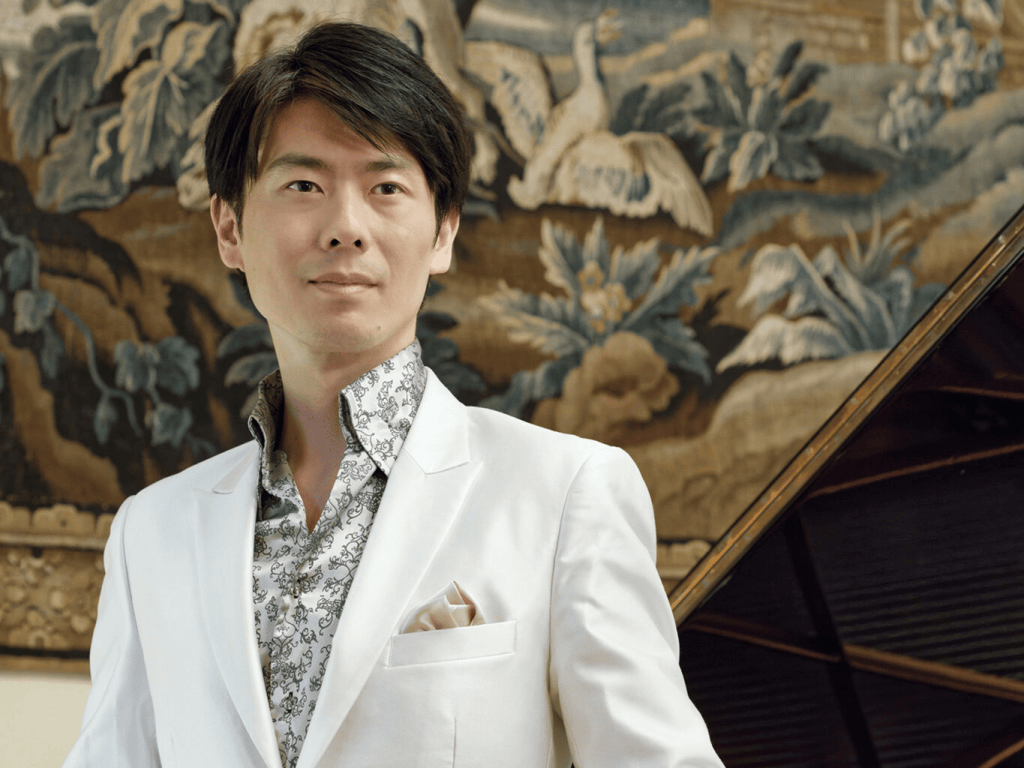
Fukuma’s history with the Bachauer goes back almost thirty years. He grew up in Kokubunji, in western Tokyo, and was fourteen when he entered the Bachauer’s 1997 Young Artists Competition. Competitors choose their own programs,⁷ and while older rivals brought Rachmaninoff sonatas and Liszt’s Mephisto Waltz, Fukuma played simpler pieces. He reached the finals anyway and took sixth prize. A judge told him his musicality stood out, and he left Salt Lake City determined to become a pianist.⁸
Six years later, at twenty, he won first prize and the Chopin Prize at the 2003 Cleveland International Piano Competition. The next morning, he opened The Plain Dealer to a review asking whether the wrong pianist had won. “How can I leave my hotel?” he remembers thinking. The shock became a turning point, he told Stephanie Manning of ClevelandClassical.com in 2025: he accepted every kind of engagement he was offered and pushed himself to study harder.⁹
In 2010, he returned to Salt Lake City as a finalist in the Bachauer’s International Artists Competition, playing Schumann’s Piano Concerto with the Utah Symphony and taking fifth prize.¹⁰ Today, he has performed in more than thirty-five countries on five continents and released twenty-one recordings, including Fantasy: Scriabin & Rachmaninoff (Naxos), nominated for a 2024 International Classical Music Award. He is also a curious programmer: since July 2020, he has produced his own concert series, Rare Piano Music, featuring fellow pianists and seldom-heard repertoire. He divides his time between Berlin, Leiden, and Tokyo.¹¹
Watch: Fukuma introduces his new album
First half: the road to Liszt (Matthieu Stefanelli, Livre)
The evening opens with a contemporary piece dedicated to Fukuma himself. Livre means “book” in French, and Matthieu Stefanelli wrote it as a homage to Liszt. Each of its four movements takes its cue from a different writer:¹²
- Earth and Reveries of Will, after the philosopher Gaston Bachelard
- Waves: The Secret of the Potion Lies Elsewhere, after Robert Louis Stevenson
- Evening Harmony: Pantoum, after Charles Baudelaire
- Iridescence: One Sees Clearly Only with the Heart, after Antoine de Saint-Exupéry’s The Little Prince
Stefanelli borrows a habit from Liszt, who constantly found inspiration in nature, poetry, and other art. “Liszt is the master of taking inspiration,” Billings says. “So I think Stefanelli was inspired the same way.”
Listen for: how each movement paints its title, from solid earth to rolling waves to the shimmer of light in the last. The “potion” in the second title may be a hint of what comes next: Tristan und Isolde, an opera set in motion by a love potion.
Wagner, Tristan und Isolde: Prelude and Liebestod
Here Fukuma places himself directly beside Liszt. The Prelude is heard in Fukuma’s own piano transcription, and the Liebestod (“love-death”) in Liszt’s. There’s a family tie too: Wagner married Liszt’s daughter Cosima. This is some of the most yearning, unresolved music ever written, and it doesn’t find rest until the final chords of the Liebestod. Billings calls it simply “agonizingly beautiful music.”
Listen for: the handoff between two transcribers working on the same opera more than 150 years apart.
Fukuma is a transcriber as well as a pianist. He rewrites music from operas, songs, and orchestral works for solo piano. His album The Art of Piano Transcription (Naxos Japan, June 2026) has the same pairing you’ll hear at this concert: his own transcription of the Tristan Prelude, then Liszt’s transcription of Isolde’s Liebestod (tracks 9 and 10). The album also includes his arrangement of Mozart’s Eine kleine Nachtmusik and a medley of French chansons, including “La vie en rose” and “Les feuilles mortes.”¹³
- Track 9: Tristan und Isolde, Prelude (transcribed by Fukuma)
- Track 10: Isolde’s Liebestod (transcribed by Liszt), which follows the Prelude directly, as it will at the concert
Liszt, St. Francis of Paola Walking on the Waves
The first half ends with a legend. When a boatman refused to carry St. Francis of Paola across the Strait of Messina, from Calabria to Sicily, the saint spread his cloak on the water and crossed anyway. (This is not the more famous St. Francis of Assisi.)
“You hear all the waves crashing . . . and you can just imagine being there.”
—Kary Billings
Listen for: the hymn-like theme rising from the bass under shimmering tremolos, then chromatic waves surging beneath it.
Second half: Liszt’s Italian pilgrimage
Liszt’s Années de pèlerinage: Deuxième année—Italie (Years of Pilgrimage: Second Year—Italy) was inspired by his travels in Italy with Marie d’Agoult in the late 1830s. Rather than depicting Italian scenery, as he often does in the Swiss volume, Liszt draws mainly on Italian Renaissance art, poetry, and literature. The seven pieces form a journey through works that stirred his imagination. Look at each artwork before the concert, then let the music fill in the rest.
Listen: hear all seven pieces in order in Aldo Ciccolini’s recording on Spotify. Ciccolini was a great Liszt interpreter and one of Fukuma’s own teachers.¹⁵
1. Sposalizio (The Marriage of the Virgin)
This piece draws on Raphael’s 1504 painting of the marriage of Mary and Joseph, which has hung in Milan’s Pinacoteca di Brera since 1806. The wedding party stands before a many-sided temple whose open doors draw your eye to the sky beyond. The music’s serene opening and increasingly radiant conclusion evoke the painting’s spiritual beauty and the solemnity of the ceremony.
View it: The Marriage of the Virgin (Raphael) · Smarthistory video
Listen for: bell-like chimes and a glow that builds, the way the painting’s light pulls your eye upward.

2. Il penseroso (The Thinker)
Michelangelo carved Lorenzo de’ Medici, Duke of Urbino, as a pensive Roman warrior for his tomb in Florence, and the statue became known as Il Pensieroso. The music is dark, restrained, and contemplative, reflecting the sculpture’s brooding, inward-looking figure.
Listen for: slow, heavy chords sinking low on the keyboard. This is the darkest, quietest piece of the evening.

3. Canzonetta del Salvator Rosa
A cheerful change of mood. The tune was long credited to the painter-poet Salvator Rosa, but it comes from the song “Vado ben spesso” by Giovanni Battista Bononcini.¹⁶ Its lively, spirited character is a welcome contrast to the first two pieces.
View it: meet the man the song was credited to. In Salvator Rosa’s self-portrait Philosophy (ca. 1645), now in London’s National Gallery, he scowls in a scholar’s cap, holding a tablet that says, in Latin, “Either be silent, or say something better than silence.” It’s a funny contrast with the carefree tune Liszt borrowed.
Listen for: a jaunty, strolling march, the evening’s breath of fresh air.
4–6. Three Petrarch Sonnets (Nos. 47, 104 and 123)
Now the inspiration turns from painting, sculpture, and song to poetry. Petrarch’s sonnets are love poems to Laura, and Liszt first set them as songs before turning them into piano pieces. One listener hears three kinds of love in them: fresh infatuation, passionate desire, and a heavenly, idealized love. They are among the most lyrical and operatic passages in the collection.
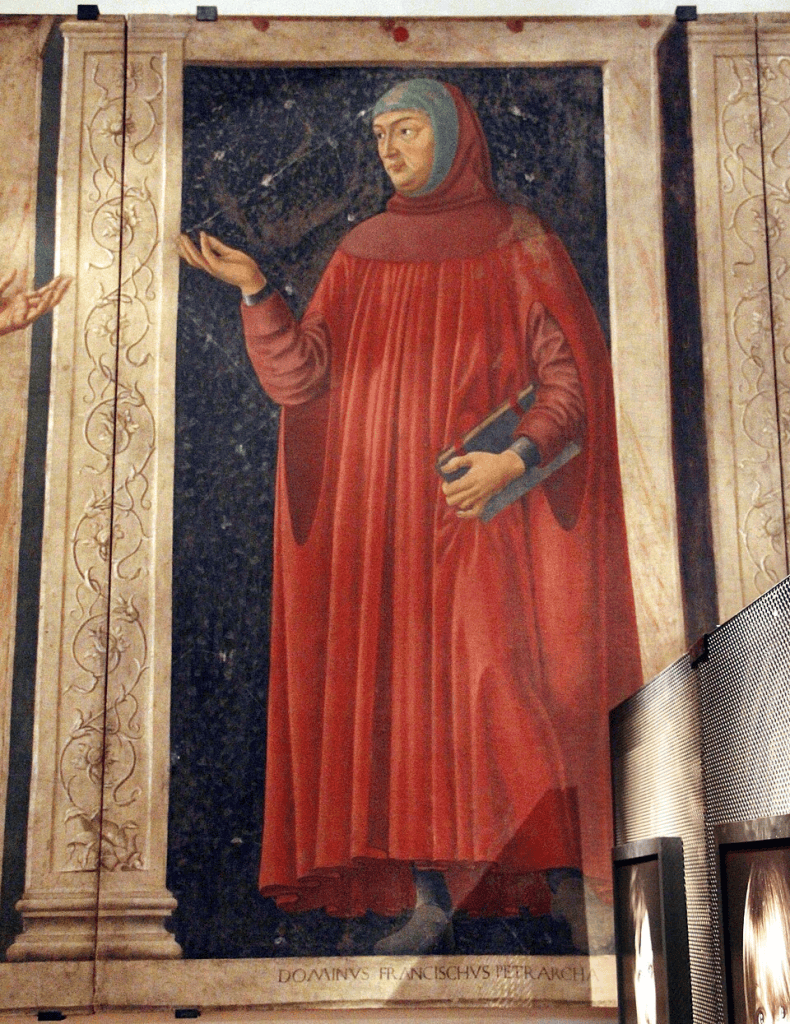
View it: see the poet himself in Andrea del Castagno’s fresco portrait of Petrarch (ca. 1450), from a cycle of famous men and women now in the Uffizi Gallery in Florence.
Read along: here are the three poems in the order you’ll hear them. Read all three in English translation on LiederNet.
Sonetto 47: “Benedetto sia ‘l giorno” (Blessed be the day)
In short: the poet blesses every detail of the moment he first saw Laura’s eyes, even the wound of love itself, and every page he has written about her.
Benedetto sia ‘l giorno, e ‘l mese, e l’anno,
E la stagione, e ‘l tempo, e l’ora, e ‘l punto
E ‘l bel paese e ‘l loco, ov’io fui giunto
Da’duo begli occhi che legato m’ànno;
E benedetto il primo dolce affanno
Ch’i’ ebbi ad esser con Amor congiunto,
E l’arco e le saette ond’ i’ fui punto,
E le piaghe, ch’infino al cor mi vanno.
Benedette le voci tante, ch’io
Chiamando il nome di Laura ho sparte,
E i sospiri e le lagrime e ‘l desio.
E benedette sian tutte le carte
Ov’io fama le acquisto, e il pensier mio,
Ch’è sol di lei, si ch’altra non v’ha parte.
Sonetto 104: “Pace non trovo” (I find no peace)
In short, love has turned the poet into a walking contradiction. He burns and freezes, flies and lies on the ground, laughs while weeping, and wants neither life nor death.
Pace non trovo, e non ho da far guerra,
E temo, e spero, ed ardo, e son un ghiaccio:
E volo sopra ‘l cielo, e giaccio in terra;
E nulla stringo, e tutto ‘l mondo abbraccio.
Tal m’ha in priggion, che non m’apre, nè serra,
Nè per suo mi ritien, nè scioglie il laccio
E non m’ancide Amor, e non mi sferra;
Nè mi vuol vivo, nè mi trahe d’impaccio.
Veggio senz’occhi; e non ho lingua e grido;
E bramo di perir, e cheggio aita;
Ed ho in odio me stesso, ed amo altrui.
Pascomi di dolor, piangendo rido,
Egualmente mi spiace morte e vita:
In questo stato son, Donna, per voi.
Sonetto 123: “I’ vidi in terra angelici costumi” (I saw on earth angelic grace)
In short: the poet remembers seeing Laura weep. Her sighs were so beautiful that heaven itself went still, and not a leaf stirred on the branches.
I’ vidi in terra angelici costumi,
E celesti bellezze al mondo sole;
Tal che di rimembrar mi giova, e dole:
Che quant’io miro, par sogni, ombre, e fumi.
E vidi lagrimar que’ duo bei lumi,
Ch’han fatto mille volte invidia al sole;
Ed udì’ sospirando dir parole
Che farian gir i monti, e stare i fiumi.
Amor! senno! valor, pietate, e doglia
Facean piangendo un più dolce concento
D’ogni altro, che nel mondo udir si soglia.
Ed era ‘l cielo all’armonia s’intento
Che non si vedea in ramo mover foglia.
Tanta dolcezza avea pien l’aer e ‘l vento.
Listen for: the piano “singing.” You can almost hear where the words used to be.
7. Après une lecture du Dante (After a Reading of Dante)
The grand finale takes its title from a Victor Hugo poem written after reading Dante. Its opening leans on the tritone, long nicknamed the “devil’s interval” to evoke the souls in hell. A second theme represents the joy of heaven, and the music moves through violent struggle and lyrical episodes toward an expansive, triumphant conclusion. Billings describes the journey as moving from “the depths of hell onto the great wonders of something miraculous and glorious.”

View it: Gustave Doré’s engravings for Dante’s Inferno (1861) are in the public domain. Start with the Gate of Hell, “Abandon all hope, ye who enter here,” a perfect match for the sonata’s opening. Then look at Charon ferrying souls across the river Acheron.
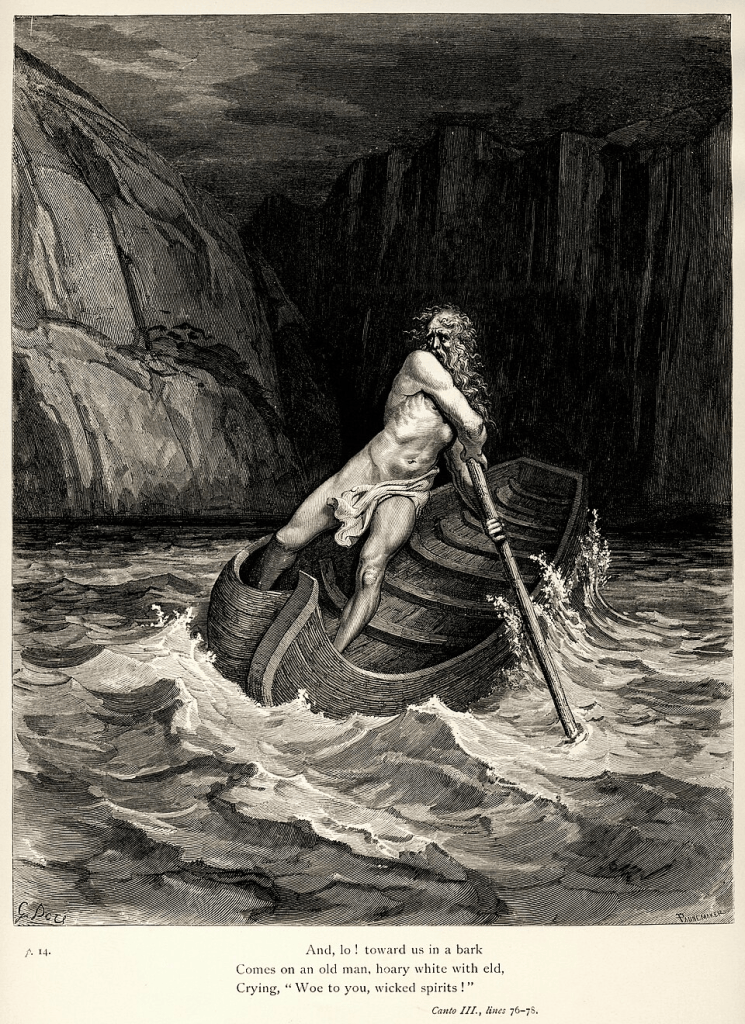
Listen for: the gates of hell opening in the first bars, then the long climb toward light.
What makes this collection so fitting for Fukuma’s Pilgrimage concert is that Liszt’s journey is as much an artistic and spiritual pilgrimage as a geographical one. Raphael and Michelangelo inspire meditations on faith and contemplation, Petrarch explores human love, and Dante brings the volume to a dramatic culmination. That creates a natural connection with Stefanelli’s Livre, whose literary references reflect the same idea: the piano as a vehicle for experiences beyond music itself.
A tip for first-timers
You don’t have to know the paintings to be moved by the music. The Bachauer even chose not to project the artwork during the concert, so each listener can picture the story in their own way. Look at the images beforehand, then close your eyes and let Liszt take you there.
“Let’s let the audience kind of imagine,” Billings says of the decision. “We don’t want to be too visual.”
Fukuma would likely agree. Speaking about Japanese music, he has said the spaces between the notes matter as much as the notes themselves. “In a haiku, you cannot explain everything,” he told Manning. “You have to imagine what’s happening.”¹⁷
There’s no substitute for hearing this music in the room. “When you have a live experience,” Billings says, “having that music wash all over you . . . There’s something very special.” And when intermission comes, keep your program in hand on the way to the lobby. Every good pilgrimage deserves a few stamps.
Show info
Kotaro Fukuma: Pilgrimage Friday, October 9, 2026, 7:30 p.m. Jeanné Wagner Theatre, Rose Wagner Performing Arts Center, 138 W 300 South, Salt Lake City
| Seating | Price |
|---|---|
| Keyboard-side | $35 |
| Other seating | $25 |
| Students | $12 |
Tickets: buy online through ArtTix or call 801-355-ARTS.
Run time: about 1 hour 45 minutes, including a 15-minute intermission.
Ages: recommended for 8 and up. Infants are not admitted, and every patron needs a ticket regardless of age.
More information: the Bachauer’s concert page, 801-297-4250 or info@bachauer.com.
Coming up in the Bachauer Concert Series: Youl Sun: Grandmasters (November 6, 2026) · Lori Sims in Concert (March 12, 2027) · Bolai Cao in Concert (April 30, 2027) · See the full season
Notes
- “Kotaro Fukuma: Pilgrimage,” Gina Bachauer International Piano Foundation, accessed September 29, 2026, https://www.bachauer.com/concerts/pilgrimage; “Kotaro Fukuma in Concert,” ArtTix, Salt Lake County Arts & Culture, accessed September 29, 2026, https://www.saltlakecountyarts.org/events/kotaro-fukuma-in-concert/.
- Les Roka, “The Bachauer at 50: Part of the Great Flourishing in the Utah Arts Scene,” The Utah Review, June 1, 2026, https://www.theutahreview.com/the-bachauer-at-50-part-of-the-great-flourishing-in-the-utah-arts-scene/.
- “Kotaro Fukuma: Pilgrimage.”
- Kary Billings, interview by the author and Dennise (Rhetorical Review; Utah Piano Lab), September 28, 2026, Rose Wagner Performing Arts Center, Salt Lake City. All quotations from Billings come from this interview unless otherwise noted.
- Les Roka, “The Bachauer at 50: Legacies of Competition Laureates, Concert Series, Piano Festivals, Educational Outreach, Formative Leaders,”The Utah Review, June 1, 2026, https://www.theutahreview.com/the-bachauer-at-50-legacies-of-competition-laureates-concert-series-piano-festivals-educational-outreach-formative-leaders/.
- Leslie Howard, liner notes to Liszt: The Complete Music for Solo Piano, vol. 43, Deuxième année de pèlerinage, Hyperion CDA67107, https://www.hyperion-records.co.uk/dc.asp?dc=D_CDA67107.
- Roka, “Part of the Great Flourishing.”
- “Kodomo no koro kara gurōbaru! Fukuma Kōtarō ga kangaeru piano to ongaku no sekai (zenpen)” [Global from childhood: Kotaro Fukuma on piano and the world of music, part 1], Lalala Club, accessed September 29, 2026, https://lalalaclub.com/501/.
- Stephanie Manning, “Kotaro Fukuma Makes Long-Awaited Return to Cleveland for Piano Days,” ClevelandClassical.com, July 23, 2025, https://clevelandclassical.com/kotaro-fukuma-makes-long-awaited-return-to-cleveland-for-piano-days/.
- “Kotaro Fukuma: Pilgrimage”; “XV Gina Bachauer International Piano Competition,” Wikipedia, accessed September 29, 2026, https://en.wikipedia.org/wiki/XV_Gina_Bachauer_International_Piano_Competition.
- “Biography,” Kotaro Fukuma (website), accessed September 29, 2026, https://kotarofukuma.com/biography-english/; “Kotaro Fukuma: Pilgrimage.”
- “Matthieu Stefanelli: Programme,” BS Artist Management, accessed September 29, 2026, https://www.bs-artist.com/de/seiten/programme/matthieu-stefanelli-programme.html; “Kotaro Fukuma: Pilgrimage.”
- The Art of Piano Transcription, Naxos Japan, accessed September 29, 2026, https://naxos.jp/special/nycc-27316.
- Miami International Piano Festival, “F Liszt St Francis Walking on the Waves Kotaro Fukuma,” YouTube video, performance recorded May 15, 2014, posted January 1, 2015, https://www.youtube.com/watch?v=XxMNHnpsmzs.
- “Biography,” Kotaro Fukuma.
- Howard, liner notes.
- Manning, “Long-Awaited Return.”


Leave a Reply