

Salt Lake City, UT—On Tuesday, April 7, 2026, Samara Joy took the stage at Kingsbury Hall in conjunction with Utah Presents, bringing with her a voice that feels both rooted in jazz tradition and strikingly contemporary, as well as a repertoire that expands beyond familiar jazz standards. At just 25, and already a six-time GRAMMY Award winner, Joy has quickly become one of the most visible figures in modern jazz. But in live performance, what stands out is not the accolades—it’s the control, clarity, and expressive depth of her voice.
What distinguishes Joy is not just vocal ability, but musical intelligence. Her phrasing feels exploratory, with runs that arrive unexpectedly—never ornamental for their own sake, but purposeful, playful, and precise. Her vibrato, used sparingly and often at the end of phrases, is quick, even, and controlled, adding a subtle shimmer without excess.
The shift in dynamics often arrives without warning—phrases that begin with restraint expand suddenly into something fuller and more powerful, revealing a level of control that feels both precise and instinctive.
That same level of control extends to her use of breath. Joy sustains notes far longer than expected, and rather than fading, they seem to grow—expanding in both volume and intensity. At times, it becomes difficult to see where she takes a breath at all, creating the sense that the sound is continuous, almost unbroken.
That sense of spontaneity is central to her approach. Joy describes her work not as repeating a melody, but as learning how to “sing a melody differently every time,” suggesting a performance practice grounded in variation and ongoing discovery. Speaking with Salt Lake Magazine, Dainon Moody highlights Joy’s emphasis on growth over recognition. Joy describes her process as an ongoing effort “to get better every single night,” continually reshaping how a melody is performed.

A native of the Bronx, New York, Joy grew up in a musical family rooted in gospel traditions. She began singing in church before turning to jazz in her teens, later studying at SUNY Purchase College, where she developed the technical and interpretive skills that now define her sound. Joy first gained major attention after winning the 2019 Sarah Vaughan International Jazz Vocal Competition, launching a career that has included acclaimed recordings such as Linger Awhile (2022) and Portrait (2024). Her work is often noted for its balance of precision and expressiveness, drawing comparisons to vocalists such as Sarah Vaughan, Betty Carter, Abbey Lincoln, and Carmen McRae.
While deeply grounded in jazz tradition, Joy’s performances and recordings continue to expand the genre’s reach, introducing lesser-known repertoire and collaborating closely with her ensemble to create arrangements that feel both classic and newly alive.
During improvisational passages, particularly in scat sections, her physicality shifts. She lifts her hand as if shaping sound in midair, as though she were playing an instrument rather than singing. It becomes clear: her voice is not simply delivering melody—it is participating in it.
This sensibility extends to her storytelling.
In songs like “Lush Life,” by Billy Strayhorn, a single lyric—“then you came along with your siren song to tempt me”—emerges with striking clarity. The shift in dynamics often arrives without warning—phrases that begin with restraint expand suddenly into something fuller and more powerful, revealing a level of control that feels both precise and instinctive. Joy doesn’t just sing the line; she builds it. Through dynamic control and careful enunciation, she transforms a familiar standard into a lived narrative, where each phrase feels discovered in real time.
The Ensemble: Precision, Speed, and Collaboration
Joy performs with a tightly unified ensemble—musicians she has worked with for several years, many of whom contribute directly to the arrangements. That collaborative structure is palpable.
The group includes Cameron Campbell on piano, Martin Jaffe on bass, and Evan Sherman on drums, alongside a dynamic horn section featuring Eli Feingold (trombone), Jason Charos (trumpet & flugelhorn), David Mason (alto saxophone), and Kendric McCallister (tenor saxophone & bass clarinet).
Joy interacts with her band members as easily as if in conversation, and that ease shapes the performance. The group moves fluidly between restraint and virtuosity.
That sense of ease is not incidental. In an interview with BOMB Magazine, I. Augustus Durham frames Joy’s approach to collaboration as a space of mutual trust and possibility, where the band is “listening, expressing themselves fully, and providing a space…to experiment and grow.” For Joy, the ensemble is not simply accompaniment, but a shared environment where risk, responsiveness, and musical discovery are possible in real time.
In one moment, horns settle behind Joy’s voice with a lush, cinematic texture—particularly in “Sunset and the Mockingbird,” where jazz harmonies blend with an undercurrent of blues-inflected melancholy. The result evokes something almost seasonal: images of spring, birdsong, and longing, layered together.
In another moment, the ensemble accelerates into something wildly different. Joy described how the group reworks lesser-known songs—sometimes pushing them to extremes, including seeing “how fast” tunes can be played. What follows is a blistering display: a breakneck duet between tenor sax and drums, executed with near-impossible speed and precision. It is exhilarating, almost disorienting, and entirely joyful.
Beyond the Standards
One of the most compelling aspects of the evening is Joy’s repertoire. Rather than relying solely on well-worn standards, she introduces audiences to songs that feel newly unearthed—particularly for listeners encountering them for the first time. For many in the room, these are not nostalgic pieces but discoveries.
Joy also moves seamlessly across styles. A bossa nova set—performed in both Portuguese and English—demonstrates not only linguistic versatility but a clear respect for the genre’s roots. The transition feels natural, expanding the emotional and cultural scope of the concert.
Later Joy performs an original work,“The Five Stages of Love,” composed by Kendric McCallister. This wordless yet deeply expressive piece unfolds as a narrative through sound alone, building gradually toward a sudden climax—an expansive, electrifying moment marked by dissonance that resolves into something quieter and deeply satisfying. It is a reminder that storytelling in jazz does not require language.
Closing in Gospel
Joy closes the evening with lineage. Returning to her roots, she ends with a gospel piece—grounded, direct, and resonant with history. The lyric “Dear Lord, God Almighty, please look down and see my people through” lands with quiet force, reframing the entire performance. What begins as a display of technical mastery resolves into something deeper: a connection to tradition, to community, and to a lineage of Black vocal expression that extends far beyond the stage.
A Voice That Carries Forward
There is a tendency to describe artists like Samara Joy as a “bridge” between generations. And while that is true, it is also incomplete. Joy is not simply preserving jazz tradition. She is reanimating it—treating each song as something alive, present, and ongoing. And, perhaps most strikingly, Joy leaves you with the sense that what you heard—no matter how precise—will never happen in quite the same way again.
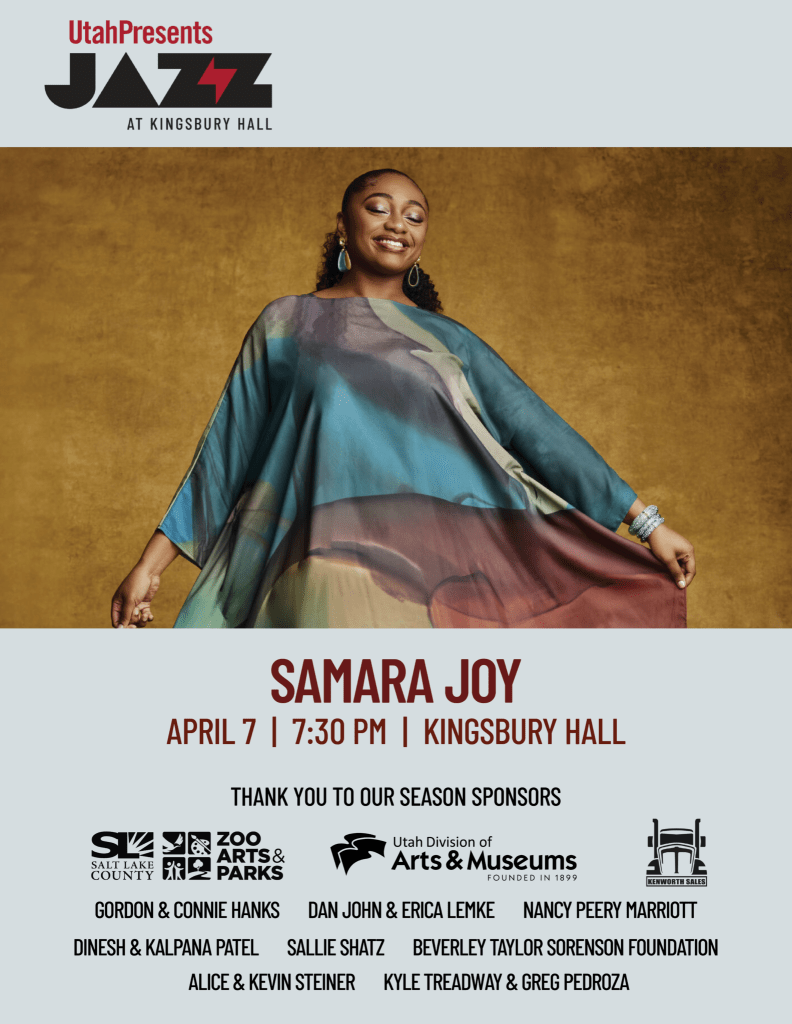
Event Details
Samara Joy
Tuesday, April 7, 2026 at 7:30 PM
Kingsbury Hall
Presented by Utah Presents
Ensemble
Cameron Campbell – Piano
Martin Jaffe – Bass
Evan Sherman – Drums
Eli Feingold – Trombone
Jason Charos – Trumpet & Flugelhorn
David Mason – Alto Saxophone
Kendric McCallister – Tenor Saxophone & Bass Clarinet


Leave a Reply