Timp Arts’ The Mystery of Edwin Drood is a fun night with a quick-witted cast, but its staging of the Landless twins shows why any company reviving an old show needs a dramaturg.
AMERICAN FORK, Utah — When Charles Dickens died in June 1870, he left The Mystery of Edwin Drood half-written in his desk, with no notes on who killed the young man in the title, or whether anyone did. Rupert Holmes’s 1985 musical, staged by the Timpanogos Arts Foundation’s Timp Arts Theater, directed by Andrew Jefferies, runs October 9–24, and turns that missing ending into a game. The audience votes on who the detective really is, who the murderer is, and which two characters fall in love, and the cast plays whichever ending the house chooses. No two performances end the same way.
On October 10, I had a wonderful time. I also watched a talented company turn two characters from colonial Ceylon, today’s Sri Lanka, into racial stereotypes. Neville and Helena Landless were dressed as a generic, made-up “East” borrowed from Romani and Orientalist caricature: glittering sequins, a sheer robe, braids, heavy kohl eyeliner, and invented accents. As the show went on and I heard them speak in those accents, I grew uneasy. Who exactly were these characters meant to be? My unease only grew through the night, as the show drew all of us toward a vote in which we might possibly pin the murder on one of these “foreigners,” making us complicit in the very suspicion the story invites. Nothing on stage suggested that anyone had asked where those stereotypes came from or whom they might hurt. And to be fair, much of it likely stems from the 1985 script, built on a novel written in the age of the British Empire. But a production decides what to do with its script, and staged this way, an old show does real harm: it teaches audiences, children included, that foreignness is a costume, and then invites them to suspect the people wearing it. This review is about how that happens, and about the one hire that could have prevented it: a dramaturg.
Drood lives or dies on improvisation, and this cast is quick on its feet.
Full Cast. Photo provided by Timp Arts Theater.
A Room That Knows How to Play
First, the fun, because there is plenty of it. The party starts before the overture: in costume and in character, the players of the Music Hall Royale fan out through the house, chatting with patrons, hyping up the evening and shamelessly lobbying for our votes at the end. By the time the lights go down, the audience is already part of the company. Drood lives or dies on improvisation, and this cast is quick on its feet, trading jabs with the audience and with each other without ever dropping the music-hall bravado.
Wayne Keller III’s Chairman runs the evening like a seasoned emcee. When the crowd fumbled the house tradition of booing and hissing the villain, Keller made us do it again until we got it right, and greeted a tepid round of applause by assuring us we must be saving our energy for later. Keller and Mark Gordon’s Jasper tore through “Both Sides of the Coin,” a rapid-fire patter song, at breakneck speed, a feat of breath and diction that had the audience hollering. When the cast voted Edwin dead, Lily Shepherd stormed off as the indignant Miss Alice Nutting, a star robbed of her second act, but not before winking at someone in the front row and telling them, “You were my favorite.” And Alexa Thompson, as Helena Landless, had one of the evening’s finest voices.
The score came from a full orchestral track rather than a live pit, a common practical choice for community theatre. Christian Wawro’s music direction was outstanding, the singing was consistently excellent, and the balance held up even though you could tell the track wasn’t live. I always prefer live music, especially for a show built to feel spontaneous. Parents should also know that the innuendo is constant and occasionally bawdy, in the best music-hall tradition; adults will laugh, but the PG rating is generous.
A Show About Putting On a Show
Holmes doesn’t drop us into Dickens’s world directly. We are guests of the Music Hall Royale in 1890s London, where a second-rate Victorian company performs its own rowdy version of the unfinished novel, set in Cloisterham, a fictional cathedral town Dickens modeled on Rochester in Kent. Every actor plays two roles: a music-hall performer and the Dickens character that performer has been cast as. Dickens himself would not have been amused. In Nicholas Nickleby, he skewered hack dramatists who would “finish unfinished works” for the stage, and he saw no difference between that and picking a man’s pocket. Holmes’s show does exactly that, and knows it; the wink is the point. As Wendy S. Jacobson argues in The Companion to The Mystery of Edwin Drood, Dickens wrote the perfect mystery precisely because it can never be solved, so Holmes hands the guessing to us. The gamble paid off: the show won five 1986 Tony Awards, including Best Musical.
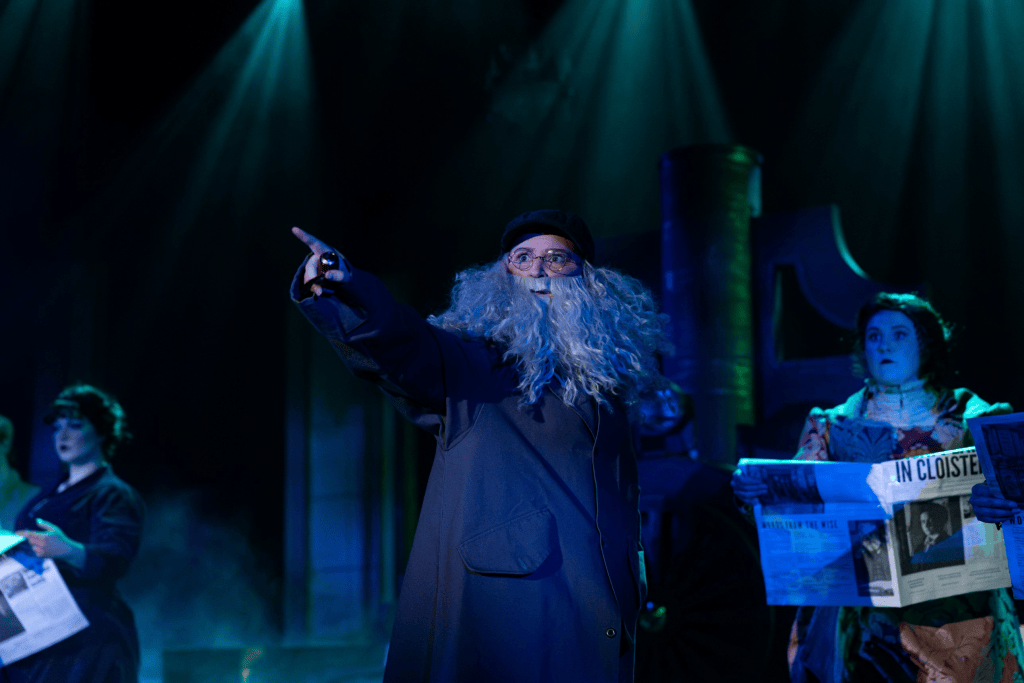
That frame means the show is always partly about how Victorian entertainers performed, and this production handles one layer of it beautifully. Edwin is played by Miss Alice Nutting, the company’s celebrated male impersonator, in the tradition of real music-hall stars like Vesta Tilley. Nobody pretends otherwise; the joke is shared openly with the house. In the second act, the bearded detective Dick Datchery is unmasked by vote, and on October 10 it was Helena, who in Dickens’s novel once escaped her cruel stepfather disguised as a boy. In this production, gender disguise is always shown as disguise: a mustache, a top hat, a performer winking at us from underneath. The audience is always in on it. That is not how the production treated the twins’ foreignness.
The suspects line up for the audience vote. Photo provided by Timp Arts Theater.
Cast/Crew Highlights
Wayne Keller III, The Chairman / Mayor Sapsea: a nimble, commanding emcee who ran the room, the votes and the ad-libs with ease, and matched Mark Gordon syllable for syllable in a lightning-fast “Both Sides of the Coin.”
Mark Gordon, John Jasper: menacing and campy in equal measure, an old-fashioned melodrama villain the audience loved to boo and hiss, with real creepiness underneath. His ‘Both Sides of the Coin’ with Keller, delivered at breakneck speed, was a feat of breath and diction that had the house hollering.
Lily Shepherd, Edwin Drood (also hair and makeup design): played Edwin and his prima donna Music Hall alter ego at once, never funnier than when Miss Nutting stormed off after the cast voted Edwin dead.
Taylor Ann Jaeger, Rosa Bud: a lovely voice, and a Rosa whose visible discomfort turned “Moonfall” from a love song into a portrait of a student under her teacher’s gaze.
Kristyan Williams, Princess Puffer (also scenic design): a great comic presence as the opium-den proprietress, and also the designer of the set.
Alexa Thompson, Helena Landless / Datchery: a fantastic voice and a winning Datchery; whatever the design asked of Helena’s look, Thompson’s performance was a highlight of the night.
Lucas Stewart, Neville Landless: Mysterious and sincere as one of the show’s conscience.
Drew Graham, Rev. Crisparkle: a solid performance full of comedic relief.
Supporting cast: Curt R. Jensen (Durdles), Beck Mercury (Bazzard), Ben Dunford-Cable (Deputy) and Ricky Tovar (James Throttle) rounded out a strong company.
Creative team: direction by Andrew Jefferies, music direction by Christian Wawro, choreography by Stephanie Cole, scenic design by Kristyan Williams, lighting by Caleb Wallengren, costumes by Brooke Holahan, hair and makeup by Lily Shepherd, wigs by Cheryl Cripps, sound by Andrew Domyan, props by Cindy Andersen, stage management by Jane Smith. Cole’s choreography was a pleasure throughout, and theatrical fog gave the simple set a smoky, Victorian atmosphere.
The disguised detective Dick Datchery (Alexa Thompson). Photo provided by Timp Arts Theater.
Foreign by Design
Let me be clear about what follows: it is not a critique of the performers. The musical direction was outstanding, and these are obviously talented actors and singers who fully committed to what they were given. The problem lies in the design and staging choices around two characters—and in the absence of any visible dramaturgical intervention to interrogate them.
The twins get the show’s sharpest moment on empire. Edwin, off to run his family’s engineering firm in Egypt, plans a grand road from Cairo to Alexandria built with stone quarried from the Great Pyramid. Neville, the colonial outsider, calls it what it is, and at my performance his objection landed squarely with the audience. The scene flows into “A British Subject,” where the twins question what Britishness offers people like them. For a moment, they were the show’s conscience rather than its suspects. Almost everything else about how they were staged worked against that moment.
Who the twins are has always been unclear, and the uncertainty starts with Dickens. In the novel, he describes them as “very dark, and very rich in colour,” Helena “of almost the gipsy type,” and even in his private notes, Jacobson points out, he hedged between “Oriental blood” and “imperceptibly acquired nature.” Holmes keeps the vagueness, and neither the novel nor the musical ever goes to Ceylon. In a show set in a made-up English town, “Ceylon” is easy to mistake for one more invention. It isn’t. It was a real colony, home to real people whose descendants could be sitting in the audience, and even its name belongs to the empire: the country dropped “Ceylon” in 1972, when it became an independent republic, and reclaimed “Sri Lanka.”
Every scene happens in England. Ceylon and Egypt are only places characters come from or plan to go, so how they look and sound on stage is entirely the production’s invention.
Some of the problem starts with the material. Character descriptions for Drood call Neville “dark and swarthy,” and one audition notice, citing the script, says the twins’ accent should be built from “Oriental clichés,” “somewhat geographically untraceable”: the Music Hall Royale’s own ignorant idea of how people from Ceylon sound. The script means that as a joke on Victorian performers. A production decides whether the joke lands, and this one filled the blank with stereotypes. The costumes dressed the twins in a generic stage “East,” part “gypsy” and part Orientalist fantasy, borrowing Romani and harem stereotypes for characters from Sri Lanka, as if anyone brown-coded and Eastern were interchangeable. Neville’s glittering sequined coat, pictured above, set him apart from the waistcoats and tweed around him: the outsider is marked before he says a word. Helena wore pants under a sheer robe, with braids and a headband, a mash-up of the stage “gypsy” and the harem dancer of Orientalist painting that no young woman in Victorian Cloisterham would have worn. She looked unmistakably different from every other woman on that stage. Neville is coded as dangerous; Helena, as simply not from here. The makeup gave them, and only them, heavy kohl eyeliner, a long-standing theatrical sign for “Oriental” exoticism that, on Neville, played into the image of the colonized man as volatile and dangerous, just as the script asks us to suspect him of murder. And the fake accents were never shown to be fake. We never heard Janet’s or Victor’s English voices underneath, so the accents stopped reading as an act. Even Helena’s line about her “geographically unplaceable accent,” the script’s built-in wink at the joke, was played straight, and the chance to show the act as an act passed by.
Here is why that does harm. First, it repeats the very prejudice the plot exposes. Cloisterham suspects Neville because he is marked as an outsider; the production amplified the very visual and vocal markers that lead the town to suspect him, then handed us a ballot to choose a murderer. If the vote falls on Neville or Helena, the show stages a confession that proves the town right: the outsider did it after all. Second, it ties danger to darkness, the old stage equation of the dark-skinned man with violence. Third, it turns real people into a costume. Romani people are not storybook figures but a people persecuted across Europe for centuries and targeted in the Nazi genocide; as the novelist Jim C. Hines has argued, dressing up in “Gypsy” costumes and accents belongs to the same family as minstrelsy. Whether or not anyone meant harm, his point holds: “Harm done in ignorance is still harm.” A production that assembles foreignness from eyeliner, costume and invented accents teaches its audience, children among them, what “foreign” is supposed to look like, and the people on the receiving end of that lesson live in our community.
On October 10, the audience happened to push back. We made Helena the detective and convicted the Reverend Crisparkle, the town’s most English and respectable figure, a clergyman Dickens modeled, Jacobson notes, on the Victorian ideal of Muscular Christianity. Dickens himself had planned for Neville to die helping unmask the killer and for Helena to marry Crisparkle; our vote let the marked man go and sent Helena after the clergyman instead. But that was luck, not design. On another night, the same production could send a full house home having convicted the foreigner and calling it a game.
One could argue that everything in Drood is over the top, so the twins’ exoticism is just one more costume. But the show’s other costumes come off. Gender is worn openly and shed with a wink; Datchery’s beard comes off on cue. The twins’ foreignness never does. “It’s all in fun” has long been the defense of stage stereotypes, but satire works only when the audience can tell who it is aimed at. Even comedians mocking racism have had to reckon with that: in 2009, Ben Miller and Alexander Armstrong dropped the word “Gypsy” from a sketch lampooning racist 1970s films so that, as Miller put it, “the target (racism) was clearer and the joke was funnier.”
Critics have been saying this about Drood for years. In 2015, when a company in Victoria, British Columbia, put white performers in dark makeup to play the twins and called it satire, the South Asian actor and playwright Anita Majumdar answered that satire must be conscious and must visibly subvert the original. In 2017, Jessica Goldman of the Houston Press called a production’s Landless portrayals racist, holding that its director could have done more. In 2018, the critic Rebecca Hodge, who loves the show, argued in The Theatrical Board that the twins’ accents and jokes add little to a musical with better laughs elsewhere: “No show is sacred.” And in 2020, Karla Kane of the Mountain View Voice found a production’s vague accents and stereotyped costumes too close to the real thing. Some theatre makers have stopped staging it altogether. In 2021, when a high school teacher asked on a BroadwayWorld forum whether the twins could be staged sensitively at all, a director who had produced the show replied that attitudes had shifted so much that their community would not stage it again. Timp Arts avoided darkening anyone’s skin, but by Majumdar’s test, the satire never arrived.
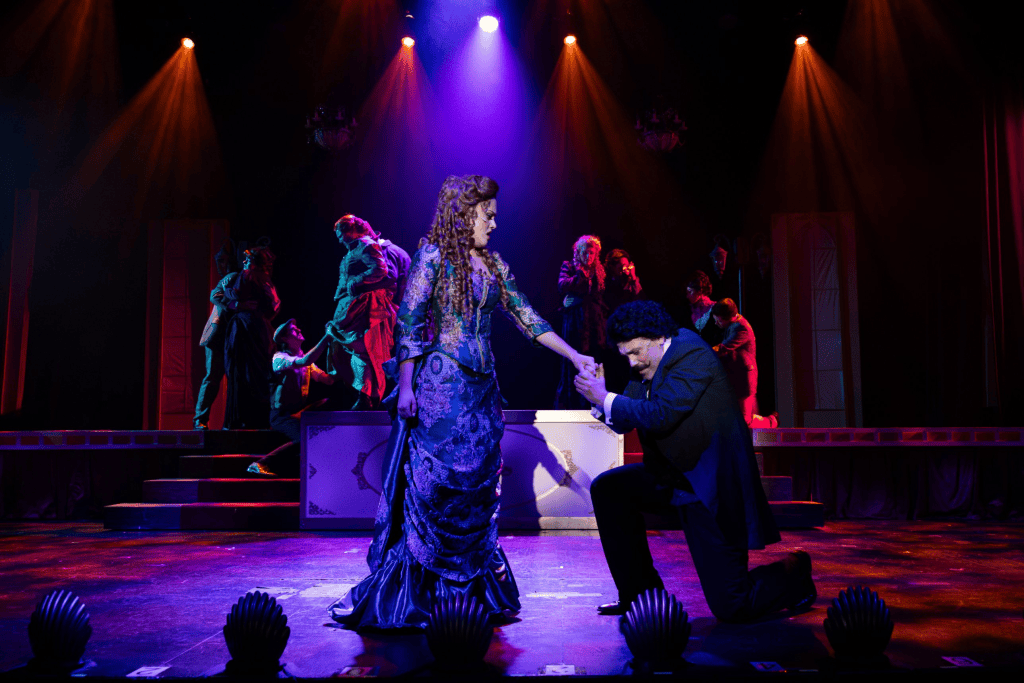
Taylor Ann Jaeger’s Rosa and Mark Gordon’s John Jasper. Photo provided by Timp Arts Theater.
The Company Already Knows How
Timp Arts handled the show’s other dangerous material with real care. “Moonfall” is the score’s loveliest melody and its creepiest scene: for Rosa’s birthday, her music master, John Jasper, makes her sing back a love song he has written to her, in front of others, until she breaks down. The company flagged the predatory teacher in its content advisory and credited Meredith DeFord for intimacy direction. Taylor Ann Jaeger’s Rosa did the rest. The show keeps putting Rosa on display: the Chairman introduces the actress as a delicate English bud not yet plucked, and Jasper makes her perform his desire while he watches, a prime example of what dynamic film theorist Laura Mulvey called the male gaze. Yet, Jaeger’s visible discomfort never let us settle into Jasper’s point of view, and the scene became about what it costs Rosa to be looked at.
That is the lesson. When this company recognized that material needed outside expertise, it brought that expertise in. The twins needed the same care, and the program lists no dramaturg.
A Call to Action
None of this requires changing a word of the licensed script. A production could let Janet’s and Victor’s British voices break through the accents in the music hall’s out-of-character moments, play the “unplaceable accent” line as a knowing wink, dress the twins like everyone else so their foreignness exists only in Cloisterham’s eyes, and make the town’s prejudice the joke. A short program note on Ceylon and the music hall’s taste for exotic acts would show the company sees what it is staging.
A lot of people love this show, and it’s easy to see why: the wordplay, the music-hall chaos, the gorgeous score and the thrill of choosing an ending together. But many of the people who love it don’t understand why it’s problematic, because no one has shown them, and the fun is exactly what makes the stereotypes so easy to miss. That is what a review and a dramaturg can do. As a theatre critic and as a scholar who studies performance and the archive, I would not be doing my job if I didn’t point it out.
So here is my ask, to Timp Arts and to every company reaching for a decades-old title: if you are going to stage a show like this one, hire a dramaturg. Budget for it the way you budget for lights and costumes. Someone in the room whose job is to know the history, from Ceylon to the Victorian music hall to the “Oriental clichés” written into the script, is the difference between staging a stereotype and staging a critique of one.
If you are going to stage a show like this one, hire a dramaturg.
I had fun at Drood too, and Timp Arts has a talented company I hope to see again. But I left wondering how much a production can repair when the script itself carries these contradictions. Until the material changes, the burden falls on companies to make the most of every choice they control. This one, unfortunately, did not. Drood asks its audience, every night, who gets cast as the suspect. The companies that stage it should be asking why.
The Mystery of Edwin Drood runs through October 24 at the Valentine Theater, 839 E 9th N in American Fork. Tickets are $15–$25 at timparts.com, and the October 23 performance is ASL-interpreted.
The Rhetorical Review is built on the belief that local theatre, art, and storytelling deserve thoughtful, accessible, and independent coverage.
Every review, interview, and feature takes time, energy, and money to produce. Attending performances often means travel costs, parking fees, research time, and hours spent writing and editing with care.
Many local artists and productions do not receive the coverage or visibility they deserve, and The Rhetorical Review exists to help amplify those voices and preserve Utah’s artistic and cultural conversations.
Your support helps make this work possible. Even a $1 donation on Venmo helps sustain independent arts criticism and keeps this writing available to the community.
Keola received her undergraduate degrees from Brigham Young University of Hawai’i in English and music and then went on to study English literature at Weber State University for her master’s degree. She is currently pursuing her doctorate in Writing and Rhetoric Studies at the University of Utah.
Rhetorical Review is built on the belief that local theatre, art, and storytelling deserve thoughtful, accessible, and independent coverage.
Every review, interview, and feature takes time, energy, and money to produce. Attending performances often means travel costs, parking fees, research time, and hours spent writing and editing with care.
Many local artists and productions do not receive the coverage or visibility they deserve, and we exist to help amplify those voices and preserve artistic and cultural conversations.
Your support helps make this work possible. Even a $1 donation on Venmo helps sustain independent arts criticism and keeps this writing available to the community.





Leave a Reply