

South Salt Lake, UT — Parker Theatre’s To Kill a Mockingbird, Christopher Sergel’s stage adaptation of Harper Lee’s novel, closed on October 17 to a nearly sold-out house. The standing ovation at the performance I attended was well deserved, and so is the story’s place on our stages. Even as it is pulled from some school curricula and reading lists, this remains an important story about who the law protects and who it fails. This is a beautifully acted, carefully designed production that chooses restraint where it could have chosen brutality. A standing ovation tells you an audience was moved, not what moved it.
That question is the heart of both the book and the play. But does this production get there? Lee’s story has always been told through white eyes: a white child’s memory of her white father’s courage. Sergel’s adaptation keeps that frame, and Parker Theatre’s production largely follows it. Within that frame, this is strong ensemble work, from Brinton Wilkins’s Atticus, Karen-Christina Jones’s Calpurnia, and Kiirt Banks’s Tom Robinson to the children who give Maycomb its spark and the design team that makes it feel lived in. There is a great deal here to praise, and there is also room to do more.
Here is where I kept getting stuck: where is the Black community of Harper Lee’s book? Jones and Banks give their roles real depth, but Calpurnia and Tom are roles the story keeps at its edges. They are nearly the only Black characters the stage version gives us; the program lists no Reverend Sykes and no Helen Robinson. But how can two people represent an entire community? Jones and Banks are asked to carry the weight of a community that Lee’s book makes room for, Sergel’s script narrows, and this production narrows further. The play ends by telling us that most people are nice once we finally see them, and this production makes it possible to see Tom and Calpurnia. It left me wondering whether seeing them is enough.
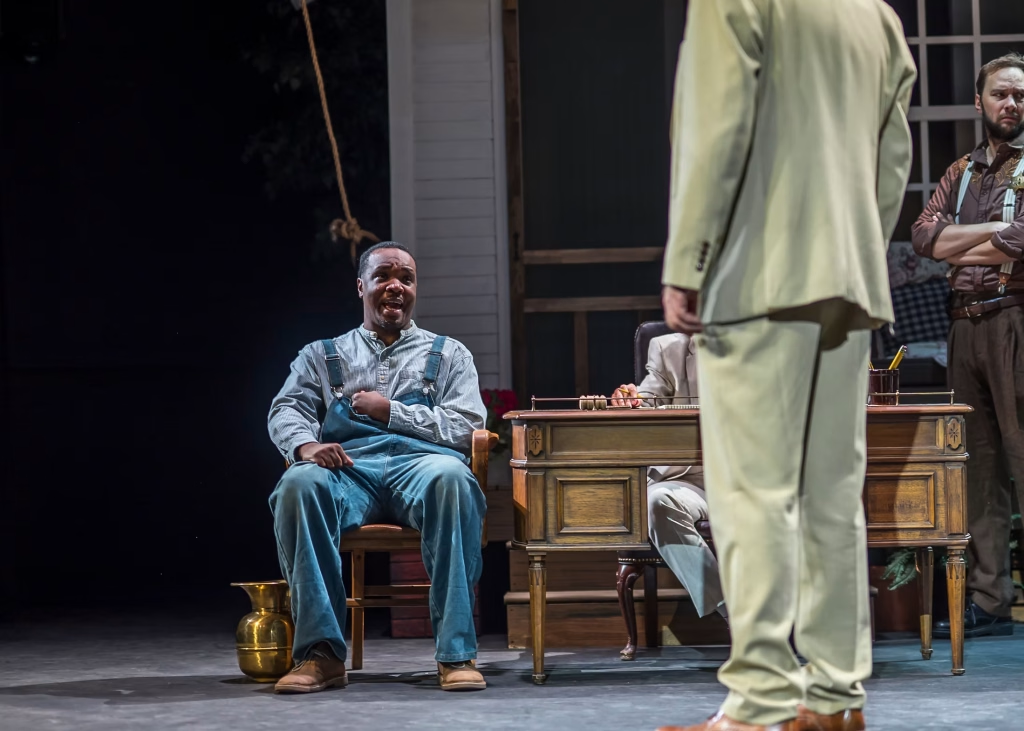
Calpurnia and Tom, at the center
Karen-Christina Jones as Calpurnia and Kiirt Banks as Tom Robinson are wonderful, and their work deserves more than a line after Atticus and Scout.
Jones dedicates her performance to her aunt, Mrs. Miriam Turner, born in 1934, during the years the novel is set. Mrs. Turner died on September 5, a week before the show opened. Jones played Calpurnia while carrying the memory of her aunt.
Jones appears only a few times, in the Finch household and at the courthouse during the trial, and she makes each entrance count. Her presence is deeply nurturing, warm enough that the stage feels safer when she is on it. You can tell how much her Calpurnia cares for the children, not only for their well-being but for their image: how they behave, how they speak, and how the town sees them. That her stage time is so brief is itself telling. Calpurnia is the woman who has raised the Finch children since their mother died, yet the play keeps her on the margins, arriving and leaving while others carry the story. The novel gives her more. It follows her to First Purchase, her own church, where one member challenges her for bringing white children, the congregation takes up a collection for Tom’s family, and Scout and Jem hear her speak differently than she does in their house. They learn she can read and that she taught her son to read, too. On stage, we rarely see her beyond the Finch household.
Banks has performed in To Kill a Mockingbird before, so he brings this story to the Parker Theatre stage having lived with it across productions. His best moment is Tom’s testimony, which turns on a single admission: Tom helped Mayella with her chores because he felt sorry for her. The prosecutor seizes on it, repeating “You felt sorry for her?” back at him, and the room shifts. In Maycomb, a Black man pitying a white woman is its own offense, and Banks lets us watch Tom realize that his kindness has just become evidence against him. Atticus names the offense himself in his closing argument: Tom had “the unmitigated temerity to ‘feel sorry’ for a white woman.” But Banks is never off. Even when Tom has no lines, sitting silent while white men argue over his life, he is fully present.
The highest compliment I can give him is this: I have seen Banks play the opposite kind of character, loud and larger than life. He was James “Thunder” Early in The Grand Theatre’s Dreamgirls, where I called his Jimmy pure dynamite, and this spring he played Agwe, god of water, in The Ruth’s Once on This Island, where his voice was one of the musical highlights of the night. He was every bit as convincing as a showman and a god as he is here as a man fighting for his life with almost no room to move. Tom Robinson asks for restraint, and Banks gives it completely. He can do it all.
His credits also include Ragtime, another story of racial violence set in this era. Shows like these are a lot for me to witness as an audience member, and they can cost Black performers even more. Nichelle Lewis, who played Sarah in the recent Broadway revival of Ragtime, told Playbill that the role brought on chills, tension, pain and nausea, and that she had even started getting tics.
What I appreciate about this Mockingbird is that it tells an important story without going to such extreme measures. Much of the play’s violence happens offstage, including Tom Robinson’s death, and keeping it there spares the performers from reliving it night after night.
I wish the stage version made more room for Maycomb’s Black community, the way the book does. That limit starts with Sergel’s script, which trims Lee’s Black community down to a handful of figures. This production narrows it further: Reverend Sykes, who appears in Sergel’s version, is not in the program here. It is hard to call that a casting necessity. There are so many talented Black actors in Utah right now, and many of them are looking for work. The Grand Theatre filled an entire cast of Dreamgirls with them just last year, and Banks himself is part of that community. Beyond Calpurnia’s church, Lee fills the courthouse’s colored balcony with neighbors who rise as Atticus leaves after the verdict, and the next morning she covers the Finches’ back steps with food left by Black families to thank him. In Lee’s Maycomb, Tom has a community that shows up for him. In Sergel’s adaptation, he mostly stands alone.
But not everything the play leaves out is violence. The novel lets us closer to Tom’s family. His wife, Helen, struggles to find work once Tom is accused, and after his death Bob Ewell follows and taunts her on the road until her employer steps in to protect her. When Atticus and Calpurnia arrive to tell her that Tom has been shot seventeen times climbing a prison fence, his children are playing in the yard, and Helen collapses before Atticus can say a word. Even the novel only glimpses them. Much of this comes secondhand, through Scout’s eyes or Dill’s retelling, and Helen is never given much of a voice of her own. But the book makes room for them. Letting the audience into Tom’s life would not ask the performers to relive any violence. What it would cost is our distance. Without Helen and the children, Tom’s death is reported, not felt. Parker Theatre’s staging makes this worse by rushing past it: the news arrives and the play moves on before the loss has time to land. There is no space to mourn him: no grieving wife, no church, no community left to carry his loss. The production lets him go almost as quickly as Maycomb does, and Black life stays at the edges of the story while the white characters hold the stage. Keeping the violence offstage spares the performers. Leaving out Tom’s family spares only us.
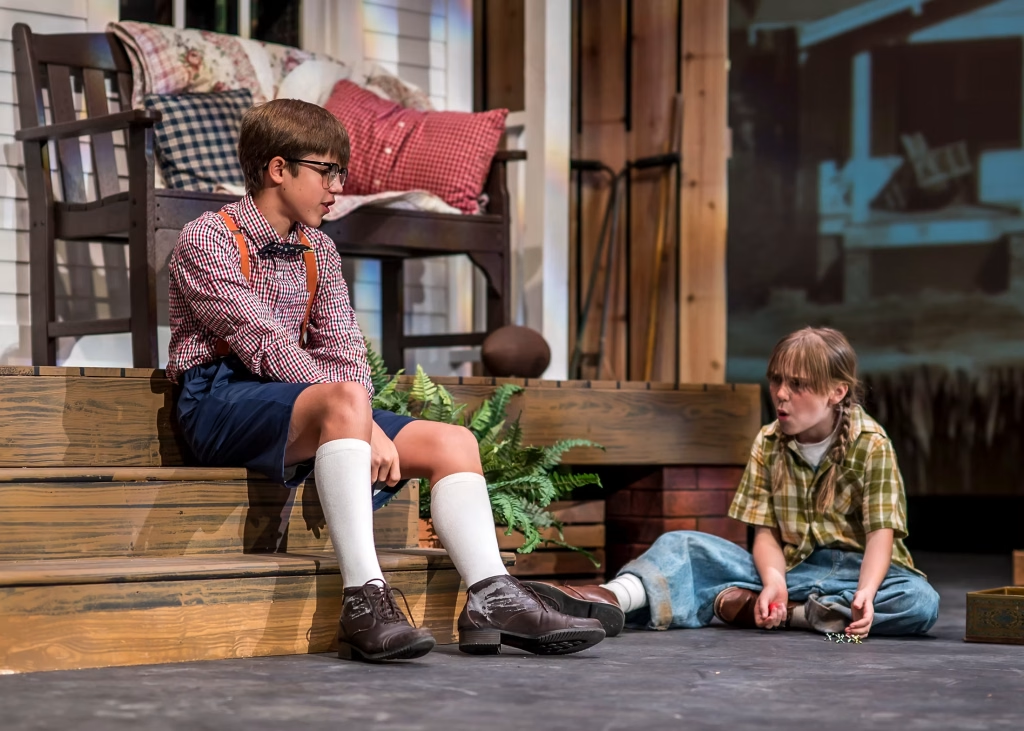
The children’s Maycomb
One of the delights of the play is its banter, and the way the children give the adults a hard time. Lizzie Kintz as Scout, Lincoln Oliphant as Jem, and Oliver Miramontes as Dill talk back, tease, and question the grown-ups around them, and their sharpness keeps a heavy story light on its feet. A favorite moment comes early, when the three try to lure Boo Radley out of his house with candy, as if the town’s great mystery could be coaxed out like a stray cat. It is pure childhood mischief, and it quietly plants the question the play will answer at the end: what happens when Boo finally does come out? I also loved the moment when Jem, furious that Mrs. Dubose (Kathryn Atwood) has spoken so poorly of Atticus, tears up the old woman’s flowers. Atwood plays Mrs. Dubose with real spice, sharp-tongued and unrepentant, so you understand exactly why Jem snaps. It is a child’s idea of justice, rash and loyal, and the play makes him pay for it, sending him to read to her as she struggles through her final days. After she dies, Atticus tells Jem that real courage is not a man with a gun in his hand, but “when you know you’re licked before you begin but you begin anyway.” It is the lesson Atticus is about to live out in the courtroom.
That same nerve pays off outside the jail, when a mob gathers to take Tom Robinson. Scout, played by Lizzie Kintz, recognizes Walter Cunningham (Dave Bruce) in the crowd and talks to him about his son. Without meaning to, she reminds him that he is a father and a neighbor before he is part of a mob, and the crowd breaks up. It is Atticus’s lesson to Scout, that you can’t understand someone until you walk in their shoes, put into action. In the novel, Atticus says as much the next morning: the children made Walter Cunningham stand in his shoes for a minute, and that was enough.
Maycomb is a fictional Alabama town, and that distance makes it easy for a Utah audience to watch the mob as a Southern story. It isn’t only one. On June 18, 1925, a mob in Price, Utah, that included Klan members overpowered police and lynched Robert Marshall, a Black miner, before he could stand trial. About a thousand people gathered to watch, and it is often called the last lynching in the American West (Utah History to Go, Utah State Historical Society).
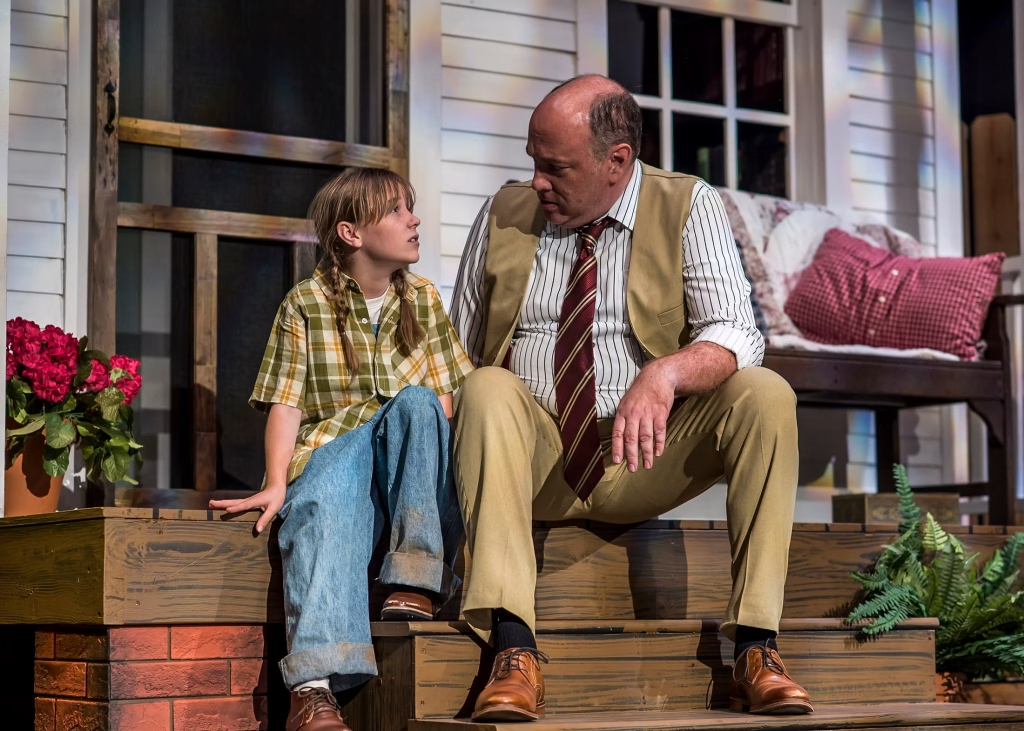
Atticus without the halo
Part of what makes Wilkins’s Atticus so strong is that he does not play him as a saint. That pushes against the tidy hero many of us remember from school, and gives the production’s center more complexity than audiences might expect.
Wilkins is a practicing attorney, general counsel for Solen Software Group, and it shows. He moves through the courtroom scenes with the ease of someone who has actually stood before a judge.
Language itself becomes a lesson in one exchange between Atticus and Scout. Because he is defending Tom, the town mocks Atticus with a slur, calling him a lover of Black people in the ugliest terms, and Scout brings the insult home. Atticus tells her not to use that word, calling it common, and uses “Negro,” the respectful term of his day. The scene shows a father teaching decency, but it also shows how language around race shifts: a word offered as respect in the 1930s lands differently on a 2026 audience. Atticus’s objection is partly about manners, too, about what a Finch should and shouldn’t say, rather than the harm the word does.
Atticus never complains about the ridicule. He absorbs it quietly and keeps doing the work, which may be the clearest measure of his character. In Lee’s novel, he goes further: when Scout asks whether he really is what the town calls him, he says he certainly is, because he does his best to love everybody.
The children police language too. During the trial, a child’s voice from the courtroom shouts out, “Do they have to use the Lord’s name in vain?” It made me smile. It is funny, and it gives the audience a breath in a tense scene, but it is also telling: the children have learned which words are wrong, while the far deeper wrong unfolding in front of them is harder to name.
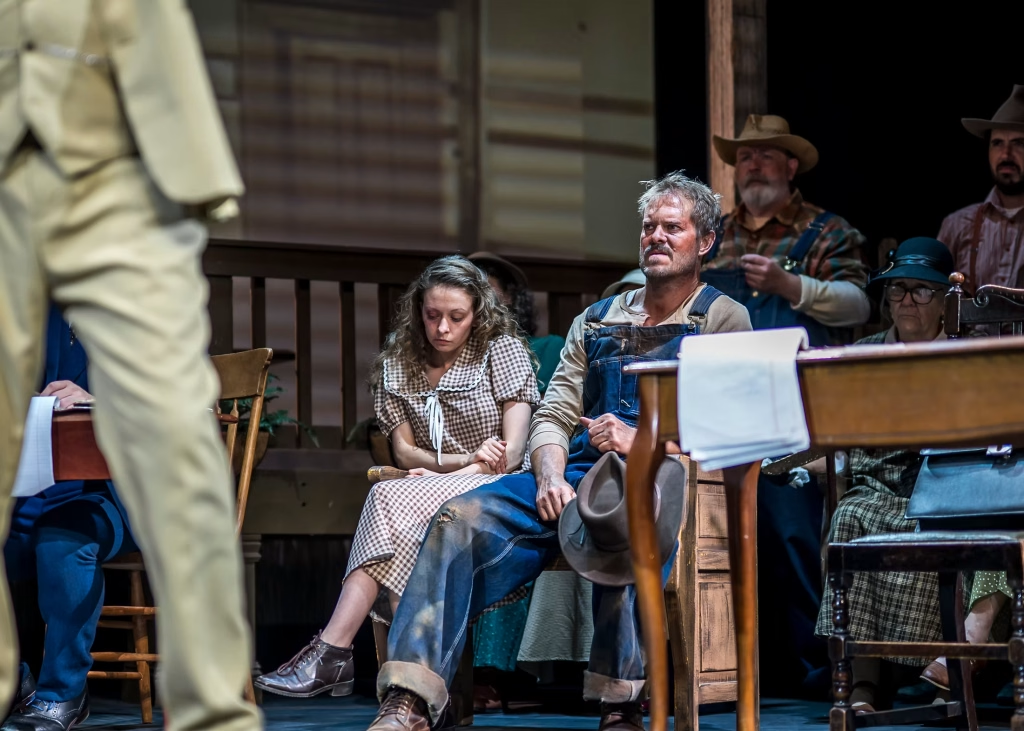
Ondine Morgan-Garner is fantastic as Mayella Ewell. Her bio notes that she first saw this play as a little girl at Hale Center Theater Orem and never forgot its gravity, and she brings that weight to a role that asks her to be both victim and accuser.
Wilkins delivers the closing argument straight to the house, casting the audience as the jury, and tells us that, in the courtroom at least, all men are equal.
At the center of that closing argument is Atticus’s explanation of Mayella’s real transgression: she tempted a Negro. In Maycomb’s code, that is the unforgivable act, and Tom must be destroyed so that no one has to face it. Wilkins delivers the line in a tepid, almost flat voice rather than with courtroom fire. The restraint works. Spoken plainly, as if he were stating a fact everyone in the room already knew, the line lands harder than any shout could.
The same speech has a line that almost made me laugh out loud. Atticus concedes that people are not equal in every sense: some are smarter than others, and some ladies make better cakes. In a plea for a Black man’s life, the homely comparison lands strangely, a small-town joke dropped into the gravest moment of the play. Notice, too, how it splits: people are measured by their minds, ladies by their cakes. As a woman who has out-argued more than a few men, I enjoyed the irony. Even in his great speech about equality, Atticus keeps women in the kitchen.
Atticus builds his plea for Tom on Thomas Jefferson’s promise that all men are created equal, a promise written by a man who enslaved people. The play shows that promise failing in Maycomb, but it was broken long before Tom Robinson ever took the stand. Atticus knows it, too. In the novel, he tells Jem after the verdict that in their courts, when it is a white man’s word against a Black man’s, “the white man always wins.”
Atticus’s complexity is clearest at the very end. When Heck Tate decides to report that Bob Ewell fell on his own knife, to keep Boo Radley out of the spotlight, Wilkins plays Atticus as truly conflicted. A man who has staked everything on the law has to accept bending it.
Therein lies the play’s quietest and most damning irony. Maycomb’s law, so unyielding when Tom Robinson stood before it, proves gentle and pliable when a white man needs its mercy. The town that could not spare an innocent Black man finds, in a single evening, every reason to protect Boo Radley.
Perhaps that is part of what Wilkins lets us see in Atticus’s hesitation. By then, he has watched his promise of equality fail twice: once in the verdict against Tom Robinson, and again on his own porch, when the law quietly makes room for a white man it never made for a Black one. We were the jurors he made that promise to. We were also the witnesses who watched it prove untrue, and still we rose to our feet at the end.
Design
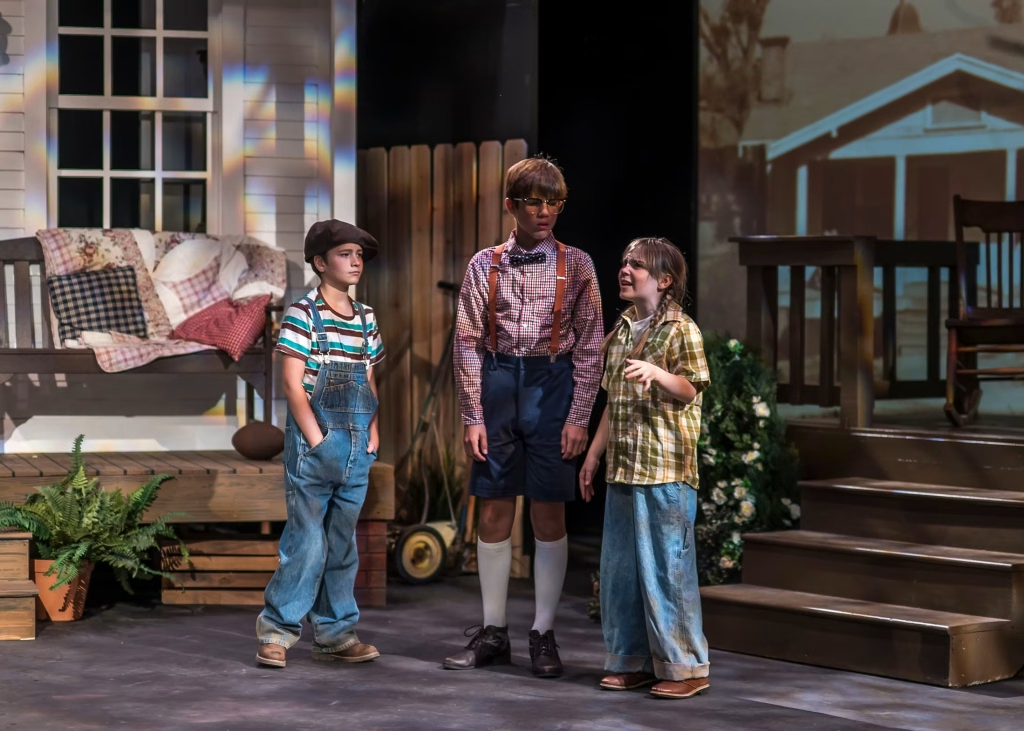
James B. Parker’s set is lovely, built around a little house on stage that grounds Maycomb in porches, yards, and neighbors. It rewards a close look: the stage is full of small details that make the town feel lived in. Buckets and odds and ends are tucked under the house, the way they would be under a real Southern home raised off the ground. The neighborhood’s maternal figure, Miss Maudie (Kate Kendrick), actually waters her flowers, a small, real task that makes the yard feel tended and alive. The stairs get plenty of use too, serving as a frequent path for entrances and exits that keeps the town in motion. His lighting is just as strong, and its standout element is the shadow work.
The projections have a sepia quality, like old photographs. They frame Maycomb as a memory, which suits a story told by a grown Scout looking back. Sepia is also the color of nostalgia, though, and nostalgia can soften what it remembers. They shift from a street scene to a house, moving us between the town at large and the private world of home.
The accents were well done across the board, a credit to dialect coach Brett Myers. Every member of the cast sounded like they belonged to the same 1930s Alabama town, without any of the voices tipping into caricature. The detail went down to individual sounds. When James Duncan’s Mr. Gilmer, the prosecutor, questions Mayella, you can clearly hear the breathy “wh” in words like “what” and “where,” an older Southern pronunciation that has mostly faded from American speech.
The music track at the end, from sound designers Spencer Hohl and David Morgan, is a fitting close.

When you finally see them
The play ends with Atticus telling Scout that most people are nice “when you finally see them.” It is a generous line, and it lands with real warmth after Scout finally meets Boo Radley face to face.
But are they? Maycomb saw Tom Robinson clearly. The jury heard his testimony, watched his useless left arm, and understood the truth, and they convicted him anyway. Seeing was never the problem. The town saw him and chose not to care. Boo is finally seen and embraced. Tom is seen and destroyed. In the novel, after Tom’s death, the town’s newspaper editor writes that killing him was like the senseless slaughter of songbirds. Reading it, Scout realizes the trial was decided before it began: “Tom was a dead man the minute Mayella Ewell opened her mouth and screamed.” Tom, too, is a mockingbird, and the play’s final mercy goes to Boo alone.
That is the question that hung over the house as the audience stood and applauded. Atticus’s faith in people is beautiful, and Wilkins makes us feel it. But Parker Theatre’s production asks the most of us when it lets us look past him: at Banks’s Tom, holding on to his dignity while his kindness is turned into evidence, and at Jones’s Calpurnia, caring for children whose story is not her own.
If the stage version cannot make room for Tom’s family, his church, and his mourners, the book can. So my call is simple: go back to the novel. Lee’s novel has its own limits, but it gives Tom and Calpurnia lives beyond the Finch household, and it shows the quiet racism of Maycomb’s most respectable people, not just the Ewells. Whatever this production moved in you, let the book finish the work of seeing Tom and Calpurnia more fully.
Seeing them is the beginning. To Kill a Mockingbird has spent more than sixty years teaching audiences to see injustice. What it cannot do is tell us what to do once we have. That part belongs to the people standing in the house when the lights come up.
This is an ensemble story, and the whole company deserves credit. Greg Hansen gives Bob Ewell the menace the story needs, and William McAllister’s Heck Tate brings quiet weight to the sheriff’s choice at the end. Randy Honaker presides as Judge Taylor, Tara Berrett brings Stephanie Crawford’s neighborly gossip to life, and Truman Schipper moves between the court clerk, Nathan Radley, and the mob. James Duncan pulls off a striking double, playing the prosecutor Mr. Gilmer and then, at the very end, Boo Radley, the man the town finally sees. Catherine Bohman and Josh Augenstein round out an ensemble that makes Maycomb feel like a real town.
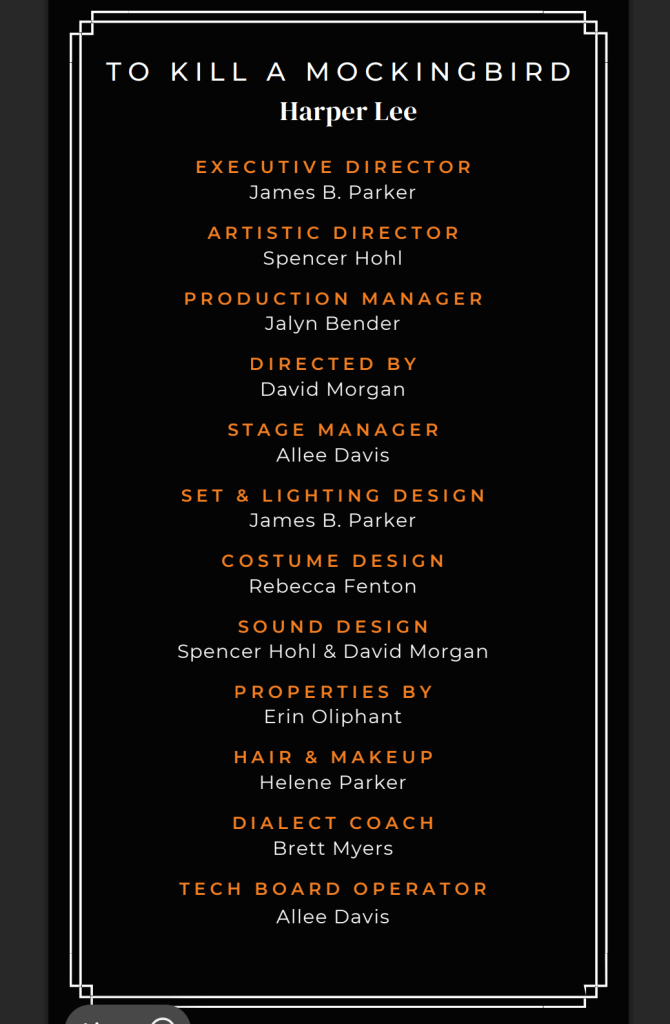
Behind the scenes, David Morgan’s direction holds a large cast and a heavy story together with clarity and care. Rebecca Fenton’s costumes, Helene Parker’s hair and makeup, and Erin Oliphant’s props ground the production in the 1930s, while stage manager and board operator Allee Davis and production manager Jalyn Bender keep it all running smoothly.
Well done to the cast and production team of Parker Theatre’s To Kill a Mockingbird.
Cast
- Atticus Finch: Brinton Wilkins
- Jean Louise “Scout” Finch: Lizzie Kintz
- Jeremy “Jem” Finch: Lincoln Oliphant
- Charles Baker “Dill” Harris: Oliver Miramontes
- Calpurnia: Karen-Christina Jones
- Tom Robinson: Kiirt Banks
- Mayella Ewell: Ondine Morgan-Garner
- Bob Ewell: Greg Hansen
- Heck Tate: William McAllister
- Judge Taylor: Randy Honaker
- Arthur “Boo” Radley / Mr. Gilmer: James Duncan
- Maudie Atkinson: Kate Kendrick
- Mrs. Dubose: Kathryn Atwood
- Stephanie Crawford: Tara Berrett
- Walter Cunningham: Dave Bruce
- Clerk / Nathan Radley / Mob Member: Truman Schipper
- Female Ensemble: Catherine Bohman
- Male Ensemble: Josh Augenstein
Production Team
- Director and Sound Design: David Morgan
- Sound Design: Spencer Hohl
- Set and Lighting Design: James B. Parker
- Costume Design: Rebecca Fenton
- Hair and Makeup: Helene Parker
- Properties: Erin Oliphant
- Dialect Coach: Brett Myers
- Stage Manager and Tech Board Operator: Allee Davis
- Production Manager: Jalyn Bender
- Executive Director: James B. Parker
- Artistic Director: Spencer Hohl
Content note: the play discusses rape at length, though never graphically, and includes racial slurs and violence. Parker Theatre recommended it for ages 8 and up.


Leave a Reply