
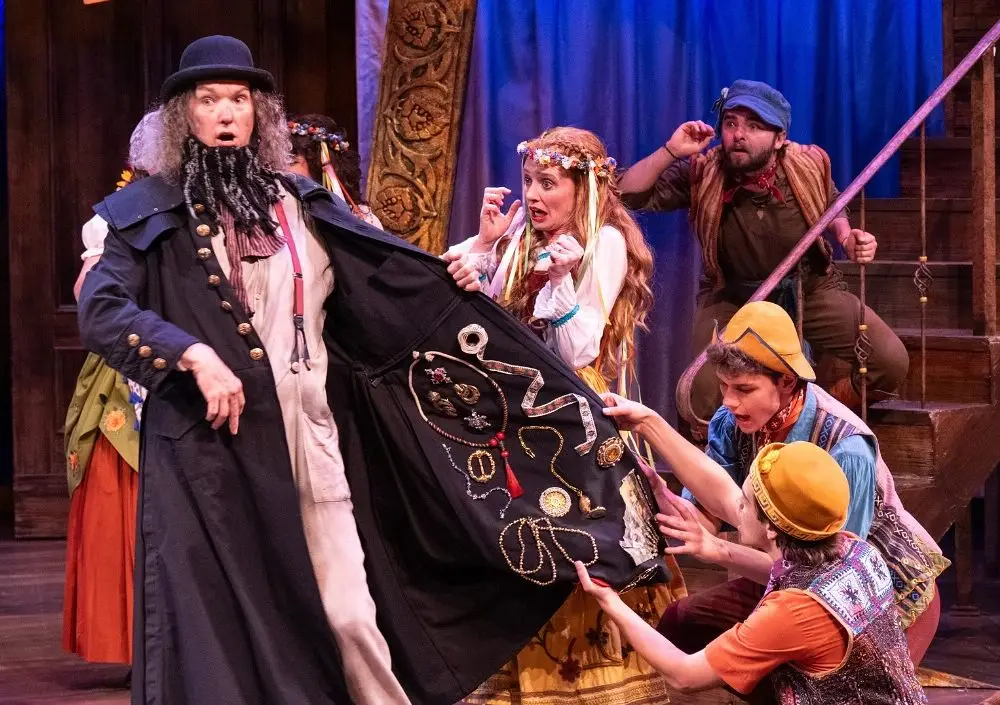
CEDAR CITY, UT — The Utah Shakespeare Festival’s 2024 production of The Winter’s Tale, directed by Carolyn Howart, delivers a nuanced interpretation on one of Shakespeare’s late romances. Blending tragedy and comedy, the production masterfully explores themes of jealousy, redemption, and the passage of time. Known for its dedication to classical theatre and high production values, the festival offers a fresh perspective on this lesser-known work.
A Rare and Unusual Shakespeare Play
The Winter’s Tale occupies a distinctive and often underappreciated place in Shakespeare’s body of work. Unlike the better-known tragedies or comedies, this late romance resists classification, combining elements of both while introducing pastoral and mythic dimensions. In Bohemia’s rustic scenes, the world feels reborn: a realm where, as the Shepherd exclaims, “Though I am not book-learned, yet I can read waiting-gentlewoman in the eyes of Perdita”” (4.4.322–323). Written near the end of Shakespeare’s career, it is part of a group of “problem plays” or “romances” — works that explore forgiveness, faith, and the supernatural rather than the strict comic or tragic formulas of his earlier periods.
Because of this hybrid form, The Winter’s Tale has historically been one of Shakespeare’s lesser-produced plays. Its tonal shifts — from jealousy and death to rustic comedy and miraculous rebirth — challenge directors and audiences alike. Few plays move so boldly from psychological realism to magical restoration. That very strangeness, however, is what makes it fascinating: it is Shakespeare’s meditation on storytelling itself—reminding us, as Time declares midway through the play, that “it is in my power / To o’erthrow law, and in one self-born hour / To plant and o’erwhelm custom” (4.1.7–9).
Director Carolyn Howarth leans into this hybridity, embracing both the play’s darkness and whimsy. The production doesn’t try to smooth over the play’s uneven edges; instead, it celebrates the tension between despair and wonder, tragedy and comedy. In doing so, Howarth reminds audiences that The Winter’s Tale may be lesser-known, but it is no lesser work — a testament to Shakespeare’s late-career experimentation and enduring faith in the redemptive power of art.
Plot Overview
The play begins with King Leontes of Sicily succumbing to a sudden and unfounded bout of jealousy, believing his wife, Queen Hermione, is unfaithful with his best friend, King Polixenes. His irrational rage devastates everyone around him, especially those he loves most. As the story shifts from a harrowing tragedy to a pastoral comedy, Leontes confronts the consequences of his actions and seeks redemption.

Themes and Analysis
The title, The Winter’s Tale, aptly reflects the play’s thematic arc. The early acts use winter imagery to depict the stark tragedy of Leontes’ jealousy and its aftermath, including the [SPOILERS] deaths of Mamillius and Hermione. The narrative then transitions to a spring-like renewal and somewhat comedic second act in the pastoral scenes set in Bohemia, symbolizing hope and regeneration. The play’s fantastical elements, including a miraculous ending, reinforce its fairy-tale quality, emphasizing themes of forgiveness and second chances. The structure mirrors the seasonal transition, with a harsh beginning giving way to a redemptive and hopeful conclusion. Shakespeare signals this cyclical renewal through imagery as delicate as it is enduring: “Daffodils, / That come before the swallow dares, and take / The winds of March with beauty” (4.4.118–120).
Performance Highlights
Standout performances mark the production. Chauncey Thomas excels as Leontes, masterfully navigating the character’s descent into madness and subsequent redemption with accessible and engaging language. Tracie Lane’s Hermione exudes elegance and emotional depth, her eloquent physicality amplifying the character’s strength and vulnerability. Notably, her striking blue gown in the opening scene (designed by Raven Ong) sets the tone for her regal presence.
Tom Coiner’s portrayal of Camillo brings warmth and authenticity, while Alaysia Renay Duncan’s performance as Perdita was another highlight, showcasing her character’s inherent nobility and charm. Christopher Centinaro and Duncan shine as Florizel and Perdita, whose chemistry brings youthful charm to the pastoral scenes. John Harrell‘s Autolycus provides comic relief, with his witty delivery and musical talent adding layers of humor. His playful costume, complete with a sock hole, perfectly complements his character’s mischievous persona. Harrell shares a hilarious scene with Topher Embry where Embry’s costume is transferred entirely to Harrell on stage, in about about a minute. Harrell remarks, “Great garments has he, but he wears them not well.” That made me smile.
Production Design

Director Carolyn Howarth’s vision is brought to life through inventive staging and a keen focus on thematic contrasts. Apollo Mark Weaver’s art deco-inspired set design effectively juxtaposes the formality of the Sicilian court with the rustic charm of Bohemia, using golden frames and aspen tree trunks to visually convey the play’s dual settings.
Donna Ruzika’s lighting design enhances the mood, contrasting the moody blues of Sicily with the warm, vibrant hues of Bohemia. Lindsay Jones’ sound design heightens dramatic tension, particularly in Leontes’ pivotal monologues.

Exploring the Term “Pastoral”
To fully understand The Winter’s Tale, one must understand that Shakespeare is pulling from the Renaissance concept of “pastoral.” In Shakespeare’s time, “pastoral” described a genre that idealized rural life and settings, originating from the Latin word for shepherd. This genre portrayed rural life as simple, innocent, and harmonious, contrasting it with the corruption and complexity of urban or courtly life. Pastoral works often explored themes of romantic love and nature or a harmonious relationship with nature, using poetic language. They also served as allegories to address broader issues. These pastoral elements, set predominantly in the countryside, stand in stark contrast to the corruption and complexity of court life. The idyllic setting of Bohemia features characters who live uncomplicated and honest lives, embodying an idealized vision of rural existence. Here, nature and its beauty are celebrated, and the pastoral world is portrayed as pure and free from the deceit found in the Sicilian court.
Central to these scenes is the romantic relationship between Perdita and Florizel, symbolizing youthful love and natural beauty. This contrast emphasizes the transition from the intricate and corrupt world of the court to a simpler, more genuine rural life, ultimately serving as a backdrop for transformation and renewal as characters seek redemption and new beginnings. Thus, the pastoral elements in The Winter’s Tale underscore themes of innocence and natural beauty, offering a refreshing counterpoint to the darker, more complex aspects of the royal court. This is a huge theme in The Winter’s Tale and probably why Director Howarth wanted the audience to feel we were in the forest with the aspen trees.


The most rewarding moment of the production lies in its poignant finale, where forgiveness and faith bring the story to a miraculous resolution. Trenell Mooring’s Paulina encapsulates the play’s heart with her line to Leontes: “It is required that you do awake your faith” (5.3.94–95). This open-ended moment allows the audience to ponder the nature of redemption and the role of genuine remorse.
The Winter’s Tale is a testament to the Utah Shakespeare Festival’s ability to deliver compelling interpretations of Shakespeare’s works. With outstanding performances, inventive design, and thoughtful direction, this production offers a memorable theatrical experience that captivates and inspires.
The Winter’s Tale runs at the Engelstad Shakespeare Theatre on the campus of Southern Utah University on Tuesdays and Fridays at 8:00 PM through September 6. Tickets range from $15 to $85. For more details, visit www.bard.org.

Learn More: Study Guide
Content Advisory
The Winter’s Tale is suitable for most audiences, but it includes mature themes and emotional content. The play portrays intense jealousy, wrongful accusation, and abuse of power within marriage and family. Viewers will encounter moments of grief, loss, and reconciliation, as well as references to death and implied violence. While much of the story ultimately celebrates forgiveness, rebirth, and renewal, some scenes—particularly those involving coercion, patriarchal control, and parental estrangement—may be distressing to some audience members. Light sexual humor and innuendo also appear throughout.
Tickets: $15 to $85.
Venue: 200 Shakespeare Ln, Cedar City, UT 84720
Sponsored by Jeremy and Amy Hanks Foundation
Address: 101-199 W University Blvd, Cedar City, UT 84720
Dates: Select dates until September 6, 2024, at 2:00 PM and 8:00 PM
Tickets: $15 to $85
Contact: 435-586-7878 or 1-800-PLAYTIX https://www.bard.org/
#thewinterstaleus


Leave a Reply