
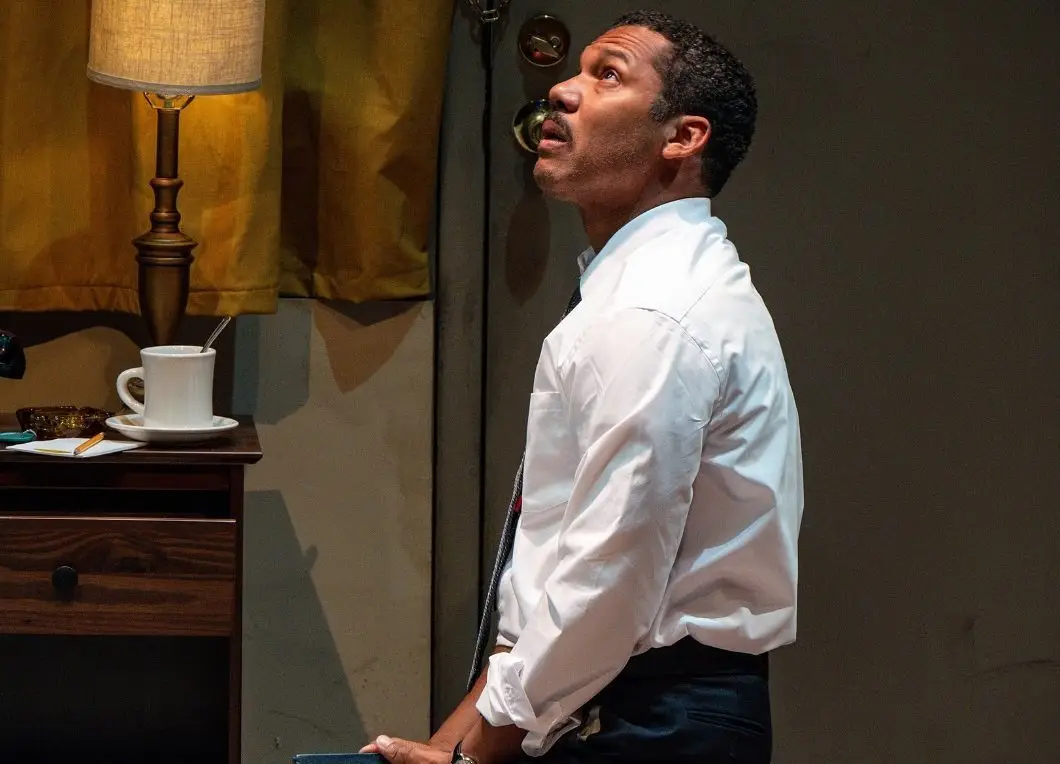
CEDAR CITY, UT—The Mountaintop, currently staged at the Utah Shakespeare Festival (USF), delivers a profound and thought-provoking portrayal of Dr. Martin Luther King Jr.’s final night. Crafted by playwright Katori Hall, the play is set in the infamous Room 306 of the Lorraine Motel in Memphis on April 3, 1968, the night before King’s assassination. The story begins with a weary Dr. King encountering a mysterious and beautiful yet equally hilarious maid, Camae, whose true identity and purpose unfold gradually, revealing profound insights into King’s legacy and humanity.
Pulitzer Prize, Olivier Award, and two-time Tony Award nominee Katori Hall is the Playwright of The Mountaintop. Better known for her musical, Tina: The Tina Turner Musical, her writing excels in humanizing a revered figure like Dr. King. The dialogue blends humor, poignancy, and philosophical reflection, tackling themes of mortality, legacy, and the ongoing struggle for social justice. The play does not shy away from portraying King’s flaws and fears, making his character more relatable and his achievements even more remarkable. The play premiered in London to critical acclaim, winning the 2010 Olivier Award for Best New Play — the British equivalent of winning a Tony in the U.S. — before it opened on Broadway.
“A warts-and-all portrayal of Dr. King is important because there’s this extraordinary human being who is actually quite ordinary . . . I feel as though by portraying him with his flaws and foibles, we, too, can see — as human beings who have these flaws — that we, too, can be Kings; we, too, can carry on that baton that he has passed down to us.”
~Katori Hall~
In an interview with NPR, Hall said, “I grew up always having his [King’s] voice in my ears, and in my heart and in my mind.” However, channeling King’s well-known voice can be a challenge for actors: “I always tell an actor who is about to play King, ‘It’s more about capturing the essence of him; it’s more about capturing the charisma.’ ” In USF’s production, you get both.
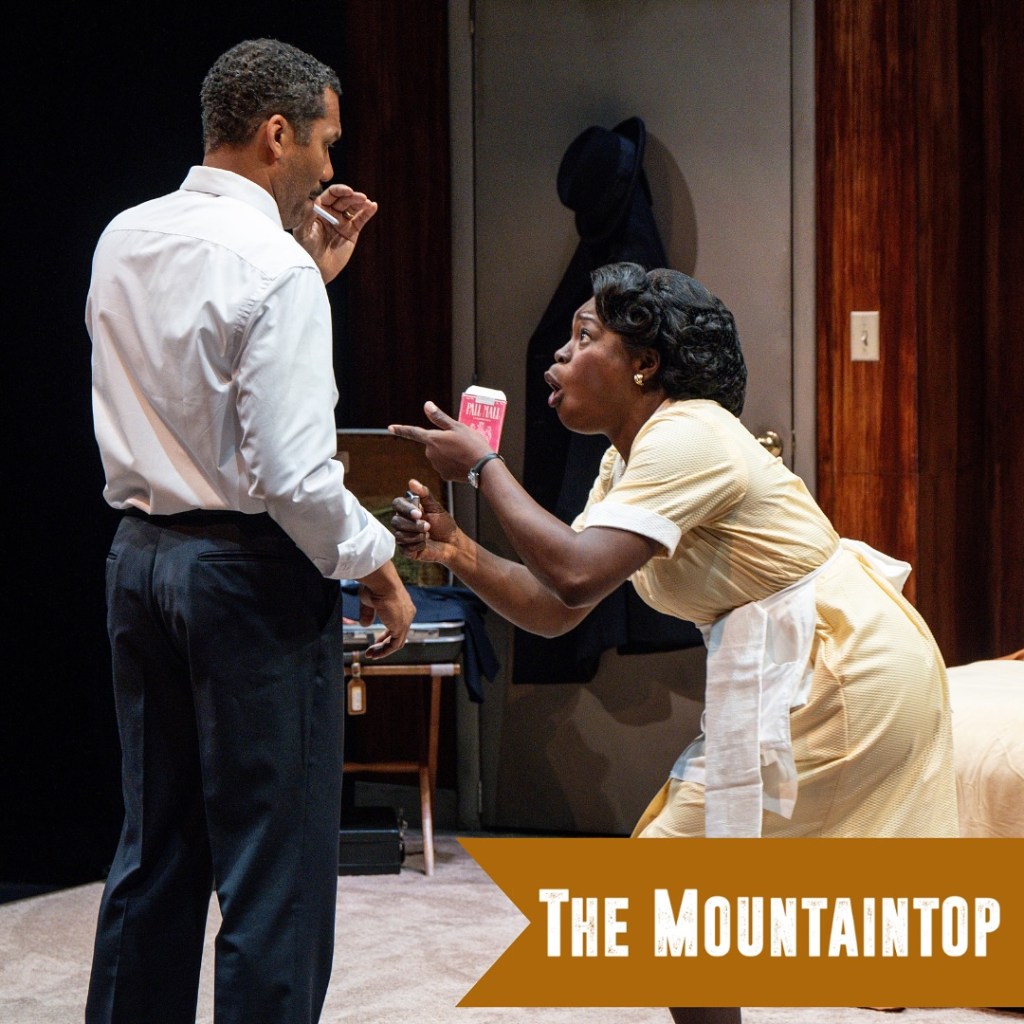
Abdul-Khaliq Murtadha, portraying Dr. King, masterfully captures the complexity of King’s character, balancing his public persona as a civil rights icon with the private vulnerabilities of a man burdened by his mission. Murtadha’s portrayal is heartfelt and multifaceted, showcasing King’s charisma, humor, and moments of doubt. Alia Shakira, playing Camae (named after the playwright’s Mother and Grandmother), delivers a powerful performance, transitioning from a seemingly ordinary hotel maid to an unusual celestial guide, adding a dynamic and moving counterpoint to King’s character. Shakira is a strong comedic actress whom the audience immediately falls in love with. Impressive, considering that Murtadha is impersonating one of the most extraordinary people to ever live and does an exceptional job at it.
The interplay between realism and supernatural elements is an unusual aspect of this play that makes Hall’s writing unique. For example, at one point in the play, King opens up his hotel room door in an attempt to escape Camae, and out of nowhere, snow flies in—remember, we are in Memphis, Tennessee, and it is April, so that is crazy. However, the transition between these two can occasionally feel uneven. But overall, Director Cameron Knight does an incredible job with this.
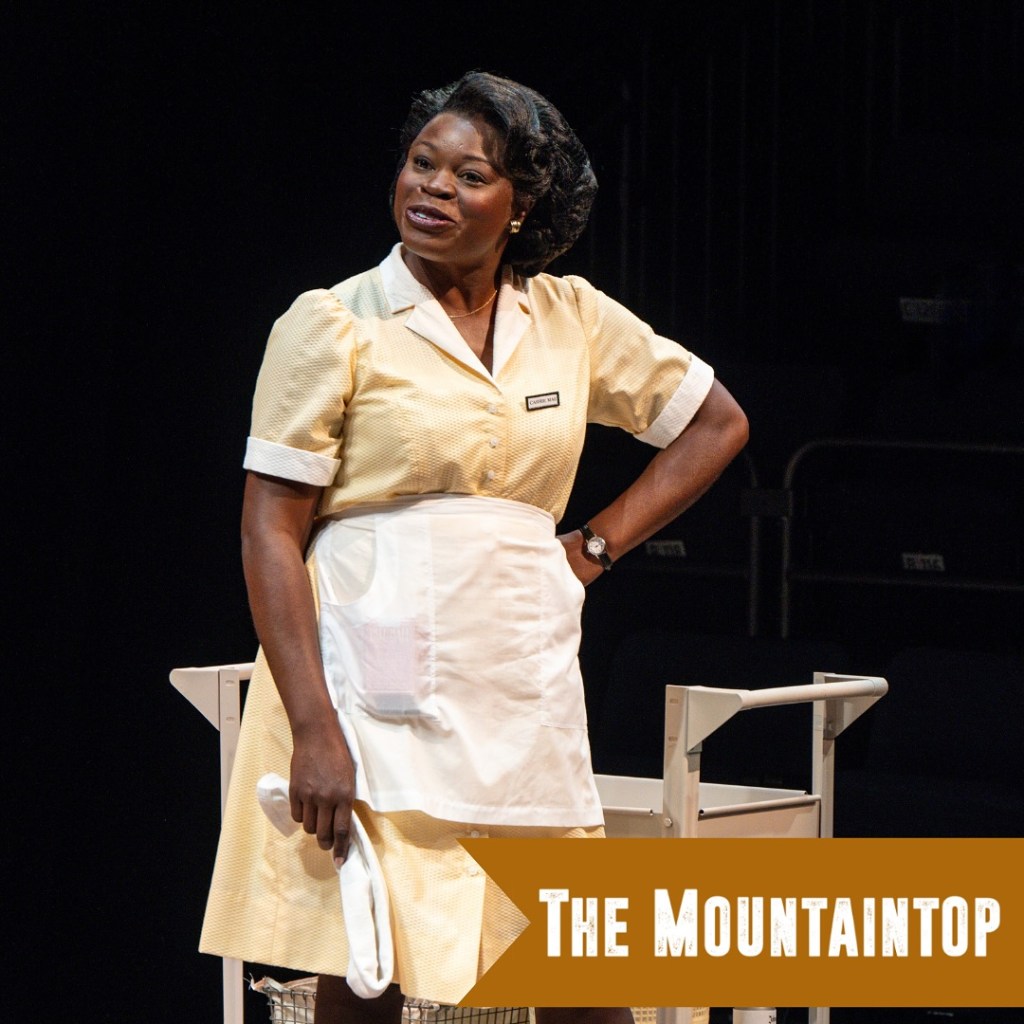
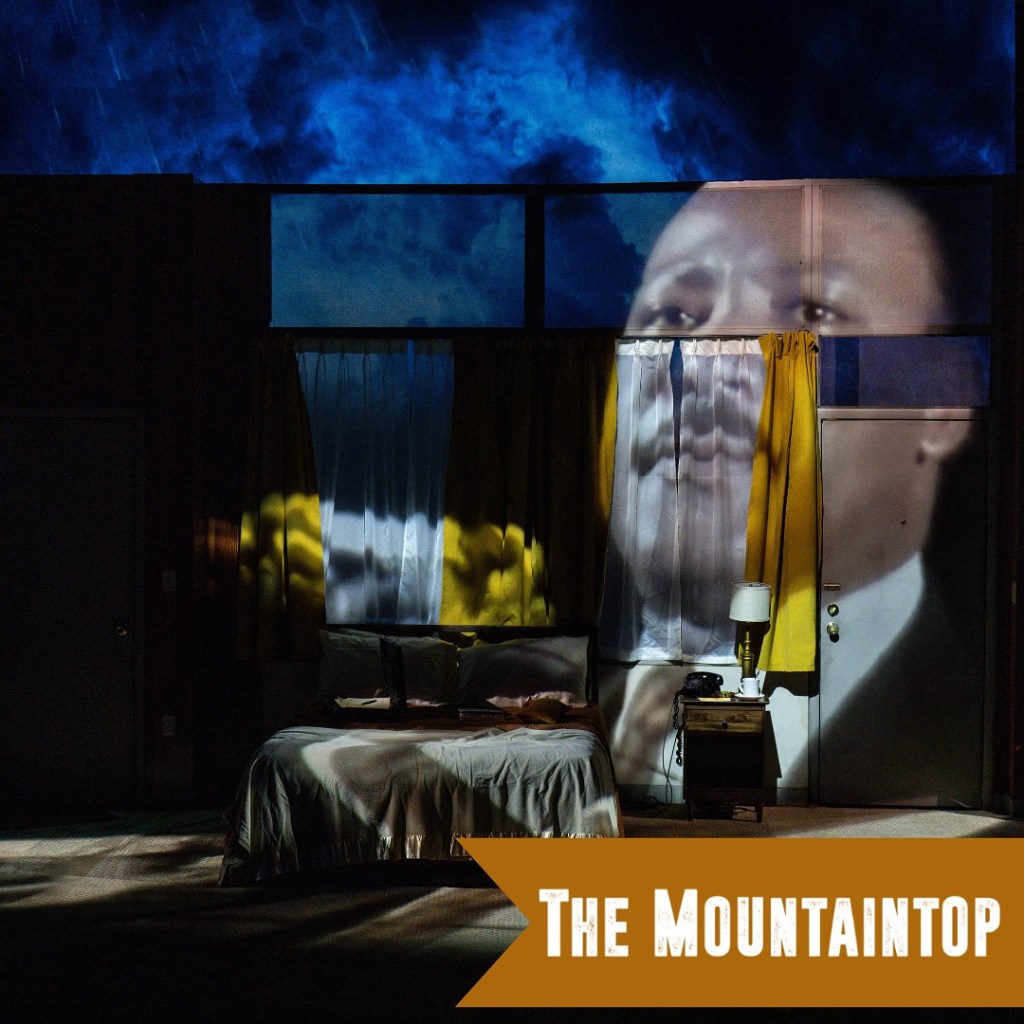
With a keen eye for intimacy, Knight immerses the audience in what feels like a deeply personal conversation *Knight directed a similarly stunning adaptation of The Tempest (2022) in the same theatre, featuring Jasmine Bracey as Prospero two years earlier. Jo Winiarski’s scenic design creates a simple yet evocative setting that captures the confined and tense atmosphere of the motel room. Jaymi Lee Smith‘s lighting design and Joe Payne’s projection work are instrumental to this play and Knight’s vision; they enhance the supernatural elements of the narrative, particularly during Camae’s revelations. The sound design by ien DeNio adds a crucial layer, heightening the emotional intensity and underscoring the play’s pivotal moments. Costume design by Jeffery Lieder places us effectively in 1968. I loved looking up to the sound and lighting booth to see Stage Manager R. Christopher Maxwell dancing to Childish Gambino’s “This is America” as the audience exited the theatre.

There were so many profound statements made through this play. For me, one that stands out was when Camae brought up MLK Jr.’s daughter Bernice.
CAMAE.The truth ain’t gotsta to be fair. It’s the truth.
KING. But why you?
CAMAE. Believe you me, I ain’t want this job. First day? Bring
over you? The Kang? I ain’t wanna do it. But God been gettin’ these
prayers from a littlun named Bunny. “Please, God,
don’t let my daddy die alone.” When I heard it … Well, it just
’bout broke my heart. I just had to come …
KING. You know her nickname … Bernice, my sweet Bernice.
My baby girl spoke to you?
CAMAE. Her prayers are powerful. I can tell she’s your’ n. She gots
a way with words. A gift. Soundin’ like she gone be a preacher one
day. I don’t like chirren too much, but she … she somethin’ .
KING. My Bunny, my baby girl. Even she knows …
CAMAE. Yes. I gotta take you to the other side. Look, I
know you afraid, Preacher Kang –
KING. How you know I’m afraid?
CAMAE. Because … You should be.
Up until this point in the play, we know little about why Camae is there to speak to King. I appreciate that Hall chose to highlight the faith of a child instead of King’s faith. What a powerful statement of hope for the future. The interplay between Shakira (Camae) and Murtadha (King) enhances the dramatic tension and underscores the emotional weight of the scene. Camae reprimands King while also providing him with comfort. As she slowly exposes who she is and why she is there.
I have followed King’s daughter, Dr. Bernice King, on social media for some time now, and she is indeed following in the footsteps of her father, providing a powerful voice for justice and equality for all.
The Mountaintop, currently playing at the Utah Shakespeare Festival, is a powerful and moving production that offers a fresh perspective on Dr. Martin Luther King Jr.’s legacy. Strong performances, combined with thoughtful direction and design, create a compelling exploration of a historical icon’s humanity. The play successfully invites the audience to reflect on King’s enduring impact and the ongoing relevance of his message.
At an after-the-show seminar and talk-back, theatergoers gave overwhelmingly positive feedback. Some of the reactions included comments like “Absolutely amazing,” “Very moving,” and “Very powerful,” which speaks to the show’s emotional and thought-provoking nature. One of the most poignant reactions came from 83-year-old Veteran Bob Van Steenburg, who I learned was deployed, serving our country in Vietnam during King’s assassination.
I came out of that play wanting to talk to someone about it…I am an old white man, who lived in that era. I wanted to talk with a Black man who lived in that era. I wanted to talk to a with a young Black person who didn’t live in that era and the same with a young white person…I had to talk to someone about all my feelings and thoughts about that play. It just made me want to engage with somebody…thats what that play did to me.
~Bob Van Steenburg~
The power of this play lies in its ability to humanize a figure often seen as perfect, reminding us that, despite his flaws, Dr. King’s contributions to peace, love, and justice are invaluable. In these politically divided times, The Mountaintop serves as a vital reminder of our shared humanity and the importance of building bridges through understanding and dialogue.
“We’ve got some difficult days ahead. But it really doesn’t matter with me now. . . And I’ve seen the Promised Land. I may not get there with you. But I want you to know tonight, that we, as a people, will get to the Promised Land!”
Dr. Martin Luther King, Jr.
https://www.npr.org/2024/02/07/1228320048/black-history-mlk-speeches-martin-luther-king
Content Advisory
An inspirational historical fiction, this play includes explicit language, including several uses of the “f” word, uses of an offensive racial slur, and mature themes regarding infidelity, sexual content, and violent imagery. May not be suitable for pre-teens.
Venue: Eileen and Allen Anes Studio Theatre, Located in the Beverley Taylor Sorenson Center for the Arts
Sponsored by the Guild of the Utah Shakespeare Festival
Address: 101-199 W University Blvd, Cedar City, UT 84720
Dates: Select dates until October 5, 2024, at 2:00 PM and 8:00 PM
Tickets: $30–60
Contact: 435-586-7878 or 1-800-PLAYTIX https://www.bard.org/

Where the Spotlight Meets Insight


Leave a Reply