

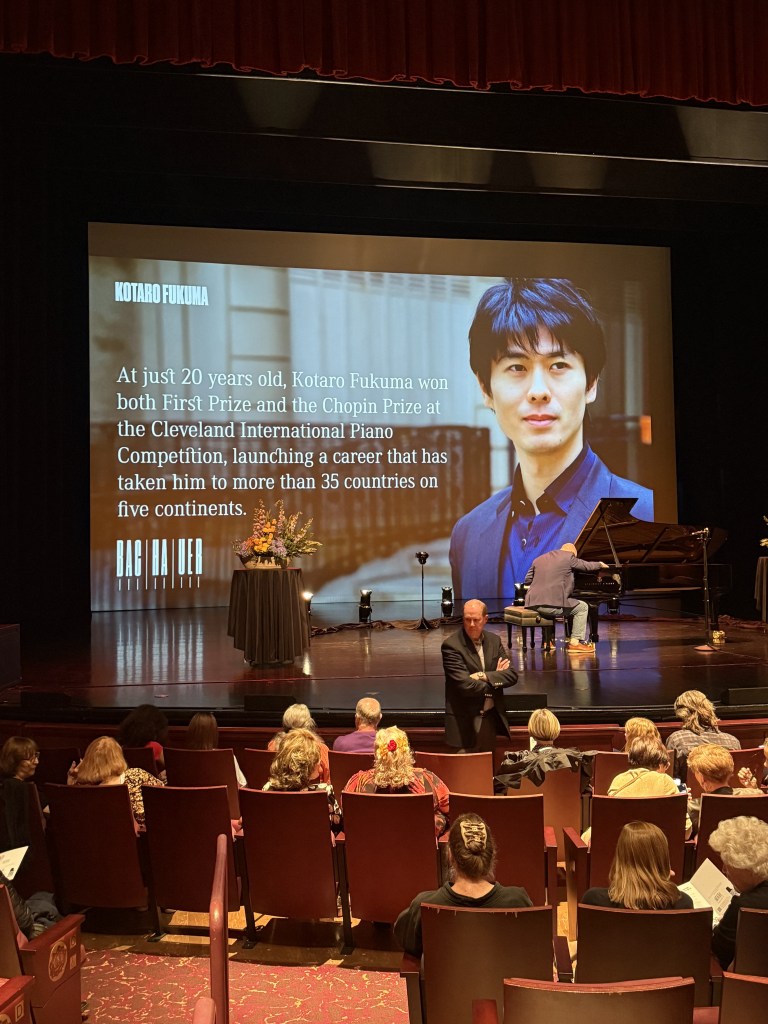
Rose Wagner Performing Arts Center, Salt Lake City, UT—Bachauer laureate Kotaro Fukuma opened the 2026–27 Gina Bachauer Concert Series on October 9th, taking audiences on a musical journey into the world of Franz Liszt and more! The performance marked the beginning of a new season for the Bachauer, continuing its tradition of presenting outstanding pianists and sharing the experience of live classical music with the Salt Lake community.
Kotaro Fukuma’s performance was a wonderful way to open the 2026–27 Gina Bachauer Concert Series. As someone who loves Romantic period music, I had been looking forward to this program, and the evening left me with plenty to reflect on. The Rose Wagner Performing Arts Center was elegant and beautiful, with two floral arrangements in blue and yellow that matched the program’s theme. Designed to look like a passport, with the Bachauer logo in the center and the word “Passport” on the cover, the program introduced the audience to the idea of traveling into Franz Liszt’s musical world. Audience members could collect stamps in their passports, receiving the first half at intermission and the remaining stamps at the end of the concert. This interactive detail made Liszt’s journey through Italy feel even more real, allowing the audience to take part in the musical pilgrimage themselves.
The excitement surrounding this musical journey was already present before Fukuma even began to play. Kary Billings, executive director of the Bachauer, shared with the audience that they had been trying for years to make this concert happen, making the evening feel even more special.

A Book for Liszt: Stefanelli’s Livre
Fukuma shared a few words about the program, introducing Livre: Homage to Franz Liszt, a work by his friend and composer Matthieu Stefanelli. Even though the piece had a modern sound, there were melodies that kept coming back, making the music feel connected. The music was full of suspense, creating a sense of anticipation as if something were about to happen, while keeping the audience wondering what would come next. Although its style was quite different from the rest of the program, it served as a beautiful introduction to the evening, opening the door to Liszt’s musical world and preparing the audience for the journey that followed.
Two Hands, One Opera: Wagner’s Tristan und Isolde Transcribed for Piano
Fukuma continued with the Prelude from Wagner’s Tristan und Isolde in his own transcription, followed by Isolde’s Liebestod in Liszt’s, bringing another composer into the evening’s musical journey. Before playing, he spoke about the relationship between Liszt and Wagner, even mentioning with a touch of humor that they were not always on the best of terms toward the end of their relationship. His comments made the connection between the two composers even more meaningful. What I found especially interesting was how naturally the two transcriptions fit together, even though they were written about 150 years apart. Fukuma’s transcription of the Prelude had a sound and style that reminded me of Liszt’s own approach to the piano, making the two pieces feel connected despite so many years between them. The pairing was beautiful, capturing the tension and agony within Wagner’s music. You could feel it in the spaces between the chords, where the music seemed to pause before continuing. When he played the last note, Fukuma remained completely still for a few seconds, as if he needed a moment to collect his thoughts after expressing so much emotion through the piano. It was a powerful moment, and the audience eventually broke the silence with well-deserved applause.
Walking on Water: Liszt’s Légende
After the emotional intensity of Wagner, Fukuma played Liszt’s Légende No. 2: St. François de Paule marchant sur les flots. The music brought to mind the image of St. Francis crossing the water, with rushing passages and powerful chords that seemed to capture the waves crashing. The technical demands were remarkable, requiring not only speed and precision but also enormous control and power. Fukuma handled these challenges with an impressive combination of control and intensity. His whole body seemed to become part of the performance, sometimes lifting off the bench as he put more power into the music. It was fascinating to watch how he used his physical energy to bring the music to life without losing control. His performance made the piece’s technical difficulty clear, but what stood out most was how he transformed that difficulty into an expressive experience for the audience.
The Pilgrimage: Liszt’s Années de pèlerinage, Italie
Before the concert began, Fukuma also mentioned that the second half of the program was especially important, setting high expectations for what was to come. He played all seven pieces from Années de pèlerinage, Deuxième année: Italie. Inspired by Liszt’s travels through Italy, the seven pieces move through Raphael’s painting, Michelangelo’s sculpture, Petrarch’s love sonnets, and finally Dante’s Inferno. My personal favorite was Il penseroso, inspired by Michelangelo’s statue of Lorenzo de’ Medici. The slow and heavy chords bring out a melody that feels thoughtful and reflective, almost as if the music were thinking, just like Michelangelo’s statue. The three Petrarch sonnets were the most lyrical of the collection, with beautiful melodies that seemed to make the piano sing. Fukuma played them intimately, like songs whose words had been taken away.
Through Hell and Back: The Dante Sonata
The collection ended with Après une lecture du Dante: Fantasia quasi Sonata, whose title comes from a Victor Hugo poem written after reading Dante. It was a perfect ending to the journey. Fukuma’s playing was powerful and intense in some moments, then soft and expressive in others; the contrast between suffering and beauty was very noticeable. In an interview before the concert, Kary Billings described the journey as moving from “the depths of hell onto the great wonders of something miraculous and glorious.” Fukuma seemed to express all of this through his playing, bringing the collection to a powerful conclusion.
What impressed me most about the last part of the program was how effortlessly Fukuma moved from one piece to the next, even when they were completely different in character. One moment, the music felt calm, with melodies that seemed to float through the room; the next, it was fast, fiery, and intense. The brief pause between each piece seemed to be all he needed to immerse himself in the new musical world. As he played, he appeared completely absorbed in the music; each new piece came naturally to him. Watching him move between such contrasting moods made the performance even more remarkable and brought Liszt’s musical journey to life.
A Dream of Love: Two Encores
Fukuma surprised us with not just one encore, but two! Just when we thought the evening had come to an end, he returned to the piano to give us more music. He first performed Liszt’s famous Liebesträume No. 3 (“Dream of Love”). It was beautiful; every tone felt carefully placed. He then played part of his Chanson Medley, his own transcription featuring “Bella Notte” and “My Way.” It was an amazing way to end the evening, reminding us once again that Fukuma’s talent extends beyond his abilities as a performer. His skill as a transcriber allows him to bring familiar melodies into his own musical world, giving the audience one more reason to admire his artistry.

Love as Pilgrimage: A Conversation with Fukuma
After the concert, Keolanani and I had the opportunity to speak with Fukuma briefly about the meaning behind the program. Keolanani asked him whether love was the ultimate pilgrimage, a question that connected so perfectly with the themes of Liszt’s music. Fukuma explained: “Love was quite an important theme for Franz Liszt, because he was such a generous man, and he contributed so much to the world, and he supported so many young artists, of course, composers.” His answer made me think that perhaps love was part of Liszt’s pilgrimage not only through his music, but also through the generosity he showed to others and the support he gave to younger artists.
Fukuma gave us more than a display of technical brilliance; through his playing and his own transcriptions, he invited us into a musical world full of different emotions and stories. His performance was a memorable beginning to the 2026–27 Gina Bachauer Concert Series, a reminder that a musical journey is measured less by the places we visit than by the emotions we carry with us along the way.
Next in the Bachauer Concert Series: Youl Sun: Grandmasters on November 6, 2026.
Catch Kotaro Fukuma on tour:
- October 23: Ann Arbor, MI, University of Michigan, “The Arts of Piano Transcriptions”
- October 25: Glens Falls, NY, de Blasiis Chamber Music Series, “The Arts of Piano Transcriptions”
- October 27: Mountain View, CA, Japan Society of Northern California, “Shimmering Water”
- December 3: Paris, Salle Cortot, “Hommage à Franz Liszt,” a version of the Liszt homage he played in Salt Lake City
See his full schedule.
Follow Kotaro Fukuma: YouTube · Instagram · Facebook · X · Apple Music · Fan Club
PROGRAM
Kotaro Fukuma, piano
Friday, October 9, 2026 · Jeanné Wagner Theatre, Rose Wagner Performing Arts Center
Gina Bachauer Concert Series, 2026–27 season opener
Matthieu Stefanelli, Livre: Homage to Franz Liszt
I. Earth and Reveries of Will
II. Waves: The Secret of the Potion Lies Elsewhere
III. Evening Harmony: Pantoum
IV. Iridescence: One Sees Clearly Only with the Heart
Richard Wagner, Tristan und Isolde: Prelude (trans. Kotaro Fukuma) and Isolde’s Liebestod (trans. Franz Liszt)
Franz Liszt, Légende No. 2: St. François de Paule marchant sur les flots (St. Francis of Paola Walking on the Waves)
Intermission
Franz Liszt, Années de pèlerinage, Deuxième année: Italie (Years of Pilgrimage, Second Year: Italy)
- Sposalizio
- Il penseroso
- Canzonetta del Salvator Rosa
- Sonetto 47 del Petrarca
- Sonetto 104 del Petrarca
- Sonetto 123 del Petrarca
- Après une lecture du Dante: Fantasia quasi Sonata
Encores
Franz Liszt, Liebesträume No. 3
Kotaro Fukuma, Chanson Medley (excerpt), including “Bella Notte” and “My Way”
For the stories and artworks behind each piece, see our listener’s guide: Pilgrimage: A Listener’s Guide to Kotaro Fukuma’s Liszt Program.


Leave a Reply