

Review: Mad World, Mad Kings, Mad Ambition: Shakespeare’s King John
Mad World, Mad Kings, Mad Ambition: Shakespeare’s King John
The title borrows and bends a line straight from the play itself: “Mad world, mad kings, mad composition!”, the Bastard’s own verdict on the England-France peace deal in Act 2.
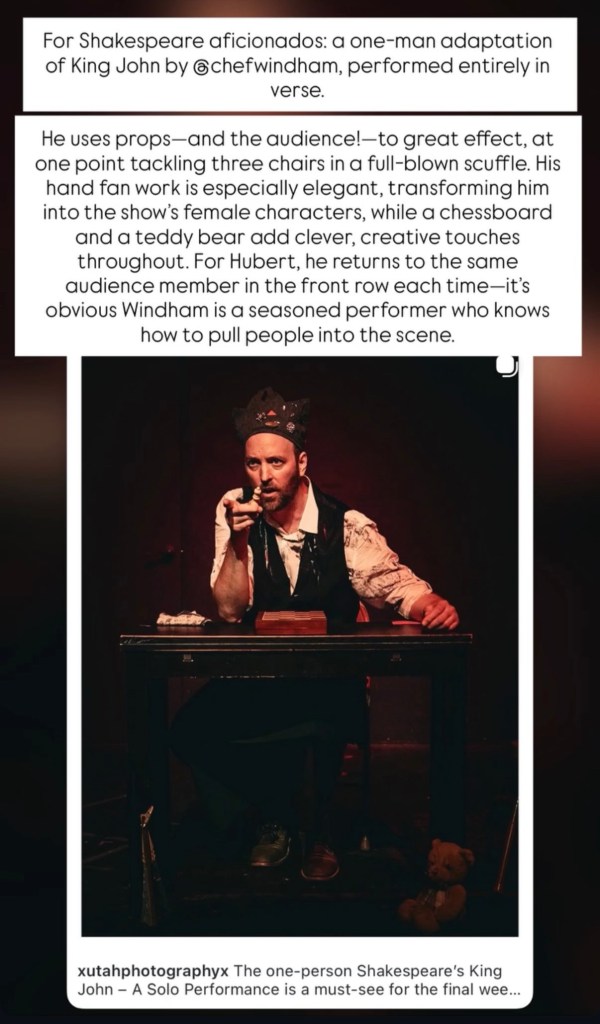
Shakespeare’s King John – A Solo Performance, produced by The Giddy Round and directed by Damjan Dimovski, condenses one of the Bard’s lesser-performed history plays, normally a 2.5-hour undertaking, into a single hour, with one actor, Matthew Windham, playing every part. In verse, notably: King John is one of only two Shakespeare plays written entirely in verse, the other being Richard II, which happens to be the other history play Windham has previously adapted solo. It’s an interesting interpretation, and an impressive feat of craft, and I want to be upfront that I’m not sure it’s a show for me. All of that can be true at once, and I think it’s worth sitting with rather than resolving one way or the other.
For anyone going in as cold as I did: the play follows the reign of King John of England, whose claim to the throne is contested by his young nephew Arthur, who has French backing and, by primogeniture, arguably the stronger right to it. War, an excommunication by the Pope, and a lot of shifting alliances follow. John captures Arthur and orders his death; his jailer Hubert can’t bring himself to do it and hides the boy instead, but Arthur dies anyway attempting to escape, and the English nobles, believing John murdered his own nephew, turn against him. John is eventually poisoned by a monk and dies with his nobles gathered around him, and the play ends with the lords swearing allegiance to his young son, Prince Henry, who becomes King Henry III. It’s a genuinely cynical, cold-blooded play about power, legitimacy, and what people will justify to hold onto both.
An Undeniable Feat of Craft
Windham comes to this with real pedigree: he’s associated with the Flagstaff Shakespeare Festival, won best solo show honors at the Pittsburgh Fringe for his cutting of Richard II, and picked up a Viola Award for Excellence in Performing Arts this year for Shakespeare on Pluto, which he also wrote. King John is clearly built on the same skill set, and it shows in the sheer control on display, control that’s as much a credit to director Damjan Dimovski’s staging as it is to Windham’s performance. Between them, they differentiate a full cast of characters using little more than a desk, a handful of props, and one actor’s body, and the transitions are legible even when the text itself gets dense. And it’s worth just saying plainly: the memorization alone is remarkable, an hour of Shakespearean verse, solo, with no scene partner to bounce off of or take a cue from, is a serious feat of recall on top of everything else Windham is doing on stage.
Windham’s voice work carries just as much of the load as the props do. At one point he switches into a hick, country-inflected accent for one of the characters, a genuinely funny, unexpected choice that stood out against everything else in the piece. The audience clearly appreciated it, real laughs went up around the room, and it’s a good example of how well Windham’s comic timing and delivery land even inside a dense, verse-heavy structure like this one.
The prop work is the clearest evidence of that skill, and here Dimovski’s direction deserves real credit alongside Windham’s execution: someone had to decide that a hand fan announces the show’s female characters every time it comes out, and it’s elegant, an economical, precise piece of physical shorthand that does real work. A chessboard and, memorably, a teddy bear standing in for young King Arthur add clever, unexpected touches throughout, right down to a small, well-thought-out detail: there’s a magnet built into the bear’s hands so it can actually hang on the back of a chair, a tiny piece of engineering that makes the prop feel considered rather than just grabbed off a shelf. At one point three chairs become the site of a full-blown scuffle, choreography that has to have been built collaboratively between the two of them. And for Hubert, the choice to return again and again to the same audience member in the front row, speaking directly to him whenever the character is addressed, reads like a directorial decision as much as a performance one, a bit that only works if the whole production has real command of the room, and by all accounts the audience member was fully into it the night I saw it.
More broadly, Windham is skilled at playing to the whole room, not just that one front-row plant. He takes the time to look each audience member in the eye, and points at them directly at moments throughout, bringing them into the show almost as castmates rather than passive onlookers, castmates without lines, but castmates all the same, working his way around the space rather than settling on a comfortable middle distance the way a lot of solo performers do, and it takes a certain type of actor, one with no fear, to do that convincingly for a full hour without it reading as mechanical or performative. He got to me, too, even from where I was sitting, notebook in hand and about as obviously a reviewer as anyone in that room, which is a small thing but the kind of small thing that adds up over an hour. It’s the kind of skill that’s easy to take for granted in a solo show until you watch someone who doesn’t have it.
The staging around John’s death lands, too: as the king lies dying, Windham closes him into a box, a small, quiet bit of visual storytelling that says more about the end of the reign than the dialogue does in that moment, and precisely the kind of image a good director builds with a performer rather than one a performer stumbles into alone. And the show doesn’t end there, it ends with the jester’s hat, the closing image handed not to the crown but to the fool. It’s a nice, quietly pointed way to close, and one that ties back to the “mad” thread running through the whole piece; Dimovski’s fingerprints are all over a choice like that.
Watching one performer juggle a full court of kings, mothers, and nobles is impressive in the way a magic trick is impressive, and there’s a real argument that the format does more than just show off: King John is a play about the isolation and paranoia of holding power alone, and collapsing the entire cast into a single body dramatizes that isolation directly, one man, genuinely alone on that stage, playing everyone who circles a throne. I’m not sure the production makes that case explicitly, but it’s there to be made.
The more I sat with all of this, though, the more I don’t think the newest thing here is the play, or even the adaptation of it. It’s what Windham and Dimovski have built together, specifically Windham’s ability, under Dimovski’s direction, to conjure characters and scenes out of the audience and out of inanimate objects alike, pointing, meeting eyes, returning to the same front-row face for Hubert, magnetizing a teddy bear’s hands so it can perch on a chair like it belongs there, turning strangers and props both into castmates without a line of dialogue between them. That’s not a skill any text, however cleverly cut, can supply on its own, and it’s not something Windham could have built entirely by himself either; staging choices like these are collaborative by nature. A different performer-director pair could do this exact adaptation and it would be a different show entirely, better or worse, but categorically different, because so much of what makes it work is happening in the room, between Windham, Dimovski’s staging, and the specific people and objects around him, not on the page. Whether a condensation of a canonical text counts as new work is a fair thing to debate, and the production itself would say yes without hesitation, SLUG Magazine’s preview described it as treating the play not as a relic to be dusted off but as new work, one performer, zero filler. But Windham’s relationship to an audience isn’t reproducible or canonical at all; it’s the one part of this show that couldn’t have existed before this particular performer walked into this particular room.
And here’s the good news buried in that observation: if the real magic is Windham, not King John specifically, then that’s a skill with no expiration date attached to this one text. He could bring the exact same gift, the eye contact, the audience-as-castmate instinct, the ability to make a teddy bear feel alive, to essentially any play he chose to adapt next. And if he ever pointed that same skill at original material, something written for this specific gift rather than a canonical text he’s cutting down to fit it, that’s when I think he’d really have something. The adaptation work proves the tool is sharp; a script built to exploit it from the ground up is where it could actually cut deepest.
Here’s my honest hesitation, though: the verse is a lot to track, especially for anyone (myself included) who doesn’t already know King John going in. The character transitions are clean, but there were real stretches where I found myself unsure exactly who was speaking or what had just happened, and I don’t think that’s a failure of the performance so much as a structural challenge of the format itself: an hour is an efficient runtime, but it’s not a lot of room to establish an unfamiliar Shakespeare history play, in verse, with a single actor switching identities constantly.
I wasn’t the only one who felt this. Rachel’s Reviews, covering the same show, made a nearly identical observation, noting she’d never seen or read King John before and found it a little hard to keep up with. That’s a useful data point: this seems to be a show that rewards familiarity with the source material more than most, and it’s honest to say that going in cold is a real, if not fatal, barrier.
Bottom Line
Shakespeare’s King John – A Solo Performance is an unmistakable showcase for Matthew Windham’s talent, disciplined, inventive, and clearly the product of real skill and experience staging the Bard alone, built in close partnership with director Damjan Dimovski, whose staging choices do as much work as anything Windham does with his voice or his props. But the real draw here isn’t King John itself, or even the adaptation; it’s the combination of Windham’s performance and Dimovski’s direction, the ability they’ve built together to make a play out of whatever and whoever is in the room, audience members and objects alike, in a way no script could hand them, a skill that isn’t tied to this one text and that I’d genuinely follow to whatever they adapt next. Whether it’s for you probably depends on how comfortable you are wading into unfamiliar Shakespeare in dense verse with only one actor to hold onto; I found myself admiring the craft more than I was swept up in the story, mad kings and mad ambition rendered with real precision, even if the play itself wasn’t ultimately the thing that stuck with me. If you already know King John, or you love watching a performer this skilled work the room without a net, this is very much worth your hour. If you’re coming in cold like I was, go in knowing it asks real attention of you, and watch Windham as much as you watch the story. Consider this a proof of concept: what I’d really love to see is what happens when that gift stops being spent adapting other people’s plays and gets pointed at something built from scratch to use it.
What: Shakespeare’s King John – A Solo Performance, adapted and performed by Matthew Windham, directed by Damjan Dimovski, presented by The Giddy Round
Where: Lightree Studios, Salt Lake City, Utah
When: July 30 – August 2
Info/tickets: greatsaltlakefringe.org

Review: A Ghost, a Gymnasium, and a Grudge: Dramapocalypse!
Dramapocalypse! is a fun, inventive hang with a talented ensemble and a premise worth the price of admission, a ghost-of-Shakespeare high-school hostage comedy is not something you see every day. It could use a tighter second half and a clearer throughline, but as a scrappy Fringe debut, it delivers more laughs than misses.
There’s a lot to like about the premise of Dramapocalypse!, Arthur Thomas’s world-premiere comedy making its debut at this year’s Fringe. Per the show’s own program note, a dysfunctional high school drama board gets locked in their auditorium overnight by the ghost of William Shakespeare himself, furious after one of them says “the word” (that word, the one you don’t say in a theater) and invokes him. He promises to kill only the person who said it, so long as they confess, leaving the group to figure out who among them would be dumb enough to do it. It’s a genuinely inventive hook: half backstage comedy, half whodunit, with a supernatural stakes-raiser that lets the show swing wildly between goofy and unexpectedly sincere.
The Ensemble Carries It
And swing it does. The best moments in Dramapocalypse! come from just letting its ensemble bicker, roast each other, and spiral into chaos under pressure, this is a script that clearly trusts its cast to be funny, and the cast mostly earns that trust. There’s a real chemistry to the group scenes, especially once the “who said the cursed word” mystery kicks in and everyone starts turning on each other. The interrogation sequences and the eventual reading of a castmate’s diary (a bit that’s simultaneously the show’s funniest and most quietly touching stretch) land well, letting a handful of characters get real emotional beats amid the absurdity.
Actor Highlights
Performance-wise, the show is carried by its ensemble rather than any single standout, and there’s real value in naming the whole cast.
Owen Briggs plays PJ, the diabetic freshman the group refuses to sacrifice, and also directs, this being his first (technically) directorial credit; he grounds the character’s panic in something real without losing the comic timing the role needs. Arthur Thomas, the play’s own writer, plays Alexander, the group’s self-serious, power-hungry president, and there’s an obvious authorial pleasure in watching him send up a character who’s just a little too invested in being in charge. Joey McDonough plays Ben, whose diary becomes the emotional center of the show’s funniest and most quietly touching stretch; McDonough handles that tonal whiplash, mortification into vulnerability, better than the script strictly earns.
Cris Criddle plays Karina, the fiery, combative accusation-magnet of the group, and leans into the character’s volatility with real commitment. Kate Duckworth plays Sophie, giving the “very spiritual person who’s talked to a psychic” bits their sincerity rather than playing them purely for laughs. Raine Finch Eldredge plays Izzy and doubles as the production’s fight choreographer, which pays off directly in the climactic mock-Shakespearean showdown, a fight scene built by someone who’s also performing in it tends to have a different level of trust and precision, and it shows. Robyn Jacobson plays Grayson (and also handled costumes, their first time doing so for a production), bringing a nice loose energy to a character who spends a lot of the show reacting to everyone else’s chaos.
And Eleanor Jonsson, as the ghost of William Shakespeare himself, is a fun, self-aware highlight, stuck talking like a “nondescript American suburban high schooler” after decades haunting the building and getting a lot of mileage out of the bit’s own absurdity. Rachel’s Reviews landed on this as one of the highlights of her own festival visit, singling out Jonsson’s performance in the role, which lines up with what I saw. The climactic mock-Shakespearean showdown, staged with real fight choreography, is a highlight: it’s ambitious for a Fringe show and mostly pulls it off.

Where It Falls Short
That said, Dramapocalypse! isn’t the strongest show at the Fringe this year, and it’s worth being honest about where it falls short. The plot moves in fits and starts. Threads get raised (the mysterious unlabeled bag in someone’s backpack, the rationing subplot, the accusations against half the cast) and then dropped without much follow-through, like the script has more ideas than it has time to fully pay off. The back half in particular feels rushed: the group lurches from interrogation to near-fight to a medical emergency to a climactic battle in a way that generates energy but not always narrative logic. A few subplots (a same-night confession of feelings, a reconciliation, a diary-reading gone sideways) are given real emotional weight but not quite enough space to breathe before the show moves on to the next bit.
The tone is also a little uneven. The show wants to be a broad farce and a story about specific, sincere teenage anxieties (identity, trust, group dynamics) at the same time, and it doesn’t always find the transition between the two smoothly. Some of the funniest material and some of the most earnest material sit right next to each other without much of a bridge, which can make the shifts feel abrupt rather than purposeful.
A Scrappy, Earnest Debut
None of this sinks the show. It’s a first-time original script getting its first-ever audience, performed by a young, clearly game cast having a lot of fun with the material, and that spirit carries a lot of goodwill. It’s the kind of Fringe show you’re glad exists: weird, personal, unpolished in places, and genuinely trying something. It’s just not quite tight enough yet to be one of the must-sees of the festival.
Bottom Line
Dramapocalypse! is a fun, inventive hang with a talented ensemble and a premise worth the price of admission, a ghost-of-Shakespeare high-school hostage comedy is not something you see every day. It could use a tighter second half and a clearer throughline, but as a scrappy Fringe debut, it delivers more laughs than misses.
What: Dramapocalypse!, a one-act play by Arthur Thomas, presented by Foolish Endeavor Theatre Company Where: Alliance Theatre Blackbox, Salt Lake City, Utah When: July 25 – August 2, as part of the Great Salt Lake Fringe Festival Fringe Rating: FFF – Full-Fledged Fringe (R) Info/tickets: greatsaltlakefringe.org


Leave a Reply